The best portable power stations for camping keep phones, lights, cameras, coolers, and small appliances running without relying on a campground outlet. The right model depends on your trip length, device wattage, charging options, and how much weight you are willing to carry.
We compared 10 popular options across capacity, output, battery chemistry, portability, and charging flexibility to help you choose a dependable power source for weekends away or extended off-grid stays.
Best 10 Portable Power Stations for Camping Picks for 2026
Best Overall

- 1,070Wh capacity and 1,500W AC output
- One-hour emergency charging via app
- 23.8-pound LiFePO4 power station
Best For: Campers needing versatile, high-output portable power
Best Fast-Charging Option

- 1,800W output and 1,024Wh capacity
- 80% charge in about 45 minutes
- 30dB silent mode and 10ms UPS
Best For: Campers who want fast recharging and quiet operation
Best Lightweight Pick

- 292Wh capacity in a roughly 7.5-pound body
- 300W output with 600W peak surge
- Charges up to six devices at once
Best For: Lightweight camping and personal electronics
Best High-Output Pick

- 288Wh capacity and 600W continuous output
- 1500W Power Lifting Mode
- Fast 45-minute 0–80% wall charging
Best For: Campers powering laptops, CPAP machines, fridges, and other demanding devices
Best Balanced Value
ALLWEI 300W Portable Power Station
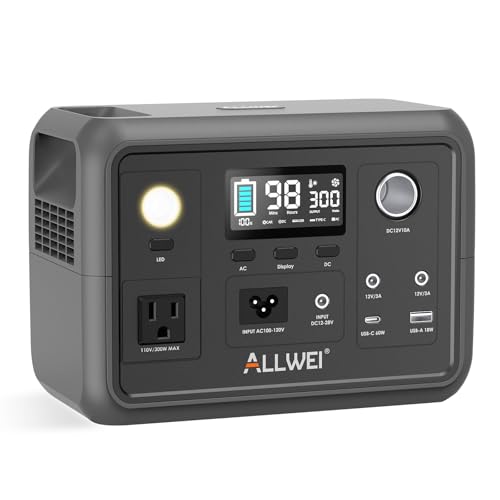
- 256Wh LiFePO4 battery
- Six outputs for simultaneous charging
- AC, car, solar, and dual charging support
Best For: Campers seeking a lightweight, versatile everyday power source
Best Overall – Jackery Explorer 1000 v2
The Jackery Explorer 1000 v2 is a strong all-around choice among portable power stations for camping. Its 1,070Wh capacity, 1,500W output, and 23.8-pound build provide enough power for appliances such as fridges, electric pots, and some AC units without becoming excessively bulky.
Best For: Campers and RV users who want substantial capacity, fast charging, and a relatively lightweight design.
Pros:
- 1,500W AC output with a 3,000W surge peak
- Fast charging option reaches full charge in one hour through the app
- LiFePO4 battery rated for over 4,000 cycles and a lifespan exceeding 10 years
- Multiple ports, including 100W USB-C and three pure sine wave AC outlets
Cons:
- One-hour charging requires enabling emergency charging in the Jackery app
- Solar charging is compatible only with Jackery solar panels
With its balance of capacity, output, portability, and long-term battery durability, the Explorer 1000 v2 is a versatile option for camping trips and emergency backup. The app also adds quiet overnight and energy-efficiency modes.
Best Fast-Charging Option – BLUETTI Elite 100 V2
The BLUETTI Elite 100 V2 stands out among portable power stations for camping with 1,024Wh of capacity and 1,800W of rated AC output. Its rapid 1200W charging system can reach 80% in about 45 minutes, while the compact 25-pound design remains practical for moving between a vehicle, campsite, and cabin.
Best For: Campers who prioritize fast recharging, quiet operation, and enough output for most everyday appliances.
Pros:
- 1,800W output with 2,700W Power Lifting capability
- Reaches 80% charge in approximately 45 minutes
- Silent mode operates at 30dB for quieter overnight use
- 10ms UPS backup, app control, and LiFePO4 battery rated for over 4,000 cycles
Cons:
- At 25 pounds, it is heavier than smaller camping power stations
- The listed package includes cables and hardware but no solar panel
The Elite 100 V2 combines strong appliance support with fast turnaround between uses. Its quiet mode and UPS function also make it useful beyond the campsite, although its higher output comes with a slightly heavier form factor.
Best Solar-Recharging Setup – Anker SOLIX C1000
The Anker SOLIX C1000 is a capable choice among portable power stations for camping, offering 1,056Wh of capacity, 1,800W output, and 11 ports. It supports up to 600W solar input for a stated full recharge in about 1.8 hours, making it well suited to longer off-grid trips when paired with compatible solar equipment.
Best For: Campers and RV users who want strong solar-recharging potential, broad device compatibility, and app-based monitoring.
Pros:
- 1,800W output with SurgePad support up to 2,400W
- Up to 600W solar input and approximately 1.8-hour solar recharge
- 80% charge in 43 minutes and full AC charge in under an hour
- 11 ports and a LiFePO4 battery designed for a 10-year lifespan
Cons:
- UltraFast AC charging requires the Anker app and a smartphone
- At 27.6 pounds, it is the heaviest product in this roundup
- Solar panels are not listed among the included components
The C1000 offers a broad mix of capacity, output, and charging flexibility. Its solar input is particularly appealing for extended camping, while the compact-for-its-class design helps offset its relatively substantial weight.
Best Lightweight Pick – Jackery Explorer 300
The Jackery Explorer 300 is a compact, lightweight option among portable power stations for camping. Weighing about 7.5 pounds and offering 292Wh of capacity, it is designed for smaller loads such as laptops, cameras, drones, and other personal electronics rather than high-demand appliances.
Best For: Hikers, campers, and travelers who need portable power for electronics without carrying a full-size power station.
Pros:
- Lightweight design at approximately 7.5 pounds
- 300W rated output with a 600W peak
- Six-device charging through AC, USB-C, USB-A, and car ports
- LiFePO4 battery rated for over 4,000 cycles
Cons:
- 292Wh capacity is limited for appliances and extended runtimes
- Solar charging requires a compatible Jackery panel, which is optional
- Lower output than the larger power stations in this roundup
The Explorer 300 is the easiest model here to carry over longer distances and fits well with electronics-focused camping kits. Its modest capacity and output make it less suitable for refrigerators, AC units, or other demanding appliances.
Best Compact Fast-Charging Pick – Anker SOLIX C300
The Anker SOLIX C300 is a strong choice among portable power stations for camping when you want a compact unit with fast charging and modern USB-C output. Its 288Wh battery, 300W continuous output, and 600W surge capacity cover phones, laptops, cameras, drones, and other smaller campsite electronics.
Best For: Campers who prioritize compact size, fast USB-C charging, and quiet operation.
Pros:
- 140W two-way USB-C ports support fast charging for compatible devices.
- LiFePO4 battery is rated for 3,000 cycles and includes a five-year warranty.
- Offers eight outlets, including three AC outlets, a car socket, USB-C, and USB-A ports.
- Recharges to 80% in about 50 minutes from a wall outlet and can also use solar, car, or USB-C charging.
Cons:
- Solar panel is optional and compatible panel choices are limited according to the supplied notes.
- Its 288Wh capacity and 300W output are intended for smaller electronics rather than high-demand appliances.
- Shoulder strap is sold separately.
The C300 stands out for campers who value portability, quiet 25dB operation, and unusually capable USB-C charging. It is a practical fit for personal electronics and light-duty campsite power.
Best Lightweight Value – VTOMAN FlashSpeed 300
The VTOMAN FlashSpeed 300 is a practical option among portable power stations for camping, combining 300W output with a lightweight 7.4-pound design. Its 230Wh LiFePO4 battery and seven outlets can support phones, cameras, lights, drones, and other modest campsite loads.
Best For: Lightweight campers who want flexible recharging and a built-in emergency light.
Pros:
- 100W PD input can recharge the station to 80% in about two hours.
- Supports up to seven devices through AC, USB-C, USB-A, and DC outlets.
- LiFePO4 battery is designed for more than 3,000 cycles.
- Offers wall, solar, car, and 100W USB-C recharging options, plus a three-mode LED light.
Cons:
- The 230Wh capacity is lower than larger camping power stations.
- Its 300W output is better suited to smaller electronics than high-wattage appliances.
- The supplied notes do not specify the exact manufacturer warranty duration.
FlashSpeed 300 makes sense when weight and charging flexibility matter more than maximum capacity. The integrated steady, strobe, and SOS light is a useful bonus for nighttime camp tasks and emergencies.
Best High-Capacity Option – 500W 519Wh Solar Generator
This 519Wh portable power station is a good fit for campers who need more capacity and higher output than compact units provide. Its 500W pure sine wave inverter, 10 outlets, and multiple charging methods can handle phones, laptops, lights, fans, routers, small appliances, cameras, and CPAP machines within its power limits.
Best For: Campers and backup-power users who need 519Wh capacity and broad device compatibility.
Pros:
- 519.48Wh capacity and 500W rated output support longer use and more demanding small devices.
- Pure sine wave AC output is designed for sensitive electronics.
- Can power up to 10 devices with AC, USB-A, USB-C, DC, car, and wireless charging outputs.
- Recharges from a wall outlet, car charger, or compatible 100W/200W solar panel.
Cons:
- At 18 pounds, it is less convenient to carry than the smaller options.
- Solar panels are not included, and solar charging can take six to nine hours with a 100W panel.
- Devices rated above 500W should not be connected, and the AC output should be turned off when not in use to conserve power.
Choose this model when capacity, outlet variety, and pure sine wave AC power are priorities. It is more suitable for extended campsite use or backup duty, but its heavier build and slower solar recharge make it less ideal for minimalist trips.
Best High-Output Pick – BLUETTI Elite 30 V2
For campers who need more than basic device charging, the BLUETTI Elite 30 V2 is a strong choice among portable power stations for camping. Its 288Wh capacity, 600W continuous output, and 9.5-pound design balance useful power with reasonable portability.
Best For: Camping setups with laptops, CPAP machines, car fridges, lights, and other higher-demand devices.
Pros:
- 600W continuous output with 1500W Power Lifting Mode.
- Fast wall charging reaches 80% in about 45 minutes.
- 10ms UPS switching supports sensitive devices during outages.
- Offers AC, solar, car, and other charging options.
Cons:
- Heavier than the smaller options in this roundup.
- Solar panel is sold separately.
The Elite 30 V2 is the most capable option here for campers who want extra output and emergency-backup features without moving to a much larger power station.
Best Balanced Value – ALLWEI 300W Portable Power Station
The ALLWEI 300W is a practical middle-ground choice for portable power stations for camping. It combines a 256Wh LiFePO4 battery, six output ports, and a compact 6.4-pound body for everyday outdoor and emergency use.
Best For: Campers and road trippers who want dependable power for small electronics, laptops, mini fridges, and CPAP machines.
Pros:
- LiFePO4 battery is rated for 3000 charge-discharge cycles.
- Six ports can power multiple devices at once.
- Supports AC, car, solar, and AC-plus-solar recharging.
- Built-in LED light includes an SOS mode.
Cons:
- 300W continuous output limits larger appliances.
- Solar panel is sold separately.
With a useful port selection and flexible recharging, the ALLWEI is a well-rounded choice when you want reliable camping power without carrying a larger, heavier unit.
Best Ultra-Portable Kit – DaranEner NEOX 192Wh
The DaranEner NEOX is a compact option for portable power stations for camping, especially when packability matters. It weighs about 5.8 pounds, includes a waterproof carrying bag, and provides 300W continuous output for common electronics and small appliances.
Best For: Lightweight camping, tailgating, emergency kits, and trips where phones, cameras, laptops, and lights are the main priorities.
Pros:
- Compact 192Wh LiFePO4 power station with 300W output.
- Two AC outlets plus USB-C, USB-A, and DC outputs.
- Includes a waterproof carrying bag for transport.
- Four-mode LED flashlight includes strobe and SOS settings.
Cons:
- Lower capacity than the other two stations.
- Only a 1-year manufacturer warranty is listed.
- Solar panels and solar, car, and charging cables are not included.
The NEOX makes the most sense for minimalist campers who value low weight and included carrying gear over longer runtimes or higher capacity.
How We Picked the Best Portable Power Stations for Camping
We focused on the specifications that matter most outdoors: usable battery capacity, continuous and surge output, battery chemistry, recharge methods, portability, and connection options. The selection includes compact units around 200–300Wh for personal electronics, as well as larger 1,000Wh-class models for coolers, CPAP machines, cooking devices, and longer trips.
LiFePO4 batteries received particular attention because they generally offer longer cycle life and strong thermal stability. We also considered whether each unit supports wall, vehicle, and solar charging, since flexible recharge options are valuable when you are away from the grid.
Quick Comparison
| Capacity range | Best suited to | Typical use |
|---|---|---|
| 190–300Wh | Short trips and light loads | Phones, lights, cameras, laptops, and small fans |
| 500–600Wh | Weekend camping | Multiple devices, portable refrigerators, and moderate AC loads |
| 1,000Wh or more | Extended stays and heavier equipment | Coolers, CPAP machines, cooking appliances, and several users |
Key Buying Factors for Portable Power Stations for Camping
Capacity and Runtime
Watt-hours indicate how much energy a station stores. Estimate your daily demand by multiplying each device’s watts by its expected hours of use, then add a reserve for inverter losses and cold-weather performance. A 1,000Wh station will not deliver a full 1,000Wh through AC outlets because conversion consumes some energy.
Output and Ports
Check both continuous wattage and peak or surge wattage. Resistive loads such as heaters and kettles can draw substantial power, while refrigerators and pumps may need extra startup capacity. USB-C ports are useful for directly charging phones, tablets, and many laptops without running the AC inverter.
Battery Type, Weight, and Durability
LiFePO4 models are often heavier than comparable lithium-ion units, but their longer expected lifespan can make them better for frequent camping. Look for a clear operating-temperature range, a robust handle, a readable display, and protection against overload, overheating, and low battery conditions.
Charging Options
Wall charging is fastest for preparation at home, while car charging is convenient during travel. Solar input can extend an off-grid trip, but panel compatibility, maximum solar wattage, connector type, and weather conditions affect real-world results.
Who Should Buy Which Portable Power Stations for Camping?
Choose a compact 190–300Wh model if you mainly need to recharge personal electronics, run lights, or power a small fan for a night or two. A 500–600Wh station is a stronger all-purpose choice for weekend campers who want more headroom for a cooler and several devices. Select a 1,000Wh-class unit when you need longer runtimes, higher output, or power for medical equipment and larger appliances.
Before buying, confirm the station’s dimensions and weight fit your vehicle and campsite setup, and compare your devices’ actual wattage with the unit’s continuous output. For repeated off-grid use, prioritize LiFePO4 longevity and solar capability; for occasional emergency or car-camping use, a lighter and less expensive model may be the better value.