A reliable air quality monitor can help greenhouse growers spot excessive humidity, poor ventilation, and CO2 levels that may affect plant health. The best models make key readings easy to check and act on.
This roundup compares 10 monitors with different combinations of CO2, particulate, VOC, temperature, humidity, connectivity, and smart-home features. Use the buying guide below to choose the right fit for your greenhouse setup.
Best 10 Indoor Air Quality Monitors for Greenhouses Picks for 2026
Best Smart CO2 Monitor

- NDIR CO2 sensing from 400–9,000 ppm
- Large display with temperature and humidity
- Up to 12 months of battery life
Best For: Greenhouse growers focused on CO2, temperature, and humidity
Best App-Connected Monitor
INKBIRD IAM-T2 Smart CO2 Monitor

- Tracks CO2, temperature, and humidity
- Bluetooth app access up to 100 meters
- Stores 30 days of offline data
Best For: Growers who want portable monitoring and historical data
Best Multi-Parameter Monitor
10-in-1 Real-Time Air Quality Monitor

- Measures particles, gases, CO2, temperature, and humidity
- Color-coded display with 1.2-second processing
- USB-C rechargeable battery lasts up to 96 hours
Best For: Users needing a broad portable air-quality snapshot
Best Comprehensive Connected Monitor

- Tracks radon, PM2.5, CO2, VOCs, and more
- Wi-Fi app supports alerts and trend analysis
- Battery-powered with roughly two-year battery life
Best For: Long-term connected monitoring across multiple air-quality factors
Best Large-Display Pick

- Tracks gases, particles, temperature, humidity, and AQI
- Large 7-inch display with adjustable brightness
- Up to 8 hours of battery runtime and audible alerts
Best For: Users wanting comprehensive readings directly on the device
Best for Data Tracking

- Eight-in-one monitoring with NDIR CO2 sensing
- 90-day app history, alerts, and CSV export
- Up to 6 hours portable use or continuous USB-C power
Best For: Users analyzing greenhouse air trends and exporting readings
Best Smart-Home Integration
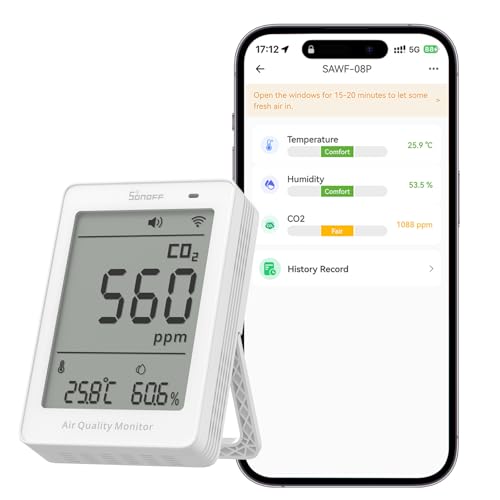
- Matter-compatible with major smart-home platforms
- Fast NDIR CO2 readings plus temperature and humidity
- Stores and exports up to 12 months of app history
Best For: Connected setups focused on CO2 and basic climate readings
Most Comprehensive
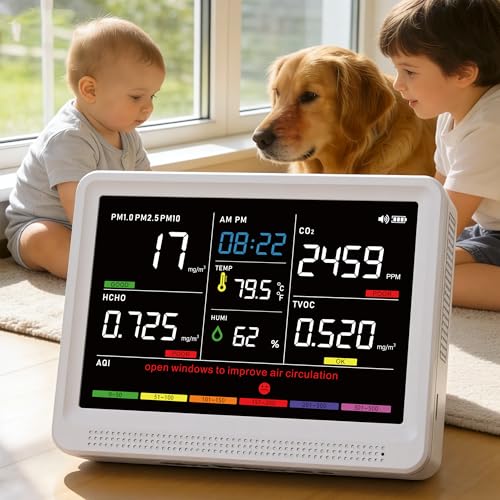
- Tracks nine air and climate parameters
- Large 5.5-inch HD display
- Up to 10 hours of portable use
Best For: Users wanting broad greenhouse air-quality coverage
Best Simple Greenhouse Fit
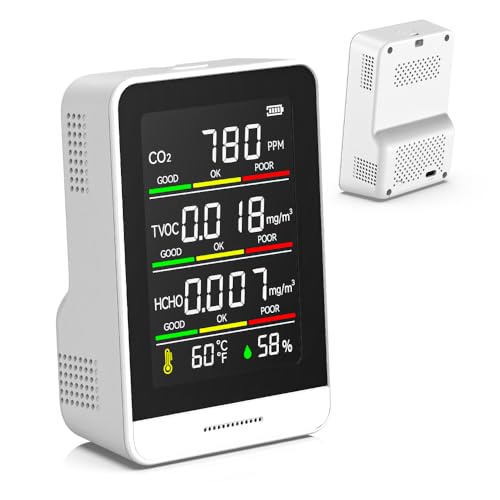
- Measures five core air and climate metrics
- Supports desktop or wall placement
- Up to 10 hours from its rechargeable battery
Best For: Growers wanting simple essential monitoring
Best for Easy Status Checks

- Uses color-coded air-quality indicators
- Tracks five essential measurements
- Continues monitoring with the screen off
Best For: Growers wanting simple visual readings and portability
Best Smart CO2 Monitor – SwitchBot Meter Pro CO2
For growers comparing indoor air quality monitors for greenhouses, the SwitchBot Meter Pro CO2 focuses on the core conditions plants and people need tracked: carbon dioxide, temperature, and humidity. Its large display, fast sampling, and flexible placement make it practical for checking greenhouse conditions at a glance.
Best For: Greenhouse growers who want a dedicated CO2 monitor with onboard alerts and optional app notifications.
Pros:
- Measures CO2 from 400 to 9,000 ppm with a stated accuracy of ±50 ppm using an NDIR sensor.
- Displays CO2, temperature, humidity, time, date, and comfort level on its 92-millimeter screen.
- Offers sound, visual, and optional app alerts, plus wall-mount holes and an adjustable bracket.
- Built-in battery is rated for up to 12 months of use.
Cons:
- App notifications require a SwitchBot Hub.
- It primarily tracks CO2, temperature, and humidity rather than particles or additional gases.
This is a focused choice when CO2 management and long battery life matter more than broad pollutant testing. The clear screen and configurable alerts are especially useful for routine greenhouse ventilation checks.
Best App-Connected Monitor – INKBIRD IAM-T2 Smart CO2 Monitor
The INKBIRD IAM-T2 is one of the more convenient indoor air quality monitors for greenhouses when remote checks and historical data are priorities. It tracks CO2, temperature, and humidity, then makes readings available through Bluetooth and its mobile app.
Best For: Growers who want portable monitoring, color-coded warnings, and stored data for reviewing greenhouse conditions.
Pros:
- Monitors carbon dioxide, temperature, and humidity in real time.
- Bluetooth 5.0 connects to a phone within an unobstructed range of up to 100 meters.
- Stores 30 days of offline data, while the app supports long-term storage and one-year export.
- Its 3,000 mAh battery is rated for more than six months of continuous use after charging.
Cons:
- Bluetooth range can be affected by obstructions.
- Its monitoring scope is limited to CO2, temperature, and humidity, without particle or VOC measurements.
Choose the IAM-T2 if data access and trend review are more important than a broad sensor lineup. The dual sound-and-indicator alarm system also makes changes easy to spot during regular greenhouse checks.
Best Multi-Parameter Monitor – 10-in-1 Real-Time Air Quality Monitor
For buyers seeking indoor air quality monitors for greenhouses beyond basic CO2 tracking, this tabletop model measures a wide range of particles, gases, and environmental conditions. Its color display and rapid sampling provide a broad snapshot without requiring Wi-Fi, Bluetooth, or an app.
Best For: Users who want portable, multi-parameter readings for greenhouse areas and other indoor spaces.
Pros:
- Measures PM0.3, PM2.5, PM10, CO2, CO, HCHO, TVOC, AQI, temperature, and humidity.
- Color-coded readings make changes easier to interpret at a glance.
- Samples and processes air data every 1.2 seconds, according to the supplied specifications.
- Rechargeable 2,000 mAh battery provides up to 96 hours of monitoring and charges through USB-C.
Cons:
- It is designed for tabletop placement rather than wall mounting.
- The listed battery runtime is much shorter than the multi-month runtimes of some dedicated CO2 monitors.
- The notes do not specify greenhouse-specific calibration or app-based remote access.
This model is the strongest fit when you want to investigate more than ventilation, including particles, VOCs, carbon monoxide, and formaldehyde. Its broad coverage comes with a shorter portable runtime and a less specialized greenhouse form factor.
Best Comprehensive Connected Monitor – Airthings View Plus
The Airthings View Plus is a comprehensive option among indoor air quality monitors for greenhouses, combining radon, particles, gases, and environmental readings. Its battery-powered design and Wi-Fi-connected app support ongoing trend tracking, though the stated operating temperature range should be checked against the intended greenhouse location.
Best For: Growers who need connected, long-term monitoring of multiple air-quality factors, including radon.
Pros:
- Monitors radon, PM2.5, CO2, VOCs, humidity, temperature, and air pressure.
- Wi-Fi and the Airthings app provide live data, notifications, cloud storage, and trend analysis.
- Battery-powered operation enables cable-free placement, with a customizable eInk screen.
- Battery life is listed at approximately two years, and an optional extended five-year warranty is available after registration.
Cons:
- The monitor and app require internet access, and an account is required to use the device.
- Operating temperature is specified as 4 to 40°C (39 to 104°F), which may limit placement in extreme greenhouse conditions.
- It is more feature-rich than needed for growers who only want CO2, temperature, and humidity readings.
View Plus is a strong choice for connected, long-term environmental oversight when radon and broader pollutant tracking are useful. Confirm the greenhouse stays within its operating range before relying on it for continuous monitoring.
Best Large-Display Pick – 16-in-1 Air Quality Monitor
For growers comparing indoor air quality monitors for greenhouses, this model offers a broad set of readings on a large, easy-to-view 7-inch display. It tracks CO2, particulate matter, formaldehyde, TVOCs, temperature, humidity, and AQI, making it useful for checking both plant-room conditions and general indoor environments.
Best For: Greenhouse users who want many readings, visible on-device alerts, and flexible USB-C or battery-powered monitoring.
Pros:
- Measures CO2, PM1.0, PM2.5, PM10, HCHO, TVOC, temperature, humidity, and AQI.
- Large 7-inch display with three brightness settings for quick at-a-glance checks.
- Offers seven AQI alert functions, a mute button, and up to eight hours of runtime.
Cons:
- Its supplied notes describe general indoor use rather than greenhouse-specific operation.
- Sensor accuracy can be affected by touching the sensors or exposing them to strong odors.
This is the most information-rich option of the three, especially if you prefer a standalone screen instead of relying on an app. Its portable battery and alerts add convenience, though greenhouse operators should still protect the unit from direct exposure to moisture and contaminants.
Best for Data Tracking – BREATHE Airmonitor Plus Gen 2
For greenhouse buyers who want to study changing conditions over time, the BREATHE Airmonitor Plus Gen 2 combines eight measurements with app-based history and export tools. It monitors CO2, PM1, PM2.5, PM10, TVOC, formaldehyde, temperature, and humidity, helping you compare ventilation and environmental changes.
Best For: Growers who value remote readings, trend graphs, 90-day history, and CSV data export.
Pros:
- Uses an NDIR CO2 sensor, laser particle sensing, and dedicated TVOC and formaldehyde detection.
- Provides app alerts, historical graphs, and up to 90 days of stored data with export capability.
- Can run on USB-C power continuously or operate portably for up to six hours.
Cons:
- App connectivity requires 2.4 GHz Wi-Fi.
- Its portable battery runtime is shorter than the first model’s stated runtime.
The app and export functions make this a strong choice when greenhouse monitoring involves comparing readings across watering, cleaning, occupancy, or ventilation changes. It is less focused on a very large standalone display, but more useful for reviewing patterns after the readings are collected.
Best Smart-Home Integration – SONOFF AirGuard CO2 Monitor
Among indoor air quality monitors for greenhouses, the SONOFF AirGuard is the streamlined option for users primarily concerned with CO2, temperature, and humidity. Its NDIR sensor updates readings every five seconds, while Matter compatibility and app notifications make it practical for connected monitoring setups.
Best For: Smart-home users who want continuous CO2, temperature, and humidity monitoring with long-term data access.
Pros:
- Supports Matter ecosystems including Apple Home, Amazon Alexa, Google Home, SmartThings, and Home Assistant.
- NDIR CO2 sensing measures from 400 to 5,000 ppm with stated accuracy of ±(50 ppm + 5%).
- Offers customizable notifications, a multicolor LED indicator, and 12 months of historical data with export.
Cons:
- Monitors fewer parameters than the other two products and does not list PM, TVOC, or formaldehyde sensing.
- Requires continuous power according to the supplied feature description.
- Wi-Fi connectivity is specified as 2.4 GHz.
This model is a good fit when CO2 and basic climate readings are the priority and you already use a compatible smart-home platform. For detecting dust, smoke, VOCs, or formaldehyde, choose one of the broader multi-sensor monitors instead.
Most Comprehensive – 16-in-1 Air Quality Monitor
For shoppers comparing indoor air quality monitors for greenhouses, this YNAK model stands out for its broad range of readings. It tracks CO2, particulate matter, HCHO, TVOC, temperature, humidity, and AQI on a large display, helping you monitor both air conditions and growing-environment comfort.
Best For: Greenhouse users who want the widest selection of air-quality readings and a highly visible screen.
Pros:
- Monitors CO2, PM1.0, PM2.5, PM10, HCHO, TVOC, temperature, humidity, and AQI.
- 5.5-inch HD display with three brightness levels.
- Offers seven AQI alert functions and a mute option.
- Rechargeable operation lasts up to 10 hours and uses USB-C charging.
Cons:
- Its many readings and alert functions may be more than needed for basic greenhouse monitoring.
- The sensors should be protected from perfumes and strong odors to help maintain accuracy.
This is the most feature-rich option in the group, particularly useful when you want particulate and chemical readings alongside CO2 and climate measurements. Its portable design also makes it practical for checking conditions in multiple locations.
Best Simple Greenhouse Fit – 5-in-1 Air Quality Monitor
This compact AK3 monitor is a straightforward choice among indoor air quality monitors for greenhouses. It measures CO2, HCHO, TVOC, temperature, and humidity, providing the core readings many growers need to watch ventilation and environmental changes.
Best For: Greenhouse users who prefer simple operation, essential measurements, and flexible placement.
Pros:
- Measures CO2, formaldehyde, TVOC, temperature, and humidity in real time.
- Color display provides readable information at a glance.
- Built-in 1200mAh battery offers up to 10 hours of use.
- Can sit on a desktop or be mounted on a wall.
Cons:
- Does not measure particulate matter or provide the broader parameter range of the 16-in-1 model.
- Its single-button control may require remembering press patterns for different functions.
With a minimalist design and greenhouse-specific positioning in its listed uses, this model offers a practical balance of portability and essential monitoring. It is a good fit when you want useful readings without a more complex interface.
Best for Easy Status Checks – Portable 5-in-1 CO2 Monitor
For growers who want quick visual feedback, this Tarewoeki monitor is a practical option among indoor air quality monitors for greenhouses. It displays CO2, HCHO, TVOC, temperature, and humidity together, while green, orange, and red indicators make changes easier to interpret.
Best For: Users who value color-coded alerts, portable operation, and simple one-button controls.
Pros:
- Displays five key air-quality and climate measurements at once.
- Green, orange, and red indicators provide quick status checks.
- Rechargeable 1200mAh battery and Type-C charging support portable use.
- Screen can be turned off while monitoring continues.
Cons:
- It does not include particulate readings such as PM2.5 or PM10.
- The manufacturer recommends calibration in fresh outdoor air and avoiding concentrated vapors, adding setup considerations.
This model is especially convenient for routine checks because its color-coded display reduces the need to interpret every number immediately. Its screen-off monitoring mode is also useful when you want ongoing measurements without a bright display.
How We Picked the Best Indoor Air Quality Monitors for Greenhouses
We focused on monitors that measure factors relevant to enclosed growing spaces, especially CO2, temperature, and relative humidity. We also considered additional readings such as PM2.5, VOCs, formaldehyde, pressure, and radon where available. Other selection factors included display readability, portability, battery operation, app support, smart-home compatibility, measurement range, and the practicality of checking readings during daily greenhouse work.
Because greenhouse conditions can be humid and change quickly, we favored products that provide real-time readings and clearly identify what each sensor measures. A monitor is not a substitute for a calibrated commercial environmental-control system, but it can provide useful trend data and early warnings.
Quick Comparison
| Priority | Look for | Why it matters |
|---|---|---|
| CO2 management | Dedicated NDIR CO2 sensor | Typically offers more dependable CO2 readings than low-cost estimates or nonspecific air-quality scores. |
| Humidity control | Temperature and relative-humidity sensors | Helps identify conditions that encourage fungal growth or plant stress. |
| Broad monitoring | PM, VOC, HCHO, and pressure readings | Useful when workers, heaters, soil products, or nearby pollution affect indoor air. |
| Remote checks | Bluetooth, Wi-Fi, or a companion app | Lets you review trends without entering the greenhouse. |
| Off-grid placement | Battery power and a clear screen | Works in locations without a convenient outlet or network connection. |
Key Buying Factors for Indoor Air Quality Monitors for Greenhouses
CO2 Sensor Type and Range
CO2 is often the most important measurement for ventilation and supplemental enrichment. Prefer a stated NDIR sensor when accuracy and consistency matter. Check the monitor’s range as well as its resolution, and remember that readings can be affected by placement, airflow, and calibration.
Humidity, Condensation, and Placement
Choose a monitor with a humidity range suitable for your environment, but keep it away from direct mist, irrigation spray, heater exhaust, and plant leaves. Mount or place it near the breathing zone while allowing air to circulate around the sensors. If condensation is common, look for clear operating specifications and avoid treating the device as waterproof unless the manufacturer says it is.
Connectivity and Alerts
Bluetooth is convenient for nearby checks, while Wi-Fi is better for remote monitoring and notifications. Matter compatibility may help integrate some models into a broader smart-home system, but verify which readings and automations the platform supports. A large local display remains valuable when internet access is unreliable.
Extra Sensors and Ongoing Costs
PM2.5 and VOC readings can add context around dust, combustion, cleaners, and materials, although they do not directly measure plant needs. Consider battery life, replacement batteries, app requirements, calibration options, and whether the monitor stores historical data before buying.
Who Should Buy Which Indoor Air Quality Monitors for Greenhouses?
Choose a straightforward CO2, temperature, and humidity monitor if you mainly need ventilation and climate checks. Select a multi-parameter model if you want a broader view of particles, VOCs, or formaldehyde in a work area. Battery-powered monitors suit small or remote greenhouses, while Wi-Fi models are better for growers who need alerts and trend tracking from indoors. If you already use a compatible smart-home platform, a Matter-ready option may offer the simplest integration. For valuable crops or automated CO2 systems, use a monitor with a dependable stated sensor type and treat its readings as one part of a larger calibration and control routine.