Large rooms can accumulate carbon dioxide quickly when occupancy is high and ventilation is limited. The right monitor makes those changes visible, helping you decide when to increase airflow, adjust HVAC settings, or open windows.
We selected 10 options spanning wireless home monitors, large-screen multi-sensor units, connected systems, and commercial alert kits. Use the guide below to match sensor technology, coverage, alerts, and installation style to your space.
Best 10 Carbon Dioxide Monitors for Large Rooms Picks for 2026
Top Wireless Pick
Aranet4 Indoor Air Quality Monitor
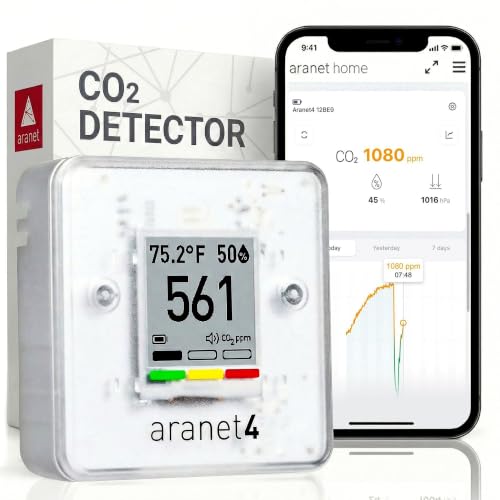
- Measures CO2, temperature, humidity, and pressure
- Wireless e-ink display with up to four-year battery life
- App stores up to 90 days of historical data
Best For: Cable-free monitoring in offices and living areas
Safety Alarm Pick
Kidde Plug-In Carbon Monoxide Detector

- Detects carbon monoxide with an 85 dB alarm
- Plug-in power includes AA battery backup
- UL 2034 tested with a 10-year limited warranty
Best For: Household carbon monoxide protection
Most Comprehensive Data
ECOWITT WH46D CO2 and Air Quality Monitor

- Tracks CO2, four PM categories, temperature, and humidity
- LCD display refreshes every 60 seconds on USB power
- Optional gateway enables app, alerts, and one-year data storage
Best For: Connected monitoring in offices, classrooms, and public spaces
Best Display Features
U UNNI Photoacoustic CO2 Monitor
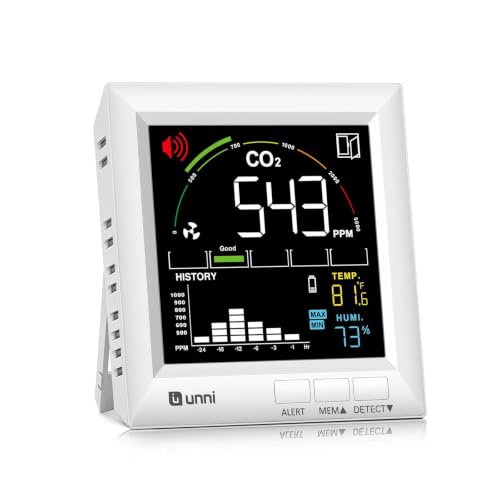
- Measures CO2, temperature, and humidity in real time
- Includes history charts, alerts, and adjustable backlighting
- Supports USB power, AAA backup, and manual calibration
Best For: Flexible home and workspace monitoring with customizable alerts
Best All-Around Coverage
10-in-1 Color Air Quality Monitor

- Tracks CO2 plus particles, gases, temperature, humidity, and AQI
- Color-coded display and audible alerts simplify monitoring
- Up to 96 hours of battery-powered use
Best For: Portable, broad indoor air-quality monitoring
Best Commercial Safety System

- NDIR sensor monitors from 0 to 50,000 ppm
- Includes horn strobe, signage, wiring, and installation hardware
- Adjustable thresholds with audible and visual alarms
Best For: Commercial spaces using or storing compressed CO2
Best Large-Display Option
16-in-1 7-Inch Air Quality Monitor

- 7-inch display keeps readings visible across a room
- Measures CO2, particles, gases, temperature, humidity, and AQI
- Three brightness settings and seven alert functions
Best For: Shared spaces where easy read-at-a-glance viewing matters
Smart CO2 Tracking

- Fast five-second CO2 refreshes with SCD4x sensing
- App, email, and buzzer alerts with data export
- AC powered with Alexa and Google Assistant support
Best For: Connected, continuous monitoring in offices, bedrooms, and smart homes
Whole-Air Monitoring
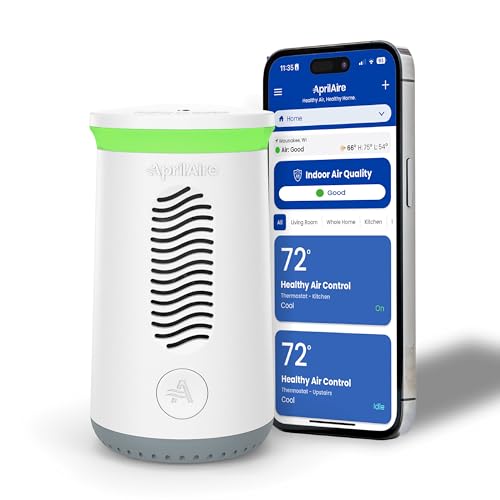
- Tracks CO2, VOCs, PM2.5, humidity, and temperature
- App provides trends, alerts, and practical guidance
- Integrates with select AprilAire systems
Best For: Homeowners wanting broad, app-based indoor-air monitoring
Top Wireless Pick – Aranet4 Indoor Air Quality Monitor
For shoppers comparing carbon dioxide monitors for large rooms, the Aranet4 is a convenient wireless option with a prominent CO2 reading and color-coded alerts. Its NDIR sensor also tracks temperature, relative humidity, and atmospheric pressure, helping you make practical ventilation decisions.
Best For: Offices, living areas, and other rooms where cable-free monitoring and long battery life are priorities.
Pros:
- Measures CO2, temperature, humidity, and atmospheric pressure in real time.
- Wireless e-ink display can run for up to four years on two included AA batteries.
- App provides graphs and up to 90 days of historical data.
- NDIR sensor, color coding, and optional buzzer support easy monitoring.
Cons:
- Historical app analysis requires using a smartphone.
- The compact display may be less suitable for viewing from far across a very large room.
The Aranet4 stands out when low-maintenance, portable CO2 monitoring matters more than a wall-sized display. Its wireless design and extended battery life make it especially practical for flexible room placement.
Safety Alarm Pick – Kidde Plug-In Carbon Monoxide Detector
For carbon dioxide monitors for large rooms, it is important to distinguish CO2 air-quality monitors from carbon monoxide safety alarms. This Kidde unit detects carbon monoxide, not carbon dioxide, and provides plug-in power, battery backup, and an 85 dB alarm for household protection.
Best For: Homes and apartments needing a dedicated carbon monoxide alarm with outage backup.
Pros:
- Sounds a loud 85 dB alarm and includes an LED warning light.
- Runs from 120V AC with two included AA backup batteries.
- Rotating plug fits vertical or horizontal outlets.
- UL 2034 5th Edition tested, ETL Listed, and backed by a 10-year limited warranty.
Cons:
- Measures carbon monoxide rather than carbon dioxide or general indoor air quality.
- Designed for outlet placement rather than room-wide visual CO2 monitoring.
This is a useful safety complement to a CO2 monitor, but it should not be substituted for one. Choose it when the primary concern is detecting carbon monoxide from household hazards.
Most Comprehensive Data – ECOWITT WH46D CO2 and Air Quality Monitor
The ECOWITT WH46D is a strong choice for buyers comparing carbon dioxide monitors for large rooms who also want particulate data. Its LCD sensor measures CO2, multiple PM sizes, temperature, and humidity, while optional gateway or console pairing enables app access and longer-term records.
Best For: Offices, classrooms, hotels, and other spaces where CO2 and particle monitoring are useful together.
Pros:
- Seven-in-one monitoring covers CO2, PM1.0, PM2.5, PM4.0, PM10, temperature, and humidity.
- LCD screen provides local readings, with USB-powered measurements refreshing every 60 seconds.
- Optional Ecowitt pairing supports app, web, alerts, and up to one year of stored data.
- Offers a CO2 calibration function and up to a 300-foot RF connection distance.
Cons:
- Gateway or compatible console is purchased separately for app and cloud features.
- Backup battery lasts about two days, and batteries are not included.
- USB power is intended for indoor use; the unit is not waterproof.
This sensor offers the broadest air-quality picture in the group, but its ecosystem adds setup and purchase requirements. It is best suited to users who value particulate readings and connected data over a simple standalone device.
Best Display Features – U UNNI Photoacoustic CO2 Monitor
For shoppers seeking carbon dioxide monitors for large rooms with flexible display controls, this U UNNI model combines real-time CO2, temperature, and humidity readings with history charts, adjustable alerts, and adjustable backlighting. It can sit on a tabletop or mount on a wall.
Best For: Homes, workspaces, RVs, and grow tents where configurable alerts and an always-on display are helpful.
Pros:
- Uses a Swiss-made photoacoustic CO2 sensor with a 400–5,000 ppm range.
- Includes CO2 history, maximum/minimum data, temperature, and humidity readings.
- Offers three alarm-volume levels and three backlight settings.
- Supports USB power with AAA battery backup and manual calibration.
Cons:
- Three AAA backup batteries are not included.
- Manual calibration requires a standard 400 ppm environment and a stated calibration procedure.
- The compact display may be less visible from a distance in a very large room.
This monitor is a practical middle ground for users who want more control than a basic CO2 readout provides. Its wall-mount option and configurable alerts can make ventilation reminders easier to notice.
Best All-Around Coverage – 10-in-1 Color Air Quality Monitor
For shoppers comparing carbon dioxide monitors for large rooms, this 10-in-1 monitor offers a broad snapshot of indoor conditions in an easy-to-read format. It tracks CO2 alongside particles, gases, temperature, humidity, and AQI, making it useful for offices, kitchens, and other shared spaces.
Best For: Buyers who want portable, multi-parameter monitoring with a color display and no app setup.
Pros:
- Measures CO2, CO, PM0.3, PM2.5, PM10, HCHO, TVOC, AQI, temperature, and humidity.
- Color-coded readings make changing air-quality levels quick to understand.
- Samples data every 1.2 seconds and includes an audible alert.
- Rechargeable 2,000mAh battery provides up to 96 hours of monitoring.
Cons:
- Tabletop design may be less suitable for permanent wall installation.
- The supplied notes do not specify a dedicated large-room coverage rating.
This is a versatile choice when you want more than CO2 readings and expect to move the monitor between rooms. Its long battery life and simple controls are especially practical for flexible, everyday use.
Best Commercial Safety System – BML-25 CO2 Monitor Kit
Among carbon dioxide monitors for large rooms, the Aerosphere ONE BML-25 is designed for commercial spaces where compressed CO2 is used or stored. Its external NDIR sensor, adjustable alarm thresholds, horn strobe, and safety signage make it a purpose-built option for single-zone CO2 safety.
Best For: Restaurants, breweries, bars, beverage areas, walk-in coolers, and other commercial compressed-CO2 applications.
Pros:
- Includes an external NDIR sensor with a 0–50,000 ppm monitoring range.
- Comes as a complete kit with horn strobe, signage, power supply, cable, and installation hardware.
- Alarm thresholds are adjustable from 0 to 50,000 ppm.
- Provides both audible and visual alerts, plus an LCD display.
Cons:
- Corded electric design is less portable than battery-powered monitors.
- It is a commercial single-zone system rather than a general-purpose multi-pollutant monitor.
This kit is the strongest fit when notification and installation components matter as much as the reading itself. It is less appropriate for casual home air-quality checks, but well matched to dedicated commercial CO2 safety duties.
Best Large-Display Option – 16-in-1 7-Inch Air Quality Monitor
If visibility is a priority when comparing carbon dioxide monitors for large rooms, this model stands out with a 7-inch LED display. It combines CO2 monitoring with readings for particulates, HCHO, TVOC, temperature, humidity, AQI, and time, while offering brightness controls and alert functions.
Best For: Homes, offices, and shared indoor areas where several people need to see readings at a glance.
Pros:
- Large 7-inch display presents readings without navigating menus.
- Monitors CO2, PM1.0, PM2.5, PM10, HCHO, TVOC, temperature, humidity, and AQI.
- Offers three brightness settings and seven AQI alert buzzers with mute control.
- Includes USB-C charging, an AC adapter, and up to 8 hours of runtime.
Cons:
- Its battery runtime is shorter than the first product in this roundup.
- The supplied notes do not identify a specified large-room coverage range.
- External sensors should be protected from perfumes and strong odors to help maintain accuracy.
The large screen makes this a practical shared-space monitor, especially when readability matters more than compact portability. Consider its shorter battery runtime if you plan to operate it away from the included adapter.
Smart CO2 Tracking – GoveeLife H5140
For shoppers comparing carbon dioxide monitors for large rooms, the GoveeLife H5140 is a practical choice when you want continuous, app-connected CO2 tracking alongside temperature and humidity readings. Its 4.82-inch display, five-second refresh rate, customizable alerts, and AC power make it suited to ongoing monitoring in offices, bedrooms, and other occupied spaces.
Best For: Smart-home users who want visible readings, remote notifications, historical data, and uninterrupted outlet-powered monitoring.
Pros:
- SCD4x CO2 sensor with stated accuracy of ±(40 ppm + 5%), pressure compensation, and five-second refreshes.
- Displays CO2, temperature, humidity, and a clock in one place.
- Offers buzzer, app, and email alerts plus up to two years of app history and CSV export.
- Works with Alexa and Google Assistant and can connect with compatible humidifiers and tower fans.
Cons:
- Requires AC power rather than battery operation.
- Some features, including the clock and data tools, require the app.
- Outdoor calibration may be needed through the app.
The H5140 stands out for connected monitoring and detailed trend review. It is a strong fit where reliable, always-on CO2 visibility matters more than cordless placement.
Whole-Air Monitoring – AprilAire ZAWTHCPV
The AprilAire ZAWTHCPV broadens the task beyond CO2 alone, making it a useful option for shoppers seeking carbon dioxide monitors for large rooms that also track common indoor-air concerns. It measures CO2, VOCs, PM2.5, particulate matter, humidity, and temperature, with readings and alerts managed through the AprilAire Healthy Air App.
Best For: Homeowners who want app-based, multi-parameter air-quality monitoring and may later integrate AprilAire ventilation or filtration equipment.
Pros:
- Combines CO2, VOC/TVOC, PM2.5, particulate matter, humidity, and temperature monitoring.
- Provides color-coded status indicators, real-time trends, expert guidance, and app notifications.
- Includes three light settings: default, always on, and always off.
- Has a three-year manufacturer warranty and can integrate with select AprilAire systems.
Cons:
- Requires the AprilAire Healthy Air App to function.
- Compatible thermostat and filtration or ventilation integrations are sold separately.
- Its corded-electric design limits placement flexibility.
This monitor is most compelling when CO2 is only one part of your indoor-air strategy. Its app guidance and broader sensor coverage can help users identify trends across several air-quality categories.
Large-Screen Air Checks – Sainlogic 16-in-1 Monitor
The Sainlogic monitor is designed for quick, across-the-room viewing, which is helpful when evaluating carbon dioxide monitors for large rooms. Its 7.2-inch display shows CO2 alongside particulate matter, HCHO, TVOC, AQI, temperature, and humidity, while color indicators and adjustable alarms make changing conditions easy to spot without an app or Wi-Fi connection.
Best For: Users who prioritize a large readable display, broad air-quality coverage, and portable operation without app setup.
Pros:
- Monitors nine listed indicators, including CO2, PM1.0, PM2.5, PM10, HCHO, TVOC, AQI, temperature, and humidity.
- Large 7.2-inch screen uses three brightness levels and increases visibility during alerts.
- Refreshes readings every one to two seconds and samples at 1.5-second intervals.
- Built-in 2500mAh battery provides up to eight hours of wireless use and recharges by USB-C.
Cons:
- Battery life is listed as up to eight hours, so continuous monitoring may require recharging or connected power.
- It does not provide app or Wi-Fi connectivity.
- The supplied notes do not specify CO2 accuracy.
For large shared spaces, the Sainlogic’s oversized screen and visual alerts are its main advantages. It is a flexible pick for moving between rooms, provided its shorter wireless runtime fits your routine.
How We Picked These Carbon Dioxide Monitors for Large Rooms
We focused on monitors that measure carbon dioxide directly and offer practical visibility for larger spaces such as classrooms, offices, meeting rooms, studios, living areas, and commercial facilities. The lineup includes NDIR and photoacoustic CO2 sensors, along with models that add particulate, VOC, temperature, or humidity readings.
We also considered display readability, alarm options, battery or plug-in operation, app connectivity, data access, portability, and whether a model is better suited to household use or a more demanding commercial installation. Because room size, ceiling height, occupancy, and airflow vary, no single monitor is ideal for every application.
Quick Comparison
- Best for portable monitoring: Choose a compact wireless unit with battery operation and a clear CO2 display.
- Best for broad air-quality tracking: Select a multi-parameter monitor that measures CO2 alongside particles, VOCs, temperature, and humidity.
- Best for connected homes and offices: Look for Wi-Fi or app support, historical readings, and configurable notifications.
- Best for commercial safety signaling: Consider a kit with NDIR sensing, a horn or strobe, and visible signage.
- Best for large spaces at a glance: A monitor with a bright, oversized display is easier to read from across a room.
Key Buying Factors for Carbon Dioxide Monitors for Large Rooms
Sensor Type and Accuracy
NDIR sensors are a common choice for dependable CO2 measurement and are widely used in indoor-air-quality equipment. Photoacoustic sensors can also provide accurate readings in appropriately designed products. Check the stated measurement range, accuracy, calibration approach, and whether automatic baseline correction is suitable for your environment.
Placement and Coverage
A monitor measures the air around its sensor, not every corner of a room. Place it near breathing height and away from windows, doors, supply vents, kitchens, and direct heat. In very large, irregular, or multi-zone rooms, multiple monitors may provide a more useful picture than one device.
Alerts and Readability
Prioritize a display you can read from normal seating or work areas. Audible alarms, visual indicators, color zones, and phone notifications are useful when people cannot watch the screen continuously. Confirm that alert thresholds can be adjusted and that alarms are not disruptive for your setting.
Power, Data, and Maintenance
Battery-powered models are easier to reposition, while plug-in units avoid charging interruptions. Smart monitors can record trends and support remote checks, but they may require Wi-Fi and an account. Keep the sensor unobstructed, follow calibration instructions, and verify readings periodically if the monitor supports comparison or recalibration.
Who Should Buy Which Carbon Dioxide Monitors for Large Rooms?
Homeowners and families should favor simple displays, dependable CO2 readings, and low-maintenance operation. Remote workers and small offices may benefit from wireless monitoring, historical data, and app alerts. Schools, conference rooms, and studios should prioritize large displays, clear thresholds, and audible or visual alerts that remain noticeable during busy periods. Facilities managers and commercial operators should consider dedicated installation kits, external signaling, signage, and compatibility with their ventilation or building-management plans.
Finally, remember that a CO2 monitor is a ventilation indicator, not a substitute for a carbon monoxide alarm. Use the appropriate safety detector for combustion-related carbon monoxide, and treat unusually high CO2 readings as a prompt to investigate airflow and occupancy conditions.