Good classroom ventilation is easier to manage when staff can see changing CO2, particulate, temperature, and humidity levels in real time. The right monitor turns invisible air-quality problems into actionable information.
We selected ten monitors ranging from compact CO2 meters to large-screen, multi-parameter detectors. Use the guide below to match your classroom, budget, and reporting needs with the most useful features.
Best 10 Indoor Air Quality Monitors for Classrooms Picks for 2026
Best App-Connected Pick
Temtop M10+ 6-in-1 CO2 & IAQ Monitor

- Tracks CO2, PM2.5, TVOCs, temperature, and humidity
- Bluetooth app offers history, calibration, and exports
- Up to 60-day battery life with a quiet e-ink display
Best For: Portable classroom monitoring with app-based data review
Best for Wi-Fi Data Logging

- Refreshes PM2.5, temperature, and humidity every two seconds
- Supports Bluetooth and 2.4G Wi-Fi monitoring
- Stores online graphs for 13 days and exports up to two years
Best For: Connected PM2.5 tracking near a classroom power outlet
Best Large-Display Monitor
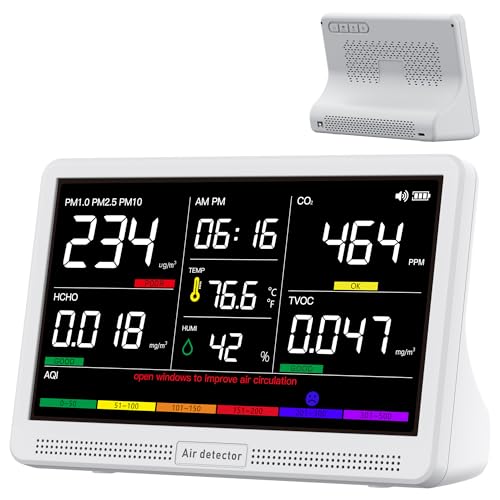
- Covers CO2, particles, HCHO, TVOC, temperature, humidity, and AQI
- Uses a bright 7-inch HD display with three brightness settings
- Includes seven alert modes and USB-C charging
Best For: Highly visible, broad-parameter monitoring in active classrooms
Best Portable Multi-Gas Option
10-in-1 MT13 Air Quality Monitor

- Measures particles, CO2, CO, HCHO, TVOC, AQI, temperature, and humidity
- Uses color-coded levels and 1.2-second updates
- Runs up to 96 hours on a rechargeable 2000mAh battery
Best For: Moving between classrooms without Wi-Fi or app setup
Best Overall

- Tracks eight air-quality and comfort measurements
- Includes app alerts, 90-day history, and CSV export
- Runs up to six hours on battery or continuously via USB-C
Best For: Data-focused classroom monitoring and ventilation analysis
Best Simple Portable Pick
16-in-1 Smart Air Quality Tester

- Shows eight core indoor air measurements
- Updates readings every 1.5 seconds on a color display
- Portable design includes Type-C charging and AC adapter
Best For: Quick, room-to-room classroom spot checks
Best Large Display
YNAK 16-in-1 Air Quality Monitor

- Uses a seven-inch screen for easy room-wide viewing
- Measures pollutants, comfort conditions, and AQI
- Provides alerts and up to eight hours of runtime
Best For: Visible real-time monitoring in active classrooms
Best Value Classroom Overview

- Monitors particles, HCHO, TVOC, temperature, and humidity
- Large color display with AQI indicators
- Compact desktop design for everyday indoor use
Best For: Teachers wanting a simple, highly visible desktop monitor
Best Portable Alerts

- Measures CO2, particles, TVOC, HCHO, and more
- Includes seven AQI alert buzzer functions
- Rechargeable for up to four to five hours
Best For: Portable classroom spot checks and audible notifications
Best Simple Pick

- Tracks CO2, particles, VOCs, temperature, humidity, and AQI
- Large 7-inch full-view screen with adjustable brightness
- Includes calibration support and muteable alerts
Best For: Classrooms needing visible CO2 and air quality readings
Best App-Connected Pick – Temtop M10+ 6-in-1 CO2 & IAQ Monitor
For classrooms seeking indoor air quality monitors for classrooms with several key readings in one compact device, the Temtop M10+ tracks CO2, PM2.5, TVOCs, temperature, and humidity. Its e-ink display, Bluetooth app connection, and long battery life make it practical for ongoing room checks without relying on Wi-Fi.
Best For: Classrooms that need portable monitoring, app-based data review, and extended battery life.
Pros:
- Measures CO2, PM2.5, TVOCs, temperature, and humidity.
- Bluetooth app supports live readings, historical analysis, calibration, and data export.
- Up to 60 days of battery life with an energy-efficient e-ink display.
- Muteable alarm suits quiet learning environments.
Cons:
- Bluetooth monitoring requires the phone to remain nearby.
- It does not provide the Wi-Fi-based remote access described for some competing models.
The M10+ is a well-rounded choice when staff want broad measurements and a simple, low-maintenance way to review classroom conditions. Its nearby-phone Bluetooth design is best suited to local checks rather than whole-building remote monitoring.
Best for Wi-Fi Data Logging – GoveeLife H5106 PM2.5 Monitor
The GoveeLife H5106 is one of the more straightforward indoor air quality monitors for classrooms, focusing on PM2.5, temperature, and humidity. It refreshes readings every two seconds and adds Wi-Fi or Bluetooth access, making it useful for viewing trends beyond the classroom itself.
Best For: Classrooms that prioritize PM2.5 tracking, fast updates, and longer-term data storage.
Pros:
- Provides PM2.5, temperature, and humidity readings with a two-second refresh.
- Supports Bluetooth and 2.4G Wi-Fi for remote monitoring.
- Offers 13-day online graphs and data export covering up to two years.
- Can connect with compatible GoveeLife appliances for automated responses.
Cons:
- Measures fewer air-quality parameters than the multi-gas monitors in this roundup.
- Requires continuous wired power and has no built-in battery.
- Wi-Fi functions require a 2.4G network.
This model makes sense for schools that want a compact, connected PM2.5 monitor and a record of changing classroom conditions. Its wired-only design means it should be installed near a dependable outlet.
Best Large-Display Monitor – bonoch AirSentry 16-in-1
For classrooms where readings need to be visible from across the room, the bonoch AirSentry combines a 7-inch HD display with measurements for CO2, PM1.0, PM2.5, PM10, HCHO, TVOC, temperature, humidity, and AQI. Its customizable alerts and external sensors provide a broad snapshot of classroom air conditions.
Best For: Teachers and staff who want a large, glanceable display with multiple pollutant alerts.
Pros:
- Displays a broad range of particle, gas, and comfort measurements.
- Large 7-inch HD screen has three brightness settings.
- Offers seven warning modes with a mute button.
- USB-C charging and an included AC adapter support flexible placement.
Cons:
- Battery runtime is listed at up to eight hours, shorter than some alternatives.
- The large display and 1.46-pound weight make it less compact for frequent relocation.
- The supplied notes do not describe app or Wi-Fi connectivity.
The AirSentry is a strong fit when visibility and measurement breadth matter more than remote access. Its audible alerts can draw attention to changes, while the mute control helps limit disruption during instruction.
Best Portable Multi-Gas Option – 10-in-1 MT13 Air Quality Monitor
The MT13 is a practical option among indoor air quality monitors for classrooms when portability and broad coverage are priorities. It measures particles, CO2, carbon monoxide, formaldehyde, TVOCs, AQI, temperature, and humidity, while its color-coded display makes changes easier to recognize at a glance.
Best For: Schools that want a self-contained monitor to move between classrooms, offices, vehicles, or other rooms.
Pros:
- Measures PM0.3, PM2.5, PM10, CO2, CO, HCHO, TVOC, AQI, temperature, and humidity.
- Color-coded levels help users interpret readings quickly.
- Refreshes data every 1.2 seconds and includes an audible alert.
- Built-in 2000mAh battery provides up to 96 hours of monitoring.
Cons:
- The supplied notes do not mention app, Bluetooth, or Wi-Fi connectivity.
- It offers tabletop placement rather than a stated wall-mount option.
- Frequent alerts may require muting during lessons.
With no network setup required and a long stated runtime, the MT13 is convenient for spot checks and room-to-room assessments. Its combination of carbon monoxide and formaldehyde monitoring also broadens the information available beyond basic ventilation indicators.
Best Overall – BREATHE Airmonitor Plus Gen 2
For classrooms needing detailed, ongoing visibility, the BREATHE Airmonitor Plus Gen 2 is a well-rounded choice among indoor air quality monitors for classrooms. It tracks CO2, particulate matter, TVOCs, formaldehyde, temperature, and humidity, while its app adds alerts, trend graphs, 90-day history, and CSV export.
Best For: Classrooms that need broad pollutant tracking, remote monitoring, and historical data for ventilation analysis.
Pros:
- Measures CO2, PM1, PM2.5, PM10, TVOC, formaldehyde, temperature, and humidity.
- Provides configurable CO2 and PM2.5 alerts through the app.
- Stores up to 90 days of data and supports CSV export.
- Offers up to six hours of battery use and can run from USB-C power.
Cons:
- App connectivity requires a 2.4 GHz Wi-Fi connection.
- Six-hour battery life may require frequent recharging during extended portable use.
This is the strongest fit when a school wants more than a basic CO2 display. Its combination of NDIR CO2 measurement, particle sensing, VOC and formaldehyde detection, plus exportable history, supports both daily classroom checks and longer-term ventilation reviews.
Best Simple Portable Pick – 16-in-1 Smart Air Quality Tester
This compact tester is a practical option for classrooms that need quick, on-site readings without app-based monitoring. It displays particulate matter, CO2, TVOC, formaldehyde, temperature, and humidity on a high-definition color screen and updates measurements every 1.5 seconds.
Best For: Teachers or staff who want a portable, easy-to-operate monitor for spot checks across classrooms and other indoor spaces.
Pros:
- Displays PM1.0, PM2.5, PM10, CO2, TVOC, HCHO, temperature, and humidity.
- Uses a large color screen with continuous real-time updates.
- Simple one-button operation and an optional audio prompt make it easy to use.
- Includes Type-C charging, an AC adapter, and a 12-month support period.
Cons:
- Battery runtime is approximately four to five hours.
- The supplied notes do not mention app connectivity, data history, or export features.
Its strength is straightforward portability: staff can carry it between rooms, take readings, and view multiple indicators at a glance. It is less suited to schools seeking centralized records or long-term trend reporting.
Best Large Display – YNAK 16-in-1 Air Quality Monitor
With its seven-inch display, the YNAK monitor is designed for classrooms where readings need to be visible from across the room. It measures CO2, PM1.0, PM2.5, PM10, TVOC, formaldehyde, temperature, and humidity, and adds AQI indications with adjustable alert buzzers.
Best For: Classrooms that prioritize at-a-glance visibility, audible AQI alerts, and flexible placement.
Pros:
- Large seven-inch LED screen offers an immediate view of readings.
- Monitors CO2, PM1.0, PM2.5, PM10, HCHO, TVOC, temperature, humidity, and AQI.
- Provides seven AQI alert functions with a mute option.
- Offers up to eight hours of runtime and USB-C charging.
Cons:
- Audible alerts may need to be muted in instruction settings.
- The supplied notes do not mention app support, historical storage, or data export.
- Its external sensors should be protected from perfumes and strong odors to help maintain accuracy.
The large screen makes this a classroom-friendly choice when students or staff should be able to see the air status without moving close to the device. Its longer stated battery runtime also helps with portable monitoring, though it is primarily a real-time display rather than a connected reporting system.
Best Value Classroom Overview – 10-in-1 AQI Monitor
For classrooms seeking indoor air quality monitors for classrooms, this desktop unit provides a broad snapshot of particulate matter, chemical indicators, temperature, and humidity. Its large color display and color-coded AQI indicator make readings easier to check from across the room.
Best For: Teachers and small classrooms that want an easy-to-read, desktop air quality overview.
Pros:
- Tracks PM1.0, PM2.5, PM10, HCHO, TVOC, temperature, humidity, AQI, and time.
- Large full-color screen is designed for quick viewing.
- Color-coded AQI indicators and real-time alerts can signal when ventilation may be needed.
- Compact desktop design measures 4.17 by 3.54 by 1.96 inches.
Cons:
- The supplied details do not list CO2 monitoring.
- Its included battery requirement may be less convenient than a rechargeable design.
This is a practical choice when visible, multi-measurement readings matter more than portability or CO2 tracking. It is especially suitable for placing on a teacher’s desk or another central surface.
Best Portable Alerts – 16-in-1 AQItech Monitor
This portable option stands out among indoor air quality monitors for classrooms for its wide measurement range and audible alert functions. It monitors particles, CO2, chemical indicators, temperature, and humidity, while the battery supports use away from an outlet.
Best For: Classrooms that need portable monitoring and prominent alerts during changing conditions.
Pros:
- 16-in-1 monitoring includes PM1.0, PM2.5, PM10, CO2, TVOC, HCHO, temperature, and humidity.
- Seven AQI alert buzzer functions provide audible notifications.
- One-button operation and double-click alert silencing are straightforward for daily use.
- Rechargeable battery provides up to four to five hours of wireless operation.
Cons:
- Battery runtime is limited to approximately four to five hours per charge.
- The supplied notes identify a visual alarm as well as buzzer alerts, but do not specify classroom mounting details.
Choose this model if staff may want to move the monitor between rooms or use it during spot checks. Its CO2 measurement and audible alerts add useful context, though continuous all-day operation may require charging.
Best Simple Pick – 16-in-1 7-Inch CO2 Monitor
For classrooms where several people need to see readings at once, this model combines indoor air quality monitors for classrooms features with a 7-inch full-view display. It covers CO2, particulate matter, chemical indicators, temperature, humidity, and AQI, with adjustable brightness for different lighting conditions.
Best For: Larger classrooms that prioritize an at-a-glance display and CO2 awareness.
Pros:
- 16-in-1 monitoring includes CO2, PM1.0, PM2.5, PM10, HCHO, TVOC, temperature, humidity, and AQI.
- 7-inch display presents readings in a single view.
- Adjustable brightness supports daytime and nighttime viewing.
- Built-in calibration support and a mute function provide added control.
Cons:
- At 1.47 pounds, it is heavier than the other listed options.
- The supplied details do not specify battery runtime or portability features.
- The manufacturer advises avoiding perfumes and strong odors near the sensors.
This is the strongest fit when display size and CO2 tracking are central buying priorities. Its calibration support is useful for ongoing monitoring, while the larger body is better suited to a fixed classroom location.
How We Picked the Best Indoor Air Quality Monitors for Classrooms
We focused on the measurements that matter most in occupied learning spaces: CO2 for ventilation awareness, PM2.5 and PM10 for airborne particles, TVOC and formaldehyde where available, plus temperature and humidity for context. We also considered display readability, portability, alarms, sensor claims, power requirements, and whether a monitor is practical for teachers or facilities teams to check throughout the day.
Because specifications and calibration quality can vary between consumer monitors, these devices should support—not replace—professional assessment, ventilation standards, and required safety equipment.
Quick Comparison
| Best For | Prioritize | Useful Features |
|---|---|---|
| Individual classrooms | CO2 and clear readings | Large display, audible or visual alerts |
| Multi-room monitoring | Portability and consistent operation | Rechargeable battery, simple controls |
| Facilities teams | Broad pollutant coverage | PM, VOC, formaldehyde, temperature, humidity |
| Parent or staff visibility | Easy-to-read status information | Color screen, AQI indicator, trend display |
Key Buying Factors for Indoor Air Quality Monitors for Classrooms
CO2 Measurement
CO2 is often the most useful everyday indicator of ventilation and occupancy effects. Look for a monitor that specifically identifies an NDIR CO2 sensor, displays readings clearly, and provides configurable or understandable alerts. A CO2 monitor does not measure every pollutant, but it can help staff identify when ventilation needs attention.
Particle and Gas Coverage
PM2.5 and PM10 readings can help reveal particle changes from outdoor air, activities, or nearby sources. TVOC and HCHO sensors add broader chemical readings, but their results may be less specific than a dedicated professional test. Treat broad “16-in-1” or “10-in-1” claims as a feature checklist, not proof that every measurement has equal accuracy.
Placement and Usability
Choose a bright, readable display for teacher-facing rooms and a compact, portable model if one device will rotate between classrooms. Place the monitor at breathing height, away from windows, vents, doors, and direct heat. Battery operation can simplify placement, while wired models may be better for continuous use in a fixed location.
Alerts, Logging, and Maintenance
Visual or audible alarms are helpful when teachers need an immediate prompt, but check whether thresholds can be adjusted. For school-wide programs, consider data logging or app connectivity. Confirm the manufacturer’s calibration guidance, sensor replacement requirements, and warranty before buying multiple units.
Who Should Buy Which Indoor Air Quality Monitors for Classrooms?
Choose a compact CO2-focused monitor for a classroom that needs simple ventilation feedback and quick checks. Select a large-screen multi-parameter model when teachers, students, or visitors need to see several readings at a glance. A portable unit with battery power suits facilities staff moving between rooms, while a connected smart monitor is preferable when remote visibility or app-based trends matter. Schools managing recurring air-quality concerns should use these monitors alongside HVAC inspections, filter maintenance, and a documented ventilation plan.