A bedroom can feel comfortable while still having elevated carbon dioxide, fine particles, humidity, or volatile organic compounds. The right monitor helps reveal those changes so you can improve ventilation, filtration, and sleep comfort.
We selected 10 indoor air quality monitors for bedrooms with different strengths, from straightforward CO2 tracking and app-connected sensors to multi-parameter displays and smart-home integrations. Use the guide below to narrow the choices by sensor coverage, accuracy, usability, and budget.
Best 10 Indoor Air Quality Monitors for Bedrooms Picks for 2026
Best for Sleep Insights

- Monitors CO2, VOCs, humidity, temperature, and pressure
- Also tracks bedroom noise and light levels
- Battery-powered with app notifications and trend analysis
Best For: Bedrooms and home offices focused on ventilation, sleep, and comfort
Best for Alexa Homes
Amazon Smart Air Quality Monitor

- Measures PM2.5, VOCs, carbon monoxide, humidity, and temperature
- Shows an air-quality score in the Alexa app
- Can trigger Alexa alerts and compatible device routines
Best For: Alexa households wanting automated air-quality notifications
Best for Quiet Long-Term Tracking

- Measures CO2, PM2.5, TVOCs, temperature, and humidity
- E-ink display offers up to 60 days of battery life
- Muteable alarm and Bluetooth app data logging suit bedrooms
Best For: Quiet, close-range monitoring in bedrooms and nurseries
Best for Detailed Portable Readings
16-in-1 Portable Air Quality Monitor

- Measures multiple particle sizes, CO2, TVOC, HCHO, temperature, and humidity
- Displays updates on an HD color screen every 1.5 seconds
- Portable design includes USB-C charging and quiet sampling
Best For: Detailed, on-demand testing across bedrooms and other spaces
Best Data-Tracking Pick

- Measures eight key air-quality and comfort metrics
- Stores 90 days of app history with CSV export
- Supports alerts and six hours of portable use
Best For: Detailed bedroom monitoring and long-term trend tracking
Best No-App Option
10-in-1 Color Display Air Monitor

- Monitors particles, gases, AQI, temperature, and humidity
- Uses color-coded levels and an audible alert
- Offers up to 96 hours of battery-powered monitoring
Best For: Simple, portable bedroom monitoring without app setup
Best Smart-Home Pick
AirGradient ONE Indoor Air Quality Monitor
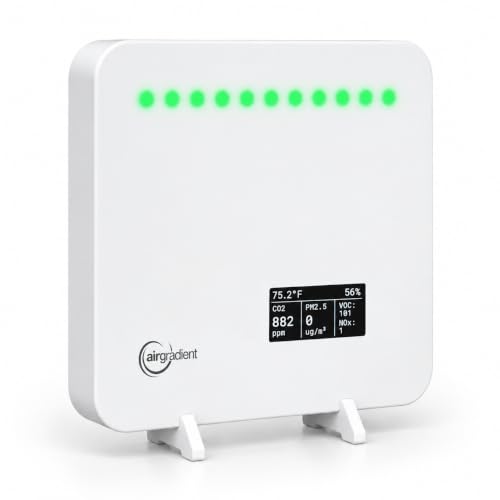
- Tracks PM2.5, CO2, TVOCs, NOx, temperature, and humidity
- Works with Home Assistant and offers open-source flexibility
- Includes a subscription-free dashboard, app, and API
Best For: Connected bedrooms and open-source smart-home systems
Most Comprehensive

- Tracks particles, gases, comfort levels, and AQI
- Large 7-inch display with adjustable brightness
- Real-time alerts with mute function
Best For: Users wanting the broadest bedroom air-quality overview
Best Connected Option

- Tracks seven air and comfort metrics plus noise
- Wi-Fi app offers remote and 30-day history access
- Touchscreen doubles as an alarm clock
Best For: Smart-home users who want remote readings and data history
Best Compact Value

- Measures common particles, pollutants, and comfort conditions
- Large color display with AQI indicators
- Compact desktop design for bedrooms and offices
Best For: Users wanting essential readings in a compact monitor
Best for Sleep Insights – Airthings Wave Enhance
For shoppers comparing indoor air quality monitors for bedrooms, the Airthings Wave Enhance is a cable-free option focused on sleep and comfort conditions. It tracks CO2, VOCs, humidity, temperature, and air pressure, while also monitoring noise and light.
Best For: Bedrooms and home offices where ventilation, sleep conditions, and long-term trends matter.
Pros:
- Tracks five always-on air-quality factors plus noise and light.
- The app provides notifications, current readings, and trend analysis.
- Battery-powered design supports flexible placement without a cable.
- A touch sensor provides a quick color-coded air-quality indication.
Cons:
- Complete readings are accessed through the app rather than directly on the unit.
- It does not list particulate matter or carbon monoxide monitoring among its tracked factors.
The Wave Enhance is a practical pick for bedroom users who want discreet monitoring and app-based trend information, especially when CO2, humidity, noise, and light are central concerns.
Best for Alexa Homes – Amazon Smart Air Quality Monitor
The Amazon Smart Air Quality Monitor is a straightforward choice among indoor air quality monitors for bedrooms, particularly for households already using Alexa. It measures particulate matter, VOCs, carbon monoxide, humidity, and temperature, then presents the information through an LED and the Alexa app.
Best For: Alexa-equipped homes that want air-quality alerts and smart-device routines.
Pros:
- Tracks PM2.5, VOCs, carbon monoxide, humidity, and temperature.
- Provides a color-coded LED and an air-quality score in the Alexa app.
- Can send phone notifications or announcements through Echo devices.
- Supports routines for compatible purifiers, dehumidifiers, and fans.
Cons:
- Its smart-home features are centered on Alexa-compatible devices.
- The supplied notes do not specify battery life, portability, or an on-device numeric display.
This monitor stands out when convenient alerts and automation are more important than standalone portability. It can help connect bedroom air readings with actions from other Alexa-enabled devices.
Best for Quiet Long-Term Tracking – Temtop M10+ 6-in-1 Monitor
The Temtop M10+ is one of the more bedroom-friendly indoor air quality monitors for bedrooms because its alarm can be muted completely and its e-ink display supports up to 60 days of battery life. It measures CO2, PM2.5, TVOCs, temperature, and humidity, with Bluetooth app connectivity for nearby viewing and data logging.
Best For: Bedrooms, nurseries, and personal workspaces needing quiet monitoring without Wi-Fi.
Pros:
- Combines CO2, PM2.5, TVOCs, temperature, and humidity readings.
- Offers an e-ink display and claimed battery life of up to 60 days.
- Muteable alarm helps avoid sleep disruptions.
- Bluetooth app connectivity supports historical data, calibration, and hourly logging.
Cons:
- Bluetooth monitoring requires staying nearby rather than using a network connection.
- The supplied notes describe an audible alarm, even though it can be muted.
The M10+ is a strong fit for users who want a visible display and extended battery life without Wi-Fi dependence. Its quiet mode and bedroom-specific design make it especially suitable for overnight monitoring.
Best for Detailed Portable Readings – 16-in-1 Portable Air Quality Monitor
For shoppers seeking broad readings from indoor air quality monitors for bedrooms, this portable 16-in-1 air quality monitor offers a detailed, on-device view. It measures particulate sizes, CO2, TVOC, HCHO, temperature, and humidity, updating readings every 1.5 seconds on an HD color screen.
Best For: Users who want comprehensive, real-time readings they can move between bedrooms, offices, cars, and other spaces.
Pros:
- Tracks PM1.0, PM2.5, PM10, CO2, TVOC, HCHO, temperature, and humidity.
- Large color screen provides real-time, color-coded readings.
- Quiet sampling mode and adjustable audio prompt support nighttime use.
- Compact design and USB-C charging allow use across multiple locations.
Cons:
- Continuous runtime is listed as approximately four to five hours per charge.
- Its broad set of readings may be more than shoppers need for basic bedroom comfort checks.
This model is best suited to hands-on testing rather than unattended, long-term monitoring. Its wide parameter range and clear display make it useful for comparing conditions around a home or checking specific spaces on demand.
Best Data-Tracking Pick – BREATHE Airmonitor Plus Gen 2
For shoppers comparing indoor air quality monitors for bedrooms, the BREATHE Airmonitor Plus Gen 2 stands out for its broad sensor coverage and useful long-term tracking. It measures CO2, particulate matter, TVOC, formaldehyde, temperature, and humidity, while its app stores up to 90 days of readings and supports data export.
Best For: Bedroom users who want detailed pollutant monitoring, app alerts, and historical data.
Pros:
- Tracks CO2, PM1, PM2.5, PM10, TVOC, formaldehyde, temperature, and humidity.
- Offers 90-day app history, graphs, alerts, and CSV data export.
- Uses NDIR CO2 measurement plus laser particle sensing and dedicated VOC and formaldehyde detection.
- Provides up to six hours of portable battery use and can run from USB-C power.
Cons:
- App connectivity requires 2.4 GHz Wi-Fi.
- Its six-hour battery life is shorter than some highly portable monitors.
This is a strong choice when you want to investigate how ventilation, cleaning, cooking, or occupancy affects bedroom air over time. It offers more analysis capability than a basic display-only monitor.
Best No-App Option – 10-in-1 Color Display Air Monitor
Among indoor air quality monitors for bedrooms, this 10-in-1 model is designed for straightforward, offline use. Its color display presents readings for particles, gases, AQI, temperature, and humidity, while one-button controls and an audible alarm make it easy to use without Wi-Fi, Bluetooth, or an app.
Best For: Families who want a portable, glanceable monitor with long battery life and no app setup.
Pros:
- Measures PM0.3, PM2.5, PM10, CO2, carbon monoxide, formaldehyde, TVOC, AQI, temperature, and humidity.
- Color-coded readings make changes easier to recognize at a glance.
- Samples and processes air data every 1.2 seconds according to the supplied notes.
- The 2000mAh rechargeable battery provides up to 96 hours of continuous monitoring.
Cons:
- Does not offer Wi-Fi, Bluetooth, or app-based history.
- The supplied information does not list remote alerts or data export.
This model favors simplicity over connected features. Its long battery runtime and clear screen make it convenient to move between a bedroom and other spaces, while the alarm can draw attention to preset air-quality changes.
Best Smart-Home Pick – AirGradient ONE Indoor Air Quality Monitor
For buyers seeking indoor air quality monitors for bedrooms that can fit into a broader smart-home setup, the AirGradient ONE offers strong integration flexibility. It measures PM2.5, CO2, TVOCs, NOx, temperature, and humidity, and works with Home Assistant alongside AirGradient’s subscription-free dashboard and API.
Best For: Smart-home users, open-source enthusiasts, and buyers who value documented sensor performance.
Pros:
- Measures PM2.5, CO2, TVOCs, NOx, temperature, and relative humidity.
- Works with Home Assistant and supports local discovery, API access, and open-source customization.
- Includes a dashboard, iOS and Android app access, and no subscription requirement.
- Uses named SenseAir, Plantower, Sensirion, and SHT40 sensor modules and includes a digital test report.
Cons:
- Requires a USB power connection rather than offering stated battery operation.
- Its advanced integrations may be more than needed for buyers seeking a basic bedroom display.
The AirGradient ONE is particularly appealing when bedroom readings need to feed into automations or a self-hosted system. Its OLED display and LED color bar still provide local feedback, while the open-source design offers room for customization.
Most Comprehensive – 16-in-1 Air Quality Monitor
For shoppers comparing indoor air quality monitors for bedrooms, this model stands out for its broad range of readings and oversized 7-inch display. It tracks particles, gases, comfort conditions, and AQI in real time, making it useful for checking changes throughout the day or night.
Best For: Bedroom users who want the widest set of measurements and a large, easy-to-read screen.
Pros:
- Monitors CO2, PM1.0, PM2.5, PM10, HCHO, TVOC, temperature, humidity, and AQI.
- 7-inch full-view display has adjustable brightness for daytime and nighttime use.
- Real-time alerts and a mute function help flag changing conditions without requiring constant monitoring.
- Includes calibration support and adjustable time and temperature formats.
Cons:
- The larger display and 1.47-pound weight may take more desk space than compact monitors.
- The sensor should be kept away from perfumes and strong odors, and users should avoid touching it.
This is the strongest fit when measurement breadth and at-a-glance visibility matter most. Its alert system and night-adjustable display also make it practical for bedroom monitoring.
Best Connected Option – Qingping Air Monitor Gen 2
Among indoor air quality monitors for bedrooms, the Qingping Air Monitor Gen 2 is a convenient choice for users who want touchscreen controls and remote access. It measures seven conditions, displays time and date, and can send historical readings to the Qingping+ app over Wi-Fi.
Best For: Smart-home users who want app access, historical data, and an integrated alarm clock.
Pros:
- Measures CO2, PM2.5, PM10, eTVOC, noise, temperature, and humidity.
- 4-inch high-resolution touchscreen has automatic brightness adjustment and color indicators.
- Qingping+ app supports remote monitoring, 30-day historical data, exports, and firmware upgrades.
- Replaceable PM sensor can simplify future maintenance.
Cons:
- It does not measure formaldehyde.
- Daily use requires USB power; full charging provides up to three hours, and the adapter is not included.
- Wi-Fi app features require connection to a 2.4GHz or 5GHz network.
This model makes the most sense if remote monitoring and data history are more important than formaldehyde detection. Its alarm-clock function adds useful bedroom convenience.
Best Compact Value – 10-in-1 Air Quality Monitor
This compact monitor is a practical pick for shoppers seeking indoor air quality monitors for bedrooms without a large desktop footprint. Its color display presents particle, pollutant, comfort, time, and AQI information in one place, while color-coded indicators make changes easier to interpret.
Best For: Bedrooms, offices, nurseries, and other spaces where a compact monitor with essential pollutant readings is preferred.
Pros:
- Monitors PM1.0, PM2.5, PM10, HCHO, TVOC, temperature, humidity, AQI, and time.
- Large full-color display makes readings visible from across the room.
- Color-coded AQI indicators provide quick visual feedback.
- Compact 4.17-by-3.54-by-1.96-inch design suits desktop placement.
Cons:
- Its 10-in-1 coverage is narrower than the 16-in-1 model in this roundup.
- The supplied notes do not mention app connectivity, data history, or calibration support.
- It requires one included A battery.
Choose this model for straightforward, room-friendly monitoring of common particles, pollutants, and comfort conditions. It balances a compact form with a display designed for quick checks.
How We Picked the Best Indoor Air Quality Monitors for Bedrooms
We focused on monitors that measure the bedroom conditions most relevant to comfort and health decisions: carbon dioxide (CO2), particulate matter such as PM2.5, volatile organic compounds (TVOC), temperature, and relative humidity. We also considered sensor types, display readability, alerts, mobile or smart-home connectivity, portability, and the usefulness of the data over time.
Products with broader sensor lists are not automatically better. A well-designed monitor with reliable core measurements can be more useful than a low-cost device that lists many parameters without clearly explaining its sensors or calibration.
Quick Comparison
- Best for simple connected monitoring: Airthings Wave Enhance and Amazon Smart Air Quality Monitor.
- Best for portable CO2 testing: Temtop M10+.
- Best for detailed, at-a-glance readings: the 16-in-1 models with larger color displays.
- Best for open smart-home integration: AirGradient ONE, particularly for Home Assistant users.
- Best for tracking particles and gases together: BREATHE Airmonitor Plus Gen 2 and Qingping Air Monitor Gen 2.
Key Buying Factors for Indoor Air Quality Monitors for Bedrooms
Choose the Right Sensors
CO2 is especially useful for identifying poor ventilation overnight. PM2.5 matters when outdoor pollution, smoke, cooking, candles, or dusty air may enter the room. TVOC and formaldehyde readings can provide additional clues about chemical pollution, but inexpensive sensors may offer estimates rather than laboratory-grade identification of individual gases.
Check Measurement Technology and Limits
For CO2, a nondispersive infrared (NDIR) sensor is generally preferable to a broad equivalent-CO2 estimate. Look for published accuracy, operating ranges, calibration guidance, and warm-up requirements. Treat warning colors and single readings as prompts to investigate, not as medical diagnoses.
Prioritize Bedroom Usability
A bright display can be convenient during the day but distracting at night, so adjustable brightness or a screen-off mode is valuable. Audible alarms may be useful for urgent changes but undesirable beside a bed. App history, exportable data, and configurable alerts help you identify patterns caused by closed windows, HVAC cycles, or air purifiers.
Consider Placement and Connectivity
Place the monitor near breathing height, away from windows, vents, humidifiers, kitchens, and direct sunlight. Wi-Fi and cloud apps offer remote access, while local dashboards or Home Assistant support can be better for privacy and automation. Battery-powered units are easier to move but may update less frequently or require regular charging.
Who Should Buy Which Indoor Air Quality Monitors for Bedrooms?
Choose a simple connected monitor if you mainly want CO2, humidity, temperature, and easy alerts. Select a particle-focused or multi-sensor model if allergies, wildfire smoke, dust, or filtration performance are your main concerns. Pick a large-display unit for shared bedrooms, nurseries, or users who want readings visible without opening an app. Home automation enthusiasts should favor documented integrations and accessible data, while travelers or renters may prefer a compact portable monitor.