Indoor air can change quickly as people gather, windows close, cooking starts, or cleaning products are used. The right monitor helps turn invisible changes in CO2, particles, VOCs, humidity, and other conditions into useful information you can act on.
We selected 10 indoor air quality monitors for homes across several needs, from simple CO2 tracking and portable particle measurements to connected displays and broader multi-sensor coverage. Use the guide below to narrow the options by sensor priorities, convenience, and budget.
Best 10 Indoor Air Quality Monitors for Homes Picks for 2026
Best for CO2-Focused Ventilation
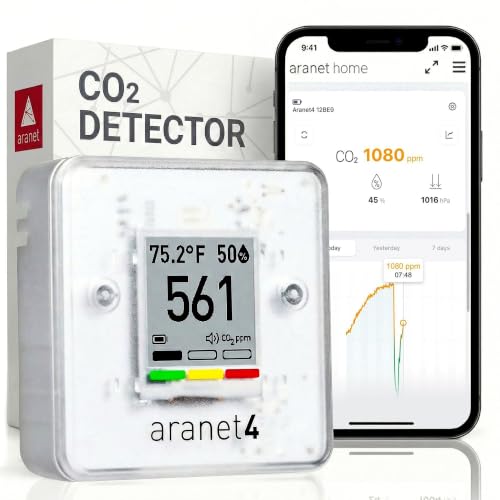
- Real-time CO2, temperature, humidity, and pressure readings
- Cable-free e-ink display with up to four years of battery life
- App tracks up to 90 days of historical data
Best For: Households focused on ventilation and CO2 tracking
Best for Alexa Smart Homes
Amazon Smart Air Quality Monitor

- Tracks PM2.5, VOCs, carbon monoxide, humidity, and temperature
- Shows an air quality score in the Alexa app
- Supports alerts and routines with compatible Alexa devices
Best For: Alexa households automating air-quality responses
Best for Radon Monitoring

- Monitors radon plus PM2.5, CO2, VOCs, humidity, temperature, and pressure
- Wi-Fi and app support remote readings, alerts, and trends
- Battery-powered with a customizable e-ink screen
Best For: Homeowners prioritizing radon and broad pollutant tracking
Best for Portable Multi-Parameter Checks

- Measures particles, TVOC, formaldehyde, temperature, and humidity
- Updates readings every 1.5 seconds on an HD color screen
- Portable, rechargeable design includes Type-C charging accessories
Best For: Portable spot checks across rooms, vehicles, and offices
Best Data-Driven Pick

- Measures CO2, particulates, TVOC, formaldehyde, temperature, and humidity
- Includes 90-day history, alerts, and CSV export
- Up to six hours of battery use with USB-C operation
Best For: Detailed home monitoring and historical air-quality analysis
Best Easy-Read Portable Pick
16-in-1 Indoor Air Quality Monitor

- Displays multiple pollutant and climate readings on an HD color screen
- Updates measurements every 1.5 seconds
- Portable design with Type-C charging and quiet sampling mode
Best For: Simple room-to-room and vehicle air checks
Best Long-Battery Pick
LifeBasis 11-in-1 Air Quality Monitor

- Monitors pollutants, AQI, temperature, and humidity
- Uses color, flashing, and audible alerts for elevated readings
- Provides up to 11–12 hours of continuous battery use
Best For: Extended portable monitoring with simple alerts
Best Comprehensive Display

- Measures gases, particles, temperature, humidity, and AQI
- 7-inch display shows readings at a glance
- Audible threshold alerts with mute option
Best For: Homes wanting broad coverage on a large screen
Best Portable PM2.5 Monitor
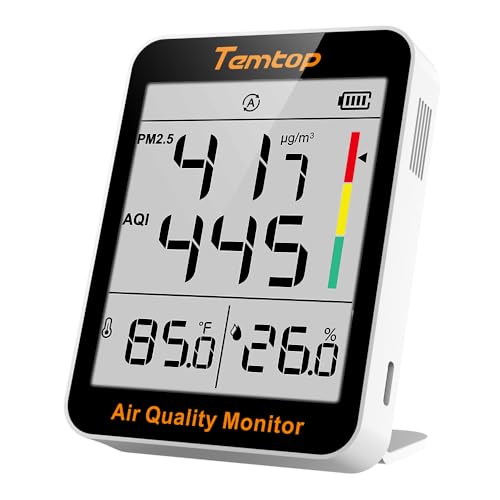
- Tracks PM2.5 and AQI alongside temperature and humidity
- Claimed up to 60 days of battery life
- Compact design for room-to-room use
Best For: Portable particulate and comfort monitoring
Best Color-Coded CO2 Monitor

- Measures CO2, gases, particles, temperature, humidity, and AQI
- Three-color screen provides quick visual feedback
- Portable design with Bluetooth clock calibration
Best For: Homes wanting broad readings with visual air-quality alerts
Best for CO2-Focused Ventilation – Aranet4
If your priority is managing ventilation, the Aranet4 is a focused choice among indoor air quality monitors for homes. It displays CO2, temperature, relative humidity, and atmospheric pressure in real time, with color coding and an optional buzzer to flag elevated CO2.
Best For: Households that want a simple, cable-free CO2 monitor with long battery life and app-based historical data.
Pros:
- Measures CO2, temperature, humidity, and atmospheric pressure.
- Uses NDIR technology for CO2 measurements.
- E-ink display and included AA batteries support up to four years of battery life.
- App provides graphs and up to 90 days of historical data.
Cons:
- Its measurements are centered on CO2 and basic comfort indicators rather than a broader pollutant panel.
- Wireless app features require a smartphone.
The Aranet4 is a practical, low-maintenance option when CO2 is your main signal for deciding when to open a window or improve airflow.
Best for Alexa Smart Homes – Amazon Smart Air Quality Monitor
The Amazon Smart Air Quality Monitor is a convenient pick among indoor air quality monitors for homes already using Alexa. It tracks PM2.5, VOCs, carbon monoxide, humidity, and temperature, then presents an air quality score and alerts through the Alexa app.
Best For: Alexa users who want notifications and routines that can respond to changing indoor air conditions.
Pros:
- Monitors five key factors: PM2.5, VOCs, carbon monoxide, humidity, and temperature.
- Color-coded LED and Alexa app provide an accessible air quality indication.
- Can send phone notifications or announcements through Echo devices.
- Alexa routines can control compatible purifiers, dehumidifiers, and fans.
Cons:
- Its smart-home features are most useful within the Alexa ecosystem.
- The supplied notes do not specify battery operation or a standalone historical-data display.
This monitor makes the most sense when you want air readings to trigger connected-home actions, rather than relying only on a display at the device.
Best for Radon Monitoring – Airthings View Plus
For broader pollutant coverage, the Airthings View Plus stands out among indoor air quality monitors for homes because it adds radon detection to PM2.5, CO2, VOC, humidity, temperature, and pressure monitoring. Its Wi-Fi connection and app support remote checks, notifications, and trend analysis.
Best For: Homeowners who want continuous, app-connected monitoring with a particular focus on radon.
Pros:
- Measures radon, PM2.5, CO2, VOCs, humidity, temperature, and air pressure.
- Provides live data, notifications, and historical trend analysis through the Airthings app.
- Battery-powered design and customizable e-ink screen allow flexible placement.
- Optional registration can extend the warranty to five years.
Cons:
- The monitor and app require internet access, and an account is required to use the device.
- Battery life is listed at approximately two years, shorter than some simpler monitors.
The View Plus is a strong fit when radon and remote monitoring justify a more comprehensive system and its connected-app requirements are acceptable.
Best for Portable Multi-Parameter Checks – 16-in-1 Air Quality Monitor
This 16-in-1 monitor offers a broad set of readings in a portable format, making it a flexible option among indoor air quality monitors for homes. It measures PM1.0, PM2.5, PM10, TVOC, HCHO, temperature, and humidity, with updates every 1.5 seconds on a color screen.
Best For: Users who want a handheld monitor for checking rooms, vehicles, offices, and other indoor spaces without buying multiple single-purpose testers.
Pros:
- Tracks particulate matter, TVOC, formaldehyde, temperature, and humidity.
- HD color display provides continuously updated, color-coded readings.
- Compact design supports use across homes, cars, bedrooms, offices, and campsites.
- Includes a Type-C cable, AC adapter, and 12-month full-unit warranty.
Cons:
- Continuous battery runtime is listed at only four to five hours per charge.
- The supplied notes do not mention app connectivity or remote alerts.
- Its broad feature count may be more than needed for users focused only on CO2.
This is best treated as a portable spot-checking tool: it offers wide coverage and quick visual feedback, but requires regular charging for extended use.
Best Data-Driven Pick – BREATHE Airmonitor Plus Gen 2
For shoppers comparing indoor air quality monitors for homes, the BREATHE Airmonitor Plus Gen 2 stands out for its broad sensor coverage and app-based tracking. It measures CO2, three particle sizes, TVOC, formaldehyde, temperature, and humidity, while offering alerts, historical graphs, and data export.
Best For: Home users who want detailed readings, long-term trend analysis, and remote monitoring through a smartphone app.
Pros:
- Tracks CO2, PM1, PM2.5, PM10, TVOC, formaldehyde, temperature, and humidity.
- Offers 90-day app history, CSV data export, and configurable CO2 and PM2.5 alerts.
- Uses NDIR CO2 measurement and laser particle sensing.
- Provides up to six hours of portable battery use and can run on USB-C power.
Cons:
- App connectivity requires a 2.4 GHz Wi-Fi network.
- Its six-hour battery life is shorter than some portable monitors.
The Gen 2 is a strong choice when you want more than a basic CO2 meter. Its combination of chemical, particulate, and climate readings makes it especially useful for identifying changes caused by cooking, cleaning, occupancy, or ventilation.
Best Easy-Read Portable Pick – 16-in-1 Indoor Air Quality Monitor
This 16-in-1 monitor is a practical option for shoppers seeking indoor air quality monitors for homes with a clear display and simple controls. It continuously updates readings for particulates, CO2, TVOC, formaldehyde, temperature, and humidity on an HD color screen.
Best For: Users who prioritize straightforward operation, quick visual readings, and portability between rooms, vehicles, and offices.
Pros:
- Monitors PM1.0, PM2.5, PM10, CO2, TVOC, HCHO, temperature, and humidity.
- Samples and processes data every 1.5 seconds for continuous updates.
- Large color display uses color-coded air-quality readings.
- Includes Type-C charging, an AC adapter, and adjustable audio prompting.
Cons:
- Battery runtime is limited to approximately four to five hours.
- The supplied notes describe core readings but do not mention app connectivity or stored history.
Its single-tap controls, quiet sampling mode, and readable screen make this a convenient everyday tester. The short battery runtime is less of an issue if you mainly use it near a power source.
Best Long-Battery Pick – LifeBasis 11-in-1 Air Quality Monitor
The LifeBasis 11-in-1 is a useful choice among indoor air quality monitors for homes when portability and extended battery life matter. It combines CO2, particulate, TVOC, formaldehyde, AQI, temperature, and humidity readings with visual and audible alerts.
Best For: Households that want a portable monitor with long runtime and easy-to-understand color and sound warnings.
Pros:
- Tracks AQI, CO2, PM1.0, PM2.5, PM10, particles, HCHO, TVOC, temperature, and humidity.
- Uses NDIR, laser particle, semiconductor, photoelectric, temperature, and humidity sensors.
- Provides color-coded status levels plus audible and visual alerts.
- Its 2500mAh battery supports up to 11–12 hours of continuous use.
Cons:
- The supplied notes do not mention smartphone connectivity or data history.
- Audible alerts may be less desirable in quiet spaces, although the monitor includes alert behavior and adjustable screen brightness.
LifeBasis is compelling for users who want to leave a monitor running longer between charges. Its LCD screen, color indicators, and dual alert system make changing conditions easy to notice without relying on an app.
Best Comprehensive Display – 16-in-1 Air Quality Monitor
If you want broad coverage in your search for indoor air quality monitors for homes, this model combines a large display with measurements for gases, particles, and comfort conditions. Its 7-inch screen is useful for checking multiple readings at once in a bedroom, office, or living area.
Best For: Households that want a large, easy-to-read display and extensive real-time monitoring.
Pros:
- Tracks CO2, PM1.0, PM2.5, PM10, HCHO, TVOC, temperature, humidity, and AQI.
- Large 7-inch full-view display with adjustable brightness.
- Real-time alerts include a buzzer and mute function.
- Supports calibration and 12/24-hour and °F/°C settings.
Cons:
- The larger display may take up more space than compact monitors.
- Notes advise avoiding perfumes, strong odors, and contact with the sensors to help maintain accuracy.
This is the most information-rich option of the three, particularly if you prefer seeing many measurements without relying on a phone. Its footprint and sensor-care requirements are worth considering before placing it permanently in a small space.
Best Portable PM2.5 Monitor – Temtop S1 PM2.5 Monitor
For shoppers comparing indoor air quality monitors for homes, the Temtop S1 focuses on PM2.5 and AQI while also tracking temperature and humidity. Its compact design and claimed 60-day battery life make it convenient to move between rooms or take to an office, nursery, or school.
Best For: Portable monitoring of PM2.5, AQI, temperature, and humidity with minimal charging.
Pros:
- Combines PM2.5 and AQI readings with temperature and humidity measurements.
- Uses a miniature laser particle sensor for PM2.5 monitoring.
- Claimed battery life of up to 60 days on a single charge.
- Compact display shows key readings at a glance.
Cons:
- Measures fewer air-quality indicators than the multi-sensor alternatives here.
- The listed temperature accuracy is plus or minus 1 degree Celsius.
The S1 is a straightforward choice when particulate monitoring and comfort readings matter more than measuring gases such as CO2 or VOCs. Its portability is a clear advantage for users who want one monitor for several locations.
Best Color-Coded CO2 Monitor – 10-in-1 Portable CO2 Detector
This portable option is designed for shoppers seeking indoor air quality monitors for homes that measure CO2 alongside particles, gases, and comfort conditions. Its color-changing screen provides a quick visual indication when readings exceed stated safety thresholds, while Bluetooth can be used to calibrate the clock.
Best For: Users who want multi-parameter monitoring with color-coded visual feedback and portable placement.
Pros:
- Measures CO2, HCHO, TVOC, PM2.5, PM1.0, PM10, temperature, humidity, and AQI.
- Three-color visualization helps flag changing air conditions from a distance.
- Includes smart calibration features and a simple button-based control system.
- Suitable for rooms, cars, offices, schools, hotels, and other listed environments.
Cons:
- Several functions depend on specific button sequences, which may require learning.
- Bluetooth is used for automatic clock calibration, so phone connectivity is part of that setup.
The MT13S offers a useful balance between portability and broad coverage. Its color display may be especially helpful when you want a quick status check, though buyers should be comfortable with the device’s multi-press controls and Bluetooth clock setup.
How We Picked the Best Indoor Air Quality Monitors for Homes
We evaluated these monitors by looking at the pollutants and environmental conditions they measure, sensor technology where specified, display readability, portability, power source, smart-home compatibility, and overall usefulness in a typical home. We also considered whether each device suits a specific job, such as checking ventilation, tracking cooking particles, monitoring a bedroom, or screening for radon.
Sensor count alone does not determine accuracy. A focused monitor with a well-specified CO2 or PM sensor may be more useful than a device that lists many measurements without clearly explaining how they are detected.
Quick Comparison
| Best for | Prioritize | Look for |
|---|---|---|
| Ventilation tracking | CO2 | NDIR CO2 sensing, alerts, trend history |
| Smoke and fine particles | PM2.5 | Clear readings, fast updates, portable operation |
| Radon awareness | Radon | Dedicated radon sensing and long-term trends |
| Whole-room visibility | Multiple metrics | Readable display, humidity and temperature data |
| Connected homes | App or voice control | Reliable Wi-Fi, notifications, smart-home integration |
Key Buying Factors for Indoor Air Quality Monitors for Homes
Choose the Sensors That Match Your Concern
CO2 is especially useful for identifying poor ventilation, while PM2.5 and PM10 can reveal particles from smoke, cooking, dust, and outdoor pollution. VOC readings may indicate changes caused by furnishings, solvents, or cleaning products, but they are generally best treated as a trend rather than an exact identification of a chemical. If radon is a concern, choose a model that specifically measures it instead of assuming a general air-quality score covers radon.
Check Sensor Type, Calibration, and Data Handling
NDIR sensors are commonly preferred for more dependable CO2 measurement. Review whether the monitor supports calibration, how often it updates readings, and whether it stores historical data. Trend graphs and alerts are often more useful than a single number because they show whether ventilation or filtration changes are working.
Match the Format to Your Routine
A large screen works well in a shared living area, while a compact battery-powered unit is easier to move between bedrooms, offices, and nurseries. Consider display visibility, noise, charging requirements, Wi-Fi dependence, app quality, and whether alerts can be seen without opening an app.
Who Should Buy Which Indoor Air Quality Monitors for Homes?
Choose a focused CO2 monitor if your main goal is knowing when to open a window or improve ventilation. Choose a PM-focused model if smoke, wildfire haze, cooking, allergies, or filtration performance matters most. Choose a radon-capable monitor for ongoing awareness in areas or homes where radon exposure is a concern; follow local testing guidance for confirmation.
Choose a multi-parameter monitor if you want one screen for CO2, particles, VOCs, humidity, and temperature. Choose a connected model if remote notifications or Alexa and app integration will help you respond consistently. For the best results, place the monitor at breathing height, away from windows, vents, direct sunlight, and immediate sources such as stovetops or air purifiers.