Basements can develop air-quality problems that are easy to miss, including elevated radon, excess humidity, carbon dioxide, mold-supporting moisture, and airborne particles. The right monitor makes these conditions visible before they become larger comfort or maintenance issues.
We selected 10 indoor air quality monitors for basements with different strengths, from dedicated radon detection and smart-home alerts to large displays and broad pollutant tracking. Use the guide below to match the sensor mix and connectivity you actually need.
Best 10 Indoor Air Quality Monitors for Basements Picks for 2026
Best Radon Coverage

- Tracks radon plus six additional indoor-air measurements
- Battery-powered with up to two years of average battery life
- App alerts and historical cloud-based trend tracking
Best For: Basement radon monitoring and comprehensive air-quality tracking
Best Alexa Integration
Amazon Smart Air Quality Monitor

- Measures PM2.5, VOCs, carbon monoxide, humidity, and temperature
- Provides an Alexa app air-quality score and color indicator
- Can trigger compatible smart-home devices through routines
Best For: Alexa-connected basement monitoring and ventilation automation
Best Long Battery Life

- Measures CO2, PM2.5, TVOCs, temperature, and humidity
- Provides up to 60 days of battery life with an e-ink display
- Bluetooth monitoring works without a Wi-Fi connection
Best For: Portable, close-range basement air-quality checks
Best for Fast PM2.5 Updates

- Refreshes PM2.5, temperature, and humidity readings every two seconds
- Stores and exports historical data for remote monitoring
- Works with compatible GoveeLife appliances for automation
Best For: Fast particulate monitoring in Govee-connected basements
Best Large-Display Pick

- Measures gases, particles, temperature, humidity, and AQI
- Large 7-inch display with adjustable brightness
- Up to 8 hours of battery-powered monitoring
Best For: Broad, at-a-glance basement air monitoring
Best for Air-Quality Tracking

- Eight-in-one monitoring with NDIR CO2 sensing
- 90-day app history with graphs and CSV export
- Remote CO2 and PM2.5 alerts over 2.4 GHz Wi-Fi
Best For: Trend analysis and connected basement monitoring
Best Smart-Home Integration
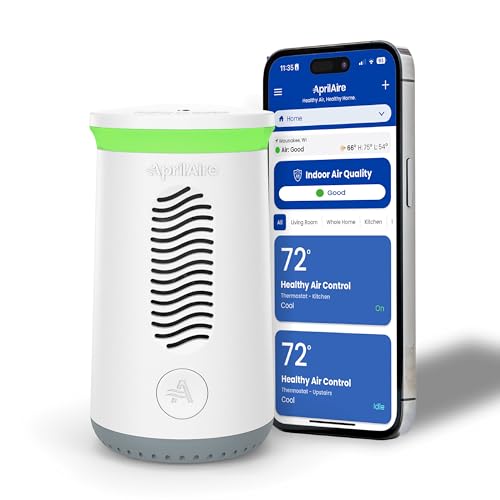
- Tracks CO2, VOCs, PM2.5, humidity, and temperature
- App provides alerts, trends, and practical guidance
- Can integrate with select AprilAire systems
Best For: AprilAire-connected homes and app-based monitoring
Most Detailed Portable Pick
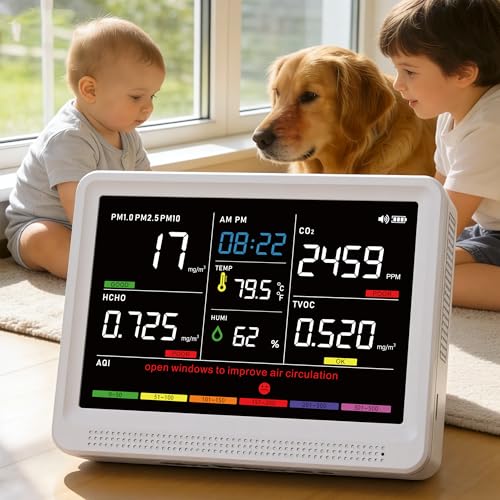
- Tracks CO2, particles, HCHO, TVOC, temperature, humidity, and AQI
- Seven AQI alerts with mute function
- 5.5-inch display and up to 10 hours of battery runtime
Best For: Portable, wide-ranging indoor air checks
Best Portable Wildfire Monitor
AirKnight AT1000 Air Quality Monitor
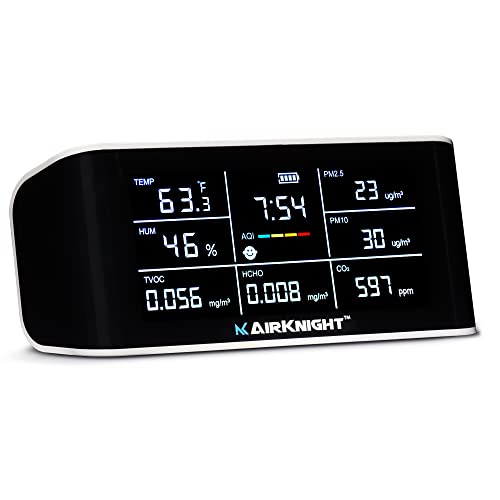
- Real-time CO2, PM2.5, PM10, TVOC, and HCHO readings
- 3000 mAh rechargeable battery
- Designed for home, school, work, car, and wildfire monitoring
Best For: Portable particulate and VOC monitoring
Best Large-Screen Pick
16-in-1 Monitor with 7-Inch Display

- Tracks gases, particles, temperature, humidity, and AQI
- Large 7-inch display with adjustable brightness
- Calibration support plus buzzer and mute functions
Best For: Easy-to-read stationary basement monitoring
Best Radon Coverage – Airthings View Plus
For basements where radon is a primary concern, the Airthings View Plus is one of the most comprehensive indoor air quality monitors for basements. It continuously tracks radon alongside PM2.5, CO2, VOCs, humidity, temperature, and air pressure, with readings available through the Airthings app.
Best For: Homeowners who want continuous radon monitoring and broad pollutant tracking in a basement.
Pros:
- Measures radon, PM2.5, CO2, VOCs, humidity, temperature, and air pressure.
- Battery-powered design supports cable-free placement, with an average battery life of up to two years.
- App notifications, historical trends, and cloud data help with long-term monitoring.
- Customizable eInk screen and optional five-year extended warranty.
Cons:
- Requires the Airthings app, an account, and internet access.
- Operating temperature is limited to 39–104°F.
The View Plus stands out when radon detection matters as much as everyday air-quality readings. Its connected app experience is more involved than a standalone display, but it provides useful long-term basement data.
Best Alexa Integration – Amazon Smart Air Quality Monitor
The Amazon Smart Air Quality Monitor is a straightforward choice for connected homes looking for indoor air quality monitors for basements. It measures PM2.5, VOCs, carbon monoxide, humidity, and temperature, then presents an air-quality score and notifications through the Alexa app.
Best For: Alexa users who want basement air-quality alerts and smart-home automation.
Pros:
- Tracks PM2.5, VOCs, carbon monoxide, humidity, and temperature.
- Color-coded LED and Alexa app score make readings easier to understand.
- Can send phone notifications or announcements through Echo devices.
- Supports Alexa routines for controlling compatible purifiers, dehumidifiers, and fans.
Cons:
- Does not measure radon.
- Its strongest automation features depend on an Alexa-enabled setup.
This monitor is appealing for households already using Alexa devices. It offers useful measurements and automation potential, but shoppers specifically concerned about basement radon will need a separate radon detector.
Best Long Battery Life – Temtop M10+
The Temtop M10+ is a compact option for shoppers comparing indoor air quality monitors for basements without wanting frequent charging. It measures CO2, PM2.5, TVOCs, temperature, and humidity, while its e-ink display and energy-efficient design provide up to 60 days of battery life.
Best For: Users who want portable, app-connected basement monitoring without relying on Wi-Fi.
Pros:
- Combines CO2, PM2.5, TVOCs, temperature, and humidity readings.
- Up to 60 days of battery life helps reduce charging frequency.
- Bluetooth connectivity supports close-range monitoring without Wi-Fi.
- App provides historical analysis, calibration, OTA updates, and hourly data logging.
Cons:
- Bluetooth monitoring requires staying within close range of the device.
- Does not measure radon or carbon monoxide.
- Its audible alarm may need to be muted for quieter spaces.
The M10+ is a flexible pick for checking basement ventilation and humidity from nearby. Its long battery life and Bluetooth option are practical, though it is not designed for remote radon or CO monitoring.
Best for Fast PM2.5 Updates – GoveeLife H5106
The wired GoveeLife H5106 is a focused option among indoor air quality monitors for basements, concentrating on PM2.5, temperature, and humidity. Its two-second refresh rate, LED air-quality indicator, and GoveeHome integrations make it useful for watching particulate changes and coordinating compatible devices.
Best For: Govee users who want fast PM2.5 updates and automated control of compatible appliances.
Pros:
- Refreshes PM2.5, temperature, and humidity data every two seconds.
- Offers stated PM2.5, temperature, and humidity accuracy specifications.
- Provides Bluetooth or Wi-Fi remote monitoring, graphs, and data export.
- Can connect with compatible GoveeLife purifiers, humidifiers, and heaters.
Cons:
- Requires continuous power through a Type-C cable and has no built-in battery.
- 2.4 GHz Wi-Fi is required for displaying the time.
- Does not measure radon, CO2, VOCs, or carbon monoxide.
The H5106 is best suited to basements where PM2.5 and moisture are the main priorities. Its wired design limits placement flexibility, but fast updates and Govee automation add convenience for compatible smart-home setups.
Best Large-Display Pick – 16-in-1 Air Quality Monitor
For shoppers comparing indoor air quality monitors for basements, this model stands out with a large 7-inch display and readings for CO2, particulate matter, formaldehyde, TVOC, temperature, humidity, and AQI. Its audible alerts and rechargeable design make it practical for checking basement conditions at a glance.
Best For: Homeowners who want broad pollutant coverage, a highly visible screen, and portable monitoring.
Pros:
- Tracks CO2, PM1.0, PM2.5, PM10, HCHO, TVOC, temperature, humidity, and AQI.
- 7-inch LED display offers a clear view with three brightness settings.
- Provides seven AQI alert functions and includes a mute button.
- Runs for up to 8 hours and charges through USB-C.
Cons:
- Its larger display may take up more space than compact monitors.
- Sensor accuracy can be affected by perfumes or strong odors.
- It does not list app connectivity or historical data features.
This is a feature-heavy choice for basements where you want immediate, easy-to-read information without relying on a phone app. The combination of wide pollutant coverage, alerts, and battery operation is especially useful for spot checks around storage, laundry, or workshop areas.
Best for Air-Quality Tracking – BREATHE Airmonitor Plus Gen 2
Among indoor air quality monitors for basements, the BREATHE Airmonitor Plus Gen 2 is a strong fit for users who want more than a live reading. It combines NDIR CO2 measurement with particle, TVOC, and formaldehyde sensing, while its app stores up to 90 days of history and supports data export.
Best For: Homeowners who want remote alerts, trend graphs, and longer-term basement air-quality analysis.
Pros:
- Monitors CO2, PM1, PM2.5, PM10, TVOC, formaldehyde, temperature, and humidity.
- Offers 90-day app history, graphs, and CSV data export.
- Uses NDIR CO2 measurement and laser particle sensing.
- Supports configurable CO2 and PM2.5 alerts through the app.
Cons:
- App connectivity requires a 2.4 GHz Wi-Fi network.
- Portable battery use lasts up to 6 hours.
- Its full smart-monitoring experience depends on the companion app.
This model makes the most sense when basement air changes need to be investigated over time. Historical readings can help connect spikes with ventilation, cleaning, occupancy, or other household activities, while USB-C power allows continuous operation.
Best Smart-Home Integration – AprilAire ZAWTHCPV Monitor
The AprilAire ZAWTHCPV is a smart option among indoor air quality monitors for basements, especially for households already using AprilAire equipment. It measures CO2, VOCs, TVOC, PM2.5, humidity, and temperature, then presents readings, trends, alerts, and guidance through the Healthy Air App.
Best For: AprilAire users who want app-based monitoring and a path toward coordinated ventilation or filtration control.
Pros:
- Monitors CO2, VOCs, TVOC, PM2.5, humidity, and temperature.
- Provides notifications, trends, and explanations through the Healthy Air App.
- Uses a simple color scheme for quick status checks.
- Offers three light options and carries a three-year manufacturer warranty.
Cons:
- Requires the AprilAire Healthy Air App to function.
- Uses corded electric power rather than a rechargeable battery.
- Healthy Air Mode integration requires a compatible AprilAire Wi-Fi thermostat sold separately.
This is a good choice for a connected basement setup where readings should lead to informed ventilation or filtration decisions. Its app-centered design is less suitable for shoppers seeking a standalone, battery-powered meter, but valuable within the broader AprilAire ecosystem.
Most Detailed Portable Pick – 16-in-1 Air Quality Monitor
For shoppers comparing indoor air quality monitors for basements, this YNAK model offers a broad set of readings in a portable format. It tracks CO2, particulate matter, HCHO, TVOC, temperature, humidity, and AQI on a 5.5-inch HD screen, making it useful for checking changing conditions in a basement or other indoor space.
Best For: Homeowners who want extensive readings, audible AQI alerts, and battery-powered portability.
Pros:
- Monitors CO2, PM1.0, PM2.5, PM10, HCHO, TVOC, temperature, humidity, and AQI.
- Provides seven AQI alert functions with a mute option.
- Offers a readable 5.5-inch display, adjustable brightness, USB-C charging, and up to 10 hours of runtime.
Cons:
- The manufacturer advises avoiding perfumes and strong odors around the sensors.
- Its 5.5-inch display is smaller than the 7-inch screen on some competing models.
This is a versatile choice when you want to move the monitor between a basement, bedroom, vehicle, or other indoor area. Its extensive measurements and portable design are particularly practical for spot-checking air conditions.
Best Portable Wildfire Monitor – AirKnight AT1000 Air Quality Monitor
For indoor air quality monitors for basements, the AirKnight AT1000 focuses on real-time readings in a compact, rechargeable design. It displays CO2, PM2.5, PM10, TVOC, HCHO, and other measurements on one LCD screen, helping you monitor particulate and volatile-compound changes in a basement or throughout the home.
Best For: Users who prioritize portability, rechargeable operation, and monitoring particulate matter during wildfire conditions.
Pros:
- Measures CO2, PM2.5, PM10, TVOC, HCHO, and additional air-quality factors in real time.
- Includes a 3000 mAh rechargeable lithium-polymer battery for moving around the home or taking it in a car.
- Includes an instructional video, user manual, and access to US-based customer support.
Cons:
- The supplied notes do not specify an audible alert function.
- Its screen and listed measurements are less extensive than the 16-in-1 alternatives in this roundup.
The AT1000 is a practical portable option for checking basement air and responding to elevated particulate or VOC readings. Its rechargeable battery is useful when you want to compare conditions in multiple rooms.
Best Large-Screen Pick – 16-in-1 Monitor with 7-Inch Display
Among indoor air quality monitors for basements, this model stands out for its large 7-inch full-view display. It tracks CO2, PM1.0, PM2.5, PM10, HCHO, TVOC, temperature, humidity, and AQI, so basement readings are easy to review from across a room.
Best For: Users who want a large, glanceable display with adjustable brightness and real-time alerts.
Pros:
- Monitors a broad range of gases, particles, temperature, humidity, and AQI measurements.
- The 7-inch display presents readings at a glance and supports adjustable brightness.
- Offers calibration support, real-time alerts, a buzzer, and a mute function.
Cons:
- At 1.47 pounds, it is heavier than the compact AirKnight monitor listed here.
- The supplied notes do not mention battery runtime or charging details.
This monitor is a strong fit for a basement where readability matters more than maximum portability. Its large display, calibration support, and alert functions make ongoing monitoring straightforward.
How We Picked the Best Indoor Air Quality Monitors for Basements
We focused on the measurements most useful in below-grade spaces: radon, carbon dioxide, particulate matter, volatile organic compounds, temperature, and relative humidity. We also considered sensor technology, display readability, app support, alert options, power requirements, portability, and how easily each monitor can support ongoing troubleshooting.
Because no single consumer monitor measures every pollutant with laboratory-level accuracy, we prioritized products with clearly defined sensor lists and practical real-time feedback. A monitor can identify trends, but it should not replace a certified radon test, carbon monoxide alarm, mold inspection, or professional remediation when readings are concerning.
Quick Comparison
| Best For | Look For |
|---|---|
| Radon-focused monitoring | Airthings View Plus and a clear placement plan |
| Alexa or app-based alerts | Wi-Fi compatibility and reliable cloud notifications |
| Portable spot checks | Battery power, compact design, and a readable screen |
| Broad pollutant coverage | PM, CO2, VOC or TVOC, temperature, and humidity sensors |
| At-a-glance viewing | A large display with visible trend or threshold indicators |
Key Buying Factors for Indoor Air Quality Monitors for Basements
Radon Detection
Radon is a major basement concern because it can enter through soil and foundation openings. If radon is a priority, choose a monitor that specifically includes radon measurement rather than assuming a general AQI reading covers it. Follow the manufacturer’s placement and averaging guidance, and confirm elevated results with an appropriate follow-up test.
Humidity and Temperature
Relative humidity is essential for spotting conditions that encourage condensation and mold growth. Place the monitor away from a dehumidifier outlet, HVAC vent, exterior wall, window, or direct sunlight. A useful target is often around 30% to 50% relative humidity, though the best range depends on the building and season.
CO2, Particles, and VOCs
CO2 is mainly a ventilation indicator, while PM2.5 and PM10 can reflect dust, combustion, or outdoor infiltration. VOC and formaldehyde readings may help identify changes after cleaning, painting, furnishing, or storage activities. Check whether a listed sensor is a true measurement sensor or an estimated index.
Connectivity and Power
Wi-Fi models are convenient for remote alerts, but they may require an outlet and a stable network. Battery models are easier to position and useful during investigations, though battery life and update frequency matter. A bright local display is valuable when the basement has weak phone or Wi-Fi access.
Who Should Buy Which Indoor Air Quality Monitors for Basements?
Choose the Airthings View Plus when radon monitoring is the central concern and you also want broader environmental readings. The Amazon Smart Air Quality Monitor suits Alexa households that prefer simple app-based status checks. Temtop and Govee options are practical for users who want portable or straightforward readings without a complex installation.
Consider BREATHE, AprilAire, AirKnight, or one of the large-screen 16-in-1 models when you want wider pollutant coverage or an easy-to-read display. Before buying, verify the exact sensor list, calibration guidance, alert thresholds, and whether the device reports measurements continuously or only provides an index.