Indoor air can change quickly when windows stay closed, cooking adds pollutants, or ventilation falls short. The right monitor helps you spot those changes and respond before stale or polluted air becomes a daily problem.
We compared 10 indoor air quality monitors with remote monitoring across sensor coverage, app access, display design, smart-home compatibility, and practical home use. This guide highlights which features matter most and which type of monitor best fits your space.
Best 10 Indoor Air Quality Monitors with Remote Monitoring Picks for 2026
Best Radon Coverage

- Tracks radon alongside PM2.5, CO2, VOCs, and climate data
- Wi-Fi app supports remote readings, alerts, and trends
- Battery-powered with an eInk display
Best For: Homes prioritizing radon detection and broad air-quality coverage
Best Remote Data Tools

- Measures six common indoor air-quality indicators
- Offers remote app access, alerts, and data export
- Selectable logging intervals and rechargeable battery
Best For: Trend tracking and customizable remote monitoring
Best Open-Source Integration
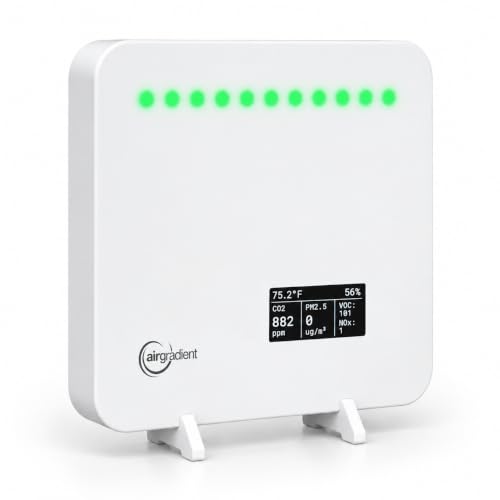
- Measures particles, gases, CO2, and climate conditions
- Includes free dashboard, API, and mobile app access
- Works with Home Assistant and supports local control
Best For: Technical users building flexible smart-home air monitoring
Best Formaldehyde Tracking

- Tracks formaldehyde, TVOC, CO2, and three particle sizes
- Provides remote alerts, 90-day history, and CSV export
- Rechargeable and portable for up to six hours
Best For: Detailed household pollutant tracking with formaldehyde monitoring
Best Wall-Mounted Option

- NDIR CO2, temperature, and humidity monitoring
- 10-inch auto-brightness display
- Wi-Fi app with remote alerts and history
Best For: Home and office CO2 monitoring with flexible installation
Best Professional Networked Monitor

- Monitors 12 air-quality and environmental parameters
- Cloud alerts, trends, and report exports
- Wi-Fi, Ethernet, PoE, and API integrations
Best For: Offices, schools, and smart-building air-quality programs
Best for Multi-Room Expansion
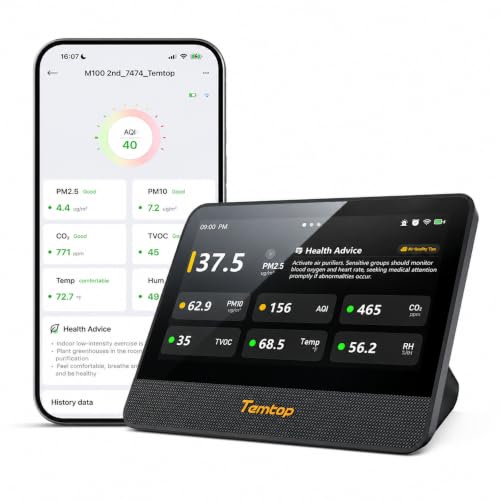
- Seven readings including PM, CO2, TVOC, and AQI
- Wi-Fi app with remote management and notifications
- Optional LoRa network coverage up to 1,000 meters
Best For: Homes, offices, and facilities planning multi-room monitoring
Best Portable Choice
AirKnight AT1000 10-in-1 Monitor
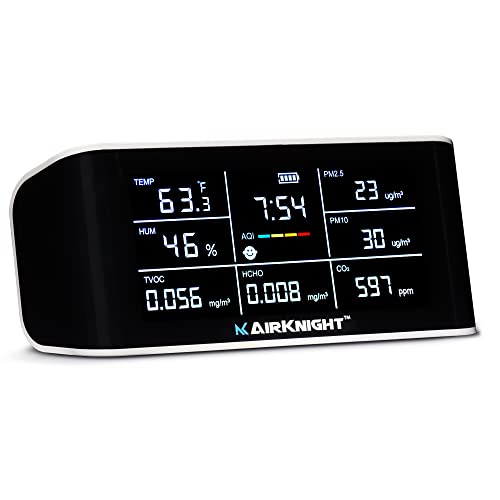
- Measures CO2, PM2.5, PM10, TVOC, formaldehyde, and more
- Large LCD shows real-time readings
- Rechargeable 3000 mAh battery for portable use
Best For: Portable, broad-spectrum pollutant monitoring
Best Remote Monitoring
ALAZUR Smart WiFi Air Quality Monitor

- Remote app access over 2.4GHz and 5GHz Wi-Fi
- Custom alerts via app, email, and SMS
- Historical trends, exports, and multi-device management
Best For: Connected homes and multi-location monitoring
Best Smart-Home Display

- Measures seven metrics, including PM2.5, PM10, CO2, and TVOC
- 4-inch touchscreen with color-coded indicators
- Remote app access and 30-day data export
Best For: Bedrooms and smart-home users wanting a detailed display
Best Radon Coverage – View Plus
For shoppers comparing indoor air quality monitors with remote monitoring, the Airthings View Plus stands out by combining radon detection with everyday air-quality tracking. Its Wi-Fi connection and Airthings app provide live readings, notifications, and trend analysis for radon, PM2.5, CO2, VOCs, humidity, temperature, and pressure.
Best For: Homes that want broad pollutant coverage with dedicated radon monitoring and cable-free placement.
Pros:
- Measures radon, PM2.5, CO2, VOCs, humidity, temperature, and air pressure.
- Remote access, cloud-based history, notifications, and trend analysis through the app.
- Battery-powered design with an eInk display and up to two years of stated battery life.
- Optional free registration extends the warranty to five years.
Cons:
- The Airthings app, account, and internet access are required for operation and cloud tracking.
- Its operating temperature range is limited to 39–104°F.
The View Plus is a strong choice when radon is a priority rather than an afterthought. It offers convenient remote monitoring, though buyers should be comfortable relying on the Airthings app and cloud service.
Best Remote Data Tools – Temtop M10+ WiFi
The Temtop M10+ WiFi is a practical pick among indoor air quality monitors with remote monitoring for users who want adjustable logging and usable historical data. It measures PM2.5, CO2, TVOC, AQI, temperature, and humidity, while its app supports remote readings, threshold alerts, push notifications, and data export.
Best For: Users who want customizable logging intervals, trend charts, and exportable records from a rechargeable monitor.
Pros:
- Six-in-one monitoring covers PM2.5, CO2, TVOC, AQI, temperature, and humidity.
- 2.4GHz Wi-Fi and the Temtop app enable remote access and customizable alerts.
- Records data at selectable 1-, 5-, 10-, or 30-minute intervals and supports export.
- E-ink display, audible alarm, and rechargeable battery with up to 40 days in power-saving mode.
Cons:
- Remote access requires Bluetooth setup and a 2.4GHz Wi-Fi connection.
- It does not include radon or formaldehyde measurements.
Choose the M10+ WiFi if data logging and remote controls matter as much as live readings. Its flexible recording options are especially useful for identifying patterns over time.
Best Open-Source Integration – AirGradient ONE
The AirGradient ONE is a strong option for shoppers seeking indoor air quality monitors with remote monitoring and smart-home flexibility. It measures PM2.5, CO2, TVOCs, NOx, temperature, and humidity, with subscription-free dashboard and app access, a free API, and support for Home Assistant and other integrations.
Best For: Home-automation users, technical buyers, and organizations wanting open-source flexibility without a dashboard subscription.
Pros:
- Uses dedicated sensor modules for PM2.5, CO2, TVOC, NOx, temperature, and humidity.
- Includes a subscription-free dashboard, free API access, and iOS and Android app support.
- Works with Home Assistant and supports local control, self-hosting, and community integrations.
- Provides an OLED display, color LED bar, wall-mounting option, and test report.
Cons:
- It requires USB-C power rather than offering battery-powered operation.
- The open-source and integration features may be more involved than needed for simple monitoring.
The AirGradient ONE is compelling for buyers who want remote visibility without being locked into a proprietary ecosystem. Its combination of documented sensor hardware and open integrations makes it particularly adaptable.
Best Formaldehyde Tracking – BREATHE Airmonitor Plus
The BREATHE Airmonitor Plus Gen 2 is designed for shoppers comparing indoor air quality monitors with remote monitoring and detailed pollutant coverage. It tracks CO2, PM1, PM2.5, PM10, TVOC, formaldehyde, temperature, and humidity, while its app adds remote readings, alerts, 90-day history, and CSV export.
Best For: Homes, offices, and classrooms that want formaldehyde and multiple particle-size readings alongside remote app access.
Pros:
- Eight-in-one monitoring includes formaldehyde, TVOC, CO2, PM1, PM2.5, PM10, temperature, and humidity.
- 2.4GHz Wi-Fi app supports remote readings, configurable alerts, historical graphs, and data export.
- Offers up to 90 days of app history for reviewing changes from cooking, cleaning, occupancy, or ventilation.
- Color display and rechargeable battery support portable use for up to six hours.
Cons:
- Portable battery operation is limited to up to six hours.
- Remote features depend on 2.4GHz Wi-Fi and the Breathe Tech app.
This model is a good fit when chemical pollutants and particle sizes deserve equal attention. Its formaldehyde measurement, long app history, and export tools give it a broader analysis feature set than a basic CO2 monitor.
Best Wall-Mounted Option – Virtue Sensor PV1000
For shoppers seeking indoor air quality monitors with remote monitoring, the Virtue Sensor PV1000 combines Wi-Fi app access with a large, easy-to-read display. Its NDIR CO2 sensor tracks carbon dioxide, temperature, and humidity, while remote alerts and historical records help you respond when ventilation is needed.
Best For: Homes, bedrooms, offices, classrooms, and other spaces needing straightforward CO2-focused monitoring with flexible placement.
Pros:
- NDIR CO2 sensing covers 400–5,000 ppm with 1 ppm sensitivity.
- 10-inch display refreshes data every second and automatically adjusts brightness.
- Wi-Fi app supports remote readings, historical data, and alerts.
- Can sit on a desk or mount on a wall.
Cons:
- Measures CO2, temperature, and humidity rather than a broad range of pollutants.
- Requires a connected power source because it has no internal battery.
The PV1000 is a practical choice when visibility and remote CO2 awareness matter more than extensive pollutant coverage. Its large screen and customizable alarm threshold make everyday ventilation decisions simple.
Best Professional Networked Monitor – Atmocube 12-in-1
The Atmocube is designed for buyers who need indoor air quality monitors with remote monitoring across multiple rooms or a larger facility. It measures 12 parameters, provides cloud dashboards and alerts, and supports Wi-Fi, Ethernet, PoE, and professional building-system integrations.
Best For: Offices, schools, healthcare environments, professional HVAC projects, and smart-building deployments requiring detailed pollutant data.
Pros:
- Tracks CO2, particulate matter, formaldehyde, TVOC, NO2, ozone, noise, light, and additional environmental readings.
- 24/7 cloud access includes push notifications, historical trends, and report exports.
- Included wireless E-Ink display is battery-powered and can be placed separately from the main unit.
- Supports Wi-Fi, Ethernet, PoE, MQTT, Modbus, REST API, and building automation connections.
Cons:
- The professional feature set may be more than needed for basic home monitoring.
- Integration options may require compatible building systems or technical setup.
Atmocube stands out for broad pollutant coverage and facility-level connectivity. It is the strongest fit here for users who need actionable trends, remote alerts, and integration beyond a single consumer app.
Best for Multi-Room Expansion – Temtop M100 2nd Gen
The Temtop M100 2nd Gen suits shoppers comparing indoor air quality monitors with remote monitoring and room-to-room expansion. It measures seven key indicators, connects to the Temtop app over 2.4 GHz Wi-Fi, and can use optional LoRa sub-units to extend coverage across larger homes or buildings.
Best For: Home offices, schools, HVAC inspections, and users who want portable monitoring with the option to build a multi-room network.
Pros:
- Tracks PM2.5, PM10, CO2, TVOC, temperature, humidity, and AQI.
- 7-inch touchscreen provides graphs, maximum/minimum values, and weather forecasts.
- Wi-Fi app offers live data, notifications, remote device management, and data logging.
- Optional LoRa sub-units can extend monitoring coverage up to 1,000 meters.
Cons:
- LoRa expansion units are sold separately.
- The 4,000mAh battery provides over eight hours of use, so extended portable operation requires recharging.
- Uses 2.4 GHz Wi-Fi for app connectivity.
The M100 2nd Gen offers a useful balance of pollutant coverage, visualization, portability, and expansion. Its adjustable alarms and manual calibration controls are especially helpful for users who want more hands-on monitoring.
Best Portable Choice – AirKnight AT1000 10-in-1 Monitor
If you want indoor air quality monitors with remote monitoring but also need a unit you can move from room to room, the AirKnight AT1000 is a versatile option. It provides real-time readings for CO2, PM2.5, PM10, TVOC, formaldehyde, temperature, humidity, and other air-quality measures on a large LCD screen.
Best For: Households that want broad pollutant coverage and a rechargeable monitor for use around the home, workplace, school, or car.
Pros:
- Tracks CO2, PM2.5, PM10, TVOC, formaldehyde, temperature, humidity, and more.
- Displays readings in real time on one easy-to-read LCD screen.
- Rechargeable 3000 mAh battery supports portable use.
- Includes an instructional video, manual, and US-based customer support.
Cons:
- The supplied information does not indicate Wi-Fi, app, or remote-access functionality.
- A broad set of measurements may be more than casual users need.
The AirKnight stands out for portability and its wide range of detected pollutants. Choose it when on-device readings and formaldehyde monitoring matter more than app-based remote access.
Best Remote Monitoring – ALAZUR Smart WiFi Air Quality Monitor
The ALAZUR DMS03 is a strong fit for shoppers seeking indoor air quality monitors with remote monitoring. Its Wi-Fi connection and app let you check readings from virtually anywhere, set alerts, review historical trends, export reports, and manage multiple monitors across different locations.
Best For: Homes, offices, classrooms, bedrooms, and vacation properties where app access, alerts, and multi-location monitoring are priorities.
Pros:
- Tracks CO2, temperature, humidity, TVOC, and air pressure.
- Supports 2.4GHz and 5GHz Wi-Fi for remote app access.
- Offers customizable notifications through the app, email, SMS, and on-screen indicators.
- Provides historical trends, report export, shared access, and multi-device management.
Cons:
- The supplied sensor list does not include PM2.5, PM10, or formaldehyde detection.
- Daily use and extended backup monitoring are recommended with the device plugged in.
- The sensor may need 20–30 minutes to adapt after placement.
With its E-Ink display and comprehensive app features, the ALAZUR is the most remote-monitoring-focused option here. It is especially useful when you want alerts and long-term data rather than only a local readout.
Best Smart-Home Display – Qingping Air Monitor Gen 2
The Qingping Air Quality Monitor Gen 2 combines a clear touchscreen with app-based access, making it a practical choice among indoor air quality monitors with remote monitoring. It measures seven metrics, including CO2, particulate matter, TVOC, noise, temperature, and humidity, while also functioning as an alarm clock.
Best For: Bedrooms and smart-home users who want an attractive local display, remote readings, historical data, and replaceable PM sensor hardware.
Pros:
- Monitors temperature, humidity, CO2, PM2.5, PM10, eTVOC, and noise.
- 4-inch IPS touchscreen includes adjustable brightness and color indicators.
- Qingping+ app supports remote viewing and export of 30 days of historical data.
- Replaceable PM sensor can simplify future maintenance.
Cons:
- It does not measure formaldehyde.
- Daily use requires USB power; battery operation lasts up to three hours after charging.
- A USB power adapter is not included.
The Qingping is a well-rounded choice for users who value both at-a-glance readings and app connectivity. Its replaceable PM sensor is a useful long-term maintenance advantage, but shoppers needing formaldehyde detection should consider another model.
How We Picked the Best Indoor Air Quality Monitors with Remote Monitoring
We focused on monitors that provide remote access through Wi-Fi, an app, or a connected smart-home platform. We compared the range of sensors, including CO2, PM2.5, PM10, VOCs, formaldehyde, radon, temperature, humidity, pressure, and noise. We also considered display readability, alert options, power requirements, data history, calibration needs, and compatibility with systems such as Home Assistant.
Sensor count alone does not determine value. A monitor is more useful when its readings are easy to understand, alerts are dependable, and the device fits the room where it will be used.
Quick Comparison
- Best for broad household coverage: Choose a model measuring CO2, particulate matter, VOCs, temperature, and humidity.
- Best for radon awareness: Look for a dedicated radon sensor, such as those included in specialized Airthings models.
- Best for smart-home users: Prioritize documented integrations, local data access, and compatibility with your preferred platform.
- Best for visual monitoring: A built-in screen or wireless E-Ink display makes room-side checks easier.
- Best for remote alerts: Confirm that the app supports notifications, historical graphs, and multiple locations before buying.
Key Buying Factors for Indoor Air Quality Monitors with Remote Monitoring
Sensor Coverage
CO2 is a useful indicator of ventilation, while PM2.5 and PM10 help identify fine and coarse particles from cooking, smoke, dust, and outdoor pollution. VOC and formaldehyde sensors may provide additional context, but their readings can be affected by household products and should not be treated as laboratory measurements. Humidity and temperature readings are valuable for comfort, condensation control, and mold-risk management.
Remote Access and Alerts
Check whether remote monitoring requires a 2.4 GHz network, a manufacturer cloud account, or a subscription. Useful apps should show current readings, trends, device status, and configurable thresholds. Push alerts are especially helpful for high CO2 overnight, rising particles during cooking, or unusual changes while you are away.
Power, Placement, and Accuracy
Battery-powered monitors are easier to move but may update less frequently or require regular charging. Plug-in units often support continuous monitoring and brighter displays. Place the monitor away from windows, vents, direct sunlight, kitchens, and air purifiers unless you are specifically testing those conditions. Follow the manufacturer’s calibration guidance and allow sensors to stabilize after setup.
Who Should Buy Which Indoor Air Quality Monitors with Remote Monitoring?
Families, home-office users, and anyone managing poor ventilation should prioritize CO2 tracking and dependable app alerts. Allergy and smoke-sensitive households should emphasize PM2.5 and PM10 detection. Smart-home enthusiasts should choose a monitor with clear integrations and accessible data. Renters or users who move between rooms may prefer a compact battery model, while those monitoring a nursery, bedroom, or office continuously may benefit from a dedicated display and wall or desk placement.
If you need medical, occupational, or regulatory-grade measurements, use professional testing equipment rather than relying solely on a consumer monitor. For everyday awareness, however, the best choice is the model that measures the pollutants most relevant to your home and makes the data easy to act on.