Indoor air can change quickly with cooking, cleaning, poor ventilation, wildfire smoke, and everyday occupancy. The right monitor helps you see those changes and decide when to ventilate, filter, or adjust humidity.
We compare 10 high-accuracy indoor air quality monitors across essential measurements, connectivity, display options, portability, and smart-home compatibility so you can choose a model that fits your space and priorities.
Best 10 High-Accuracy Indoor Air Quality Monitors Picks for 2026
Best for CO2-Focused Monitoring
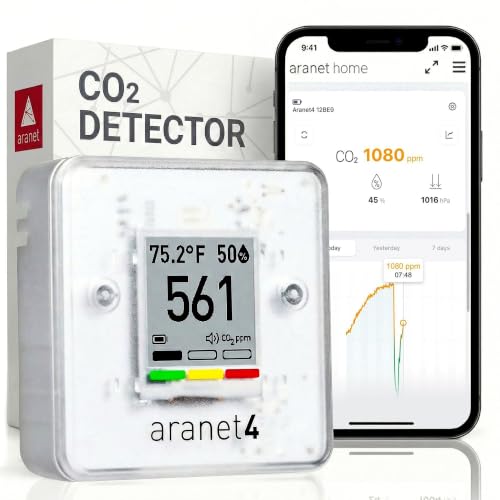
- Precise NDIR CO2 sensor
- Up to four years of battery life
- 90 days of app history
Best For: Cable-free CO2 and ventilation monitoring
Best Multifunction Value

- Measures CO2, PM2.5, and TVOCs
- Bluetooth app with hourly logging
- Up to 60 days of battery life
Best For: Broad, close-range monitoring in bedrooms and offices
Best for Air Quality Scoring

- Tracks particles, gases, and climate data
- Simple 0–100 indoor air score
- App alerts and smart-home integrations
Best For: Connected homes wanting clear trends and alerts
Best Portable Six-in-One Monitor

- Measures CO2, PM2.5, and PM10
- Three-level AQI display and alarm
- Desktop or wall-mount placement
Best For: Portable monitoring across rooms, cars, and grow tents
Best Large-Screen Pick

- Measures particles, gases, CO2, and comfort conditions
- Large seven-inch HD display
- Seven alerts and up to eight hours of runtime
Best For: Home users who prioritize readable, comprehensive monitoring
Best Connected Accuracy Pick
AirGradient ONE Indoor Monitor
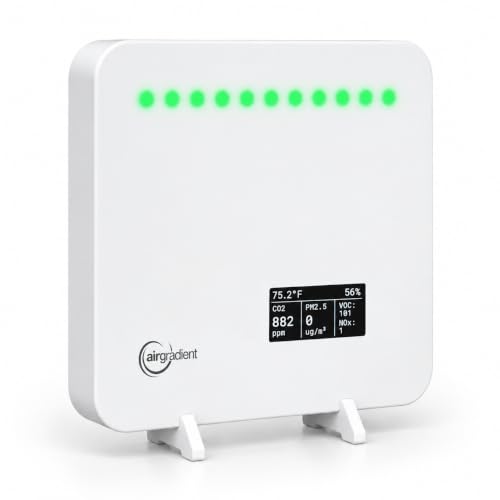
- Named sensors for PM2.5, CO2, TVOC, and NOx
- Individual PM2.5 calibration with test report
- Home Assistant and open-source support
Best For: Technical users building connected indoor-air monitoring
Best Portable Value Pick
16-in-1 Color-Screen Air Monitor

- Covers particles, CO2, gases, temperature, and humidity
- Refreshes readings every 1.5 seconds
- Compact design with simple controls
Best For: Portable air checks around rooms, offices, and vehicles
Best for Bedrooms

- Tracks CO2, VOCs, humidity, temperature, and pressure
- Adds noise and light monitoring for sleep-focused use
- Battery-powered with app-based readings and trends
Best For: Bedrooms and home offices focused on ventilation, sleep, and concentration
Best for Portable Multi-Parameter Tracking
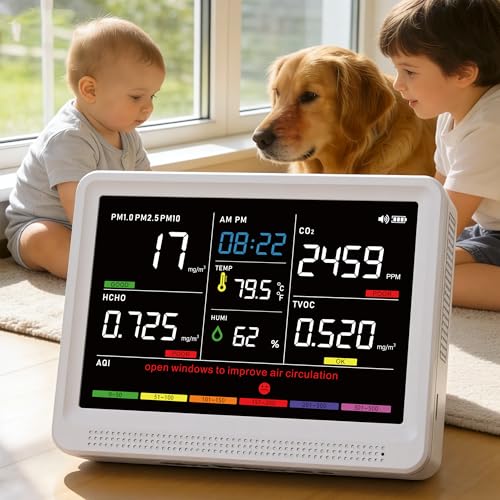
- Measures CO2, particulates, HCHO, TVOC, and comfort data
- Uses a 5.5-inch HD display with seven AQI alerts
- Offers USB-C charging and up to 10 hours of runtime
Best For: Portable monitoring across bedrooms, offices, vehicles, and other indoor spaces
Best for Large-Display Monitoring
YNAK 7-Inch Air Quality Monitor

- Tracks particulates, gases, CO2, comfort data, and AQI
- Uses a large 7-inch display with three brightness settings
- Includes alerts, USB-C charging, and up to 8 hours of runtime
Best For: Home and office users who prioritize highly visible readings
Best for CO2-Focused Monitoring – Aranet4
The Aranet4 is a practical choice among high-accuracy indoor air quality monitors when dependable CO2 tracking is your priority. Its NDIR sensor measures CO2 alongside temperature, relative humidity, and atmospheric pressure, while the color-coded display makes ventilation decisions easy.
Best For: Homes, offices, and users who want long-term, cable-free CO2 monitoring.
Pros:
- NDIR technology provides precise, reliable CO2 measurements.
- Wireless e-ink display offers up to four years of battery life.
- App stores and graphs up to 90 days of historical data.
- Color coding and an optional buzzer provide clear high-CO2 alerts.
Cons:
- Its listed measurements focus on CO2, temperature, humidity, and pressure rather than particulate matter or VOCs.
- Requires two AA batteries, even though they are included.
Choose the Aranet4 if you want a simple, low-maintenance monitor centered on accurate CO2 readings and ventilation awareness. It is less suited to shoppers seeking broad pollutant coverage.
Best Multifunction Value – Temtop M10+
The Temtop M10+ is a versatile pick among high-accuracy indoor air quality monitors, combining CO2, PM2.5, TVOCs, temperature, and humidity readings in one compact unit. Bluetooth app access, hourly logging, and a muted alarm make it useful for ongoing monitoring without Wi-Fi.
Best For: Bedrooms, nurseries, home offices, and users who want several indoor readings in one device.
Pros:
- Tracks CO2, PM2.5, TVOCs, temperature, humidity, and AQI.
- Bluetooth app supports live data, historical analysis, calibration, and OTA updates.
- Energy-efficient e-ink display provides up to 60 days of battery life.
- Alarm can be muted for quieter bedroom or nursery monitoring.
Cons:
- Bluetooth close-range monitoring requires you to stay nearby.
- Its 60-day battery life is shorter than the multi-year life listed for some simpler monitors.
The M10+ stands out when broad indoor coverage matters more than a minimal feature set. Its Bluetooth approach avoids network setup, though it is not designed for unrestricted remote monitoring.
Best for Air Quality Scoring – RuuviAir
RuuviAir offers a broad, easy-to-interpret approach to high-accuracy indoor air quality monitors. It measures CO2, PM2.5, VOC and NOx indexes, temperature, humidity, and pressure, then combines CO2 and fine-particle data into a 0–100 Indoor Air Quality Score.
Best For: Users who want app-based trends, alerts, and a quick overall air quality rating.
Pros:
- Monitors CO2, PM2.5, VOC index, NOx index, temperature, humidity, and pressure.
- Its 0–100 score makes air quality changes easy to understand.
- App provides live readings, trends, alerts, and practical suggestions.
- Works with Victron Energy, Home Assistant, and Homey, with remote access through Ruuvi Gateway.
Cons:
- Requires USB-C power rather than battery operation.
- Remote monitoring requires the separately mentioned Ruuvi Gateway.
RuuviAir is a strong fit for connected homes and readers who prefer a simplified score alongside detailed measurements. Plan for a nearby USB-C power source and additional equipment if remote access is important.
Best Portable Six-in-One Monitor – INKBIRDPLUS NDIR
The INKBIRDPLUS NDIR is a portable option among high-accuracy indoor air quality monitors, measuring CO2, PM2.5, PM10, AQI, temperature, and humidity. Its color screen, automatic CO2 calibration function, and desktop-or-wall placement support make it easy to use in different indoor spaces.
Best For: Bedrooms, living rooms, basements, cars, and grow tents where portable six-in-one readings are useful.
Pros:
- Combines CO2, PM2.5, PM10, AQI, temperature, and humidity monitoring.
- Color LED screen displays readings clearly along with time and date.
- Three AQI levels provide normal, warning, and hazard guidance.
- Can sit on a desktop or hang on a wall.
Cons:
- The supplied details do not specify battery runtime or app connectivity.
- Its audible alert sounds when AQI exceeds 100, which may not suit noise-sensitive spaces.
This model makes sense for shoppers who want a broad set of readings and a straightforward visual alert system without relying on an app. Its portable design also makes it practical for moving between rooms or other enclosed locations.
Best Large-Screen Pick – bonoch AirSentry 16-in-1
For shoppers comparing high-accuracy indoor air quality monitors, the bonoch AirSentry stands out for its large display, broad pollutant coverage, and portable design. It tracks particulate matter, CO2, formaldehyde, TVOC, temperature, humidity, and AQI in real time, with external sensors designed for detailed readings.
Best For: Homes, bedrooms, offices, and users who want easy-to-read readings on a large screen.
Pros:
- Tracks PM1.0, PM2.5, PM10, CO2, HCHO, TVOC, temperature, humidity, and AQI.
- Seven-inch HD display offers a clear view without navigating menus.
- Seven configurable warning alarms provide alerts for major readings.
- USB-C charging and up to eight hours of runtime support portable use.
Cons:
- Its larger display makes it less compact than simpler handheld monitors.
- Sensor accuracy can be affected by perfumes or strong odors, according to the product notes.
The bonoch is a practical choice when visibility and broad measurements matter most. Its large screen, alerts, and rechargeable design make it especially convenient for routine monitoring across multiple indoor spaces.
Best Connected Accuracy Pick – AirGradient ONE Indoor Monitor
The AirGradient ONE is a strong option for shoppers seeking high-accuracy indoor air quality monitors with documented sensor hardware and smart-home flexibility. It measures PM2.5, CO2, TVOC, NOx, temperature, and humidity, and includes individual calibration details and a digital test report.
Best For: Smart-home users, technical buyers, and anyone who wants open-source integrations or local control.
Pros:
- Uses named SenseAir, Plantower, Sensirion, and SHT40 sensor modules.
- Individually calibrated for PM2.5 and supplied with a digital test report.
- Works with Home Assistant and supports open-source hardware and firmware.
- Includes a subscription-free dashboard, free API access, and mobile app.
Cons:
- The 1.3-inch OLED display is much smaller than the screen on some standalone monitors.
- Its broader integration features may be more than casual users need.
AirGradient ONE is particularly compelling when measurement credentials and connectivity matter more than a large on-device display. Its calibrated PM2.5 monitoring, open platform, and local integration options make it a flexible long-term system.
Best Portable Value Pick – 16-in-1 Color-Screen Air Monitor
This 16-in-1 monitor suits shoppers who want high-accuracy indoor air quality monitors in a compact, straightforward format. Its sensor array updates readings every 1.5 seconds and covers particulate matter, CO2, TVOC, formaldehyde, temperature, and humidity on a color-coded HD screen.
Best For: Portable testing in bedrooms, offices, vehicles, and other indoor spaces.
Pros:
- Monitors PM1.0, PM2.5, PM10, CO2, TVOC, HCHO, temperature, and humidity.
- Updates air data every 1.5 seconds for continuous real-time viewing.
- Simple one-button operation and adjustable audio prompts are easy to use.
- Compact design, USB-C charging, and included adapter support flexible placement.
Cons:
- Battery runtime is limited to approximately four to five hours.
- The product notes describe a broad sensor array but do not provide named sensor components or a calibration report.
This model is a convenient everyday tester for buyers who value portability and simple operation. It provides broad coverage and quick updates, though users seeking documented calibration or smart-home connectivity may prefer a more specialized monitor.
Best for Bedrooms – Airthings Wave Enhance
For shoppers seeking high-accuracy indoor air quality monitors in a compact, cable-free design, the Airthings Wave Enhance focuses on everyday comfort indicators. It tracks CO2, VOCs, humidity, temperature, and air pressure, while also monitoring noise and light levels through the Airthings app.
Best For: Bedrooms and home offices where ventilation, sleep conditions, and concentration are priorities.
Pros:
- Monitors five core air-quality and comfort measurements continuously.
- Also tracks noise and light, which can help assess bedroom conditions.
- Battery-powered and easy to place without a cable.
- App provides notifications, current readings, and trend analysis.
Cons:
- Complete readings require the Airthings app rather than the device alone.
- Uses Bluetooth connectivity instead of a built-in Wi-Fi connection.
- Does not list particulate measurements such as PM2.5.
The Wave Enhance is a practical choice if CO2, VOCs, and bedroom comfort data matter more to you than particulate monitoring. Its understated, battery-powered design makes it especially convenient for bedside or desk placement.
Best for Portable Multi-Parameter Tracking – YNAK 16-in-1 Monitor
This YNAK model is aimed at shoppers comparing high-accuracy indoor air quality monitors with broad pollutant coverage and a readable display. It reports CO2, PM1.0, PM2.5, PM10, HCHO, TVOC, temperature, humidity, AQI, and time, with external sensors and a 5.5-inch HD screen.
Best For: Users who want detailed readings and alerts in bedrooms, offices, vehicles, or other indoor spaces.
Pros:
- Covers major particulate, gas, temperature, humidity, and AQI readings.
- Large 5.5-inch display shows information at a glance.
- Provides seven AQI alert functions with a mute option.
- USB-C charging and up to 10 hours of runtime support portable use.
Cons:
- Its “16-in-1” count combines nine detected parameters with seven alert types.
- Requires care around perfumes and strong odors to help maintain sensor accuracy.
- Battery runtime is limited to up to 10 hours per charge.
With particulate and gas measurements in addition to basic comfort data, this monitor offers broader coverage than a CO2-only device. The combination of a color screen, alerts, and portable charging makes it useful for checking changing conditions across several locations.
Best for Large-Display Monitoring – YNAK 7-Inch Air Quality Monitor
For buyers who want high-accuracy indoor air quality monitors with highly visible readings, this YNAK unit pairs the same broad measurement range with a 7-inch LED display. It monitors CO2, PM1.0, PM2.5, PM10, HCHO, TVOC, temperature, humidity, AQI, and time, while providing real-time alerts.
Best For: Home or office users who prefer a large, easy-to-read screen for continuous air-quality checks.
Pros:
- Displays particulate, gas, comfort, and AQI information in real time.
- 7-inch screen provides a clear view without navigating menus.
- Includes seven AQI alert functions and a mute option.
- Supports Fahrenheit/Celsius switching and USB-C charging.
Cons:
- The “16-in-1” description includes nine parameters plus seven alert types.
- Advertised battery runtime is up to 8 hours, shorter than the smaller-screen version.
- Its larger display may be less convenient for compact spaces or travel.
The 7-inch display is the main advantage here, making readings easier to see from across a room. Choose it over a smaller model when screen visibility is more important than minimizing the monitor’s footprint or maximizing battery runtime.
How We Picked the Best High-Accuracy Indoor Air Quality Monitors
We evaluated these monitors by looking at the sensors they use, the measurements they provide, ease of setup, display readability, data access, portability, and suitability for common rooms such as bedrooms, offices, nurseries, and grow tents. Carbon dioxide (CO₂) tracking received special attention because it is useful for judging ventilation, while particulate matter (PM2.5), VOC, temperature, and humidity readings add context for broader indoor-air decisions.
We also considered whether each monitor works independently, connects to a phone or wireless network, supports smart-home platforms, or is better suited to quick spot checks. A larger parameter count is not automatically better: sensor quality, calibration, update frequency, and clear presentation can matter more than the number of readings listed on the box.
Quick Comparison
- Best for simple CO₂ tracking: Choose a focused monitor with a clear display and straightforward alerts.
- Best for broad measurements: Multi-parameter models can track CO₂, PM2.5, VOCs, temperature, humidity, and related indicators.
- Best for wireless monitoring: Look for app access, remote dashboards, historical charts, and reliable network connectivity.
- Best for smart homes: Confirm compatibility with your preferred platform, such as Home Assistant, before buying.
- Best for portability: Battery-powered units are useful for comparing bedrooms, offices, classrooms, and other locations.
Key Buying Factors for High-Accuracy Indoor Air Quality Monitors
Sensor Coverage and Accuracy
Decide which measurements you genuinely need. CO₂ is valuable for ventilation decisions; PM2.5 matters for smoke and fine-particle exposure; VOC readings can reveal changes from cleaners, paints, and furnishings. Check whether the manufacturer explains sensor technology, calibration, expected accuracy, and operating limits.
Display, Alerts, and Data History
A bright real-time screen is convenient for quick checks, while app dashboards and historical graphs help identify patterns. Adjustable thresholds, audible or visual alerts, and exportable data are useful if you want to respond consistently rather than glance at readings occasionally.
Power and Connectivity
Battery operation improves placement flexibility but requires charging or replacement. Wired models may be better for continuous monitoring. For connected devices, review Wi-Fi or Bluetooth requirements, cloud dependence, privacy terms, and whether readings remain available during an internet outage.
Who Should Buy Which High-Accuracy Indoor Air Quality Monitors?
Choose a dedicated CO₂ monitor if your main goal is improving ventilation in a bedroom, office, classroom, or meeting space. Select a multi-sensor unit if you also want visibility into particles, VOCs, humidity, and temperature. Wireless models suit users who want remote notifications and long-term trends, while Home Assistant-compatible options are best for automation and local smart-home dashboards. If you need to compare several rooms, prioritize portability and battery life. For anyone managing allergies, smoke, or sensitive occupants, favor a monitor with PM2.5 measurement rather than relying on CO₂ alone.