Good classroom ventilation is easier to manage when teachers and facilities teams can see carbon dioxide levels as they change. The best monitors turn that information into clear, timely prompts to ventilate without requiring specialized expertise.
We selected 10 CO2 monitors with practical features for schools, including NDIR or photoacoustic sensing, audible alarms, humidity and temperature readings, historical data, portable designs, and connectivity. Use the guide below to match the right monitor to each classroom’s size, schedule, and oversight needs.
Best 10 Carbon Dioxide Monitors for Classrooms Picks for 2026
Best Portable Classroom Pick

- Measures CO2, temperature, and humidity
- Sensirion SCD41 sensor with five-second refresh
- Portable design with quiet alert options
Best For: Portable classroom and shared-room monitoring
Best for Trend Tracking
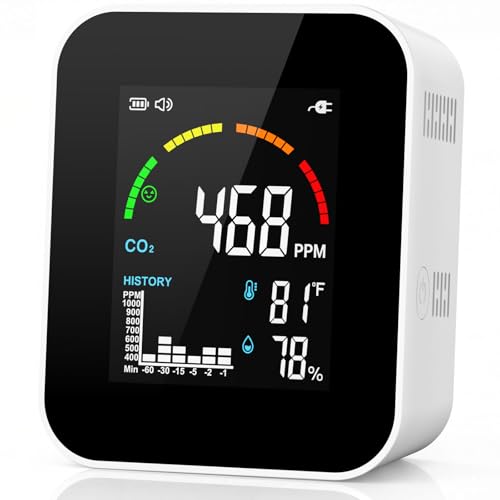
- Shows a 24-hour CO2 history bar chart
- NDIR sensor supports automatic and manual calibration
- Kid-friendly emoticons and 1000 ppm alarm
Best For: Classrooms reviewing daily ventilation patterns
Best Multi-Parameter Monitor
MT13 10-in-1 Air Quality Monitor

- Measures CO2 plus particles, gases, and climate data
- Color-coded display with 1.2-second sampling
- Up to 96 hours of battery monitoring
Best For: Classrooms needing broader indoor air data
Best Wall-Mountable Option
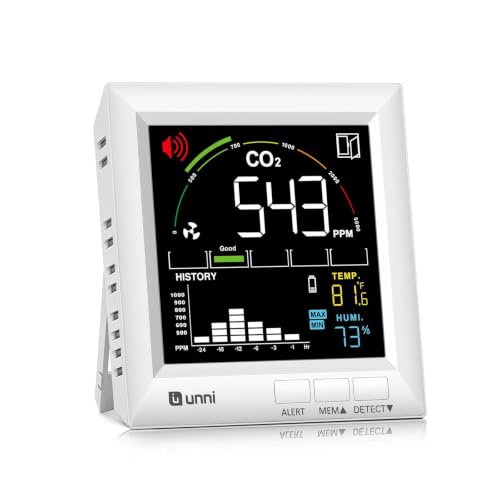
- Sensirion photoacoustic sensor
- Wall or tabletop placement with USB power
- History chart, adjustable alerts, and backlight
Best For: Permanent classroom CO2 displays
Feature-Rich Desktop Monitor

- Measures CO2, temperature, humidity, dew point, and wet bulb
- NDIR sensor with TWA, STEL, alarms, and 99-reading memory
- Desktop design includes AC adapter
Best For: Detailed, stationary classroom air-quality tracking
Portable Battery Monitor

- Displays CO2, AQI, temperature, and humidity
- Rechargeable 1,600mAh battery lasts up to 72 hours
- Bright LED screen supports quick visual checks
Best For: Portable monitoring between classrooms and offices
Handheld NDIR Monitor
Gain Express Portable CO2 Meter

- Measures CO2 up to 9,999 ppm with an NDIR sensor
- Includes temperature, humidity, dew point, and wet-bulb readings
- Handheld design with audible alarm and battery power
Best For: Room-to-room classroom ventilation surveys
Best Long-Term Classroom Monitor
Briidea Bluetooth CO2 Detector

- NDIR sensor tracks CO2 plus temperature and humidity
- Bluetooth app stores historical air-quality trends
- Up to four years of battery life with E-Ink display
Best For: Classrooms needing low-maintenance monitoring and ventilation history
Best Visual Classroom Alert

- Large display shows CO2, temperature, and humidity
- Six CO2 levels with optional voice reminders
- Supports USB or battery power and wall mounting
Best For: Classrooms needing prominent readings and ventilation prompts
Best Wide-Range Classroom Meter

- Measures CO2 across a 0–9,999 ppm range
- NDIR sensor with stated low-range accuracy
- Large backlit display and audible/visual alarms
Best For: Schools wanting broad-range readings and threshold alerts
Best Portable Classroom Pick – Temtop CO2 Monitor
For classrooms that need portable carbon dioxide monitors for classrooms, the Temtop combines CO2, temperature, and humidity readings in a compact device. Its photoacoustic sensor refreshes every five seconds, while customizable alerts help staff monitor ventilation without unnecessary disruption.
Best For: Teachers and school staff who want a portable, quiet monitor for classrooms, offices, or other shared rooms.
Pros:
- Measures CO2 from 400–5000 ppm, temperature, and humidity.
- Uses a Sensirion SCD41 photoacoustic sensor with 1 ppm resolution.
- Offers customizable audio and display settings, plus up to 70 days of standby.
- Compact design with versatile mounting options.
Cons:
- For the most current real-time readings, the manufacturer advises keeping it plugged in.
- It detects carbon dioxide, not carbon monoxide.
The Temtop is a practical choice when portability and low-distraction operation matter. Its combination of environmental readings and flexible alert controls makes it well suited to everyday classroom ventilation checks.
Best for Trend Tracking – YOWEXA NDIR CO2 Monitor
The YOWEXA is one of the more useful carbon dioxide monitors for classrooms when you want to see changes over the course of a school day. Its NDIR sensor, 24-hour history bar chart, and continuous USB-powered monitoring make ventilation patterns easier to review.
Best For: Classrooms where staff want visible CO2 trends, quick refreshes, and an easy-to-understand display.
Pros:
- Uses an NDIR sensor with automatic and manual calibration.
- Displays a 24-hour CO2 history bar chart.
- Measures every four seconds and refreshes the LCD every second in continuous mode.
- Includes emoticon indicators and an alarm at 1000 ppm or higher.
Cons:
- Continuous monitoring requires USB power and uses more energy.
- Unplugging switches it to a power-saving mode that is not intended for daily monitoring.
- Historical data is lost when the device is restarted.
This model stands out for its visual history display and kid-friendly indicators. Keep it connected to USB in a classroom for the most consistent monitoring and to avoid relying on its limited backup-battery mode.
Best Multi-Parameter Monitor – MT13 10-in-1 Air Quality Monitor
If your classroom air-quality needs extend beyond carbon dioxide monitors for classrooms, the MT13 adds particle, gas, temperature, and humidity readings. Its color-coded screen and rapid sampling make it easy to spot changes without connecting to Wi-Fi, Bluetooth, or an app.
Best For: Schools that want a broad indoor air snapshot covering CO2 alongside particles and other listed air-quality measurements.
Pros:
- Monitors PM0.3, PM2.5, PM10, CO2, CO, HCHO, TVOC, AQI, temperature, and humidity.
- Samples and processes readings every 1.2 seconds.
- Color-coded levels make changes easy to recognize at a glance.
- Rechargeable 2000mAh battery provides up to 96 hours of continuous monitoring.
Cons:
- Its broader feature set may be unnecessary if CO2 is the only measurement needed.
- The supplied notes specify tabletop mounting rather than wall mounting.
The MT13 is the most comprehensive option in this group for classrooms concerned with multiple indoor pollutants. Choose it when a single portable screen for several measurements is more valuable than a dedicated CO2-only monitor.
Best Wall-Mountable Option – U UNNI CO2 Monitor
The U UNNI offers a straightforward way to use carbon dioxide monitors for classrooms, with real-time CO2, temperature, humidity, and history information. Its photoacoustic sensor, wall-mounting option, and adjustable display make it suitable for a permanent classroom setup or tabletop use.
Best For: Classrooms wanting a dedicated CO2 display that can remain plugged in or be mounted on a wall.
Pros:
- Uses a Swiss-made Sensirion photoacoustic CO2 sensor.
- Shows real-time CO2, temperature, humidity, concentration history, and maximum/minimum data.
- Supports USB power with AAA battery backup and wall or tabletop placement.
- Offers three alarm-volume levels and three backlight settings.
Cons:
- AAA batteries are not included.
- The listed temperature range begins at 14.2°F, which may be more than a typical classroom needs.
- Calibration requires following a manual 400 ppm procedure.
This is a useful classroom choice for a visible, dedicated CO2 monitor with flexible placement. Its adjustable alarm and backlight settings can help balance awareness with minimal distraction during lessons.
Feature-Rich Desktop Monitor – Extech CO220
For classrooms needing more than basic carbon dioxide readings, the Extech CO220 is a desktop option that monitors CO2, temperature, humidity, dew point, and wet-bulb temperature. Its NDIR sensor, visual air-quality icons, alarms, and exposure calculations make it useful for ongoing indoor-air checks.
Best For: Classrooms that want a plugged-in desktop monitor with detailed environmental data and logged readings.
Pros:
- Measures CO2 from 0–9,999 ppm along with temperature and humidity.
- NDIR sensor, automatic baseline calibration, and six visual air-quality icons.
- Calculates 8-hour TWA and 15-minute STEL values.
- Stores up to 99 manually logged readings and includes an audible high/low alarm.
Cons:
- Designed for desktop use rather than portable, battery-powered monitoring.
- Requires access to an AC outlet because an AC adapter is included as the power source.
The CO220 is a strong choice when classroom staff need a fuller indoor-air snapshot and historical readings, though its desktop format is less convenient for moving between rooms.
Portable Battery Monitor – Dienmern 5-in-1 CO2 Detector
For classrooms that need flexible carbon dioxide monitoring, this Dienmern unit displays CO2, AQI, temperature, and humidity in real time. Its bright LED screen and rechargeable battery make it easy to use at a desk or carry between rooms.
Best For: Teachers and staff who want a portable, rechargeable monitor with straightforward at-a-glance readings.
Pros:
- Shows CO2, AQI, temperature, and humidity on a high-contrast LED display.
- Uses a Swiss-made CO2 sensor with a stated 400–5,000 ppm range and ±50 ppm accuracy.
- Built-in 1,600mAh battery runs for up to 72 hours per charge.
- Supports USB charging and can be used in different locations.
Cons:
- Its stated CO2 detection range is narrower than monitors reaching 9,999 ppm.
- The notes indicate readings may vary by approximately ±50 ppm.
- The supplied information does not specify an audible alarm or data-memory function.
This monitor emphasizes portability and easy viewing rather than advanced logging or exposure calculations, making it a practical choice for moving around a school or keeping on a classroom desk.
Handheld NDIR Monitor – Gain Express Portable CO2 Meter
This Gain Express handheld meter is a practical option for carbon dioxide monitors for classrooms when staff need to survey multiple spaces. It measures CO2, temperature, humidity, dew point, and wet-bulb temperature, with an audible alarm and a portable handle design.
Best For: Classroom ventilation checks, room-to-room surveys, and users who prefer a handheld monitor.
Pros:
- Measures CO2 from 0–9,999 ppm with a stable NDIR sensor.
- Also measures temperature, humidity, dew point, and wet-bulb temperature.
- Includes an audible alarm and manual calibration for CO2 and humidity.
- Runs on included batteries, with optional 9V adapter compatibility.
Cons:
- The 9V adapter is not included.
- Battery operation may be less convenient for continuous stationary monitoring.
- Accuracy varies by range, with less precise specifications above 2,000 ppm.
With its handle, broad measurement range, and classroom-focused application, this meter suits staff who need to identify ventilation conditions across several rooms rather than leave one monitor in place.
Best Long-Term Classroom Monitor – Briidea Bluetooth CO2 Detector
For classrooms that need ongoing ventilation awareness without frequent charging, the Briidea is one of the more convenient carbon dioxide monitors for classrooms. Its NDIR sensor tracks CO2, temperature, humidity, and air pressure, while the color indicators and adjustable buzzer make changing air conditions easy to notice.
Best For: Classrooms, offices, and other spaces where teachers or facility staff want long-term monitoring and Bluetooth history tracking.
Pros:
- NDIR sensor is designed for stable CO2 readings and is less affected by temperature, humidity, or other gases.
- Bluetooth app provides historical charts for CO2, temperature, humidity, and air pressure.
- Rechargeable battery and low-power E-Ink display offer up to four years of battery life.
- Color-coded indicators, numeric readings, and an adjustable ventilation buzzer simplify at-a-glance checks.
Cons:
- Bluetooth app connectivity is required for viewing historical trend data.
- The notes do not specify a numerical CO2 measurement range or accuracy rating.
The Briidea stands out when a school wants a low-maintenance monitor with useful trend data. It is especially practical for comparing ventilation changes over time, though buyers seeking a published measurement range may prefer a model with more detailed specifications.
Best Visual Classroom Alert – KETOTEK CO2 Monitor
The KETOTEK is a practical choice among carbon dioxide monitors for classrooms when clear, immediate feedback matters. Its large VA display shows CO2, temperature, humidity, comfort status, and ventilation prompts, while six CO2 levels and optional voice reminders help staff identify when fresh air may be needed.
Best For: Classrooms, waiting rooms, offices, and homes that need a large display with audible or voice-based ventilation reminders.
Pros:
- Measures CO2 from 400 to 5,000 ppm, along with temperature and humidity.
- Large viewing-angle display includes concentration levels, comfort information, ventilation prompts, and battery status.
- Supports desktop or wall mounting for flexible placement.
- Can run from USB power or battery, with sound that can be turned off.
Cons:
- The included USB cable does not include a power adapter.
- Battery mode requires manually pressing the CO2 button to measure concentration.
- Its photoacoustic sensor differs from the NDIR technology used by some competing monitors.
With its prominent screen and configurable reminders, the KETOTEK is well suited to shared classroom visibility. USB power is convenient for regular use, but schools should account for the missing adapter and the different measurement behavior in battery mode.
Best Wide-Range Classroom Meter – TEKCOPLUS CO2 Monitor
For schools that want a broad measurement range and visible alarm notifications, the TEKCOPLUS is a capable option among carbon dioxide monitors for classrooms. It displays CO2, temperature, and humidity together, and its audible and visual alarms can signal when readings pass a chosen threshold.
Best For: Classrooms, offices, and facility checks where a wide CO2 range, simultaneous environmental readings, and threshold alarms are useful.
Pros:
- Measures CO2 from 0 to 9,999 ppm and includes temperature, humidity, dew point, and wet-bulb ranges.
- Uses a stated NDIR sensor and lists CO2 accuracy specifications up to 2,000 ppm.
- Large backlit LCD shows CO2, temperature, and humidity simultaneously.
- Audible and visual alarms can alert users when CO2 exceeds a desired threshold.
Cons:
- The product is battery powered, so ongoing operation requires battery management.
- Its listed dimensions are unusually large, which may limit placement on small desks or shelves.
- The supplied notes do not specify app connectivity or historical data storage.
The TEKCOPLUS makes sense for buyers who prioritize a broad measurement range and straightforward on-device alarms over connected features. Its backlit display supports quick checks, while the battery-powered design may require more hands-on upkeep in a busy classroom.
How We Picked the Best Carbon Dioxide Monitors for Classrooms
We focused on features that matter in active learning spaces rather than simply counting displayed measurements. Each selected monitor offers carbon dioxide readings and adds useful context through temperature, humidity, alarms, portability, or data history. We also considered whether the display is easy to read from a desk, whether controls are straightforward for staff, and whether the device is practical for daily use.
Sensor type was a major consideration. NDIR sensors are common in classroom monitors and are generally preferred for dependable CO2 measurement. Photoacoustic models can also be useful, particularly when their specifications, calibration guidance, and operating instructions are clear. No monitor replaces proper ventilation assessment or professional testing when a building issue is suspected.
Quick Comparison
- Best for straightforward classroom use: Choose a clearly labeled desktop monitor with an always-visible CO2 reading, temperature, humidity, and an adjustable alarm.
- Best for portable checks: Handheld and battery-powered models make it easier to compare rooms, verify ventilation changes, or support facilities walk-throughs.
- Best for trend monitoring: Models with historical charts or Bluetooth connectivity can help staff identify recurring spikes instead of relying on occasional spot checks.
- Best for broader air-quality information: Multi-parameter monitors may show additional readings, but verify what each parameter means before using it for decisions.
Key Buying Factors for Carbon Dioxide Monitors for Classrooms
Sensor Performance and Calibration
Look for a stated measurement range, accuracy information, calibration instructions, and a sensor designed for indoor CO2 measurement. Automatic baseline correction can be convenient, but it may need careful handling in spaces that are rarely exposed to outdoor-air levels.
Display and Alerts
A large, high-contrast display helps teachers check readings quickly. Audible or visual alarms are valuable when levels rise during a lesson, but adjustable thresholds are preferable so the device fits your school’s operating policy and avoids unnecessary interruptions.
Power and Placement
For a permanent classroom station, USB or mains power is convenient. Battery models are better for room-to-room surveys, provided they offer enough runtime. Place the monitor where occupants can see it, away from windows, vents, direct sunlight, heat sources, and obstructed corners.
Data and Connectivity
Historical charts, downloadable records, or Bluetooth can reveal patterns across class periods. These features are most useful when someone is assigned to review the information and act on repeated ventilation problems.
Who Should Buy Which Carbon Dioxide Monitors for Classrooms?
Teachers and small schools should prioritize simple desktop units with readable displays and alarms. Facilities teams may prefer portable NDIR meters with long battery life and historical tracking for comparing rooms. Schools building an ongoing indoor-air-quality program should consider connected or data-logging models, while buyers seeking a basic visual indicator can save money with a focused CO2, temperature, and humidity monitor. Whatever you choose, use Carbon Dioxide Monitors for Classrooms as practical feedback tools—not as a substitute for ventilation maintenance, HVAC evaluation, or professional indoor-air-quality advice.