Choosing among carbon dioxide monitors for greenhouses can be difficult when products range from basic portable meters to connected air-quality systems. The right monitor helps you track CO₂ levels alongside temperature and humidity, so you can adjust ventilation or enrichment with better information.
We compared these 10 options by sensor technology, measurement range, display and app features, portability, data logging, and overall suitability for greenhouse or grow-room use.
Best 10 Carbon Dioxide Monitors for Greenhouses Picks for 2026
Best for Integrated Greenhouse Systems

- 400–5,000 ppm range with temperature compensation
- 4–20mA, 0–5V, and 0–10V outputs
- IP65 PVC housing for demanding environments
Best For: Fixed greenhouse and climate-control integrations
Best for Connected Air-Quality Tracking

- Monitors CO2, particulates, temperature, and humidity
- LCD display with optional app and cloud pairing
- Supports calibration with compatible Ecowitt equipment
Best For: Indoor spaces needing broader air-quality data
Best for Standalone Plant Monitoring

- Dual-beam NDIR measurement from 0–5,000 ppm
- Plant mode for greenhouses and hydroponics
- CO2, temperature, humidity, alarms, and trend charts
Best For: Growers wanting local readings and basic history
Best for Portable App Monitoring
INKBIRD IAM-T2 Smart CO2 Monitor

- Tracks CO2, temperature, and humidity
- Bluetooth 5.0 phone connectivity
- Rechargeable battery and up to 30 days of offline data
Best For: Mobile indoor monitoring with app-based records
Best All-Around Greenhouse Monitor
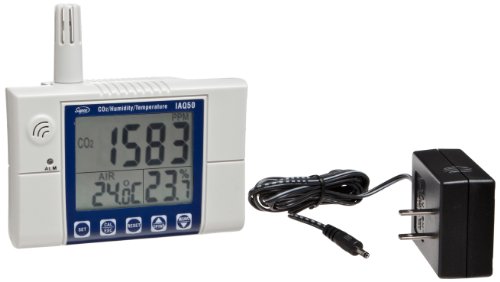
- Measures CO2, temperature, humidity, dew point, and wet bulb
- NDIR sensor with programmable 80 dB alarm
- Desktop or wall mounting with a large LCD
Best For: Fixed greenhouse monitoring with multiple environmental readings
Best Battery-Powered Pick

- Tracks CO2, temperature, and humidity in real time
- Rechargeable battery claims 3–6 months per charge
- Portable table or wall placement with sound and light alerts
Best For: Portable monitoring where frequent charging or cables are undesirable
Best for Continuous USB Monitoring

- NDIR sensor measures 400–10,000 ppm
- Four-second measurement interval with one-second refresh
- HD color display and 400 ppm manual calibration
Best For: Plugged-in monitoring of frequent CO2 fluctuations
Best Value CO2 Monitor
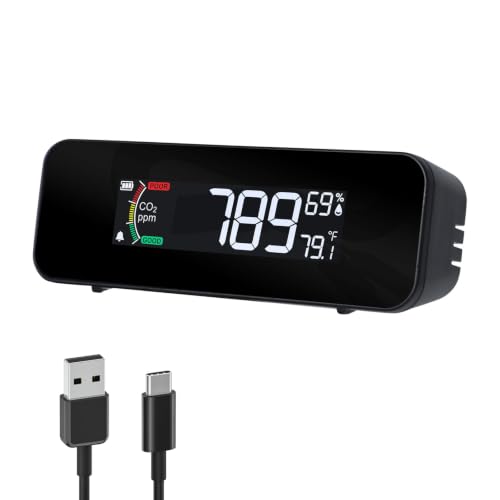
- Measures CO2, temperature, and humidity
- Three-color indicator with buzzer alert
- 40+ hours of rechargeable use
Best For: Portable greenhouse monitoring with simple visual and audible alerts
Best Sensor Accuracy

- Uses a Sensirion SCD41 sensor
- 1ppm resolution with five-second refresh
- Up to 70 days of battery standby
Best For: Detailed readings in grow tents and indoor growing spaces
Best Connected Option

- 400-9000ppm range with NDIR sensor
- Large display with five environmental readouts
- Sound, visual, and optional app alerts
Best For: Flexible greenhouse placement and extended monitoring
Best for Integrated Greenhouse Systems – High-Accuracy CO2 Transmitter
For growers comparing carbon dioxide monitors for greenhouses, this transmitter is designed for integration with climate-control equipment rather than casual desktop viewing. It measures 400–5,000 ppm, offers multiple signal outputs, and uses an IP65 PVC housing for demanding environments.
Best For: Agricultural greenhouses, flower cultivation, and users connecting CO2 readings to a controller or monitoring system.
Pros:
- Supports 4–20mA, 0–5V, and 0–10V output options.
- IP65 housing helps resist dust and water exposure.
- Temperature compensation and a 2-second data update support responsive monitoring.
- Wide 400–5,000 ppm measuring range suits greenhouse applications.
Cons:
- Installation requires wiring and system integration.
- Maximum accuracy requires about 10 minutes of warm-up.
- It is less convenient for users seeking a simple standalone display.
This is the most purpose-built option here for fixed greenhouse installations. Choose it when output compatibility, enclosure protection, and continuous system monitoring matter more than portability.
Best for Connected Air-Quality Tracking – ECOWITT WH46D 7-in-1 Sensor
The ECOWITT WH46D expands beyond CO2, making it a useful choice for buyers who want broader environmental context from their carbon dioxide monitors for greenhouses. Its LCD shows CO2, particulate readings, temperature, and humidity, while optional gateway pairing adds app and cloud access.
Best For: Indoor greenhouse-adjacent spaces, air-quality surveys, and users who want CO2 data alongside particulate, temperature, and humidity readings.
Pros:
- Measures CO2, PM1.0, PM2.5, PM4.0, PM10, temperature, and humidity.
- Includes a built-in LCD for local viewing.
- Can pair with supported Ecowitt gateways or consoles for app, cloud, and alert features.
- Supports CO2 calibration through the device button when paired with compatible equipment.
Cons:
- Gateway or compatible console is required for app and cloud features.
- It is not waterproof and is intended for indoor use.
- Long-term operation needs USB power; the backup battery lasts about two days.
This sensor is best when CO2 is only one part of your monitoring plan. Its ecosystem adds useful history and alerts, but the extra hardware and indoor-only design should be considered before greenhouse deployment.
Best for Standalone Plant Monitoring – AMT310 CO2 Meter
Among carbon dioxide monitors for greenhouses, the AMT310 stands out as a practical desktop monitor with plant and human modes. It combines CO2, temperature, and relative humidity readings with a display, alarms, and historical trend charts for reviewing growing conditions.
Best For: Grow rooms, greenhouses, and hydroponic setups where growers want local readings, plant-focused monitoring, and built-in data history.
Pros:
- Uses dual-beam NDIR technology across a 0–5,000 ppm CO2 range.
- Plant mode is designed for greenhouse and hydroponic monitoring.
- Records 24-hour or 7-day trends for CO2, humidity, and temperature.
- Audible high- and low-CO2 alarms provide immediate notification.
Cons:
- Battery pack is not included.
- Desktop operation may be less suitable for permanent wired control systems.
- Trend history is limited to the listed 24-hour or 7-day views.
This is a balanced choice for growers who want more than a live number but do not need industrial signal outputs. The plant mode and trend display make it especially useful for checking whether daily greenhouse conditions are staying on target.
Best for Portable App Monitoring – INKBIRD IAM-T2 Smart CO2 Monitor
The INKBIRD IAM-T2 is a portable option for buyers who want carbon dioxide monitors for greenhouses with phone access. It tracks CO2, temperature, and humidity on a backlit display, then adds Bluetooth monitoring, alarms, and stored data through its mobile app.
Best For: Growers who need a rechargeable monitor they can move between indoor growing areas and check from a nearby phone.
Pros:
- Monitors CO2, temperature, and humidity in real time.
- Bluetooth 5.0 provides a stated unobstructed range of up to 100 meters.
- Built-in 3,000 mAh battery can run for more than six months after a full charge, according to the supplied notes.
- Stores up to 30 days of offline data and supports longer-term app storage and export.
Cons:
- Bluetooth monitoring depends on a nearby compatible phone and unobstructed range.
- It does not provide the industrial wired outputs of a dedicated transmitter.
- The supplied notes describe indoor air-quality monitoring rather than waterproof greenhouse installation.
The IAM-T2 is a convenient pick for spot checks and portable monitoring. Choose it for mobility, phone-based records, and long battery life; choose a wired transmitter instead when you need direct connection to greenhouse controls.
Best All-Around Greenhouse Monitor – Supco IAQ50
For growers comparing carbon dioxide monitors for greenhouses, the Supco IAQ50 is a practical corded-electric option that tracks CO2, temperature, and humidity in one unit. Its NDIR sensor, large LCD, and wall- or desktop-mounting design make it useful for routine greenhouse checks.
Best For: Greenhouse users who want a corded monitor with CO2, temperature, humidity, dew-point, and wet-bulb readings.
Pros:
- Measures CO2, temperature, humidity, dew point, and wet bulb.
- Uses a non-dispersive infrared sensor.
- Offers a programmable visible and audible 80 dB CO2 alarm.
- Can sit on a desktop or mount on a wall, with a large LCD display.
Cons:
- Requires corded electric power rather than battery operation.
- Has a 30-second warm-up period.
The IAQ50 is a solid choice when you want broad environmental readings and an alarm in a straightforward greenhouse monitoring setup. Its corded design is best suited to a fixed location near a reliable power source.
Best Battery-Powered Pick – INKBIRD IAM-O2
Among carbon dioxide monitors for greenhouses, the INKBIRD IAM-O2 stands out for portable, low-power operation. It monitors CO2, temperature, and humidity in real time, and its rechargeable battery is designed to provide three to six months of use on a single charge.
Best For: Growers who need a lightweight, portable monitor that can operate without staying plugged in.
Pros:
- Measures CO2 from 0–9,999 ppm, plus temperature and humidity.
- Uses a Swedish CO2 sensor and lists temperature and humidity accuracy specifications.
- Provides three to six months of claimed use per charge.
- Offers sound and indicator-light alerts for different air-quality levels.
Cons:
- The supplied notes identify it for indoor environments rather than specifically greenhouse use.
- Its small display may be less convenient for viewing from a distance.
The IAM-O2 is appealing for greenhouse areas where portability matters or where running a power cable is inconvenient. It can be placed on a table or hung on a wall, making it easy to reposition as needed.
Best for Continuous USB Monitoring – YOWEXA YEM-42-LF
For growers seeking carbon dioxide monitors for greenhouses with frequent readings, the YOWEXA YEM-42-LF measures CO2 every four seconds and refreshes its display every second. Its NDIR sensor covers 400–10,000 ppm, while USB power supports uninterrupted monitoring.
Best For: Users who prioritize near-continuous CO2 tracking and plan to operate the monitor from USB power.
Pros:
- Uses an NDIR sensor with a 400–10,000 ppm range.
- Measures at four-second intervals with a one-second display refresh rate.
- Includes automatic calibration features and a 400 ppm manual calibration mode.
- Has an HD color display, adjustable backlight, and CO2 alarm with one-touch mute.
Cons:
- Battery life is limited to up to three hours in continuous operation.
- The product notes recommend continuous USB power for round-the-clock monitoring.
- Its listed response time is three minutes.
This model makes the most sense as a plugged-in monitor rather than a portable, long-running battery device. Its rapid measurement interval and calibration options can be useful when you want to observe changing CO2 levels closely.
Best Value CO2 Monitor – Portable 0-5000ppm CO2 Meter
For shoppers comparing carbon dioxide monitors for greenhouses, the DANOPLUS CO2 Monitor offers a portable way to track CO2, temperature, and humidity. Its 0-5000ppm range, NDIR sensor, color indicator, and audible warning make it useful for checking air conditions as you manage a growing space.
Best For: Portable greenhouse monitoring with straightforward visual and audible alerts.
Pros:
- Measures CO2, temperature, and humidity in one device.
- 0-5000ppm CO2 range with stated ±50ppm accuracy.
- Three-color indicator and buzzer alert above 1400ppm.
- Rechargeable battery supports more than 40 hours of continuous use.
Cons:
- Its alarm threshold is preset at above 1400ppm, which may not suit every growing setup.
- The compact portable design may be less convenient for fixed, remote monitoring.
This is a practical pick when you want core readings and clear alerts without a complicated setup. The large LCD and rechargeable design also make it easy to move around a greenhouse or use in several locations.
Best Sensor Accuracy – Temtop CO2 Monitor
The Temtop CO2 Monitor is a strong option among carbon dioxide monitors for greenhouses when detailed, frequently refreshed readings matter. It combines CO2, temperature, and humidity measurements with a Swiss Sensirion SCD41 photoacoustic sensor and a compact design suited to grow tents or other indoor growing areas.
Best For: Growers who want fine-resolution readings and extended battery standby.
Pros:
- Measures CO2 from 400-5000ppm, temperature, and humidity.
- Provides 1ppm resolution and a five-second refresh rate.
- Uses a Sensirion SCD41 photoacoustic CO2 sensor with stated accuracy of ±40ppm plus 5% of reading from 400-2500ppm.
- Offers up to 70 days of battery standby.
Cons:
- The product notes advise keeping it plugged in for real-time monitoring.
- It detects carbon dioxide, not carbon monoxide.
- The supplied accuracy specification applies to the 400-2500ppm range.
With its fast refresh rate and 1ppm resolution, the Temtop is well suited to observing gradual changes in a controlled growing environment. Its customizable sound and display settings are useful when alerts or illumination would be distracting.
Best Connected Option – SwitchBot Meter Pro CO2
For greenhouse owners who want broad placement flexibility, the SwitchBot Meter Pro CO2 is one of the more versatile carbon dioxide monitors for greenhouses. It displays CO2, temperature, humidity, time, date, and comfort level, while its wall-mount holes, adjustable bracket, and long battery life support ongoing monitoring.
Best For: Greenhouse users who want high-range readings, multiple alert methods, and flexible placement.
Pros:
- Measures CO2 from 400-9000ppm with stated ±50ppm accuracy.
- Large 92mm screen displays CO2, temperature, humidity, time, date, and comfort level.
- Provides sound and visual alerts, plus app notifications when paired with a SwitchBot Hub.
- Built-in battery can last up to 12 months and the unit supports wall mounting.
Cons:
- App notifications require a SwitchBot Hub.
- It is heavier than some compact portable monitors at 154g.
- The product notes do not specify a rechargeable battery.
The SwitchBot stands out for its unusually broad 9000ppm range and flexible alert options. It is a good fit when you want the monitor visible at a glance but also value wall mounting and optional app-based notifications.
How We Picked the Best Carbon Dioxide Monitors for Greenhouses
We focused on monitors that use NDIR sensing or clearly specify CO₂ measurement performance, since NDIR is generally preferred for stable indoor and growing-environment readings. We also considered measurement range, display readability, temperature and humidity tracking, portability, data logging, alerts, connectivity, and whether a device could support routine greenhouse decisions.
Because these products vary widely, some are better suited to spot checks while others make more sense for continuous monitoring. A home air-quality monitor may work in a sealed grow tent, but greenhouse users should confirm that its range, operating conditions, and placement recommendations fit the space.
Quick Comparison
- Best for broad agricultural measurements: Choose a transmitter-style monitor with a wide CO₂ range and clear sensor specifications.
- Best for multiple air-quality readings: Consider a 7-in-1 model that also measures particulate matter, temperature, and humidity.
- Best for app-based monitoring: Smart Bluetooth models can make reviewing trends and checking readings more convenient.
- Best for portable spot checks: Handheld or compact battery-powered meters are useful when moving between benches, rooms, or tents.
- Best for basic environmental tracking: A three-in-one CO₂, temperature, and humidity monitor covers the measurements most growers check regularly.
Key Buying Factors for Carbon Dioxide Monitors for Greenhouses
Sensor Type and Accuracy
Look for NDIR CO₂ sensing, a stated accuracy rating, and a calibration process. Avoid treating a low-cost reading as laboratory-grade data, particularly when controlling expensive enrichment equipment.
Measurement Range
Match the range to your setup. A monitor designed mainly for occupied rooms may be adequate for ambient readings but may not be suitable where CO₂ levels are intentionally elevated. A wider range provides more flexibility, but only if accuracy remains acceptable across that range.
Temperature and Humidity Measurements
Temperature and relative humidity affect plant health and ventilation decisions. Built-in readings reduce the need for separate instruments, although sensor placement still matters. Keep the monitor away from direct mist, irrigation spray, heaters, and intense sunlight.
Logging, Alerts, and Connectivity
Data logging helps reveal daily patterns, while audible or app alerts can identify unsafe or unwanted changes quickly. Bluetooth is convenient nearby, but it may not provide remote access through walls or across a larger greenhouse.
Power and Durability
Check whether the device uses batteries, USB power, or a fixed supply. For greenhouse use, consider condensation resistance, enclosure quality, cable length, and whether the manufacturer specifies an appropriate operating environment.
Who Should Buy Which Carbon Dioxide Monitors for Greenhouses?
Small greenhouse and grow-tent owners should prioritize a readable portable monitor with CO₂, temperature, and humidity readings. Commercial or larger greenhouse operators may benefit from a transmitter with a broad range, stronger documentation, and compatibility with environmental controllers. Data-focused growers should choose a model with logging, app connectivity, or exportable trends. Users monitoring general air quality may prefer a multi-sensor unit that adds particulate readings, but should not assume those extra measurements replace dedicated greenhouse controls.