Basements can feel comfortable while still having limited ventilation, especially when they are used as bedrooms, offices, gyms, or family rooms. A carbon dioxide monitor helps you track ventilation conditions in real time and identify when fresh air is needed.
We selected 10 monitors with useful combinations of CO2 measurement, NDIR sensing, alarms, portability, temperature and humidity readings, and broader air-quality tracking. Use the guide below to match the right monitor to your basement layout and daily routine.
Best 10 Carbon Dioxide Monitors for Basements Picks for 2026
Best Wireless Pick
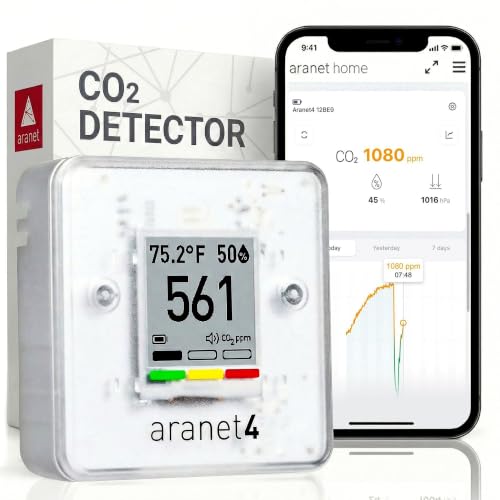
- NDIR sensor for CO2 measurement
- Up to four years of battery life
- App stores up to 90 days of history
Best For: Portable, low-maintenance basement monitoring
Best Whole-Air Monitor

- Monitors CO2, radon, PM2.5, and VOCs
- Wi-Fi app with trends and notifications
- Battery-powered with customizable e-ink display
Best For: Comprehensive basement air-quality tracking
Best Plug-In Alarm

- Continuous AC-powered monitoring
- Alarm at 2,000 ppm
- Stores 180 days of history
Best For: Fixed basement locations with an available outlet
Best Portable Display

- NDIR sensor with 400–5,000 ppm range
- Large 3-inch LED display
- Rechargeable 2,200mAh battery
Best For: Portable, easy-to-read basement monitoring
Best Portable Pick

- Measures CO2, temperature, and humidity
- Sensirion SCD41 sensor with 5-second refresh
- Up to 70 days of standby battery life
Best For: Portable, multipurpose room monitoring
Best Air-Quality Coverage

- Monitors CO2, PM2.5, PM10, AQI, temperature, and humidity
- Three-level AQI display with sound alert
- Desktop or wall-hanging placement
Best For: Broad basement air-quality monitoring
Best Simple Alert System
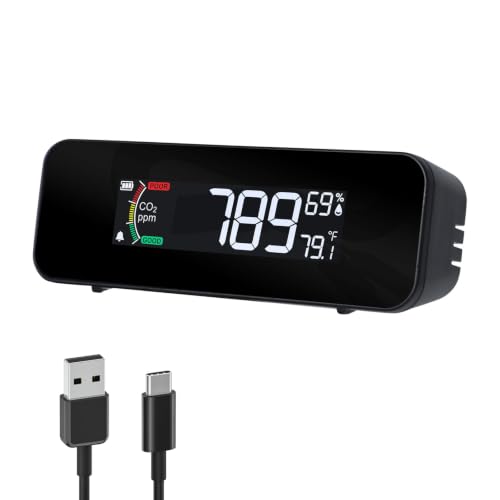
- 0–5,000 ppm range with ±50 ppm stated accuracy
- Three-color indicator and 1,400 ppm buzzer alert
- More than 40 hours of use per charge
Best For: Clear, rechargeable CO2 monitoring
Most Comprehensive

- Monitors CO2 and eight other indoor-air parameters
- Large 7-inch display with adjustable brightness
- Seven AQI alerts and up to 8 hours of runtime
Best For: Homeowners wanting broad basement air-quality tracking
Dedicated CO2 Choice

- Measures CO2 from 0 to 9,999 ppm
- NDIR sensor with audible and visual alarms
- Also tracks temperature and humidity
Best For: Focused CO2 monitoring with threshold alerts
Longest Battery Life

- Up to 72 hours from a 1,600mAh battery
- Tracks CO2, AQI, temperature, and humidity
- 400–5,000 ppm range with ±50 ppm accuracy
Best For: Portable, extended-runtime basement monitoring
Best Wireless Pick – Aranet4 CO2 Monitor
For shoppers comparing carbon dioxide monitors for basements, the Aranet4 is a compact, cable-free option with a prominent CO2 reading and supporting temperature, humidity, and atmospheric-pressure data. Its NDIR sensor and long battery life make it well suited to ongoing ventilation checks.
Best For: Homeowners who want portable, low-maintenance CO2 monitoring with app-based history.
Pros:
- NDIR technology is designed for precise, reliable CO2 measurements.
- E-ink display and included AA batteries support up to four years of battery life.
- App provides graphs and up to 90 days of historical data.
- Color coding and optional buzzer help flag elevated CO2.
Cons:
- Monitoring features are focused on CO2, temperature, humidity, and pressure rather than radon or particulate matter.
- App analysis requires using a smartphone.
The Aranet4 is a strong choice when basement monitoring needs to be simple, wireless, and easy to move between rooms. Its four-year battery claim is especially useful for locations without a convenient outlet.
Best Whole-Air Monitor – Airthings View Plus
If you want carbon dioxide monitors for basements that also track other indoor-air concerns, the Airthings View Plus offers a broader sensor lineup. It monitors CO2 alongside radon, PM2.5, VOCs, humidity, temperature, and air pressure, with battery-powered placement and app connectivity.
Best For: Basement owners who want CO2 monitoring plus radon and broader air-quality information.
Pros:
- Tracks CO2, radon, PM2.5, VOCs, humidity, temperature, and pressure.
- Wi-Fi and app access support live readings, trends, and notifications.
- Battery-powered design and customizable e-ink display allow flexible placement.
- Optional registration can extend the warranty to five years.
Cons:
- The monitor and app require internet access.
- An Airthings account is required to use the device.
- Battery life is listed at about two years, shorter than some simpler monitors.
The View Plus is the most comprehensive option here for basements where radon and particulate monitoring matter alongside CO2. Choose it if you are comfortable with cloud-connected app features and account setup.
Best Plug-In Alarm – YHCmeter 5-in-1 CO2 Detector
For a basement with an accessible outlet, this plug-in unit provides continuous carbon dioxide monitoring without battery changes. It displays CO2, temperature, and humidity in real time, refreshes readings every two seconds, and sounds an alarm when CO2 reaches 2,000 ppm.
Best For: Users who prioritize uninterrupted, outlet-powered monitoring and an audible high-CO2 warning.
Pros:
- AC plug-in design supports continuous 24/7 operation.
- CO2 readings refresh every two seconds across a 400–5,000 ppm range.
- Audible and visual alerts activate when CO2 exceeds 2,000 ppm.
- Stores up to 180 days of historical trend data.
Cons:
- Placement depends on having a suitable wall outlet.
- It uses an electrochemical sensor rather than the NDIR technology specified for some alternatives.
- The supplied notes describe temperature and humidity monitoring but not the additional air pollutants covered by broader air-quality monitors.
This YHCmeter is a practical pick for a fixed basement location where you want an always-powered display and a clear audible alert. Its screen-off mode and mute function add flexibility for quieter areas.
Best Portable Display – ATuMan CO2 Detector
The ATuMan is a portable choice for carbon dioxide monitors for basements, especially if you want a large display without relying on disposable batteries. Its NDIR sensor measures CO2 along with temperature and humidity, while a three-color alert bar provides a quick visual indication.
Best For: Users who want rechargeable, portable monitoring with an easy-to-read screen.
Pros:
- NDIR sensor measures CO2 from 400–5,000 ppm.
- Large 3-inch LED display shows CO2, temperature, and humidity.
- Rechargeable 2,200mAh battery avoids disposable battery replacements.
- Three-color visual alerts make elevated readings easy to spot.
Cons:
- Its alert is visual rather than an audible alarm.
- Battery runtime is described as all-day, but no longer lifespan is specified.
- It does not include the radon, PM2.5, or VOC measurements offered by a broader air-quality monitor.
The ATuMan fits shoppers who value portability and readability over app connectivity or multi-pollutant coverage. Its rechargeable design is convenient for checking several basement areas or moving the unit as needed.
Best Portable Pick – Temtop CO2 Monitor
For shoppers comparing carbon dioxide monitors for basements, the Temtop CO2 Monitor is a compact option that also tracks temperature and humidity. Its photoacoustic Sensirion SCD41 sensor measures CO2 from 400 to 5,000 ppm, with a 5-second refresh rate and customizable alerts.
Best For: Portable monitoring in basements, bedrooms, offices, schools, nurseries, or grow tents.
Pros:
- Measures CO2, temperature, and humidity in one device.
- Uses a Sensirion SCD41 photoacoustic sensor with stated accuracy of ±40 ppm + 5% of reading from 400–2,500 ppm.
- Offers up to 70 days of standby battery life and flexible mounting options.
- Audio alerts and display illumination can be disabled.
Cons:
- For the most current real-time monitoring, the manufacturer advises keeping it plugged in.
- It detects carbon dioxide, not carbon monoxide.
The Temtop combines useful environmental readings with a slim, portable design. It is a practical choice when you want basement CO2 information without giving up temperature and humidity tracking.
Best Air-Quality Coverage – INKBIRDPLUS 6-in-1 Monitor
Among carbon dioxide monitors for basements, the INKBIRDPLUS stands out for measuring more than CO2 alone. Its 6-in-1 design monitors carbon dioxide, PM2.5, PM10, AQI, temperature, and humidity, giving you a broader view of indoor conditions.
Best For: Basement users who want particulate and air-quality readings alongside CO2 measurements.
Pros:
- Combines CO2, PM2.5, PM10, AQI, temperature, and humidity monitoring.
- Three-level AQI display includes normal, warning, and hazard modes.
- Sounds an alert when the AQI exceeds 100.
- Color screen, desktop placement, and wall-hanging hook support easy viewing.
Cons:
- The supplied notes do not specify the CO2 measurement range or accuracy.
- Automatic CO2 calibration requires moving the unit to a ventilated area and holding three buttons for 200 seconds.
The INKBIRDPLUS is a strong fit if basement air quality concerns include dust or particulate matter as well as elevated CO2. Its broader sensor lineup is more informative than a CO2-only meter, though the calibration process takes some effort.
Best Simple Alert System – DANOPLUS CO2 Monitor
The DANOPLUS CO2 Monitor is a straightforward choice for carbon dioxide monitors for basements, with a 0–5,000 ppm range and readings for temperature and humidity. Its three-color indicator and buzzer provide quick visual and audible cues when CO2 rises.
Best For: Users who want a compact, rechargeable CO2 meter with clear threshold indicators.
Pros:
- Measures CO2, temperature, and humidity, with stated ±50 ppm CO2 accuracy.
- Uses a fast-response NDIR sensor with a response time under two minutes.
- Green, yellow, and red indicators make air-quality status easy to read.
- Provides more than 40 hours of continuous use per charge and includes USB-C charging.
Cons:
- The buzzer activates when CO2 exceeds 1,400 ppm, which may not suit quiet spaces.
- The supplied notes do not specify wall-mounting or extended standby performance.
With a large LCD, lightweight design, and simple color coding, the DANOPLUS is easy to use at a glance. It is a sensible pick for routine basement checks when rechargeable portability and clear alarms matter most.
Most Comprehensive – 16-in-1 Air Quality Monitor
For shoppers comparing carbon dioxide monitors for basements, this model stands out when you want CO2 readings alongside broader indoor-air data. Its large 7-inch display shows CO2, particulate matter, HCHO, TVOC, temperature, humidity, AQI, and time, while alert buzzers can help draw attention to changing conditions.
Best For: Homeowners who want a large-screen, multi-parameter monitor for a basement or other indoor space.
Pros:
- Tracks CO2 plus PM1.0, PM2.5, PM10, HCHO, TVOC, temperature, humidity, and AQI.
- Large 7-inch display has three brightness settings for easy viewing.
- Provides seven AQI alert functions, a mute button, and USB-C charging.
- Portable design offers up to 8 hours of runtime and includes a 12-month warranty.
Cons:
- Its many readings and alerts may be more than needed if you only want CO2 monitoring.
- Battery runtime is listed at up to 8 hours, shorter than some portable alternatives.
- The sensors should be kept away from perfumes and strong odors to help maintain accuracy.
This is the most feature-rich option in the group. Choose it if basement air quality concerns extend beyond carbon dioxide and you value a prominent, glanceable display.
Dedicated CO2 Choice – Portable NDIR CO2 Meter
If your priority is focused carbon dioxide monitoring for a basement, this portable meter uses a non-dispersive infrared sensor and measures CO2 from 0 to 9,999 ppm. It also displays temperature and humidity, with audible and visual alarms for thresholds you set.
Best For: Buyers who want a dedicated CO2 meter with a broad measurement range and alarms.
Pros:
- Uses an NDIR CO2 sensor with stated accuracy of ±50 ppm or ±5% from 0–2,000 ppm.
- Measures CO2, temperature, humidity, dew point, and wet bulb readings.
- Large backlit LCD displays CO2, temperature, and humidity together.
- Audible and visual alarms can signal when CO2 exceeds the selected threshold.
Cons:
- It is battery powered, so it may require ongoing battery management.
- The display and feature set are more focused than those of full-spectrum air-quality monitors.
- Supplied dimensions are listed unusually, so verify the physical size before placing it in a tight area.
This is a practical pick when CO2 is the main concern and you want a high measurement ceiling, visible readings, and threshold alerts without paying for extensive particulate monitoring.
Longest Battery Life – Dienmern 5-in-1 CO2 Monitor
For portable carbon dioxide monitors for basements, the Dienmern 5-in-1 model is a convenient choice when you want to move the unit between rooms or keep it running away from an outlet. It tracks CO2, AQI, temperature, and humidity, and its 1,600mAh battery is rated for up to 72 hours per charge.
Best For: Users who value extended cordless operation and straightforward CO2, comfort, and AQI readings.
Pros:
- Uses a Swiss-made CO2 sensor with a 400–5,000 ppm range and stated ±50 ppm accuracy.
- Built-in 1,600mAh battery provides up to 72 hours of operation.
- Bright LED display shows CO2, AQI, temperature, and humidity at a glance.
- Compact design supports use at home, in an office, while traveling, or in grow tents.
Cons:
- Its CO2 measurement range tops out at 5,000 ppm, lower than the TEKCOPLUS meter’s range.
- It does not provide the particulate, HCHO, or TVOC readings offered by the 16-in-1 model.
- The manufacturer notes that readings may vary by approximately ±50 ppm.
Choose this model if long battery life and portability matter most. It provides the core readings many basement users need while remaining easy to relocate and recharge by USB.
How We Picked the Best Carbon Dioxide Monitors for Basements
We focused on features that matter in below-grade rooms: dependable CO2 measurement, clear displays, useful alert settings, and flexible placement. NDIR sensors are especially valuable because they are designed specifically for carbon dioxide measurement. We also considered power options, portability, battery life, calibration features, and whether a monitor tracks related conditions such as temperature, humidity, particulate matter, VOCs, or radon.
Because product specifications and included accessories can vary by listing, verify the latest details before buying. A CO2 monitor is a ventilation tool, not a substitute for a radon test, carbon-monoxide alarm, smoke alarm, or professional indoor-air assessment.
Quick Comparison
| Best for | Look for | Useful feature |
|---|---|---|
| Everyday basement monitoring | Clear CO2 display and simple controls | Audible or visual alerts |
| Rooms without convenient outlets | Rechargeable or replaceable battery | Portable placement |
| Whole-home air-quality tracking | Multi-sensor monitoring | PM, VOC, humidity, or pressure readings |
| Connected households | Wireless app support | Remote readings and history |
| High-confidence CO2 readings | NDIR sensor and calibration controls | Long-term stability |
Key Buying Factors for Carbon Dioxide Monitors for Basements
Sensor Type and Accuracy
Choose an NDIR-based monitor when possible. Check the stated measurement range, accuracy, warm-up behavior, and calibration method. Automatic baseline calibration can be convenient, but it may be less suitable for a basement that rarely reaches outdoor-air CO2 levels.
Placement and Power
Place the unit at breathing height in the occupied part of the room, away from windows, vents, direct sunlight, and exhaled breath. Battery models are easier to move and useful in finished basements; plug-in models are convenient for continuous monitoring in a fixed location.
Alerts and Readability
A large display, color status indicator, configurable alarm, and readable nighttime mode make a monitor easier to use. Look for an alert that is noticeable without being unnecessarily disruptive.
What Else Should It Measure?
Temperature and humidity readings help explain comfort and condensation risk. PM and VOC sensors can broaden air-quality awareness, while radon monitoring addresses a separate basement-specific concern. More sensors are useful only if the display and app remain easy to interpret.
Who Should Buy Which Carbon Dioxide Monitors for Basements?
Choose a simple portable CO2 meter if you want an affordable way to check a basement office, workout space, or occasional living area. Select a plug-in model if the monitor will stay in one frequently occupied room and you want continuous operation with minimal maintenance.
A connected monitor is best for users who want readings and trends from a phone, while a multi-sensor unit suits households investigating several comfort or air-quality factors at once. If radon is a concern, choose a model that explicitly measures radon or pair your CO2 monitor with a dedicated radon detector. For any model, treat repeated high readings as a prompt to improve ventilation and investigate the cause rather than relying on the monitor alone.