Fresh-feeling air is not always well-ventilated air. Carbon dioxide monitors help reveal when a room needs more outdoor air, making them useful for homes, offices, classrooms, and shared spaces.
These 10 picks cover dependable everyday monitors, portable meters, multi-sensor air-quality stations, and connected models with app features or alerts.
Best 10 Carbon Dioxide Monitors Picks for 2026
Best Overall
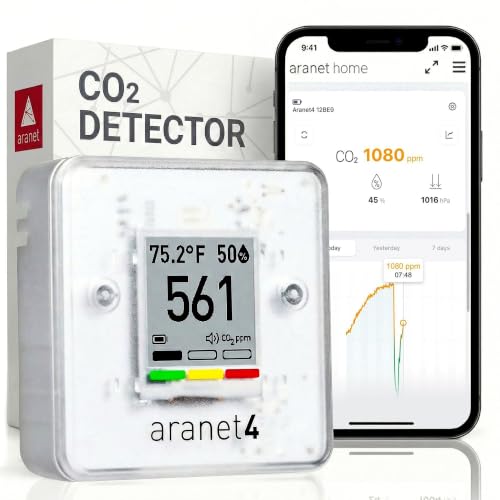
- Precise NDIR CO2 sensing
- Up to four years of battery life
- App history with 90 days of data
Best For: Homes and offices needing premium cable-free monitoring
Best Multi-Pollutant Monitor

- Measures gases and particulate matter
- Stores up to 9,999 records
- Includes AQI grading and audible prompts
Best For: Industrial, laboratory, and broad indoor air-quality testing
Best Value for Home Use
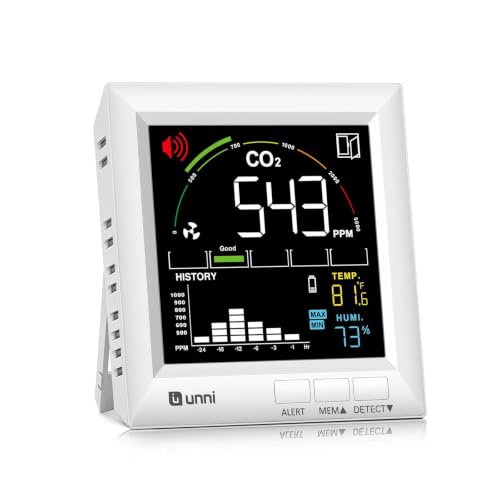
- Photoacoustic Sensirion sensor
- USB power with battery backup
- Adjustable alerts and backlight
Best For: Simple CO2 monitoring in homes, RVs, and grow tents
Best Smart-Home Pick

- Five-second refresh rate
- Two years of app data and CSV export
- Buzzer, app, and email alerts
Best For: Bedrooms, nurseries, and connected smart homes
Best Portable Pick

- Measures CO2, temperature, and humidity
- Five-second refresh rate with Sensirion SCD41 sensor
- Portable design with quiet-mode controls
Best For: Portable monitoring in bedrooms, offices, schools, and grow tents
Best Everyday Display

- Uses Sensirion PASens CO2 technology
- Customizable CO2 concentration alerts
- Adds temperature, humidity, clock, and alarm functions
Best For: Continuously powered monitoring at home, work, or in an RV
Best Handheld Option
Gain Express Portable CO2 Meter

- 0–9,999 ppm CO2 range
- Measures temperature and humidity
- Battery powered with audible alarm
Best For: Portable air-quality checks in offices, classrooms, and public spaces
Best Travel-Friendly Monitor

- Monitors CO2, AQI, temperature, and humidity
- Rechargeable 1,600mAh battery
- Bright LED display with 400–5,000 ppm range
Best For: Portable monitoring at home, work, while traveling, or in grow tents
Best Smart Alert Features

- Large display with five monitoring categories
- 400–9,000 ppm range and ±50 ppm accuracy
- Audible, visual, and optional app alerts
Best For: Continuous home, office, classroom, or greenhouse monitoring
Best Overall – Aranet4 Wireless CO2 Monitor
The Aranet4 is a polished choice among carbon dioxide monitors for anyone who wants reliable CO2 readings without a power cable. Its prominent display, color coding, long battery life, and app-based history make everyday ventilation decisions straightforward.
Best For: Homes, offices, and users who want a premium, cable-free CO2 monitor with historical tracking.
Pros:
- Uses NDIR technology for precise CO2 measurements.
- Measures CO2, temperature, humidity, and atmospheric pressure.
- E-ink display and included AA batteries support up to four years of battery life.
- App provides graphs and up to 90 days of historical data.
Cons:
- Provides fewer pollutant measurements than multi-sensor air quality meters.
- Its premium feature set may be more than casual users need.
Choose the Aranet4 if dependable CO2 monitoring, low-maintenance operation, and a clean wireless setup matter more than measuring particulates or chemical pollutants.
Best Multi-Pollutant Monitor – 10-in-1 Air Quality Meter
This 10-in-1 meter goes beyond carbon dioxide monitors by combining CO2, formaldehyde, TVOC, particulate matter, temperature, humidity, and AQI grading in one device. It is designed for users who want broad indoor air-quality data and extensive logging in a portable format.
Best For: Workshops, laboratories, industrial spaces, and households that need multiple pollutant readings and long-term logs.
Pros:
- Tracks CO2, HCHO, TVOC, PM1.0, PM2.5, PM10, temperature, and humidity.
- Uses color indicators, emoji AQI grading, and audible prompts.
- Stores up to 9,999 records and captures readings every five minutes.
- Portable Type-C rechargeable design supports more than eight hours of continuous measurement.
Cons:
- Its eight-plus-hour runtime is less suitable for unattended continuous monitoring without charging.
- The large number of readings may be unnecessary for shoppers focused only on CO2.
This is the most versatile option in the group for comparing different air-quality factors, especially where data logging and particulate measurements are as important as CO2.
Best Value for Home Use – U UNNI CO2 Monitor
The U UNNI CO2 monitor is a practical home-focused option among carbon dioxide monitors, displaying CO2, temperature, humidity, and historical trends. USB power, battery backup, adjustable alerts, and wall- or tabletop placement give it useful everyday flexibility.
Best For: Homes, RVs, grow tents, and workspaces where simple CO2 and comfort readings are the priority.
Pros:
- Uses a Swiss-made Sensirion photoacoustic CO2 sensor.
- Displays CO2 history along with temperature and humidity.
- Offers three volume levels and three backlight settings.
- Supports USB power with three AAA batteries for backup.
Cons:
- AAA batteries are not included.
- Manual calibration requires following a multistep process.
- Does not measure particulate or other chemical pollutants.
For straightforward residential monitoring, the U UNNI balances useful alerts and flexible power options without the broader measurement scope or app ecosystem of some alternatives.
Best Smart-Home Pick – GoveeLife Smart CO2 Monitor
The GoveeLife H5140 is a smart, outlet-powered choice among carbon dioxide monitors, pairing a clear display with app alerts, long-term charts, and smart-home connectivity. It is particularly useful for users who want monitoring to fit into daily routines rather than relying only on the device screen.
Best For: Bedrooms, nurseries, offices, and smart homes that need continuous monitoring with remote alerts and data export.
Pros:
- Refreshes every five seconds and lists accuracy of ±(40 ppm + 5%).
- Displays CO2, temperature, humidity, and clock information.
- Provides buzzer, app, and email alerts with customizable thresholds.
- Tracks up to two years of data and supports CSV export.
Cons:
- Requires AC power for continuous operation.
- App connection is needed for the clock and smart features.
- Cannot link to air purifiers for CO2 reduction.
The H5140 stands out when remote notifications, historical reporting, and voice or smart-device integrations are more important than battery portability.
Best Portable Pick – Temtop CO2 Monitor
The Temtop CO2 Monitor is a practical choice for shoppers seeking portable carbon dioxide monitors with temperature and humidity tracking. It measures CO2 from 400–5000 ppm, refreshes readings every five seconds, and uses a Swiss Sensirion SCD41 photoacoustic sensor.
Best For: Bedrooms, offices, schools, nurseries, and grow tents where portable monitoring and quiet operation matter.
Pros:
- Measures CO2, temperature, and humidity in one compact device.
- Offers 1 ppm resolution and stated accuracy of ±40 ppm + 5% of the reading from 400–2500 ppm.
- Provides customizable alerts, adjustable display illumination, and up to 70 days of standby battery life.
- Includes mounting options and can be used plugged in for real-time monitoring.
Cons:
- The manufacturer advises keeping it plugged in for the most up-to-date real-time monitoring.
- It detects carbon dioxide, not carbon monoxide.
Choose this model if portability, fast refreshes, and flexible placement are more important than monitoring a broad range of pollutants. Its sleep-friendly controls also make it suitable for bedrooms and other quiet spaces.
Best Everyday Display – Newentor CO2 Monitor
The Newentor CO2 Monitor combines carbon dioxide monitoring with temperature, humidity, clock, calendar, and alarm-clock functions. Its corded design and customizable CO2 alerts make it a straightforward option for spaces where a continuously powered display is useful.
Best For: Homes, offices, RVs, classrooms, greenhouses, wine cellars, and other indoor areas needing an always-on CO2 display.
Pros:
- Uses Swiss Sensirion PASens technology for CO2 detection.
- Lets users customize CO2 concentration alert levels.
- Tracks temperature and humidity alongside carbon dioxide.
- Also functions as a clock, calendar, and alarm clock.
Cons:
- It uses corded electric power rather than a battery-powered setup.
- The supplied notes do not specify a CO2 measurement accuracy or refresh rate.
This is a sensible pick for buyers who want carbon dioxide monitors with a large, multifunctional display and no need to manage battery charging. Its application range also suits specialized spaces such as grow tents and wine cellars.
Best Multi-Pollutant Option – Lwyinp 10-in-1 Air Quality Monitor
The Lwyinp 10-in-1 monitor is designed for shoppers who want more than carbon dioxide monitors alone. Along with CO2, it tracks formaldehyde, TVOC, particulate matter, temperature, humidity, and AQI on a color display, with Bluetooth connectivity for time calibration.
Best For: Homes, cars, offices, schools, hotels, kitchens, basements, and other spaces where broader indoor air-quality information is useful.
Pros:
- Monitors CO2, HCHO, TVOC, AQI, PM1.0, PM2.5, PM10, temperature, humidity, and time.
- Uses a three-color visualization system to make changing air-quality conditions easier to notice.
- Starts full-range detection automatically when powered on.
- Offers sound controls, screen-sleep settings, smart calibration, and Bluetooth time calibration.
Cons:
- The supplied notes do not provide specific measurement accuracy figures or ranges.
- It requires a phone connection via Bluetooth to calibrate the clock.
- Its wider sensor coverage may be unnecessary for shoppers focused only on CO2.
Consider this model when you want a broader snapshot of indoor air quality rather than CO2 readings alone. The color screen and multi-sensor layout provide more information at a glance, while the compact design supports use across multiple locations.
Best Handheld Option – Gain Express Portable CO2 Meter
For shoppers comparing carbon dioxide monitors, this Gain Express handheld meter stands out for its broad 0–9,999 ppm CO2 range and included temperature and humidity measurements. Its NDIR sensor, audible alarm, handle design, and manual calibration options make it practical for checking ventilation in different locations.
Best For: Offices, classrooms, hotels, and users who want a portable monitor with a wide measurement range.
Pros:
- Measures CO2 from 0 to 9,999 ppm with stated accuracy specifications.
- Also tracks temperature, humidity, dew point, and wet bulb readings.
- Runs on the included battery or a 9V adapter, with audible alarms.
- Portable handle and manual CO2 and humidity calibration support flexible use.
Cons:
- 9V adapter is not included.
- At CO2 levels above 2,000 ppm, stated accuracy is ±10% of the reading.
This is a versatile choice when portability and a comprehensive set of environmental readings matter more than a minimalist design. The wide range is especially useful for air-quality surveys across multiple spaces.
Best Travel-Friendly Monitor – Dienmern 5-in-1 CO2 Detector
This Dienmern model is one of the more convenient carbon dioxide monitors for portable indoor use, combining CO2, AQI, temperature, and humidity readings on a bright LED display. Its 1,600mAh rechargeable battery and lightweight design make it easy to move between home, office, travel, or a grow tent.
Best For: Users who want a rechargeable, easy-to-read monitor for everyday indoor and travel use.
Pros:
- Tracks CO2, AQI, temperature, and humidity in real time.
- Uses a Swiss-made sensor with a stated 400–5,000 ppm range and ±50 ppm accuracy.
- Bright, high-contrast LED display is designed for quick viewing day or night.
- Built-in 1,600mAh battery provides up to 72 hours of operation per charge.
Cons:
- Its stated CO2 detection range ends at 5,000 ppm.
- The manufacturer notes readings may vary by approximately ±50 ppm between meters.
Choose this monitor if straightforward visual feedback and rechargeable portability are priorities. It offers a useful set of basic indoor readings without requiring a constant power connection.
Best Smart Alert Features – SwitchBot Meter Pro CO2
Among carbon dioxide monitors, the SwitchBot Meter Pro CO2 is a strong fit for users who want a large information display and configurable alerts. It shows CO2, temperature, humidity, time, date, and comfort level together, while optional app notifications require a SwitchBot Hub.
Best For: Homes, offices, classrooms, and greenhouses where large-screen monitoring and multiple alert methods are useful.
Pros:
- Large 92-millimeter screen displays five categories of information at once.
- Swiss-made NDIR sensor measures CO2 every second across a 400–9,000 ppm range.
- Supports audible, visual, and optional app alerts for configured limits.
- Built-in battery can last up to 12 months and the unit supports wall mounting or bracket placement.
Cons:
- App notifications require a SwitchBot Hub.
- It is designed around a 400 ppm minimum detection range rather than zero.
This is the most feature-rich option of the three for ongoing room monitoring. Its long battery life, flexible placement, and alert choices make it particularly appealing when you want to notice changing conditions without constantly checking the screen.
How We Picked These Carbon Dioxide Monitors
We focused on the features that most affect useful day-to-day measurements: sensor technology, readable displays, portability, alarm options, battery life, data logging, smart-home connectivity, and the ability to show temperature and humidity alongside CO2. We also considered whether each design suits a specific setting, such as a bedroom, home office, classroom, or mobile inspection kit.
Sensor type matters. NDIR and photoacoustic sensors are generally preferable to low-cost estimation methods because they are designed specifically to measure carbon dioxide. However, accuracy also depends on calibration, placement, room conditions, and following the manufacturer’s maintenance guidance.
Quick Comparison
| Best For | Look For | Useful Features |
|---|---|---|
| Home or office monitoring | Clear display and dependable sensor | CO2 history, temperature, humidity |
| Bedrooms and shared rooms | Quiet operation and adjustable alerts | Visual or audible warnings |
| Travel and inspections | Compact design and battery power | Portable body, USB charging |
| Whole-home awareness | App or smart-home connectivity | Remote notifications and trends |
| Broader air-quality checks | Multiple environmental sensors | PM, TVOC, HCHO, and AQI readings |
Key Buying Factors for Carbon Dioxide Monitors
Sensor Accuracy and Calibration
Choose a monitor with a clearly identified CO2 sensing method, preferably NDIR or photoacoustic. Look for calibration instructions and avoid placing the unit directly beside a window, vent, humidifier, or person’s face, where readings can be distorted.
Display, Alarms, and History
A large, continuously visible display is useful when you want to react quickly. Color indicators and audible alarms provide faster warnings, while data logging helps identify patterns such as overnight buildup or poor ventilation during meetings.
Power and Connectivity
Battery-powered models are easier to move between rooms, but wired units can be better for continuous monitoring. App support is worthwhile if you need remote alerts or historical graphs; otherwise, a simple standalone display may be more private and easier to maintain.
Extra Sensors
Temperature and humidity readings add helpful context. PM2.5, TVOC, HCHO, and AQI sensors can broaden the monitor’s usefulness, but they may increase cost and complexity. Do not assume a multi-function unit measures every pollutant with equal accuracy.
Who Should Buy Which Carbon Dioxide Monitors?
Choose a straightforward display monitor for a bedroom, nursery, or home office where quick readings matter most. Pick a connected model if you want phone notifications, remote checks, or integration with a smart-home routine. A portable battery model is the better choice for classrooms, travel, inspections, or moving between rooms. If you want a wider picture of indoor conditions, select a multi-sensor air-quality monitor—but prioritize a reliable CO2 sensor over a long feature list.