The best single-board computer kits make it easier to start building without tracking down a compatible board, power supply, storage, cooling, and case separately. This roundup covers beginner-friendly Raspberry Pi bundles, touchscreen IoT systems, AI development kits, and complete educational setups.
Whether you want a compact Linux computer, a robotics platform, or a guided way to learn Python and machine learning, the right kit depends on its included hardware, software support, cooling, and room to expand.
Best 10 Single-Board Computer Kits Picks for 2026
Best Performance Starter Kit
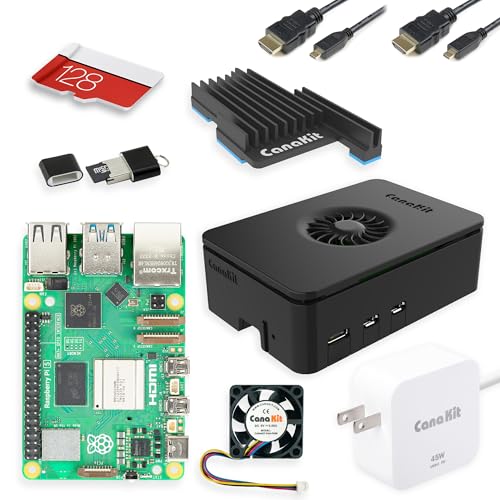
- 8GB Raspberry Pi 5 with 2.4GHz quad-core CPU
- 128GB microSD card with Raspberry Pi OS
- Includes cooling, case, power supply, and display cables
Best For: Complete Raspberry Pi 5 desktop and maker setups
Best Beginner-Friendly Kit
UNIHIKER M10 Python IoT Dev Kit

- Pre-installed Debian and Python environment
- Built-in touchscreen, sensors, microphone, and buzzer
- Wi-Fi, Bluetooth, and micro:bit accessory support
Best For: STEM learning and hands-on Python IoT projects
Best Value Raspberry Pi Kit

- 8GB Raspberry Pi 5 with 2.4GHz quad-core processor
- Active cooler, case, screwdriver, and instructions included
- Supports dual 4K displays and PCIe expansion
Best For: DIY, home automation, and flexible Raspberry Pi projects
Best for Edge AI

- Ampere GPU with 1024 CUDA cores and 32 Tensor Cores
- Up to 34–67 TOPS of listed AI performance
- Ubuntu 22.04 with CUDA, TensorRT, cuDNN, and OpenCV
Best For: Computer vision, robotics, and edge-AI development
Best AI Learning Lab

- Multi-LLM, vision, voice, and sensor projects
- Includes camera, pan-tilt hardware, and IMU
- Raspberry Pi required; guided video lessons included
Best For: Raspberry Pi AI and computer-vision learners
Best Complete UNO Q Bundle
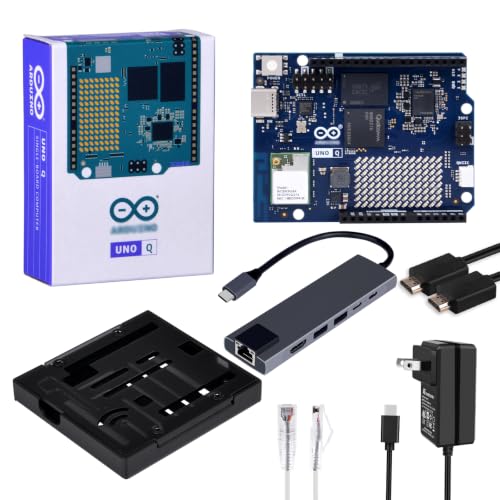
- UNO Q with 2GB RAM and 16GB eMMC
- Includes case, power, HDMI, and USB-C hub
- Supports standalone and PC-connected operation
Best For: UNO Q embedded-development setups
Best Beginner Python Kit

- Built-in 2.8-inch touch screen and Linux
- 15 guided Python and AIoT lessons
- Plug-and-play camera, sensors, and actuators
Best For: Beginner coding classes and hands-on Python IoT learning
Best Learning Kit
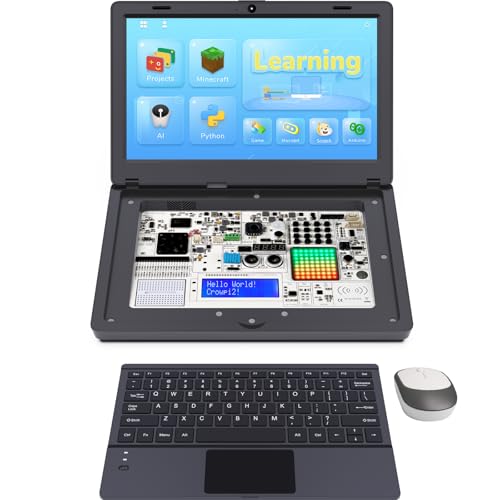
- Raspberry Pi 5 with 8GB RAM and touchscreen
- Built-in board with 22 sensors and controls
- Includes 76 step-by-step programming lessons
Best For: Structured electronics and programming education
Best Budget Starter
Raspberry Pi 5 4GB Essentials Kit

- Includes Pi 5 board, active cooler, case, and screwdriver
- Supports Wi-Fi, Bluetooth, Ethernet, HDMI, USB, and GPIO
- Suitable for IoT, robotics, gaming, and media projects
Best For: Flexible Raspberry Pi 5 projects on a simpler budget
Best Plug-and-Play Bundle

- Official 8GB Pi 5 with 128GB preloaded microSD
- Includes power, cooling, case, cables, and guide
- Designed for coding, gaming, smart home, and robotics
Best For: Starting Raspberry Pi projects with minimal setup
Best Performance Starter Kit – Raspberry Pi 5 8GB Pro Kit
CanaKit Raspberry Pi 5 Starter Kit PRO - Turbine Black (128GB Edition) (8GB RAM)
Check Price On AmazonFor shoppers comparing single-board computer kits, the CanaKit Raspberry Pi 5 Starter Kit PRO offers a ready-to-use setup with 8GB of RAM, 128GB of included storage, cooling hardware, a case, power supply, and display cables. The preloaded Raspberry Pi OS helps reduce setup time.
Best For: Desktop projects, media setups, coding, and makers who want a well-equipped Raspberry Pi 5 bundle.
Pros:
- Includes a Raspberry Pi 5 with 8GB RAM and a 2.4GHz quad-core processor.
- Comes with a 128GB microSD card preloaded with 64-bit Raspberry Pi OS.
- Includes a case, low-noise fan system, heat sink, 45W USB-C power supply, and two display cables.
Cons:
- The larger bundle may include accessories you do not need for a minimal project.
- Storage is provided on a microSD card rather than built-in storage.
This is a strong all-in-one choice when you want Raspberry Pi 5 performance without sourcing the essential accessories separately. Its cooling and display accessories also make it practical for desktop-style use.
Best Beginner-Friendly Kit – UNIHIKER M10 Python IoT Dev Kit
Among single-board computer kits, the UNIHIKER M10 stands out as an approachable learning platform. It combines Debian Linux, a Python environment, a touchscreen, sensors, wireless connectivity, and expansion interfaces in one compact board.
Best For: Beginners, STEM classrooms, and interactive Python or IoT projects that benefit from built-in sensors and a screen.
Pros:
- Pre-installed Debian and Python support can reduce initial setup work.
- Built-in 2.8-inch touchscreen, microphone, gyroscope, accelerometer, light sensor, and buzzer.
- Wi-Fi, Bluetooth, micro:bit compatibility, and Gravity interfaces support varied projects.
Cons:
- Its 512MB of RAM is modest compared with more powerful Raspberry Pi and Jetson options.
- The kit is more specialized for learning and embedded projects than general desktop use.
The UNIHIKER M10 is designed to make experimentation accessible, especially when wiring separate components would add complexity. Its block-to-Python workflow is useful for learners progressing toward conventional programming.
Best Value Raspberry Pi Kit – Raspberry Pi 5 8GB Kit
This RasTech bundle is a practical option for shoppers seeking single-board computer kits centered on the Raspberry Pi 5. It includes the 8GB board, an ABS case, active cooler, screwdriver, and installation instructions, while retaining the Pi 5’s support for fast USB, dual displays, wireless networking, and PCIe expansion.
Best For: DIY projects, home automation, coding, media streaming, and users who already have a power supply or storage solution.
Pros:
- Includes an 8GB Raspberry Pi 5 with a 2.4GHz quad-core Arm processor.
- Supports dual 4K displays at 60Hz, USB 3.0, Gigabit Ethernet, Wi-Fi, and Bluetooth 5.0/BLE.
- Active cooler and case are included, along with a screwdriver and installation instructions.
Cons:
- The listed built-in media is 8GB rather than a larger preloaded storage bundle.
- A compatible power supply and suitable storage may need to be purchased separately.
This kit keeps the core Raspberry Pi 5 hardware and cooling covered while leaving storage and power choices flexible. It is a sensible fit for experienced makers who already have compatible accessories.
Best for Edge AI – Jetson Orin Nano AI Super Kit
For demanding AI-focused single-board computer kits, the Yahboom Jetson Orin Nano development kit is built around accelerated edge computing. It combines an NVIDIA Ampere GPU with Tensor Cores, a six-core Arm CPU, LPDDR5 memory, external NVMe support, and an Ubuntu 22.04 software environment.
Best For: Computer vision, robotics, ROS2 development, AI models, and real-time video or voice-interaction experiments.
Pros:
- Provides an NVIDIA Ampere GPU with 1024 CUDA cores and 32 Tensor Cores.
- Supports up to 34–67 TOPS of AI performance, with configurable 7W–25W power use noted in the listing.
- Includes an Ubuntu 22.04 environment with CUDA, TensorRT, cuDNN, and OpenCV support.
Cons:
- The listed 4GB RAM configuration is less generous than some competing development boards.
- External NVMe storage is required for the supported M.2 setup.
- Its advanced AI software stack may be more complex for first-time single-board computer users.
This kit is best evaluated as an edge-AI development platform rather than a general-purpose beginner computer. Its GPU acceleration and software support are the main reasons to choose it for vision, robotics, and model deployment work.
Best AI Learning Lab – SunFounder Fusion Lab Kit
The SunFounder Fusion Lab Kit is an ambitious option among single-board computer kits for learners who want to explore AI with a compatible Raspberry Pi. It combines sensors, a camera, pan-tilt hardware, and guided video lessons for projects involving voice, vision, motion, and Python. The Raspberry Pi itself is not included.
Best For: Beginners and engineers building hands-on Raspberry Pi AI, computer-vision, and voice-interaction projects.
Pros:
- Supports Raspberry Pi 5, 4B, 3B+, 3B, and Zero 2W models.
- Includes a camera, Pan-Tilt HAT, 10-axis IMU, OLED screen, servo, and other project hardware.
- Guided video courses, sample code, documentation, and technical support help structure the learning process.
- Supports projects using multi-LLMs, YOLO, OpenCV, MediaPipe, speech recognition, and text-to-speech.
Cons:
- The required Raspberry Pi board must be purchased separately.
- The large feature set may feel complex for users seeking a simple starter project.
Choose this kit when the goal is a broad, project-based introduction to AI hardware rather than basic electronics alone. Its strongest advantage is the combination of structured lessons and interactive components that let learners see, hear, and control their programs.
Best Complete UNO Q Bundle – GeeekPi Arduino UNO Q Kit
The GeeekPi Starter Kit packages the Arduino UNO Q with the core accessories needed to begin AI and embedded development. For shoppers comparing single-board computer kits, it stands out with 2GB of RAM, 16GB of eMMC storage, an aluminum case, power supply, HDMI cable, and a USB-C hub with Ethernet.
Best For: Users who want a protected, ready-to-connect Arduino UNO Q setup for standalone or PC-assisted development.
Pros:
- Includes the official UNO Q with 2GB RAM and 16GB eMMC storage.
- Can operate as a standalone computer with a monitor and keyboard or connect to a PC through USB-C.
- Aluminum case provides protection and supports heat dissipation.
- Accessory bundle includes a USB-C hub, USB-C PD power supply, HDMI cable, Ethernet cable, screws, and screwdriver.
Cons:
- The kit is designed specifically for the Arduino UNO Q and is not a general Raspberry Pi accessory bundle.
- The listed warranty is six months.
This is a practical choice if convenience and physical protection matter as much as the board itself. The included connectivity accessories reduce the number of separate purchases, while the dual operating modes accommodate both traditional Arduino workflows and standalone use.
Best Beginner Python Kit – UNIHIKER M10 IoT Bundle
The UNIHIKER M10 Python IoT Kit is one of the more approachable single-board computer kits for learning Python without assembling a traditional monitor-and-keyboard setup. Its Linux-based board has a built-in 2.8-inch touch screen, Wi-Fi, Bluetooth, and a plug-and-play sensor and actuator package.
Best For: Beginners, classrooms, and coding camps that want guided Python, IoT, and entry-level AI projects with minimal wiring.
Pros:
- Built-in touch screen, Wi-Fi, Bluetooth, and Linux allow standalone use.
- Includes a 15-lesson curriculum progressing from basic Python to AIoT projects.
- Color-coded Gravity connectors simplify connection of the camera, speaker, pump, servo, and other hardware.
- Supports practical projects such as object detection, MQTT control, and data-focused Python applications.
Cons:
- The included warranty is 90 days from delivery.
- Its plug-and-play approach offers less emphasis on traditional breadboard wiring practice.
For a low-friction introduction to physical computing, this bundle is especially compelling. The integrated display and structured lessons make it easier to begin, while the included peripherals provide a path from basic coding to interactive IoT and AI activities.
Best Learning Kit – CrowPi2 Raspberry Pi 5 8GB
The ELECROW CrowPi2 is one of the most complete single-board computer kits for hands-on programming and electronics learning. It combines a Raspberry Pi 5 8GB, an 11.6-inch HD touchscreen, camera, protective case, and a development board with built-in sensors and controls.
Best For: Students, beginners, and makers who want structured Raspberry Pi lessons without separately wiring common components.
Pros:
- Includes a Raspberry Pi 5 with 8GB of RAM and an integrated 11.6-inch touchscreen.
- Built-in components include an LCD, LED matrix, buzzer, light, PIR, ultrasonic, and IR sensors.
- Provides 76 step-by-step programming lessons covering components, code, and terminal use.
- The solid ABS shell and organized design make it convenient to transport.
Cons:
- Its all-in-one design may be more kit than users need for basic Raspberry Pi projects.
- The supplied notes do not specify included storage media or a power supply.
Choose this kit when the goal is guided learning and immediate experimentation. Its integrated hardware reduces setup friction, while the lesson library gives beginners a clear path from identifying components to running code.
Best Budget Starter – Raspberry Pi 5 4GB Essentials Kit
The SANOOV Raspberry Pi 5 4GB bundle is a practical entry point for single-board computer kits, supplying the board, active cooler, ABS case, and screwdriver in one package. It is suited to projects ranging from programming and 4K playback to IoT, robotics, retro gaming, and media servers.
Best For: Beginners and hobbyists who need a ready-to-assemble Raspberry Pi 5 foundation with cooling and basic protection included.
Pros:
- Includes the Raspberry Pi 5 4GB board, active cooler, ABS case, and screwdriver.
- Supports Wi-Fi, Bluetooth 5.0, Gigabit Ethernet, HDMI, USB, and GPIO connectivity.
- The aluminum heatsink and PWM fan are designed to limit heat buildup during sustained loads.
- The case preserves access to the board’s ports and buttons.
Cons:
- The case cannot accommodate an M.2 HAT add-on board and solid-state drive.
- The supplied notes do not list a microSD card or power supply.
- With 4GB of RAM, it offers less memory than the 8GB kits in this roundup.
This kit makes sense if you want the core hardware for a variety of projects without paying for an integrated display or lesson platform. Add storage and power as needed, and keep the case limitation in mind if an M.2 setup is part of your plan.
Best Plug-and-Play Bundle – Vilros Raspberry Pi 5 MAX 8GB
The Vilros Raspberry Pi 5 Starter Kit MAX is a ready-to-use choice among single-board computer kits. It pairs the official 8GB Raspberry Pi 5 board with a 128GB microSD card preloaded with Raspberry Pi OS, a case, power supply, cooling, HDMI cables, a card reader, and setup documentation.
Best For: Beginners and advanced users who want substantial storage and a plug-and-play Raspberry Pi 5 package for coding, gaming, smart-home, or robotics projects.
Pros:
- Includes the official Raspberry Pi 5 8GB board and a 128GB microSD card with Raspberry Pi OS.
- Supplies a power supply, cooling case, two micro-HDMI-to-HDMI cables, card reader, and quick-start guide.
- Supports up to 4K at 60p through the included HDMI cables, according to the supplied details.
- Quad-core 2.4GHz processing and broad connectivity support demanding project types.
Cons:
- The larger bundle may include accessories you already own.
- The supplied notes do not identify the exact power-supply specification.
This is the strongest convenience-focused option of the three. With the operating system already installed and storage, cooling, cables, and power included, it minimizes the extra shopping usually required before a Raspberry Pi project can begin.
How We Picked These Single-Board Computer Kits
We focused on kits that combine a capable single-board computer with the accessories needed to begin building. Our evaluation emphasizes board performance, memory and storage, cooling, enclosure quality, power compatibility, included sensors or peripherals, software support, and the clarity of the learning materials. We also considered whether each bundle suits a specific use case rather than treating every kit as interchangeable.
Because these products target different users, the list includes conventional Raspberry Pi starter bundles alongside AI-focused boards, touchscreen development systems, robotics kits, and all-in-one educational computers.
Quick Comparison
| Best For | What to Look For | Typical Strength |
|---|---|---|
| First Linux projects | Raspberry Pi board, case, cooling, storage, and power supply | Broad community support |
| AI and computer vision | GPU acceleration, supported frameworks, and adequate memory | Machine-learning experimentation |
| Python and IoT learning | Built-in display, sensors, guided lessons, and simple setup | Hands-on education |
| Robotics | GPIO access, motor or sensor compatibility, and documentation | Physical computing |
| Portable learning | Integrated screen, keyboard, battery options, and durable housing | Self-contained projects |
Key Buying Factors for Single-Board Computer Kits
Performance and Memory
Choose the processor and RAM according to your workload. Basic coding, home automation, and lightweight servers need less power than local AI inference, computer vision, multitasking, or desktop use. More memory can also help when running several services at once.
Cooling and Power
Performance boards can throttle when they get hot. Active coolers, heatsinks, and ventilated cases are valuable for sustained workloads. Confirm that the included USB-C power supply provides the board’s recommended output; an underpowered adapter can cause crashes and unstable peripherals.
Storage and Software
Preloaded microSD cards or onboard eMMC shorten setup time, but check their capacity and whether the operating system is replaceable. Raspberry Pi kits benefit from extensive community documentation, while AI boards may require specific Linux images, drivers, and framework versions.
Expansion and Included Accessories
For robotics and IoT, inspect the GPIO layout, sensor compatibility, camera support, USB ports, display connections, and included modules. A complete-looking bundle is not necessarily complete for your project, so verify whether cables, adapters, storage, and power are included.
Who Should Buy Which Single-Board Computer Kits?
Beginners and families should favor a Raspberry Pi kit with a case, cooling, storage, power supply, and clear documentation. Students learning Python or IoT may get more value from a UNIHIKER or CrowPi-style bundle with a display, sensors, and guided lessons. AI enthusiasts and robotics developers should prioritize Jetson or AI-oriented kits with suitable acceleration and framework support. Experienced makers can choose a simpler board bundle and spend the savings on project-specific sensors, cameras, or controllers.
Before ordering, compare the board generation, RAM, storage, included power adapter, cooling design, and operating-system support. Those details usually matter more than the number of accessories in the box.