The best robot building kits turn screen time into hands-on problem-solving, combining construction, electronics, coding, and mechanical design in one project.
We selected 10 options for different ages and skill levels, from beginner-friendly remote-control builds to advanced Arduino, AI, hydraulic, and programmable robotics kits.
Best 10 Robot Building Kits Picks for 2026
Best Programmable Car Kit

- FPV camera, line tracking, and obstacle avoidance
- Guided wiring with Arduino programming support
- Rechargeable battery and app or IR control
Best For: Beginners, families, classrooms, and coding clubs
Best No-Battery STEM Build
Thames & Kosmos Mega Cyborg Hand

- Wearable hydraulic hand powered by water and air
- Adjustable fingers and three possible configurations
- Teaches principles used in industrial robotics
Best For: Hands-on mechanical STEM exploration from age 7
Best AI Robotics Kit
TinkRbot AI Robot Building Kit

- Programmable sensors and motors for autonomous builds
- Includes block coding and simple AI lessons
- Designed for repeated rebuilding and classroom groups
Best For: Ages 12+ exploring coding, robotics, and introductory AI
Best Multi-Model Kit
Sillbird 5-in-1 Building Robot
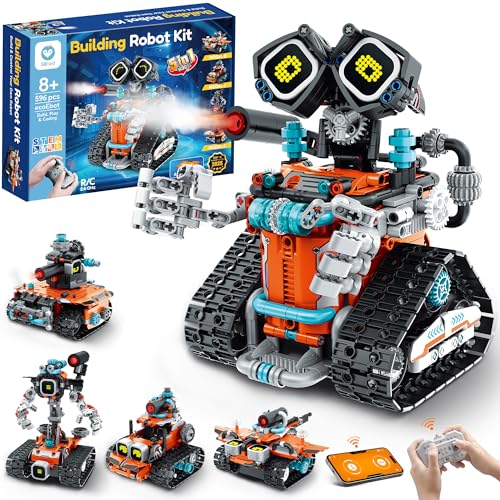
- 596 pieces create five different models
- App and remote control with lights and sound
- Rechargeable design with beginner-friendly instructions
Best For: Ages 8–14 and families wanting varied, guided builds
Best Multi-Model Pick

- Builds five different robot-themed models
- Remote and app control with basic programming
- 337+ pieces with step-by-step instructions
Best For: Kids who want variety and beginner coding
Best Movie-Themed Build

- 1,176-piece oversized Johnny 5 model
- Remote and app-controlled movement
- Rechargeable battery with about 40 minutes of runtime
Best For: Movie fans and experienced builders
Best Hands-On Electronics Project

- Introduces motors, wiring, and circuit control
- Wooden mechanical-arm construction project
- No soldering required; batteries sold separately
Best For: STEM projects at home or in classrooms
Most Versatile

- Five buildable designs
- App and remote control
- 488 pieces with rechargeable battery
Best For: Kids who want varied builds and programmable play
Best for Control Options
Programmable Building Block Robot
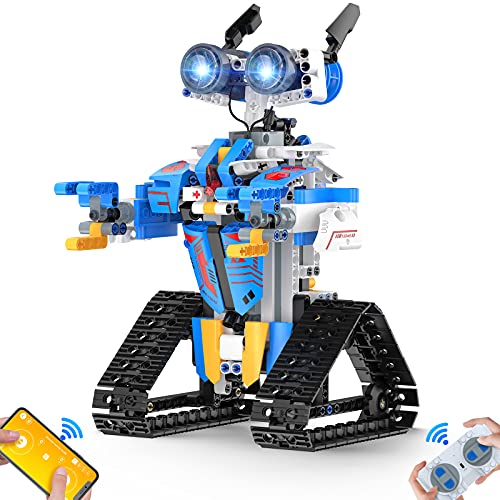
- Six interactive control modes
- 468-piece STEM build
- Lights and stunt movement
Best For: Kids who want varied ways to control a finished robot
Best Solar STEM Pick

- Builds 12 different models
- Powered by sunlight or strong artificial light
- 190 parts with clear instructions
Best For: Kids exploring DIY engineering and renewable energy
Best Programmable Car Kit – ELEGOO UNO R3 Smart Robot Car
For shoppers comparing robot building kits, the ELEGOO UNO R3 Smart Robot Car Kit combines hands-on assembly with Arduino programming and several interactive driving modes. Its guided wiring, camera, and included sensors make it a practical choice for beginners ready to build and code a working robot car.
Best For: Families, coding clubs, STEM classrooms, and beginners ages 12 and up who want to explore programmable robotics.
Pros:
- Includes line tracking, obstacle avoidance, FPV video, app control, and IR remote control.
- Keyed connectors and an illustrated tutorial help reduce wiring mistakes.
- Arduino IDE support encourages custom routes, sensor reactions, and coding experiments.
- Includes a rechargeable 2000 mAh lithium-ion battery.
Cons:
- The many modules and wiring connections may require adult guidance for first-time builders.
- Its recommended age is 12 and up, making it less suitable for younger children.
This is a strong pick when the goal is to move beyond simple assembly into electronics, programming, and autonomous robot-car behaviors.
Best No-Battery STEM Build – Thames & Kosmos Mega Cyborg Hand
Among robot building kits, the Thames & Kosmos Mega Cyborg Hand offers a different approach: builders create a wearable mechanical hand powered by air pressure, water, and their own fingers. It provides a focused introduction to hydraulic and pneumatic principles without motors or batteries.
Best For: Kids ages 7 and up who enjoy mechanical experiments, hands-on STEM learning, and wearable builds.
Pros:
- Uses hydraulic pistons to open, close, and grip objects.
- Adjustable finger joints support more precise movement.
- Can be configured as a right hand, left hand, or claw-like design.
- Requires no batteries and fits virtually any human hand.
Cons:
- It is a mechanical hand experiment rather than a programmable robot.
- Builders must work with tubing, screws, springs, and water during assembly and operation.
This kit is best for understanding how pressure-based systems work in industrial robotics, especially when the builder prefers physical experimentation over coding.
Best AI Robotics Kit – TinkRbot AI Robot Building Kit
The TinkRbot AI is one of the more advanced robot building kits for learners ready to assemble a chassis, wire sensors and motors, and program autonomous behaviors. Its reusable hardware, real-time sensor visualization, and online lessons extend the project beyond a single build.
Best For: Solo builders, classroom groups, and learners ages 12 and up interested in coding, autonomous robots, and introductory AI.
Pros:
- Supports line following, obstacle avoidance, and maze-solving projects.
- Includes ultrasonic, reflectance, and infrared sensors, plus DC and servo motors.
- Online lessons cover block coding and simple machine-learning model training.
- Designed for repeated rebuilding and classroom use by groups of two to four.
Cons:
- The number of components and programming options may feel demanding for beginners.
- Recommended for ages 12 and up and includes small parts.
Choose this kit when long-term learning matters: the same robot can be rebuilt, tested, and reprogrammed for progressively more challenging coding and AI activities.
Best Multi-Model Kit – Sillbird 5-in-1 Building Robot
The Sillbird Robot Building Kit is a versatile entry point for families comparing robot building kits for children ages 8 to 14. Its 596 pieces can be assembled into five models, while app and remote control, lights, sound, and a rechargeable battery add variety after construction.
Best For: Children and families seeking multiple beginner-friendly builds with creative play and basic coding-oriented robotics features.
Pros:
- Offers five models, including a robot, car, and tank.
- Includes colorful step-by-step instructions for beginners.
- Supports Bluetooth app and remote control, with LED eyes and sound effects.
- Rechargeable power and a spray function add interactive play options.
Cons:
- The kit focuses on guided model building and play rather than advanced programming.
- The spray feature requires adding water before use.
This is a practical choice for younger builders who may lose interest after one design, since the five-model format encourages rebuilding and shared family projects.
Best Multi-Model Pick – 5-in-1 STEM Robot Kit
If you’re comparing robot building kits for children, this 337-piece set stands out for its variety. Kids can build five different machines, then use the included remote or smartphone app to control and program their creations.
Best For: Kids ages 8–12 who want multiple builds, beginner programming, and hands-on STEM play.
Pros:
- Five build options include a camera robot, lion chariot, battle armor, shooter, and agricultural harvester.
- Remote and iOS/Android app control support interactive play.
- App introduces basic programming for custom actions and paths.
- Step-by-step instructions and modular construction encourage rebuilding.
Cons:
- The set contains many pieces, so assembly may require patience and organization.
- The product notes list a recommended age of 6 years and up, while the main description targets ages 8–12.
This is a flexible choice for families who want one kit with several projects rather than a single finished model. Its combination of building, remote control, and introductory coding gives children multiple ways to engage with robotics.
Best Movie-Themed Build – Johnny 5 Remote-Control Robot
For shoppers seeking robot building kits with a display-worthy result, this 1,176-piece Johnny 5 set recreates the recognizable movie robot in an oversized, motorized form. It combines a substantial building project with remote or app-controlled movement.
Best For: Movie fans, adult builders, and older children who want a large interactive model.
Pros:
- 1,176-piece build creates an approximately 18.5-inch-tall Johnny 5 figure.
- Remote and mobile app control enable forward, backward, turning, and head rotation.
- Includes movable arm joints, eyebrows, tracks, and a laser-weapon model for added display detail.
- Rechargeable battery provides about 40 minutes of runtime and includes a charging cable.
Cons:
- AA batteries for the remote are required but not included.
- The large, detailed build is better suited to patient builders than quick-play sessions.
- The listing gives both an 8+ manufacturer recommendation and a 14+ age-range description.
This kit is particularly appealing when the finished model matters as much as the building experience. Its large scale, movie styling, and powered functions make it a stronger fit for collectors and experienced builders than for beginners seeking a simple project.
Best Hands-On Electronics Project – Wooden Robot Arm Kit
This robot arm kit offers a practical introduction to robotics and circuits for kids, teens, and adults. Builders assemble a wooden mechanical arm, connect motors and a PCB microcontroller board, and explore how electrical controls create mechanical movement.
Best For: Families, classrooms, and hobbyists looking for a hands-on engineering project without soldering.
Pros:
- Combines a wooden construction project with motors, wiring, and circuit concepts.
- No soldering is required, making the electronics assembly more approachable.
- Detailed assembly guidance supports a challenging, skill-building project.
- Suitable for children ages 8 and up, teens, adults, and classroom STEM activities.
Cons:
- Six AA batteries are needed and are not included.
- The wooden build may be more demanding than a basic snap-together kit.
- It is a single robot-arm project rather than a multi-model set.
Among robot building kits, this is the most directly focused on mechanical engineering and basic electronics. Choose it when the goal is learning how components, circuits, and movement work together rather than controlling a character-style robot.
Most Versatile – 5-in-1 Programmable Robot Kit
This 5-in-1 option is one of the more versatile robot building kits for children who want to build, rebuild, and control their creations. The 488-piece set includes colorful instructions, app and remote control, and a rechargeable battery for up to 40 minutes of continuous play.
Best For: Kids ages 8 and up who enjoy model variety, beginner programming, and screen-free STEM activities.
Pros:
- Builds five designs, including a robot, car, tank, and dinosaur.
- Supports Bluetooth app control and remote control, with programmable play.
- Includes clear, colorful step-by-step instructions and a rechargeable battery.
Cons:
- The rechargeable battery provides about 40 minutes of continuous play.
- Its 488-piece assembly may require adult help for some builders.
Choose this kit if flexibility matters more than a single specialized build. Adjustable joints and multiple models give children plenty of opportunities to experiment as their building skills develop.
Best for Control Options – Programmable Building Block Robot
Among robot building kits, this 468-piece model stands out for its range of control modes. Children can build the robot, then use the app, 2.4GHz remote, path mode, voice control, gravity sensing, or STEM programming mode to explore different ways to operate it.
Best For: Kids ages 8 and up who want interactive controls, lights, movement, and a hands-on building project.
Pros:
- Offers app Bluetooth control, remote control, voice control, path mode, and programming.
- Moves in multiple directions and includes rotating stunt movement and glowing eyes.
- Includes 468 pieces, stickers, organized bags, and a colorful assembly manual.
Cons:
- The product listing specifies a 90-day warranty against manufacturer defects.
- Its numerous control modes may be more than younger or first-time builders need.
This is a practical pick for children who may lose interest after assembly alone. The combination of building, lights, movement, and several control methods creates more ways to play after the robot is complete.
Best Solar STEM Pick – 12-in-1 Solar Robot Kit
This 12-in-1 solar robot kit offers a different approach to robot building kits by connecting construction with renewable-energy concepts. Its 190 parts can be assembled into 12 models, and the robot can run in sunlight or under a strong artificial light source such as a flashlight.
Best For: Kids ages 8 and up who are interested in DIY engineering, solar power, and outdoor or screen-free play.
Pros:
- Builds 12 different models with progressively challenging designs.
- Uses sunlight or a strong artificial light source instead of batteries.
- Includes a larger solar panel and clear step-by-step instructions.
Cons:
- It has 190 pieces, fewer than the two programmable kits in this roundup.
- Performance depends on available sunlight or a sufficiently strong indoor light source.
Consider this kit when the learning goal includes renewable energy rather than app-based control. The multiple builds and increasing difficulty can help children practice dexterity and problem-solving while exploring how light can power a project.
How We Picked the Best Robot Building Kits
We evaluated these Robot Building Kits by looking at the type of construction involved, recommended age range, control method, learning potential, included components, and likely replay value. Kits that support programming, multiple builds, or mechanical experimentation offer more ways to keep learning after the first project is complete.
We also considered whether a kit is better suited to independent building, guided family activities, classroom use, or experienced hobbyists. Because product contents can vary by seller and edition, check the current listing for exact battery, app, tool, and software requirements before ordering.
Quick Comparison
| Kit Type | Best For | What to Look For |
|---|---|---|
| Programmable robot car | Older children, teens, and beginners in coding | Arduino compatibility, sensors, camera support, and expansion options |
| Remote-control robot | Kids who want immediate play value | Durable parts, simple controls, rechargeable power, and build variety |
| Solar or multi-build kit | Younger builders and science projects | Clear instructions, multiple configurations, and suitable lighting conditions |
| Hydraulic or robot-arm kit | Mechanical STEM learning | Movement range, grip strength, assembly complexity, and safe operation |
| Large model or collectible build | Teens and adult hobbyists | Piece quality, display appeal, motorization, and space requirements |
Key Buying Factors for Robot Building Kits
Age and Difficulty
Choose a kit that matches the builder’s patience and prior experience, not just their age. Younger children often benefit from larger pieces and remote controls, while older learners may prefer wiring, sensors, coding, or open-ended builds.
Controls and Programming
Remote control is usually the fastest route to active play. App control adds convenience, while Arduino or block-based programming offers deeper learning. Confirm device compatibility and whether software is included.
Power and Accessories
Check whether batteries, a USB cable, tools, or a compatible smartphone are required. Rechargeable kits can reduce running costs, but charging time and battery access matter for regular use.
Build Quality and Project Variety
Look for sturdy connectors, readable instructions, replacement-part availability, and enough configurations to justify the price. A multi-build kit is especially useful for classrooms or siblings sharing one set.
Who Should Buy Which Robot Building Kits?
For a first robotics experience, choose a straightforward remote-control or multi-build kit with clear instructions. For coding practice, an Arduino-compatible robot car or app-controlled programmable model is the stronger choice. Builders interested in engineering mechanics may prefer a hydraulic hand or robot arm, while collectors and experienced hobbyists can consider a larger motorized display model.
Before buying, match the kit to the intended setting. A compact, battery-powered build works well for bedrooms and travel; larger sets need a dedicated workspace. If the goal is education, prioritize programming and repeatable experiments. If the goal is a gift or weekend activity, prioritize fast assembly, reliable controls, and an engaging finished robot.