Smart aquarium controllers make it easier to monitor temperature, humidity, lighting, pumps, and other equipment without staying beside the tank. The right system can provide remote alerts, automate routine tasks, and help you respond quickly when conditions drift.
This roundup covers ten controller options, including simple Wi-Fi thermostats, smart timers, aquarium displays, and broader reef-control systems. Use the buying guide below to match features, compatibility, and control depth to your setup.
Best 10 Smart Aquarium Controllers for Remote Monitoring Picks for 2026
Best Temperature Hub

- Remote temperature control via iOS and Android app
- Dual relay outputs for heating and cooling
- High/low temperature and sensor-failure alarms
Best For: Aquarium keepers managing heating and cooling remotely
Best Smart Lighting Hub

- Required for Aquascape Color-Changing Lights
- Remote app control with scheduling
- Supports Alexa voice controls
Best For: Aquascape lighting setups needing wireless control
Best Heater Safety Controller

- Dual probes monitor temperature differences
- Dual relays help protect against overheating
- App notifications for heating and probe alerts
Best For: Remote heater monitoring and aquarium temperature safety
Best Reef Pump Controller
Red Sea ReefRun Dual Controller

- Works with the ReefBeat app
- Controls up to two ReefRun devices
- Includes feed, maintenance, and emergency modes
Best For: Red Sea reef systems with compatible pumps
Best Environmental Display

- Designed for Neptune Apex setups
- Tracks temperature and humidity
- Monitors CO2 and VOCs
Best For: Neptune Apex users monitoring room conditions
Best App-Based Sensor
WiFi Aquarium Thermometer Hygrometer

- Uses Smart Life or Tuya apps
- Includes a one-meter wired probe
- Offers alerts and data export
Best For: Remote temperature and humidity checks
Best Simple Lighting Timer

- Combines timer and power strip
- Includes eight grounded outlets
- Supports aquarium day/night cycles
Best For: Scheduled aquarium lighting without app connectivity
Best Dual-Probe Value
WiFi Heating & Cooling Controller

- Dual probes monitor two locations
- Separate heating and cooling outlets
- Remote app readings, settings, and alerts
Best For: Aquarium temperature control with remote access
Best Dedicated Display
Insight Standard Aquarium Monitor
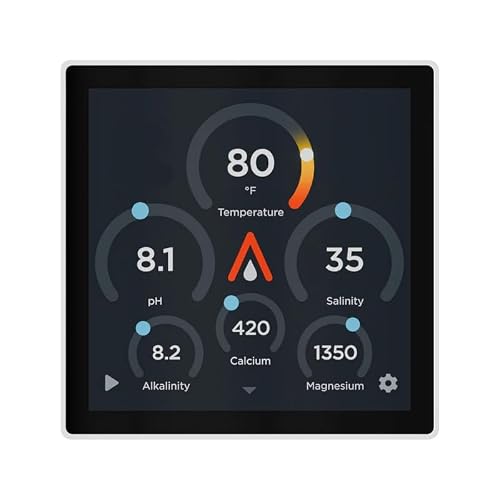
- 4-inch touchscreen for live Apex data
- Wireless Apex Local connectivity
- Customizable always-on dashboard
Best For: Neptune Apex users wanting an at-a-glance display
Best Environmental Alerts
WiFi Temperature & Humidity Monitor

- App alerts for temperature or humidity changes
- Waterproof external probe
- Color LCD with wide measurement ranges
Best For: Remote aquarium environment monitoring and alerts
Best Temperature Hub – Inkbird WiFi ITC-308
For aquarists comparing smart aquarium controllers for remote monitoring, the Inkbird WiFi ITC-308 focuses on temperature management. Its app supports remote control over 2.4 GHz Wi-Fi, while dual relay outputs handle heating and refrigeration equipment.
Best For: Aquarium keepers who want app-based remote temperature control for both heating and cooling equipment.
Pros:
- Supports iOS and Android remote control through the INKBIRD app.
- Controls heating and refrigeration with dual relay outputs.
- Provides high- and low-temperature alarms, including sensor-malfunction alerts.
- Plug-and-play design with Celsius/Fahrenheit readings and temperature calibration.
Cons:
- Supports only 2.4 GHz Wi-Fi.
- Maximum output load is listed as 1100 W at 110 V.
This is a practical choice when temperature is the main remote-monitoring priority. It is more specialized than a broader aquarium automation hub, but its app control and alarm functions make it useful for maintaining a stable setup.
Best Smart Lighting Hub – Aquascape Smart Control Hub
The Aquascape Smart Control Hub is a lighting-focused option for shoppers considering smart aquarium controllers for remote monitoring. It is required for Aquascape Color-Changing Lights and enables app-based control, scheduling, flow adjustment, and Alexa voice commands.
Best For: Aquascape Color-Changing Light users who want wireless control and customized lighting schedules.
Pros:
- Controls compatible lights from anywhere through the Aquascape Smart Control App.
- Supports customized scheduling and wireless flow adjustment.
- Offers Alexa voice-control functions.
- Designed for quick and easy setup.
Cons:
- Required to power and run Aquascape Color-Changing Lights.
- Requires adequate wireless coverage and supports 2.4 GHz Wi-Fi.
This hub makes the most sense as part of an Aquascape lighting system rather than as a general aquarium monitoring controller. Its strength is convenient remote lighting management, not temperature or equipment safety monitoring.
Best Heater Safety Controller – Inkbird ITC-306A WiFi
The Inkbird ITC-306A is a heater-specific pick among smart aquarium controllers for remote monitoring. Its two probes help verify tank temperature, while the app can push notifications when probe readings differ by more than 3 degrees Celsius or when a heating period ends without reaching the target.
Best For: Aquarium owners who want remote heater control with dual-probe checks and overheating protection.
Pros:
- Uses two probes to provide more reliable temperature checks.
- Dual relays can shut off the connected heater when overheating is detected.
- App notifications alert users to probe differences and heating-time issues.
- Plug-and-play design supports heaters up to 1100 W.
Cons:
- Controls a heater only and is not intended for cooling equipment.
- Temperature setting range is 20 to 35 degrees Celsius, or 68 to 95 degrees Fahrenheit.
Choose this model when heater safety and redundant sensing matter more than all-in-one equipment control. The two-probe alerts add useful oversight, but its heater-only design limits its role in more complex systems.
Best Reef Pump Controller – Red Sea ReefRun Dual Controller
The Red Sea ReefRun Dual Controller targets reef-system equipment management for those comparing smart aquarium controllers for remote monitoring. Through the ReefBeat app, it controls up to two compatible ReefRun return or skimmer pumps and provides customizable operating modes.
Best For: Reef aquariums using up to two compatible ReefRun return or skimmer pumps.
Pros:
- Integrates with Red Sea’s ReefBeat app.
- Controls up to two ReefRun devices.
- Supports customizable feed, maintenance, and emergency modes.
Cons:
- Compatibility is limited to ReefRun return and skimmer pumps.
- The supplied notes do not indicate temperature-control functions.
This controller is best viewed as a dedicated reef-pump management accessory rather than a universal aquarium controller. It is a focused option for Red Sea users who want app-based control of compatible circulation and skimmer equipment.
Best Environmental Display – AvidAqua Insight Pro
For shoppers comparing smart aquarium controllers for remote monitoring, the AvidAqua Insight Pro is a display designed for Neptune Apex setups. It provides at-a-glance environmental readings beyond basic aquarium temperature.
Best For: Neptune Apex users who want a dedicated high-contrast monitoring display for surrounding room conditions.
Pros:
- Designed as a display for Neptune Apex aquarium controllers.
- Monitors ambient room temperature and humidity.
- Also tracks CO2 and volatile organic compounds (VOCs).
Cons:
- The supplied information does not indicate that it independently controls aquarium equipment.
- Its compatibility is specifically presented around Neptune Apex systems.
This is a focused monitoring display rather than an all-in-one controller. It makes the most sense for Apex owners who want broader environmental awareness at the aquarium station.
Best App-Based Sensor – WiFi Aquarium Thermometer Hygrometer
Among smart aquarium controllers for remote monitoring, this WiFi thermometer and hygrometer focuses on sensor data rather than equipment control. Its wired probe, mobile app access, alerts, and data export make it useful for checking conditions when you are away.
Best For: Aquarium keepers who want phone-based temperature and humidity monitoring with a probe for confined spaces.
Pros:
- One-meter probe cable supports placement in aquariums and other tight spaces.
- Supports remote monitoring through the Smart Life or Tuya Smart app.
- Sends app notifications when temperature or humidity exceeds set limits.
- Works with Alexa for voice temperature queries and supports data storage and export.
Cons:
- Alexa does not display the temperature data; it can only provide the reading by voice.
- The listed temperature range is limited to 40°C, with stated accuracy specifications that buyers should review.
- The supplied information does not indicate direct control of aquarium equipment.
This sensor is a practical remote-monitoring add-on for users who prioritize alerts and historical data. Its smart-scene support may also connect readings with compatible devices, though the product is primarily a monitoring gauge.
Best Simple Lighting Timer – Zoo Med AquaSun Controller
For buyers considering smart aquarium controllers for remote monitoring, the Zoo Med AquaSun takes a simpler approach: it combines a programmable timer with a power strip. Its analog design helps automate aquarium lighting and establish a consistent day/night cycle.
Best For: Aquarium owners who need straightforward scheduled lighting with multiple grounded outlets.
Pros:
- Combines a programmable timer and power strip in one unit.
- Provides eight grounded outlets.
- Supports a natural day/night cycle for fish.
- Works with various aquarium lamps and is easy to program.
Cons:
- Its analog design is not presented as app-connected or remotely monitored.
- The supplied information describes two settings, limiting scheduling flexibility.
- It focuses on lighting and power scheduling rather than environmental sensing.
This controller is best viewed as a dependable local timer rather than a connected monitoring hub. Choose it when consistent lamp scheduling matters more than WiFi alerts or phone-based aquarium access.
Best Dual-Probe Value – WiFi Heating & Cooling Controller
For shoppers comparing smart aquarium controllers for remote monitoring, this WiFi thermostat stands out for its dual probes and separate heating and cooling outlets. Its app supports remote temperature adjustments, live readings, and alerts, while the LED display provides local visibility.
Best For: Aquariums and other setups needing remote temperature monitoring with independent heater and cooling control.
Pros:
- Dual probes can monitor temperatures in different locations.
- Independent outlets support separate heating and cooling ranges.
- WiFi app provides remote settings, readings, and alerts.
- Includes calibration support and a clear LED display.
Cons:
- It is primarily a temperature controller rather than a broad aquarium-parameter monitor.
- The product is corded and designed for 120-volt operation.
- Its advertised applications extend beyond aquariums, so aquarium-specific features are limited.
This is a practical choice when temperature stability is the main priority. The dual-probe design and two controlled outlets offer more flexibility than a basic single-outlet thermostat, though users seeking pH, salinity, or other water-parameter tracking will need a different system.
Best Dedicated Display – Insight Standard Aquarium Monitor
AvidAqua Insight Standard Aquarium Controller Display | Neptune Apex, Hydros Monitoring Screen
Check Price On AmazonAmong smart aquarium controllers for remote monitoring, the Insight Standard is designed for aquarists who want an always-on screen alongside a Neptune Apex system. Its 4-inch touchscreen displays key readings over existing WiFi without requiring a cable back to the head unit.
Best For: Neptune Systems Apex users who want a dedicated, glanceable display for aquarium parameters.
Pros:
- Shows real-time pH, temperature, salinity, ORP, and supported Trident parameters.
- Connects wirelessly through Apex Local over WiFi.
- Customizable dashboard widgets keep preferred data visible.
- Includes a table stand and supports compatible magnetic mounting options.
Cons:
- Designed exclusively for Neptune Systems Apex controllers.
- It is a display rather than a standalone aquarium controller.
- Advanced room monitoring features are listed for the Pro model, not this Standard model.
This model makes the most sense for an existing Apex setup where continuous local visibility matters. It complements mobile access with a dedicated screen, but its compatibility limitation makes it unsuitable for aquariums built around other control platforms.
Best Environmental Alerts – WiFi Temperature & Humidity Monitor
This WiFi temperature and humidity monitor is a useful option for shoppers seeking smart aquarium controllers for remote monitoring of environmental conditions. It combines a waterproof external probe, color LCD, and app alerts over 2.4GHz WiFi, with Bluetooth support as an additional connection method.
Best For: Aquarium setups that need remote temperature and humidity alerts from a moisture-resistant external probe.
Pros:
- Push notifications warn when readings move outside preset limits.
- Waterproof, corrosion-resistant probe suits wet environments.
- Measures temperatures from -40°C to 125°C and humidity from 0 to 100% RH.
- Color display shows live readings and supports Celsius or Fahrenheit.
Cons:
- Its supplied features focus on monitoring rather than automatic heater or chiller control.
- WiFi operation uses the 2.4GHz band.
- It is a general-purpose environmental monitor, not a full aquarium water-parameter controller.
Choose this model when notifications and probe durability are more important than multi-parameter aquarium automation. It can help flag changing conditions remotely, but aquarists needing active equipment switching or measurements such as pH and salinity should look for a more comprehensive controller.
How We Picked the Best Smart Aquarium Controllers for Remote Monitoring
We focused on controllers that offer practical monitoring or automation for aquarium and related aquatic setups. The selection includes temperature-focused devices, app-connected sensors, lighting and power controls, dedicated display units, and reef controllers designed to coordinate pumps or skimmers.
Key considerations included remote access, probe design, outlet or device compatibility, alert functionality, ease of setup, app support, display readability, and whether a product is best suited to freshwater, reef, or general environmental monitoring. Because these products vary substantially in scope, the best choice depends on the equipment you need to control—not simply the number of advertised features.
Quick Comparison
- For basic heater control: Consider a Wi-Fi thermostat with a dedicated probe and clear temperature settings.
- For broader reef automation: Look for a controller that integrates pumps, skimmers, lighting, and an established aquarium app.
- For at-a-glance readings: A dedicated high-contrast display can complement an existing controller or monitoring system.
- For lighting and power scheduling: A smart hub, timer, or power strip may be more appropriate than a full aquarium controller.
- For multi-purpose monitoring: Dual temperature and humidity probes are useful for mixed environments, equipment rooms, and enclosures.
Key Buying Factors for Smart Aquarium Controllers for Remote Monitoring
Connectivity and App Support
Verify whether the controller uses 2.4GHz Wi-Fi, Bluetooth, a proprietary hub, or a larger ecosystem. Check that the app supports push notifications, historical readings, device sharing, and reliable remote access. A controller is only useful remotely if its connection remains stable.
Probe Accuracy and Placement
Temperature probes should be waterproof where appropriate, long enough to reach the desired location, and easy to secure away from heaters or direct equipment flow. Dual-probe models can provide redundancy or monitor separate zones, but confirm how the controller uses each reading.
Control Capacity and Safety
Check outlet ratings, the number of independently controlled outlets, and compatibility with heaters, pumps, lights, and skimmers. For heating equipment, look for adjustable thresholds, alerts, and safeguards against overheating. Avoid exceeding the controller’s electrical limits.
Compatibility and Expansion
Some devices work independently, while others are intended for a particular brand or ecosystem. Confirm compatibility with your existing lights, pumps, aquarium controller, and mobile device before buying. Expansion support matters if you expect your system to grow.
Who Should Buy Which Smart Aquarium Controllers for Remote Monitoring?
Choose a Wi-Fi thermostat if temperature control is your main priority and you want straightforward alerts without a complex automation platform. Choose a reef controller or smart hub if you need coordinated control of multiple devices and are comfortable configuring an ecosystem.
Choose a display unit if you already own compatible aquarium hardware but want clearer local visibility. Choose a smart timer or power strip for scheduled lighting and basic equipment switching. Finally, choose a dual-probe temperature and humidity controller when you need flexible environmental monitoring beyond a single aquarium temperature reading.