Choosing the right enclosure can make or break your storage setup, especially when reliability and data protection matter.
These RAID storage enclosures for reliable operation are built for users who want stable performance, flexible RAID options, and room to grow.
Best 10 RAID Storage Enclosures for Reliable Operation Picks for 2026
High-Speed 4-Bay Pick

- USB 3.2 Gen 2x2 for faster transfers
- RAID 0/1/5/10, JBOD, and Normal modes
- Fan-cooled aluminum design with 150W power
Best For: Users wanting fast, flexible RAID storage with strong cooling
Premium Thunderbolt Choice
OWC ThunderBay 4 with SoftRAID

- Dual Thunderbolt 3 ports
- Up to 1527MB/s sustained performance
- Includes SoftRAID Premium subscription
Best For: Mac and pro users who want Thunderbolt speed with RAID software
Capacity-Focused 5-Bay Pick
ORICO 5-Bay RAID HDD Enclosure

- Eight RAID and utility modes
- Up to 110TB total capacity
- Locking design with silent cooling fan
Best For: Large-capacity users who want flexible RAID and drive security
Balanced 4-Bay Value

- Supports Normal, RAID 0/3/5/1/10, Clone, and JBOD
- Up to 96TB capacity
- Dual fans with switchable cooling
Best For: Users wanting a practical 4-bay enclosure with solid mode variety
Enterprise 5-Bay RAID Pick
ORICO 5-Bay RAID Enclosure, 20Gbps USB 3.2 Gen 2x2
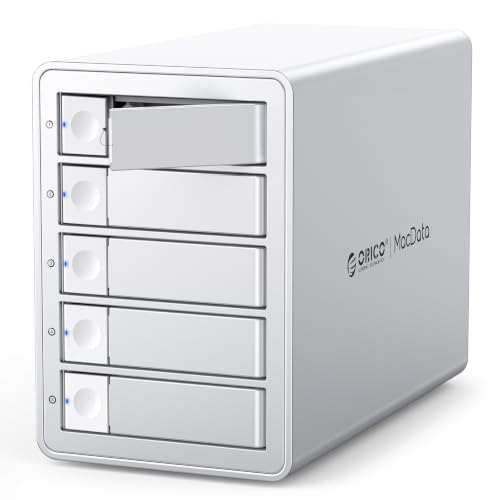
- 5 RAID options plus Normal and JBOD
- Up to 130TB with 26TB-per-drive support
- Aluminum build, 45dB fan, and 150W PSU
Best For: High-capacity users who want flexible RAID and reliable cooling
Compact 2-Bay RAID Choice
TERRAMASTER D2-320 2-Bay USB RAID Enclosure

- RAID 0, 1, JBOD, and Single modes
- Up to 10Gbps USB 3.2 Gen 2 transfer speed
- Tool-free trays with intelligent cooling fan
Best For: Small teams and home users who want a simple, reliable 2-bay DAS
Flexible 5-Bay RAID Option
UGREEN 5-Bay USB-C DAS, 8 RAID Modes

- 8 modes including RAID 0, 1, 3, 5, and 10
- Up to 160TB across five 2.5/3.5-inch drives
- Smart cooling fan and five status LEDs
Best For: People who want lots of RAID and storage mode flexibility
Dual-Bay RAID Workhorse
Mercury Elite Pro Dual USB/eSATA

- Two-bay enclosure with RAID 0, 1, SPAN, and JBOD
- Pre-set RAID 0 can reach up to 407MB/s
- USB 3.2 Gen 1 and eSATA 6 Gb/s connectivity
Best For: Users who want a simple dual-drive RAID enclosure for backup and fast desktop storage
High-Capacity 5-Bay RAID

- Supports RAID 0, 1, 3, 5, 10, JBOD, Clone, and Clear
- Up to 110TB capacity across five SATA drives
- Built-in 150W PSU with 80mm cooling fan
Best For: Users building a large desktop RAID setup for backups and media storage
Flexible 4-Bay DAS
CENMATE 80TB Aluminum RAID Enclosure

- Eight modes including RAID 0, 1, 3, 5, 10, and CLONE
- Supports up to 80TB across four SATA drives
- Aluminum case and built-in fan for cooling
Best For: People who need a versatile 4-bay DAS for backup, storage, and mixed drive use
High-Speed 4-Bay Pick – ORICO 4-Bay RAID Enclosure
If you want RAID storage enclosures for reliable operation with more headroom for large workloads, this ORICO 4-bay model is built around speed, cooling, and flexible array support. Its USB 3.2 Gen 2×2 connection and JMS591 chip are aimed at faster transfers, while the aluminum body, fan, and 150W internal power supply help it stay steady during long sessions.
Best For: Video creators, enterprise users, and technical teams that need fast multi-drive storage with multiple RAID options.
Pros:
- Supports RAID 0, 1, 5, 10, JBOD, and Normal modes.
- USB 3.2 Gen 2×2 interface is designed for high-speed transfers, with USB4 able to reach full 20Gbps.
- Built-in 45dB fan, aluminum construction, and large cooling grille support stable operation.
- Internal 150W power supply helps deliver smooth multi-drive performance.
Cons:
- Changing RAID mode or setting up an array will erase drive contents.
- Thunderbolt connections are limited to around 10Gbps here, not full 20Gbps.
- Best suited to SATA drives, so it is not a universal drive-format solution.
Overall, this is the most performance-focused option in the group, especially if you care about faster transfers and broader RAID flexibility. It is a strong fit when reliable operation matters and you want a high-capacity enclosure that can keep up with demanding workflows.
Premium Thunderbolt Choice – OWC ThunderBay 4 with SoftRAID
This OWC enclosure is a strong pick among RAID storage enclosures for reliable operation if you want Thunderbolt performance and software-backed RAID management. With dual Thunderbolt 3 ports, sustained speeds up to 1527MB/s, and SoftRAID Premium included, it is aimed at users who want a polished, enterprise-style setup.
Best For: Mac and pro workstation users who want Thunderbolt connectivity and included RAID management software.
Pros:
- Dual Thunderbolt 3 ports support a fast, professional workflow.
- Up to 1527MB/s sustained performance is listed.
- Works with 3.5-inch or 2.5-inch drives without adapters.
- Includes SoftRAID Premium for creating, monitoring, and managing arrays.
Cons:
- It is the most premium option here, so it is not the budget pick.
- Best value depends on whether you will use the included RAID software.
- Storage and RAID flexibility are strong, but the notes focus more on speed than raw capacity.
For buyers who value a refined Thunderbolt setup and software support, this enclosure stands out immediately. It makes sense when you want dependable day-to-day RAID use and prefer an all-in-one ecosystem rather than a bare enclosure.
Capacity-Focused 5-Bay Pick – ORICO 5-Bay RAID HDD Enclosure
If your priority is dependable RAID storage enclosures for reliable operation with more bays and backup-friendly features, this ORICO 5-bay model gives you plenty of room to grow. It supports multiple RAID modes, a locking design, and a high-power internal supply, making it a practical choice for large media libraries and project archives.
Best For: Users who need higher drive counts, strong capacity, and straightforward RAID flexibility.
Pros:
- Supports eight modes: 0, 1, 3, 5, 10, JBOD, CLONE, and CLEAR.
- Accommodates up to 22TB per drive for a total of 110TB.
- 80mm silent cooling fan and front/rear vents help with heat dissipation.
- Independent safety locking mechanism adds physical drive security.
Cons:
- USB 3.0 performance is rated up to 5Gbps, so it is not the fastest option.
- RAID changes require backing up data first, since switching modes can erase drives.
- It is focused on 3.5-inch SATA disks, not a mixed-format storage solution.
This is a practical enclosure when capacity, cooling, and security matter more than top-end interface speed. It is well suited to users who want a stable five-bay platform for backups, engineering data, or large video files.
Balanced 4-Bay Value – MAIWO 4-Bay RAID Enclosure
The MAIWO model is a straightforward option in RAID storage enclosures for reliable operation if you want a balanced mix of features, cooling, and capacity. It offers several RAID modes, USB-C connectivity, and dual fans, making it a sensible fit for backups, media storage, and workstations that need stable everyday use.
Best For: Professionals and power users who want a capable 4-bay RAID enclosure with simple cooling and broad mode support.
Pros:
- Supports Normal, 0, 3, 5, 1/10, Clone, and Large (JBOD) modes.
- USB A/C 3.1 interface is rated up to 5Gbps.
- Up to 96TB capacity with four 24TB drives.
- Two built-in fans with an on/off switch help maintain drive temperatures.
Cons:
- 5Gbps transfer speed is modest compared with faster RAID enclosures.
- Best suited to 3.5-inch SATA drives, so it is less flexible than some alternatives.
- Mode switching still requires care, since RAID changes can affect stored data.
For buyers who want a practical four-bay enclosure without overspending on premium interfaces, this MAIWO option covers the basics well. It is especially appealing if you value cooling control and a broad mix of RAID choices over maximum speed.
Enterprise 5-Bay RAID Pick – ORICO 5-Bay RAID Enclosure, 20Gbps USB 3.2 Gen 2×2
If you need RAID storage enclosures for reliable operation with plenty of room to grow, this ORICO 5-bay model is built for high-capacity workflows. It combines a JMS591 upgrade, USB 3.2 Gen 2×2 connectivity, and support for multiple RAID layouts so you can balance speed, redundancy, and capacity for demanding storage tasks.
Best For: IT, media, AI, and research users who want a high-capacity 5-bay RAID enclosure with strong cooling and flexible RAID options.
Pros:
- Supports RAID 0, 1, 5, 10, JBOD, and Normal modes for flexible storage planning
- Built for up to 130TB total capacity with 26TB per 3.5-inch SATA drive
- Includes a 150W power supply plus aluminum housing and a low-noise fan for stable operation
- Compatible with Windows, macOS, and Linux, and supports hot-swapping
Cons:
- Thunderbolt connections will not reach the enclosure’s full 20Gbps capability
- Changing RAID modes erases drives, so backing up first is required
This is a strong fit if you want a roomy enclosure that prioritizes dependable operation, cooling, and RAID flexibility. Its best advantages show up in workloads that need both capacity and controlled performance.
Compact 2-Bay RAID Choice – TERRAMASTER D2-320 2-Bay USB RAID Enclosure
The TERRAMASTER D2-320 is a practical choice if you want RAID storage enclosures for reliable operation in a compact 2-bay format. It uses USB 3.2 Gen 2 for up to 10Gbps transfer speeds and offers hardware RAID modes that can support either performance or mirrored protection, depending on how you set it up.
Best For: Users who want a simple 2-bay DAS with RAID 0/1 support, tool-free drive access, and quiet temperature management.
Pros:
- Supports RAID 0, RAID 1, JBOD, and Single modes
- Tool-free tray design and push-lock mechanism make drive swaps easy
- Intelligent temperature-controlled fan adjusts speed based on drive heat
- Works with 2.5-inch and 3.5-inch SATA HDDs, plus 2.5-inch SATA SSDs
Cons:
- Only two drive bays, so expansion is limited compared with larger enclosures
- As a DAS, it is not a NAS and is meant for direct attachment
For small setups, this enclosure keeps the feature set focused on reliability and ease of use rather than complexity. It is especially appealing if you want mirrored data protection without giving up straightforward installation.
Flexible 5-Bay RAID Option – UGREEN 5-Bay USB-C DAS, 8 RAID Modes
If you need RAID storage enclosures for reliable operation with more mode choices, this UGREEN 5-bay DAS is built around flexibility. It supports multiple RAID and storage configurations, gives you room for up to five SATA drives, and adds smart cooling plus clear drive-status indicators for day-to-day confidence.
Best For: Users who want a 5-bay USB-C DAS with many RAID modes, drive status LEDs, and smart cooling.
Pros:
- Offers 8 storage modes, including RAID 0, 1, 3, 5, 10, PM, Large, and Clone
- Supports up to 160TB total capacity with five 32TB drives
- Smart cooling fan uses S.M.A.R.T. temperatures and can stop during inactivity in PM mode
- Five independent LEDs help show drive presence, issues, and RAID rebuilding
Cons:
- USB 3.2 Gen 1 tops out at 5Gbps, which is slower than higher-speed enclosures
- Changing RAID modes requires reformatting, so backups are essential
This model stands out for users who value mode flexibility and clear operating status over raw interface speed. It is a sensible pick when you want a roomy enclosure that is easy to monitor and manage.
Dual-Bay RAID Workhorse – Mercury Elite Pro Dual USB/eSATA
If you want RAID storage enclosures for reliable operation with simple setup, the OWC Mercury Elite Pro Dual is a practical two-bay option for desktop backup and production work. It supports two 3.5-inch SATA drives and gives you RAID 0, RAID 1, SPAN, and JBOD through a hardware switch, so you can choose speed, mirroring, or basic expansion without dealing with complex configuration.
Best For: Home offices and studios that want a straightforward dual-drive enclosure with fast USB/eSATA connectivity and easy RAID switching.
Pros:
- Supports four RAID modes: RAID 0, RAID 1, SPAN, and JBOD
- Pre-configured in RAID 0 for speeds up to 407MB/s
- Includes both USB 3.2 Gen 1 Type-B and eSATA 6 Gb/s ports
- Designed for two 3.5-inch SATA 7200 RPM hard drives
Cons:
- Only supports two drives, so capacity is more limited than larger enclosures
- Best performance depends on using matching drives and the right RAID mode
This is a solid pick if you want a compact, hardware-based RAID enclosure that balances speed, mirroring, and connection flexibility. The included cables and simple mode switching make it easy to deploy for backup or media workflows.
High-Capacity 5-Bay RAID – ORICO 110TB 5-Bay DAS Station
For RAID storage enclosures for reliable operation with bigger capacity needs, this ORICO 5-bay DAS is built for multi-drive desktops and long-running use. Its hardware RAID controller supports RAID 0, 1, 3, 5, 10, JBOD, Clone, and Clear modes, giving you plenty of options for redundancy, disk duplication, or independent drive use without software management.
Best For: Large backup jobs, media libraries, and workstation users who need a high-capacity 5-bay hardware RAID enclosure.
Pros:
- Hardware RAID controller with multiple modes, including RAID 5 and RAID 10
- Supports both 2.5-inch and 3.5-inch SATA HDDs and SSDs
- Up to 110TB total capacity with 22TB per drive support
- Built-in 150W power supply and 80mm cooling fan for stability
Cons:
- USB 3.0 transfer speed tops out at 230MB/s in the supplied notes
- Large desktop footprint compared with smaller dual-bay units
This enclosure is a strong fit when reliability and capacity matter more than compact size. The built-in power supply and active cooling make it better suited to sustained multi-drive operation than basic external enclosures.
Flexible 4-Bay DAS – CENMATE 80TB Aluminum RAID Enclosure
If you need RAID storage enclosures for reliable operation in a smaller desktop format, the CENMATE 4-bay aluminum enclosure offers a balanced mix of capacity, cooling, and RAID options. It supports 2.5-inch and 3.5-inch SATA HDDs/SSDs, uses USB 3.0 plus eSATA, and provides eight modes including RAID 0, 1, 3, 5, 10, CLONE, LARGE, and NORMAL.
Best For: Users who want a 4-bay external RAID enclosure with flexible mode choices and both USB and eSATA connectivity.
Pros:
- Eight RAID modes, including RAID 0, 1, 3, 5, 10, and CLONE
- Supports up to 80TB total capacity with 20TB per drive
- Aluminum-alloy body and 2-inch fan help with heat management
- Includes USB A/C 3.0 and eSATA cables for wider compatibility
Cons:
- Fan noise is noted at around 40-50 decibels
- RAID mode switching requires a specific reset process and data can be lost when changing modes
- Mac OS does not have RAID software per the supplied notes
This model is best viewed as a flexible DAS enclosure for users who need more than two bays but do not want a full NAS. Its cooling and mode flexibility are practical strengths, especially for mixed backup and storage workflows.
How We Picked the Best RAID Storage Enclosures for Reliable Operation
We focused on RAID Storage Enclosures for Reliable Operation that balance build quality, controller support, cooling, connectivity, and bay count. We also favored models with practical RAID modes, clear compatibility with 2.5-inch and 3.5-inch drives where applicable, and interfaces that match common desktop workflows.
Quick Comparison
Need the shortest path to the right choice? Two-bay models are usually best for compact backups and mirrored protection, while four- and five-bay enclosures are better for larger media libraries, business files, and more flexible RAID layouts. USB 3.2 Gen 2×2 and Thunderbolt offer higher throughput, while USB 3.0 and USB-C options are often the better value for general storage.
Key Buying Factors for RAID Storage Enclosures for Reliable Operation
RAID Modes and Redundancy
Look for support for the RAID level you actually need. RAID 1 is the simplest choice for redundancy, RAID 5 or similar layouts improve usable capacity while preserving fault tolerance, and JBOD or individual disk modes are useful when you want each drive to remain separate.
Drive Support and Bay Count
Match the enclosure to your workflow. Two-bay units suit mirrored backups and smaller projects. Four-bay models hit a strong middle ground for creators and home offices. Five-bay enclosures make more sense when capacity, expansion, and storage efficiency matter more than footprint.
Cooling, Noise, and Build
Reliable operation depends on thermal control. Aluminum construction, built-in fans, and decent airflow help protect drives during long transfers and constant use. If the enclosure will sit near your desk, consider noise output as well as cooling performance.
Host Connection and Speed
Choose a connection that fits your computer and your speed needs. Thunderbolt is excellent for demanding workloads, USB-C and USB 3.2 Gen 2×2 offer strong everyday performance, and older USB/eSATA options can still be fine for backup-focused systems.
Who Should Buy What
If you want simple, dependable redundancy, a two-bay RAID enclosure is usually enough. If you need a balance of speed, capacity, and flexibility, a four-bay model is the safest all-around pick. If you manage large media libraries or want more room for growth, a five-bay enclosure is the smarter long-term investment.
In short, the best choice depends on how much capacity you need today, how much data protection you want, and whether speed or expandability matters more in your setup.