Reliable solar power can keep a boat’s lights, electronics, refrigeration, and communication gear running without depending entirely on shore power or a generator. The best off-grid solar kits for boats balance usable battery capacity with efficient panels, a suitable charge controller, and an inverter sized for your real loads.
Our roundup covers compact 100W and 200W systems, higher-output flexible-panel kits, and complete LiFePO4 packages. Use the buying guide below to match the kit’s voltage, charging technology, installation format, and storage capacity to your boat and cruising plans.
Best 10 Off-Grid Solar Kits for Boats Picks for 2026
Best Complete Marine Power System
ExpertPower 1.3kWh 12V Solar Kit

- 400W solar array with 100Ah LiFePO4 battery
- 2,000W pure sine inverter/charger
- Bluetooth monitoring and shore-power UPS switching
Best For: Boat owners wanting expandable lithium storage and AC power
Best 400W Panel-Only Kit

- Four 100W monocrystalline solar panels
- 40A MPPT Rover charge controller
- Bluetooth module, brackets, cables, and adaptor kit included
Best For: Boats with an existing battery bank and inverter
Best Compact All-in-One Setup

- 240W rigid panels and 100Ah LiFePO4 battery
- 1,000W pure sine inverter with 2,000W peak
- Includes cables, connectors, and Z-brackets
Best For: Smaller boats needing an integrated 12V and AC system
Best Smaller Footprint
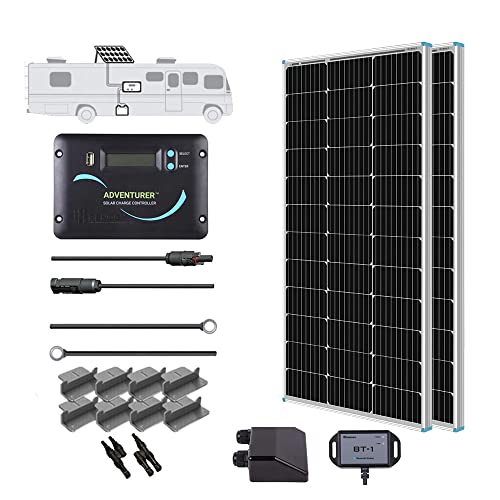
- Two 100W monocrystalline panels
- 30A Adventurer-Li PWM controller
- Bluetooth, cables, brackets, and entry housing included
Best For: Space-constrained boats with moderate charging needs
Best Flexible Pick

- Two 400W monocrystalline flexible panels
- Designed for curved boat and yacht surfaces
- Water-resistant with a sealed junction box
Best For: Curved or irregular marine mounting areas
Best Complete Small System

- Includes a 12V 20Ah LiFePO4 battery
- 20A MPPT controller supports 12V and 24V systems
- Bluetooth monitoring, cables, and brackets included
Best For: Small 12V boat systems with modest loads
Best Rigid-Panel Value
ECO-WORTHY 200W Marine Solar Kit
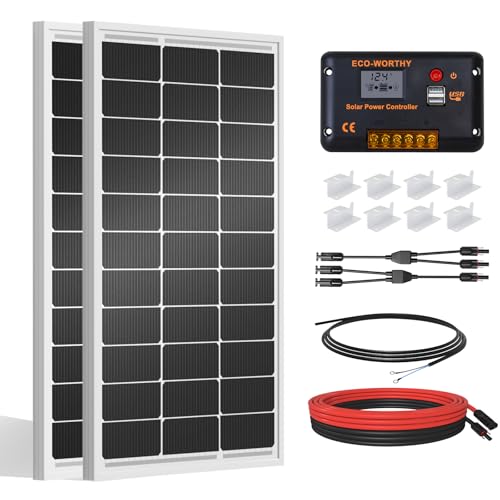
- Two 100W monocrystalline rigid panels
- 30A PWM controller with 12V/24V wiring options
- Corrosion-resistant frames and included mounting hardware
Best For: Boats with space for framed solar panels
Flexible Marine Power

- Two 300W flexible monocrystalline panels
- Waterproof junction box for marine use
- Includes 40A controller and inverter
Best For: Curved boat surfaces needing a higher-output solar setup
Compact Battery Starter

- Includes 12V 20Ah LiFePO4 battery
- 10A controller supports 12V and 24V systems
- Cables and mounting brackets included
Best For: Small boats and light-duty 12V power projects
Connected Deck Power

- Four 100W rigid monocrystalline panels
- 40A MPPT controller with Bluetooth monitoring
- Includes mounting Z brackets and panel cables
Best For: Larger boats with rigid-panel space and remote monitoring needs
Best Complete Marine Power System – ExpertPower 1.3kWh 12V Solar Kit
For boat owners seeking off-grid solar kits for boats with both battery storage and AC output, this ExpertPower package combines 400W of solar generation, a 100Ah LiFePO4 battery, and a 2,000W pure sine wave inverter/charger. Bluetooth monitoring and shore-power backup add useful control for marine installations.
Best For: Boat owners who want a substantial 12V system with lithium storage, phone monitoring, and shore-power switching.
Pros:
- Includes four 100W monocrystalline panels, a 100Ah LiFePO4 battery, and a 2,000W pure sine wave inverter/charger.
- Battery and MPPT controller include Bluetooth monitoring through a smartphone app.
- LiFePO4 battery has built-in BMS protection, low-temperature charge cutoff, and support for expansion up to four batteries.
- Inverter/charger includes UPS functionality and automatically switches between shore power and battery power.
Cons:
- The 400W panel array and included mounting hardware require considerable installation space.
- The package is more elaborate than necessary for boats needing only basic 12V charging.
This is one of the more capable options in the group for a boat that needs stored energy and occasional 120V AC power. Its expansion and shore-power features make it particularly flexible, though installation planning is important.
Best 400W Panel-Only Kit – Renogy 400W Premium Solar Kit
This Renogy kit is a straightforward choice among off-grid solar kits for boats when you already have a compatible battery bank. It supplies four 100W monocrystalline panels, a 40A MPPT controller, Bluetooth capability, cables, an adaptor kit, and mounting brackets.
Best For: Boat owners who need a 400W solar charging array and already have batteries and an inverter.
Pros:
- Four 100W monocrystalline panels provide a 400W rated array.
- The 40A MPPT Rover controller is sized for the included solar capacity and is designed for efficient charging.
- Bluetooth monitoring allows system information to be viewed and modified from a phone.
- Includes Z-brackets, cables, and an adaptor kit for a more complete installation package.
Cons:
- It does not include a battery or inverter, so a boat power system requires additional components.
- The four-panel layout may be difficult to place on smaller boats.
Choose this kit when your marine electrical system already has storage and AC equipment. Its 400W array and MPPT controller offer a useful upgrade path, but the missing battery and inverter increase the total project cost.
Best Compact All-in-One Setup – 1280Wh 240W Boat Solar Kit
For buyers comparing off-grid solar kits for boats, this compact package includes the core components in one bundle: 240W of rigid panels, a 100Ah 12.8V LiFePO4 battery, a 1,000W pure sine wave inverter, and a 20A MPPT controller. Included cables and Z-brackets support a relatively direct installation.
Best For: Boat owners seeking an all-in-one 12V system for modest DC loads and selected 120V AC electronics.
Pros:
- Combines 240W of solar panels, a 1280Wh battery, a 1,000W continuous inverter, and a 20A MPPT controller.
- Pure sine wave AC output is intended for sensitive devices such as laptops, CPAP machines, and televisions.
- Includes battery cables, PV extension cables, plug-and-play connectors, and mounting Z-brackets.
- The LiFePO4 battery includes BMS protection, while the controller provides several electronic safeguards.
Cons:
- The 240W array is smaller than the 400W systems in this roundup.
- The 20A controller and 100Ah battery may be limiting for larger onboard loads.
This kit offers a balanced starting point for a smaller boat or cabin-style marine setup. It is convenient because the battery, inverter, controller, and installation accessories are included, but higher-demand systems may need more solar and storage.
Best Smaller Footprint – Renogy 200W N-Type Boat Kit
This Renogy package is a practical lower-capacity option among off-grid solar kits for boats. It pairs two 100W monocrystalline panels with a 30A Adventurer-Li PWM controller, Bluetooth monitoring, mounting accessories, and cables, making it suited to boats with limited panel space and moderate energy needs.
Best For: Boat owners who need a compact 200W charging system for lithium, lead-acid, or gel batteries.
Pros:
- Two 100W panels provide a smaller 200W array for installations with limited roof or deck space.
- Panels use 22% efficient solar cells and corrosion-resistant aluminum frames designed for outdoor use.
- The 30A Adventurer-Li controller supports lithium, lead-acid, and gel batteries and offers multiple protections.
- Includes Bluetooth monitoring, mounting hardware, cables, branch connectors, and a cable-entry housing.
Cons:
- The PWM controller is less energy-efficient than the MPPT controllers included with several other kits here.
- It provides 200W of solar capacity and does not include a battery or inverter.
- The supplied daily output estimate depends on about four hours of sunlight.
This is a sensible choice when installation footprint matters more than maximum generation. It covers the charging hardware and accessories well, but buyers must supply compatible storage and any inverter needed for AC appliances.
Best Flexible Pick – 800W Flexible Solar Panel Kit
For boat owners comparing off-grid solar kits for boats, this 800-watt setup stands out for its flexible construction and generous rated output. The two 400W monocrystalline panels are designed for curved or irregular surfaces, making them practical for sailboats, yachts, and other marine installations where rigid panels may be difficult to mount.
Best For: Boats with curved decks or other irregular mounting surfaces that need a high-output panel setup.
Pros:
- Flexible panels suit boats, sailboats, yachts, and other curved surfaces.
- Monocrystalline cells are designed to perform in low-light conditions.
- Water-resistant construction and a sealed, waterproof junction box support marine use.
- Six grommet mounting holes allow installation with fasteners, silicone, or adhesive tape.
Cons:
- The kit’s notes do not specify a battery, inverter, or cabling beyond the 40A charge controller.
- Flexible installation may require careful surface preparation and adhesive selection.
This is the most adaptable option of the three for boats with limited flat mounting space. Confirm the available deck area, battery requirements, and controller compatibility before installation.
Best Complete Small System – ExpertPower 200W LiFePO4 Kit
This ExpertPower package is one of the more complete off-grid solar kits for boats because it combines 200W of rigid solar panels, a 12V 20Ah LiFePO4 battery, and a Bluetooth-enabled 20A MPPT controller. It is suited to boaters who want the core charging components in one kit rather than sourcing the battery separately.
Best For: Small 12V marine power systems needing an included battery and MPPT charging controller.
Pros:
- Includes two 100W monocrystalline panels, a 12V 20Ah LiFePO4 battery, and a 20A MPPT controller.
- The controller automatically recognizes 12V and 24V systems.
- Bluetooth connectivity and a digital display provide charging and battery information.
- The battery includes a BMS and low-temperature charging cutoff.
Cons:
- The 20Ah battery is relatively compact for larger onboard electrical loads.
- Rigid panels require suitable mounting space and brackets.
With its included battery, cables, brackets, and Y-branch adapter, this is a practical starter system for smaller marine setups. Its limited battery capacity means it is better for modest loads than full-boat power demands.
Best Rigid-Panel Value – ECO-WORTHY 200W Marine Solar Kit
For boaters who prefer a straightforward rigid-panel arrangement, this ECO-WORTHY kit offers two 100W monocrystalline panels and a 30A PWM controller. Among off-grid solar kits for boats, it is a practical choice for installations that can accommodate framed panels and benefit from included mounting hardware and cables.
Best For: Marine and RV-style installations with enough room for two framed 100W panels.
Pros:
- Includes two 100W monocrystalline panels and a 30A charge controller.
- Panels can be wired in series for 24V or parallel for 12V applications.
- Aluminum frames are corrosion-resistant, with an IP65-rated junction box.
- Includes Z brackets, solar cables, connectors, and tray cable for installation.
Cons:
- The rigid panels weigh 31.6 pounds as listed, which may matter on smaller boats.
- It uses a PWM controller rather than an MPPT controller.
- The supplied notes do not indicate that a battery is included.
This kit makes sense when durability, familiar rigid-panel mounting, and wiring flexibility matter more than a compact or lightweight design. Plan for its panel footprint and provide a compatible battery separately.
Flexible Marine Power – 600W Flexible Solar Panel Kit
This 600-watt flexible kit is designed for boats and other off-grid applications where panels need to follow curved or irregular surfaces. Its monocrystalline cells, waterproof junction box, and multiple installation options make it a practical choice among off-grid solar kits for boats.
Best For: Boat, sailboat, yacht, RV, or other installations with curved mounting surfaces and higher power needs.
Pros:
- Two 300W flexible monocrystalline panels provide a 600W system capacity.
- Flexible construction suits curved boat and marine surfaces.
- Water-resistant design and sealed, waterproof junction box add durability.
- Includes a 40A solar charge controller and inverter.
Cons:
- Battery storage is not listed as included.
- Flexible panels may require careful adhesive or grommet-based installation.
This is the most adaptable option of the three for curved marine layouts. Confirm the controller, inverter, battery, and mounting requirements match your boat’s electrical system before installation.
Compact Battery Starter – 100W 12V LiFePO4 Solar Kit
This compact 12V kit combines a 100W rigid monocrystalline panel with a 20Ah LiFePO4 battery, making it a straightforward entry point for small marine and off-grid systems. It includes the core charging hardware, cables, and mounting brackets needed for a more organized installation.
Best For: Small boats, campers, trailers, and modest 12V projects that need an included battery and simple setup.
Pros:
- Includes a 12V 20Ah LiFePO4 battery for built-in energy storage.
- 10A PWM controller automatically recognizes 12V and 24V systems.
- Controller includes protections against overcharge, over-discharge, overload, and short circuits.
- Includes MC4 solar cables, battery cables, and mounting brackets.
Cons:
- 100W panel capacity is intended for smaller power requirements.
- PWM charging is less advanced than MPPT technology.
For boat owners prioritizing a complete, compact package, this kit is easier to evaluate because the battery and accessories are included. Its modest panel and battery capacities are better suited to lighter loads than full onboard power demands.
Connected Deck Power – ECO-WORTHY 400W 12V MPPT Kit
This 400W rigid-panel system is a strong fit for boat owners who want higher output, MPPT charging, and phone-based monitoring. The kit includes four 100W monocrystalline panels, a 40A MPPT controller, mounting brackets, and a Bluetooth module.
Best For: Boats and RVs with room for multiple rigid panels and users who want to monitor system data remotely.
Pros:
- Four 100W panels provide a 400W total system capacity.
- 40A MPPT controller is specified with up to 99% tracking efficiency.
- Bluetooth module provides real-time panel, battery, and load data through a mobile phone.
- Panels use aluminum frames, low-iron glass, and waterproof IP-65 junction boxes.
Cons:
- Rigid glass panels require more dedicated mounting space than flexible panels.
- Battery storage is not listed as included.
- The complete system is heavier than a flexible-panel alternative.
This kit offers a useful balance of output and monitoring for a larger boat installation. Its rigid construction and multi-panel layout make available deck or roof space, mounting strength, and battery compatibility important planning considerations.
How We Picked the Best Off-Grid Solar Kits for Boats
We compared these kits by solar wattage, nominal system voltage, battery inclusion, battery chemistry, controller type, inverter capacity, panel construction, and installation flexibility. We also considered practical marine concerns such as limited deck space, shade, salt-air exposure, vibration, cable routing, and the need to monitor charging away from the main cabin.
Specifications vary considerably: some products are panel-and-controller bundles, while others include LiFePO4 storage and a pure sine wave inverter. Treat advertised wattage as a maximum under favorable conditions, not guaranteed daily output.
Quick Comparison
| Kit category | Best suited to | Main advantage | Watch for |
|---|---|---|---|
| 100W to 200W compact kits | Day boats and light overnight use | Lower cost and easier installation | Limited energy for refrigeration or heavy electronics |
| 400W rigid-panel kits | Weekend cruising and moderate loads | Good balance of output and durability | Requires secure mounting space |
| 600W to 800W flexible kits | Higher-demand boats with usable deck area | More generation potential and installation flexibility | Flexible panels need careful mounting and ventilation |
| Complete battery-and-inverter systems | Boaters wanting an integrated power station | Includes storage and AC power capability | Heavier, costlier, and more complex to install |
Key Buying Factors for Off-Grid Solar Kits for Boats
Solar Output and Available Space
Measure usable, unshaded mounting areas before choosing wattage. Rigid panels are typically more durable, while flexible panels can suit curved surfaces but should not be walked on unless specifically rated for that use. Partial shade can reduce output substantially, so panel placement and controller quality matter as much as headline wattage.
Battery Capacity and Chemistry
LiFePO4 batteries generally offer lower weight, longer cycle life, and more usable capacity than comparable lead-acid batteries. Calculate daily watt-hours for refrigeration, navigation, lighting, pumps, and devices, then add reserve capacity for cloudy weather. A 12V battery system is common, but confirm compatibility with the controller, inverter, and boat’s existing electrical system.
Controller, Inverter, and Protection
MPPT controllers usually extract more energy than PWM controllers, especially when panel voltage differs from battery voltage. Choose a pure sine wave inverter for sensitive electronics and size it above the highest simultaneous load, not merely the average load. Include appropriately rated fuses, disconnects, marine-grade cable, waterproof connectors, and corrosion-resistant mounting hardware.
Monitoring and Installation
Bluetooth monitoring can make it easier to track charging, battery state, and faults. Confirm the kit includes—or allows for—proper brackets, cable glands, strain relief, and a dry, ventilated location for electronics. Have a qualified marine electrician review the installation when integrating with shore power, an alternator, or an existing distribution panel.
Who Should Buy Which Off-Grid Solar Kits for Boats?
Choose a 100W or 200W kit for maintaining a small battery, powering lights, or supporting occasional electronics. A 400W system is a sensible middle ground for many weekend cruisers. Consider a 600W or 800W flexible-panel setup when your boat has sufficient mounting area and you regularly use refrigeration, pumps, or multiple devices. Select a complete LiFePO4 kit with an inverter when you want stored energy and convenient AC output in one package. Before buying, verify dimensions, controller limits, battery compatibility, weather exposure ratings, and the kit’s wiring requirements against your boat’s electrical plan.