Choosing the right off-grid solar kit starts with matching daily energy needs, battery capacity, and inverter output—not simply buying the largest panel array available. The 10 systems in this roundup cover compact 12V kits, RV-friendly packages, and larger 24V and 48V setups for serious backup power.
Use the comparison and buying advice below to narrow your options by system voltage, charging performance, storage capacity, and installation requirements.
Best 10 Off-Grid Solar Kits for Battery Charging Picks for 2026
Budget LiFePO4 Starter

- Includes a 100W panel, 20Ah LiFePO4 battery, and 10A controller
- Includes cables and mounting brackets
- Automatic 12V/24V detection with digital monitoring
Best For: Small 12V RV, marine, and beginner off-grid projects
Expandable MPPT Platform

- Four 100W monocrystalline panels provide 400W
- Includes a 40A MPPT Rover controller
- Bluetooth module enables monitoring and adjustment from a phone
Best For: Larger 12V battery banks and RV installations
Whole-System Powerhouse

- Six 195W bifacial panels with anti-shade technology
- 7.168kWh stated storage from two LiFePO4 batteries
- Includes a 60A MPPT controller and 3000W pure sine inverter
Best For: Cabins, RVs, and high-capacity off-grid backup power
Proven Expandable Starter

- 100W panel and 30A PWM controller for 12V systems
- Expandable up to 400W with additional panels
- Compatible with AGM, Gel, Flooded, and Lithium batteries
Best For: RVs, campers, and expandable 12V charging setups
High-Capacity Home Kit
SUNGOLDPOWER 5000W Off-Grid Solar Kit

- 5,000W pure sine wave hybrid inverter
- Six 200W panels and 5.12kWh LiFePO4 battery
- Expandable by paralleling up to six units
Best For: Homes, cabins, RVs, and demanding backup systems
Compact 12V Option
ExpertPower 200W Solar Charging Kit

- Two 100W monocrystalline solar panels
- 12V 20Ah LiFePO4 battery with BMS
- 20A PWM controller with digital display
Best For: Small RV, marine, camper, and 12V projects
Balanced Backup System
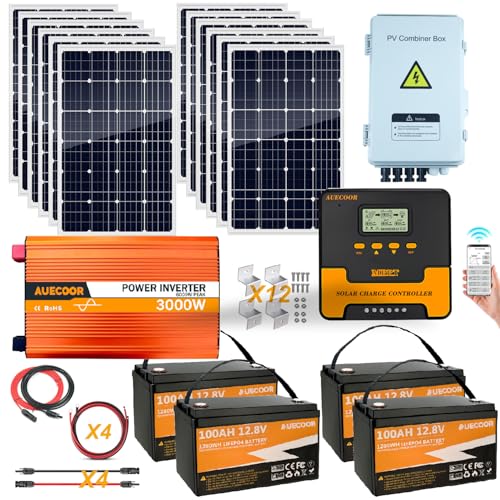
- 1,440W solar array with 5.12kWh battery
- 3,000W pure sine wave inverter
- 60A MPPT controller and PV combiner box
Best For: RV, off-grid, and essential-load backup power
Best Budget Panel Kit
200W 12V/24V ECO-WORTHY Solar Kit

- Two 100W monocrystalline panels
- 30A PWM controller with 12V/24V flexibility
- Includes brackets and solar cables
Best For: Basic battery charging for RVs, campers, cabins, and small off-grid systems
Best Complete 24V System

- 3000W inverter charger with 80A MPPT
- Two 24V 100Ah LiFePO4 batteries
- Four 200W monocrystalline panels
Best For: Cabins, tiny homes, farms, RVs, and larger 24V off-grid systems
Best 12V All-in-One
1280Wh Solar Kit with 1000W Inverter

- 100Ah 12.8V LiFePO4 battery
- 1000W pure sine wave inverter
- 240W panels with 20A MPPT controller
Best For: RV, boat, cabin, shed, and modest home-backup applications
Budget LiFePO4 Starter – 100W 12V Solar Kit
For shoppers seeking off-grid solar kits for battery charging, this compact ECI Power package combines a 100W monocrystalline panel, a 12V 20Ah LiFePO4 battery, and a 10A PWM controller. It also includes solar and battery cables plus mounting brackets, making it a practical starting point for smaller RV, trailer, marine, and backup projects.
Best For: Small 12V systems, beginner installations, and portable or light-duty off-grid projects.
Pros:
- Includes the panel, LiFePO4 battery, controller, cables, and mounting brackets.
- LiFePO4 battery is rated for at least 2,000 cycles at 80% depth of discharge.
- Controller supports automatic 12V/24V recognition and includes a digital display.
- Built-in protections address overcharging, over-discharge, overload, and short circuits.
Cons:
- The 20Ah battery and 100W panel are intended for modest power needs.
- Uses a 10A PWM controller rather than a more efficient MPPT design.
This is an economical all-in-one option when simplicity and included accessories matter more than high capacity. Its small battery limits runtime, but the LiFePO4 chemistry and straightforward monitoring make it a useful entry point for small battery-charging setups.
Expandable MPPT Platform – Renogy 400W Premium Kit
This Renogy kit is designed for buyers who want more panel capacity from their off-grid solar kits for battery charging. It pairs four 100W monocrystalline panels with a 40A MPPT Rover controller and includes brackets, cables, an adaptor kit, and Bluetooth monitoring hardware.
Best For: Larger 12V battery banks, RV installations, and users who want MPPT charging with phone-based monitoring.
Pros:
- Provides four 100W monocrystalline panels for a 400W array.
- 40A MPPT controller is designed for efficient energy harvesting.
- Includes Z-brackets, tray cable, adaptor kit, and Bluetooth module.
- Panel includes a five-year material and workmanship warranty.
Cons:
- The kit does not list a battery, so one must be supplied separately.
- Its 56.4-pound weight may make installation less convenient than smaller kits.
- The supplied maximum battery voltage is listed as 32V, so system compatibility should be checked.
Compared with compact starter kits, this package offers substantially more solar input and a more capable MPPT controller. It is a stronger foundation for regular battery charging, provided you already have—or plan to add—a compatible battery bank.
Whole-System Powerhouse – ECO-WORTHY 1200W 24V System
For substantial energy storage and appliance support, this ECO-WORTHY package is one of the most complete off-grid solar kits for battery charging in the group. It combines six 195W bifacial panels, two 12.8V 280Ah LiFePO4 batteries, a 60A MPPT controller, and a 3000W pure sine wave inverter.
Best For: Cabins, sheds, RVs, trailers, and backup systems requiring high storage capacity and AC power.
Pros:
- Includes 1,170W of bifacial solar panels with anti-shade technology.
- Two batteries provide 7.168kWh of stated storage capacity.
- 3000W pure sine wave inverter supports substantial AC loads.
- 60A MPPT controller and Bluetooth monitoring are included.
Cons:
- This large system requires considerably more installation space and planning.
- The listed daily generation depends on sunlight and is based on under four hours of sunshine.
- It may be more system than necessary for simple battery-charging needs.
This is the choice for buyers moving beyond basic charging into whole-system off-grid power. Its large battery bank, MPPT controller, and pure sine inverter offer broad capability, while the scale and installation requirements make it less suitable for small or occasional projects.
Proven Expandable Starter – Renogy 100W 12V Kit
This Renogy starter kit offers a straightforward entry into off-grid solar kits for battery charging, with a 100W monocrystalline panel, 30A Wanderer PWM controller, cables, and Z-brackets. It is aimed at 12V users who want a compact system today with room to expand later.
Best For: RVs, campers, and 12V battery owners who want a compact, expandable starter system.
Pros:
- Panel is rated at 22.5% cell efficiency and can produce an average of 500Wh per day under stated conditions.
- 30A controller supports expansion up to 400W.
- Compatible with AGM, Gel, Flooded, and Lithium batteries.
- Panel has extensive stated service coverage, including a 25-year power-output plan.
Cons:
- Uses a PWM controller rather than MPPT technology.
- Bluetooth monitoring requires the separately added BT-1 module.
- The package does not list a battery, so storage must be purchased separately.
This kit is a sensible choice when you need dependable 12V panel-and-controller hardware rather than a complete battery system. Its expansion support and broad battery compatibility make it more flexible than its basic 100W starting size suggests.
High-Capacity Home Kit – SUNGOLDPOWER 5000W Off-Grid Solar Kit
For shoppers comparing off-grid solar kits for battery charging, the SUNGOLDPOWER SGM-5K5E is a large, expandable system built around a 5,000W hybrid inverter, six 200W panels, and a 51.2V 100Ah LiFePO4 battery. It is sized for substantial backup and off-grid loads rather than small portable charging.
Best For: Homes, cabins, RVs, sheds, and users who need high-output 120V AC power with substantial battery storage.
Pros:
- Complete package includes inverter, six panels, battery, mounting brackets, and extension cables.
- 5,000W pure sine wave inverter provides 120V AC output and up to 10,000W peak output.
- LiFePO4 battery offers a safer, long-life storage option than traditional lead-acid batteries.
- Inverter can be paralleled with up to six units for future expansion.
Cons:
- At 350 pounds, the kit is substantial and requires careful planning for installation.
- The Wi-Fi monitoring module is sold separately.
- The system may be more capacity than needed for small charging setups.
This is a strong choice when battery charging is only part of a broader off-grid power plan. Its high inverter rating, 48V architecture, and included LiFePO4 storage make it practical for demanding installations, but buyers should be prepared for a heavier, more involved setup.
Compact 12V Option – ExpertPower 200W Solar Charging Kit
For a smaller approach to off-grid solar kits for battery charging, the ExpertPower 200W kit pairs two 100W monocrystalline panels with a 12V 20Ah LiFePO4 battery and a 20A PWM controller. Its 12V format is straightforward for RV, camper, marine, and small solar projects.
Best For: RVs, trailers, campers, boats, and compact 12V systems with modest energy-storage needs.
Pros:
- Includes panels, LiFePO4 battery, controller, cables, mounting brackets, and a Y-branch adapter.
- Controller automatically recognizes 12V and 24V systems.
- Battery BMS helps protect against overcharge, deep discharge, overload, overheating, and short circuits.
- Digital display shows charging and battery information.
Cons:
- The 20Ah battery is much smaller than those in larger home backup systems.
- The 20A PWM controller is less sophisticated than an MPPT-based design.
- Its 200W panel capacity is intended for smaller loads rather than whole-home power.
This kit is a practical entry point for maintaining or charging a small 12V battery bank. The included protection features and accessories simplify setup, while the compact capacity keeps it better suited to mobile and light-duty applications than major backup power.
Balanced Backup System – 3000W 24V Solar Power Kit
This 24V system is one of the more substantial off-grid solar kits for battery charging, combining 1,440W of solar input with a 5.12kWh battery and a 3,000W pure sine wave inverter. The package also includes an MPPT controller and PV combiner box for a more organized installation.
Best For: Off-grid homes, RVs, and backup users who need clean 120V AC power for essential appliances and electronics.
Pros:
- 1,440W of panel capacity is paired with a 5.12kWh battery for substantial daily energy storage.
- 3,000W pure sine wave inverter supports sensitive electronics and motor-driven appliances.
- 60A MPPT controller is rated above 99% tracking efficiency and includes app control.
- PV combiner box helps organize the 12-panel array and adds DC surge protection.
Cons:
- The supplied details do not specify the complete cable and mounting-hardware package.
- A 24V system may require more installation planning than a basic 12V setup.
- Actual daily energy production depends on sunlight and site conditions.
This kit offers a useful middle ground between compact 12V chargers and large 48V systems. Its MPPT controller, sizable battery, and pure sine wave inverter make it well suited to serious RV or essential-load backup use, provided the installation is planned around the 24V architecture.
Best Budget Panel Kit – 200W 12V/24V ECO-WORTHY Solar Kit
For shoppers comparing off-grid solar kits for battery charging, the ECO-WORTHY 200W kit is a straightforward panel-and-controller setup for 12V or 24V systems. It includes two 100W monocrystalline panels, a 30A PWM controller, mounting brackets, and solar cables, making it a practical choice for smaller mobile or backup installations.
Best For: RVs, campers, cabins, sheds, boats, golf carts, and other applications that need basic solar battery charging.
Pros:
- Supports 12V parallel or 24V series configurations.
- Includes two 100W panels, a 30A PWM controller, brackets, and cables.
- Corrosion-resistant aluminum frames and an IP65-rated junction box support outdoor use.
- Rated daily output is up to 800Wh under four hours of full sunshine.
Cons:
- The included PWM controller is less energy-efficient than an MPPT controller.
- This kit does not include a battery or inverter.
- At 31.6 pounds, it may require careful planning for smaller mounting surfaces.
This is a good entry-level option when the priority is panel-based charging rather than a complete power system. Buyers will need to supply a compatible battery and any inverter required for AC appliances.
Best Complete 24V System – 3000W SUNGOLDPOWER Solar Kit
Among off-grid solar kits for battery charging, this SUNGOLDPOWER package stands out as a larger, integrated 24V system. It combines a 3000W inverter charger, 80A MPPT solar charging, two 24V 100Ah LiFePO4 batteries, and four 200W solar panels for substantial storage and inverter capacity.
Best For: Off-grid cabins, tiny homes, farms, RVs, trailers, and users who want solar charging with battery storage and utility or generator support.
Pros:
- Includes a 3000W, 120V AC inverter charger with 80A MPPT solar charging.
- Two 24V 100Ah LiFePO4 batteries provide a substantial storage bank.
- 40A AC charging and a stated 10ms transfer response add charging flexibility and backup capability.
- Four 200W monocrystalline panels are designed for long service life.
Cons:
- The system’s 24V architecture may not suit existing 12V battery setups.
- Its larger capacity and multiple components can make installation more involved.
- The supplied notes do not specify mounting hardware or solar cabling details.
This is the strongest choice of the three for buyers seeking a complete, higher-capacity energy system rather than a simple charging array. Confirm the installation space, wiring requirements, and compatibility with your existing equipment before purchasing.
Best 12V All-in-One – 1280Wh Solar Kit with 1000W Inverter
This all-in-one option is a balanced pick among off-grid solar kits for battery charging when you need both stored energy and household-style AC output. It pairs two 120W panels with a 100Ah 12.8V LiFePO4 battery, a 20A MPPT controller, and a 1000W pure sine wave inverter.
Best For: RVs, boats, cabins, sheds, tiny homes, and emergency backup users running modest 12V and 120V loads.
Pros:
- Includes a 1280Wh LiFePO4 battery and 1000W continuous pure sine wave inverter.
- MPPT charging is designed to improve energy harvest over PWM controllers.
- Package includes panels, controller, inverter, cables, and Z-brackets.
- Pure sine wave output is suitable for sensitive devices such as laptops and CPAP machines.
Cons:
- The 240W solar array is smaller than the array in the SUNGOLDPOWER system.
- A 20A controller and 1000W inverter limit overall system capacity.
- The 12V design may be less suitable for larger, high-demand installations.
This kit offers a convenient middle ground: more complete than a panel-only package, but less substantial than a large 24V system. Its included accessories and pure sine wave inverter make it especially practical for mobile use and modest emergency loads.
How We Picked These Off-Grid Solar Kits for Battery Charging
We selected kits across several useful capacity ranges and system voltages, from portable 12V packages to larger 24V and 48V systems. Our focus was on practical completeness: solar panels, charge controllers, batteries, inverters where included, and the compatibility information needed to build a working off-grid setup.
We also considered battery chemistry, controller type, usable storage, inverter capacity, expandability, and likely applications such as RV travel, sheds, cabins, emergency backup, and remote equipment. Product specifications can vary by seller, so confirm included components, certifications, wiring, and warranty terms before ordering.
Quick Comparison
| System type | Best suited for | What to prioritize |
|---|---|---|
| 100W–200W, 12V | Small electronics, lights, RV essentials | Simple installation and adequate battery capacity |
| 400W, 12V | RVs and moderate daily loads | MPPT charging and panel expansion |
| 1,000W–1,280Wh | Compact backup power | Pure sine wave output and usable battery storage |
| 1,200W–3,000W, 24V | Cabins, workshops, and heavier loads | Higher voltage efficiency and inverter surge rating |
| 5,000W, 48V | Whole-area or high-demand off-grid use | Professional installation, battery expansion, and compliance |
Key Buying Factors for Off-Grid Solar Kits for Battery Charging
Panel Wattage and Sun Conditions
Panel wattage determines how quickly the battery can recover in good sunlight. Account for shade, seasonal changes, roof angle, cable losses, and local peak-sun hours. A larger array is useful when loads are frequent or weather is inconsistent.
Battery Capacity and Chemistry
Battery capacity is measured in watt-hours or kilowatt-hours. LiFePO4 batteries generally offer longer cycle life, lower maintenance, and more usable capacity than lead-acid alternatives, but they may cost more initially. Leave reserve capacity rather than planning to drain the battery completely every day.
Controller and System Voltage
MPPT controllers typically extract more energy than basic PWM controllers, particularly in colder conditions or with higher-voltage panel arrays. A 24V or 48V system can reduce current and cable-size requirements for larger loads, but every component must share the correct voltage.
Inverter Output
Choose a pure sine wave inverter for sensitive electronics, appliances, and motors. Compare continuous wattage with startup or surge wattage, especially for refrigerators, pumps, compressors, and power tools. Also check AC outlets, transfer capability, and low-voltage protections.
Who Should Buy Which Off-Grid Solar Kits for Battery Charging?
Choose a 100W or 200W 12V kit for lights, phones, small fans, monitoring equipment, or occasional RV use. A 400W kit is a better fit for regular RV camping and multiple modest loads. Compact inverter-and-battery systems suit emergency charging and short-duration backup.
Move to a 24V kit for a cabin, workshop, or installation with larger daily demands. The 48V system is intended for substantial loads and longer-term off-grid operation; plan for professional electrical work, grounding, permits where applicable, and future battery or panel expansion.