Choosing among the best off-grid solar kits for rooftops means balancing panel capacity, battery storage, inverter output, roof space, and the appliances you need to run. The systems in this roundup span compact 24V kits and larger 48V home systems with split-phase output.
Use the comparisons below to narrow your options by power demand, backup runtime, installation complexity, and expansion potential before committing to a kit.
Best 10 Off-Grid Solar Kits for Rooftops Picks for 2026
High-Capacity Pick
ECO WORTHY 10kW Off-Grid Solar Kit

- 10,000W split-phase inverter output
- 16.1kWh LiFePO4 battery storage
- Scalable, feature-rich system
Best For: Larger homes needing 120V/240V power and substantial storage
Compact Home System
SUNGOLDPOWER 5kW 48V Solar Kit

- 5,000W pure-sine inverter
- 5.12kWh LiFePO4 battery
- Panels, brackets, and cables included
Best For: Cabins, sheds, RVs, and smaller 120V backup systems
Lightweight Value Option

- 1,170W bifacial panel array
- 3,500W inverter with 7,000W surge
- Portable 2.56kWh LiFePO4 battery
Best For: Cabins, sheds, and essential 110V/120V appliance loads
Split-Phase Midrange Pick

- 6,500W 120V/240V output
- 5.12kWh wall-mounted battery
- 2,220W panel array and hardware included
Best For: Homes and cabins needing flexible split-phase backup power
Best Complete Starter Kit

- 2,340W of N-type solar panels
- 5,000W 48V off-grid inverter
- 100Ah 51.2V LiFePO4 battery
Best For: Cabins, sheds, RVs, and moderate backup power
Best Compact High-Output System
- 6,500W 120/240V inverter
- Six 370W UL61730 panels
- 100Ah 51.2V LiFePO4 battery
Best For: Homes, cabins, and backup systems needing split-phase output
Best High-Capacity Home System

- 10,000W 120/240V inverter
- Two 100Ah lithium batteries
- 2,340W bifacial N-type panels
Best For: Homes and backup systems with larger split-phase loads
High-Capacity Home Backup
3kW 24V Solar Kit with 5.12kWh Battery
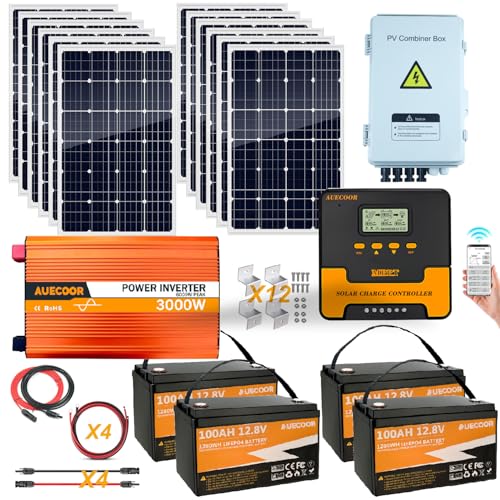
- 1,440W solar input with 5.12kWh storage
- 3,000W pure sine wave inverter
- MPPT control, app monitoring, and surge protection
Best For: Extended home or RV backup power
Whole-Home Power
10kW Split-Phase Solar Kit with 32.2kWh Storage

- 10,620W PV array from 18 high-power panels
- 10kW 120V/240V split-phase output
- 32.2kWh LiFePO4 storage with smart monitoring
Best For: Large homes and high-demand off-grid installations
Expandable RV Backup
3kW 24V Solar Kit with 2.56kWh Battery

- 960W solar input with 2.56kWh battery storage
- 3,000W pure sine wave inverter with 6,000W peak
- Controller accepts future PV additions up to 1,440W
Best For: RV use and smaller essential-load systems
High-Capacity Pick – ECO WORTHY 10kW Off-Grid Solar Kit
The ECO WORTHY 10kW kit is a high-capacity option among off-grid solar kits for rooftops, combining 2,950W of solar panels with a 16.1kWh LiFePO4 battery and a 10,000W split-phase inverter. It is designed for larger household loads, but its pallet delivery and professional-installation recommendation make planning essential.
Best For: Homes needing substantial 120V/240V output, generous battery storage, and a scalable off-grid power system.
Pros:
- 10,000W continuous output with 120V/240V split-phase support and 20,000W peak output.
- Large 16.076kWh 48V LiFePO4 battery with monitoring through its display, Bluetooth, Wi-Fi, and PC connectivity.
- Dual MPPT controllers, 200A battery charging, and support for paralleling up to six inverters.
- Battery includes wheels and handles, while the system includes required cables.
Cons:
- The included 2,950W PV array is modest relative to the inverter’s 10kW output.
- Large panels and battery ship by pallet truck, so delivery access must be confirmed.
- Professional installation is recommended, adding setup cost and planning.
This is the strongest choice here for output and storage capacity, especially where split-phase household power is important. Verify roof space, electrical requirements, and installer availability before ordering.
Compact Home System – SUNGOLDPOWER 5kW 48V Solar Kit
The SUNGOLDPOWER SGM-5K5E is a practical entry point among off-grid solar kits for rooftops, pairing six 200W monocrystalline panels with a 5.12kWh LiFePO4 battery and a 5,000W inverter. Its 120V output suits smaller homes, cabins, sheds, RVs, and backup applications.
Best For: Smaller off-grid properties and backup setups that need a complete 48V system with straightforward 120V AC output.
Pros:
- Complete package includes inverter, six solar panels, battery, mounting brackets, and extension cables.
- 5,000W pure-sine inverter offers 10,000W peak output, a 100A MPPT controller, and a 40A AC charger.
- 51.2V 100Ah LiFePO4 battery provides safer, longer-life storage than traditional lead-acid batteries.
- Inverters can be connected in parallel, with up to six units supported for expansion.
Cons:
- The inverter provides 120V output rather than 120V/240V split-phase power.
- Wi-Fi monitoring requires a separately sold Wi-Fi module.
- The listed package weighs 350 pounds, which may complicate handling and installation.
With included mounting hardware and a balanced component set, this kit is easier to specify than a pieced-together system. Its single-phase output and moderate battery capacity are best matched to smaller loads rather than whole-home high-demand use.
Lightweight Value Option – ECO-WORTHY 1170W Solar Kit
The ECO-WORTHY 1170W kit offers a lighter-duty approach to off-grid solar kits for rooftops, with six bifacial panels, a 2.56kWh LiFePO4 battery, and a 3,500W inverter. It is aimed at cabins, sheds, and essential household appliances rather than large continuous loads.
Best For: Buyers who want a relatively portable 48V system for essential 110V/120V appliances and smaller off-grid spaces.
Pros:
- Six 195W N-type bifacial panels provide 1,170W of rated solar capacity.
- 3,500W inverter delivers 7,000W surge power, Wi-Fi monitoring, and 20ms UPS switching.
- Lightweight 48V 50Ah LiFePO4 battery weighs 58.4 pounds and is rated for more than 4,000 cycles.
- Package includes panels, inverter, battery, solar cables, and mounting accessories.
Cons:
- The 2.56kWh battery is smaller than those in the other kits listed here.
- Advertised daily generation is approximately 4.68kWh under four hours of full sunlight, so output depends heavily on conditions.
- The listing notes multiple packages, so buyers should confirm that all components arrive.
This kit makes sense when lower weight and manageable loads matter more than maximum storage. The 3,500W inverter can handle appliance startup demands, but available runtime will be limited by the smaller battery.
Split-Phase Midrange Pick – SUNGOLDPOWER 6.5kW Solar Kit
The SUNGOLDPOWER SGM-655M balances roof-mounted generation, battery storage, and high-output AC power in one of the more capable off-grid solar kits for rooftops. It includes 2,220W of panels, a 5.12kWh wall-mounted LiFePO4 battery, and a 6,500W 120V/240V split-phase inverter.
Best For: Homes, cabins, RVs, and backup systems that need both 120V and 240V appliance compatibility.
Pros:
- 6,500W inverter supports 120V/240V split-phase output and up to 10,000W of PV input.
- Dual MPPT controllers, Wi-Fi monitoring, and up to 140A combined solar and AC charging add flexibility.
- UL1973-compliant 5.12kWh LiFePO4 battery is wall-mounted and rated for 7,000-plus deep cycles.
- Complete kit includes panels, mounting brackets, cables, breakers, and a 4 AWG connection cable.
Cons:
- The 5.12kWh battery offers less storage than the highest-capacity option in this roundup.
- The 2,220W panel array may not fully utilize the inverter’s maximum PV-input capability.
- Installation still requires careful planning around breakers, cabling, roof mounting, and split-phase wiring.
This is a well-rounded middle ground for buyers who need split-phase power without moving to the largest battery system. Its wall-mounted battery and included protection hardware can help streamline a planned installation.
Best Complete Starter Kit – 5KW ECO-WORTHY 2340W System
For shoppers comparing off-grid solar kits for rooftops, this ECO-WORTHY package provides a straightforward 48V system with 2,340W of panel capacity, a 5,000W inverter, and a 100Ah LiFePO4 battery. The included panels, brackets, and cables make it a practical option for DIY-oriented installations, though roof layout and electrical requirements should be checked first.
Best For: Cabins, sheds, RVs, and backup-power users seeking a complete 48V starter system.
Pros:
- Includes 12 N-type 195W monocrystalline panels for 2,340W of solar capacity.
- Combines a 5,000W off-grid inverter with a 51.2V 100Ah Cubix LiFePO4 battery.
- Includes necessary cables and Z-brackets for a more complete installation package.
Cons:
- The single 100Ah battery offers less storage than larger multi-battery systems.
- Installation still requires careful roof mounting, wiring, and system setup.
This is a balanced entry point for buyers who want panels, conversion equipment, and storage in one package. Its 5,000W inverter can support common essentials, while the 2,340W array and single battery are better suited to moderate loads than extensive whole-home demand.
Best Compact High-Output System – SUNGOLDPOWER 6500W Kit
This SUNGOLDPOWER kit is a compact choice among off-grid solar kits for rooftops, pairing six 370W panels with a 6,500W 48V inverter and a 100Ah LiFePO4 battery. The system is designed for homes, cabins, RVs, and backup use, with split-phase 120/240V capability and an advertised daily output of approximately 8.88kWh under four hours of full sunlight.
Best For: Buyers who want higher inverter capacity and 120/240V flexibility with a relatively small panel array.
Pros:
- 6,500W inverter supports 120/240V AC output and up to 140A battery charging.
- Six UL61730 370W monocrystalline panels provide 2,220W of rated solar capacity.
- Includes a wall-mounted 51.2V 100Ah LiFePO4 battery with stated 7,000-plus cycle life.
- Includes mounting brackets, extension cables, and PV and battery breakers.
Cons:
- The included 100Ah battery may provide limited storage for sustained high loads.
- The panel array is smaller than the inverter’s maximum output capability.
This kit stands out when inverter capacity and split-phase output matter more than maximizing included solar-panel wattage. Its dual-MPPT inverter and communication support add expansion potential, but buyers should size future loads and storage carefully.
Best High-Capacity Home System – ECO-WORTHY 10KW Home Kit
For larger household loads, this ECO-WORTHY package is one of the more capable off-grid solar kits for rooftops, combining 2,340W of bifacial N-type panels, two 100Ah lithium batteries, and a 10,000W 120/240V inverter. It supports parallel inverter expansion, app-based battery monitoring, and multiple charging modes, but the manufacturer recommends professional installation.
Best For: Homes, farms, cabins, and backup installations with higher 120/240V power requirements.
Pros:
- 10,000W inverter provides split-phase 120/240V output and can support parallel expansion.
- Two 48V 100Ah lithium batteries provide more storage than single-battery kits.
- N-type bifacial panels offer 25% stated efficiency, IP68 protection, and a claimed 30-year lifespan.
- Supports CAN/RS485 communication, Bluetooth/WiFi monitoring, and several charging modes.
Cons:
- Professional installation is recommended, increasing setup complexity and cost.
- The included 2,340W array may not fully support the inverter’s maximum continuous output.
- Its larger system capacity requires more planning for roof space, wiring, and battery configuration.
This is the strongest fit for buyers prioritizing split-phase power, monitoring, and expansion options. The two-battery design improves storage capacity, while the 10KW inverter is better prepared for demanding appliances than the smaller kits in this roundup.
High-Capacity Home Backup – 3kW 24V Solar Kit with 5.12kWh Battery
This high-capacity option is one of the more substantial off-grid solar kits for rooftops, pairing 1,440W of solar input with a 5.12kWh battery. Its 3,000W pure sine wave inverter and 6,000W peak output are suited to essential home circuits, RV appliances, and emergency backup, provided the roof and electrical setup can support the panel array.
Best For: Homeowners or RV users who need extended battery storage and clean AC power for appliances such as refrigerators, pumps, laptops, and TVs.
Pros:
- Large 5.12kWh battery paired with 1,440W of solar input.
- Pure sine wave inverter supports sensitive electronics and motor-driven loads.
- MPPT controller offers over 99% tracking efficiency, app control, and LCD monitoring.
- PV combiner box includes DC surge protection and helps organize the 12-panel array.
Cons:
- Its 24V architecture and multi-panel installation require careful system planning.
- The stated daily production depends on strong sunlight and site conditions.
- A 3,000W inverter may not cover all high-demand household loads simultaneously.
This is the stronger choice of the two smaller 24V systems when battery runtime matters most. The modular design and protection features add practical value, but rooftop mounting, wiring, and load management still need to be handled appropriately.
Whole-Home Power – 10kW Split-Phase Solar Kit with 32.2kWh Storage
This large-format system is designed for buyers seeking serious off-grid solar kits for rooftops rather than a small backup array. It combines 18 590W panels, 10,620W of PV capacity, a 10kW 120V/240V split-phase inverter, and 32.2kWh of LiFePO4 storage for substantial household power support.
Best For: Larger homes or properties needing split-phase power, high storage capacity, and the ability to run multiple common household appliances.
Pros:
- 10,000W continuous output with 120V/240V split-phase support.
- Large 32.2kWh total battery capacity for extended energy storage.
- Dual MPPT controllers, Wi-Fi monitoring, and up to 20,000W peak output.
- Battery supports monitoring through its display, Bluetooth, Wi-Fi, and PC connectivity.
Cons:
- The 18-panel, two-battery package requires professional installation.
- Pallet delivery by truck requires a suitable delivery address and access.
- Its physical scale and high output may exceed the needs of small homes or occasional backup use.
This is the most capable system in the group, with the output and storage to support a broader range of household needs. However, its roof area, structural requirements, permitting, wiring, and professional installation should be evaluated before purchase.
Expandable RV Backup – 3kW 24V Solar Kit with 2.56kWh Battery
This more compact kit offers a practical entry point among off-grid solar kits for rooftops, with 960W of solar input, a 2.56kWh battery, and a 3,000W pure sine wave inverter. It is sized for essential home circuits, RV use, and emergency backup, while the charge controller can accept up to 1,440W of future PV additions.
Best For: RV owners and smaller homes that want clean inverter power, manageable storage, and room to expand the solar array later.
Pros:
- 3,000W continuous and 6,000W peak pure sine wave inverter output.
- 960W panel array with a 2.56kWh battery for essential loads and RV appliances.
- 60A MPPT controller provides over 99% tracking efficiency and supports future PV additions.
- Includes LCD monitoring, app control, BMS protection, and a PV combiner box with surge protection.
Cons:
- The 2.56kWh battery provides less reserve runtime than the larger companion kit.
- Actual daily generation varies with sunlight, shading, and rooftop orientation.
- The 24V system still requires correct wiring, mounting, and load planning.
This kit balances inverter capability with a smaller battery and panel footprint. Its expansion-ready controller makes it attractive for buyers who want to start modestly, though heavier or longer-running loads may require additional storage and PV capacity.
How We Picked These Off-Grid Solar Kits for Rooftops
We selected systems across several practical size ranges, from 24V kits designed for modest loads to 48V systems intended for larger homes and high-demand appliances. We compared stated inverter output, battery capacity, solar array wattage, voltage architecture, and included equipment. We also considered whether a kit offers 120V or 120/240V split-phase power, since that affects compatibility with household circuits, well pumps, power tools, and larger appliances.
Because complete-kit contents vary, verify the exact battery, panels, mounting hardware, cables, controller, disconnects, and certifications listed by the seller before purchase. Professional electrical and roof-mounting work may be required.
Quick Comparison
| System type | Typical strength | Best suited to |
|---|---|---|
| 24V, 960W–1,440W solar | Lower entry cost and simpler loads | Sheds, cabins, workshops, and basic backup |
| 48V, about 1,170W–2,340W solar | Better efficiency and moderate home loads | Small homes, cabins, and essential circuits |
| 48V, 5,000W–6,500W output | Higher surge capacity and household flexibility | Homes with multiple appliances or 240V needs |
| 10,000W-class systems | Large output and substantial storage options | Whole-home or heavy-load off-grid designs |
Key Buying Factors for Off-Grid Solar Kits for Rooftops
Load, Surge, and Voltage
Add the running wattage of appliances you expect to use simultaneously, then account for startup surges from refrigerators, pumps, compressors, and motors. Confirm whether the inverter supplies standard 120V power or 120/240V split phase. A high wattage number alone does not guarantee compatibility with every household circuit.
Battery Capacity and Usable Energy
Battery capacity determines how long loads can run after sunset or during cloudy weather. Compare the listed kilowatt-hours with your daily energy use, and leave reserve capacity rather than planning to discharge the battery fully every day. Battery chemistry, cycle rating, temperature limits, and warranty terms also matter.
Roof, Array, and Installation Requirements
Measure usable roof area and check orientation, shading, structural capacity, and local permitting requirements. Panel wattage is only the array’s rated output; real production changes with season, weather, tilt, and shade. Make sure the included charge controller and inverter accept the panel voltage and current.
Safety, Certification, and Expandability
Look for suitable overcurrent protection, disconnects, grounding provisions, battery management, and clearly documented certifications. UL-listed components can simplify permitting and insurance requirements. If your needs may grow, check whether the inverter supports additional batteries or panels and whether expansion requires matching equipment.
Who Should Buy Which Off-Grid Solar Kits for Rooftops?
Choose a compact 24V kit for a cabin, shed, workshop, communications equipment, lighting, and other modest loads. A midrange 48V system is a better fit for essential household circuits and more efficient longer cable runs. Select a 5,000W–6,500W split-phase kit when you need greater surge capacity or want to power both 120V and 240V equipment. The largest 10,000W systems make sense for substantial off-grid homes, but only when the roof, battery bank, wiring, and installation budget can support their scale.