Digital anatomy models and detailed physical teaching aids can make complex structures easier to study, explain, and remember. The right model depends on the body system, level of detail, scale, and how often it will be handled.
This roundup compares ten anatomy-focused options, from removable-organ torsos and muscular figures to joint, skull, brain, foot, and skeleton models.
Best 10 Digital Anatomy Models Picks for 2026
Portable Torso Classroom Pick

- 15 removable organ and structure pieces
- Portable 11-inch PVC design with wooden base
- Includes a colorful educational brochure
Best For: Portable classroom demonstrations and anatomy study
Detailed Foot Study Aid

- Shows foot bones, muscles, nerves, arteries, and ligaments
- Nine-part design with magnetic connectors
- Useful for classrooms, study, and patient education
Best For: Foot anatomy, kinesiology, and orthopedic instruction
Complete Study Bundle
Human Body and Anatomy Model Set

- Includes body, skeleton, heart, and skull-with-brain models
- Guides and charts cover several anatomy systems
- Carrying case supports storage and portability
Best For: Broad anatomy instruction and medical student study
Joint Mechanics Training Set

- Includes six major life-size human joints
- Articulated parts demonstrate joint movement
- Durable PVC construction for repeated handling
Best For: Physiotherapy, biomechanics, and musculoskeletal demonstrations
Best Overall Torso Model
Deluxe Musculature Anatomy Model
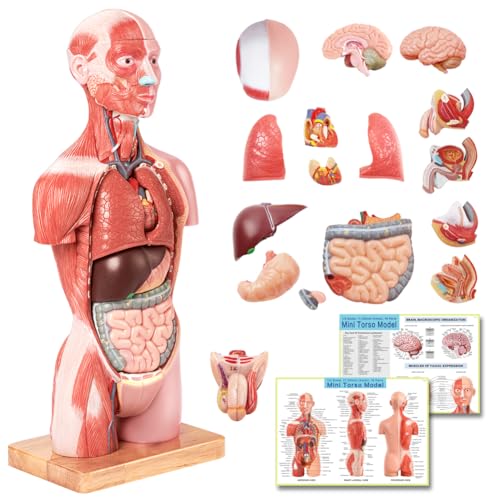
- 16 removable torso and organ parts
- Portable 17-inch PVC design with wood base
- Includes male and female parts and study brochure
Best For: Anatomy and nursing learners studying organ placement
Best Skull and Brain Focus
Life-Size Skull and Brain Model

- 11-part life-size skull and brain design
- 32 brain and 55 skull numeric markers
- Lightweight, durable PVC construction
Best For: Focused neuroanatomy study and patient education
Best Compact Skeleton
17-Inch Movable Human Skeleton

- 17.7-inch model with a compact base
- Movable arms, legs, and jaw
- Entry-level design for basic anatomy study
Best For: Beginners and small-space classroom or desktop use
Best Compact Torso Model
15-Part Removable Organ Anatomy Doll

- 15 removable organs and structures
- Interactive assembly for beginners
- Portable, stable, and easy to clean
Best For: Introductory anatomy and physiology learning
Best Muscular System Model
33-Inch Removable Muscle Anatomy

- 27-part half-size body model
- 347 numbered anatomical structures
- Includes removable limb muscles and organs
Best For: Detailed muscular-system education and medical training
Portable Torso Classroom Pick – 15-Piece Human Torso Model
This compact human torso model is a practical choice for buyers comparing digital anatomy models with hands-on teaching aids. Its 15 removable parts cover major organs and structures, while the PVC construction, hand-painted finish, and wooden base support repeated classroom or study use.
Best For: Students, nursing learners, anatomy enthusiasts, and educators who need a portable torso display.
Pros:
- Includes 15 detachable parts, including the brain, heart, lungs, stomach, liver, pancreas, spleen, and intestines.
- Colorful educational brochure helps explain organ placement and structure.
- Non-toxic PVC is easy to clean, and the model sits on an oak-wooden base.
- Portable 11-inch size fits conveniently in a bag or on a shelf.
Cons:
- Small organ pieces should be kept away from young children.
- It focuses on the torso rather than providing a complete full-body model.
Choose this model when portability and removable internal organs matter more than digital interactivity. Securely fitting parts make it suitable for demonstrations and independent review.
Detailed Foot Study Aid – 9-Part Anatomical Foot Model
For buyers seeking digital anatomy models focused on lower-limb detail, this nine-part foot model offers a specialized, hands-on alternative. It highlights bones, muscles, ligaments, nerves, and arteries, including structures beneath the sole.
Best For: Anatomy students, physiotherapy and kinesiology learners, orthopedic professionals, and patient education in medical offices.
Pros:
- Displays major and minor ligaments, nerves, and arteries with realistic texture.
- Nine-part design supports closer examination of foot structures.
- Magnetic connectors make installation straightforward.
- Non-toxic PVC is easy to clean and designed for repeated use.
Cons:
- Its focused foot anatomy limits usefulness for whole-body study.
- The model is relatively compact at approximately 7.5 by 5.5 inches.
This is a strong choice when the goal is explaining foot anatomy, common injuries, or biomechanics rather than surveying the entire human body. Its removable construction also supports demonstrations and patient conversations.
Complete Study Bundle – Human Body and Anatomy Model Set
This hands-on set broadens anatomy study beyond a single region by combining human body, skeleton, heart, and half-size skull-with-brain models. It is a useful alternative for shoppers comparing digital anatomy models with portable physical references for medical education.
Best For: Medical students, teachers, families, and learners studying general, skeletal, cardiovascular, and nervous-system anatomy.
Pros:
- Combines four study tools: a human body model, skeleton, heart, and skull with brain.
- Includes brochures, charts, and manuals with illustrations and anatomy information.
- Hand-painted models use sturdy bases and can also serve as desktop or shelf displays.
- A carrying case helps store and transport the set.
Cons:
- The models are different sizes, so storage space is still required despite the carrying case.
- The set is recommended for ages 14 and up.
This bundle offers the broadest subject coverage of the four products, making it a sensible pick for learners who want several physical models in one purchase. The included guides add structure for classroom or self-directed study.
Joint Mechanics Training Set – Six Ligament Models
This six-piece joint set is a focused option for buyers comparing digital anatomy models with interactive musculoskeletal teaching tools. Life-size shoulder, elbow, hip, knee, hand, and foot models include connected ligaments and articulated movement for studying flexion, rotation, and joint relationships.
Best For: Physiotherapy, nursing, anatomy, biomechanics, classroom demonstrations, and medical-office reference.
Pros:
- Covers six major joints: shoulder, elbow, hip, knee, hand, and foot.
- Articulated bones and connected ligaments demonstrate bending, rotation, and flexion.
- Sturdy PVC construction is lightweight, durable, and suited to repeated handling.
- Supports lab exercises, science projects, professional presentations, and home study.
Cons:
- The set focuses on joints and does not provide whole-body organ anatomy.
- At 5.6 pounds, it is less lightweight than a single compact model.
Pick this set when movement and ligament relationships are central to the lesson. Its range of joints makes it more versatile than a single-joint aid for comparative demonstrations and biomechanics practice.
Best Overall Torso Model – Deluxe Musculature Anatomy Model
For shoppers comparing digital anatomy models with hands-on study aids, this 16-piece torso model offers a practical way to examine organ placement and major internal structures. Its removable components, portable 17-inch format, and colorful educational brochure make it useful for classroom or home study.
Best For: Anatomy, nursing, and physiology learners who want a detailed torso model with removable organs.
Pros:
- Includes 16 detachable parts, including the brain, heart, lungs, stomach, liver, intestines, and pancreas.
- Made from non-toxic PVC and hand-painted, with an oak-wooden base.
- Portable design fits in a bag and the parts are designed to fit securely.
- Includes male and female anatomical parts plus a colorful brochure.
Cons:
- Small organ pieces should be kept away from young children.
- As a half-size torso model, it may not provide the scale of a life-size display.
This is a strong all-around choice when removable organs and broad torso coverage matter more than a specialized focus. The included stand also makes it suitable for shelf or cabinet display between study sessions.
Best Skull and Brain Focus – Life-Size Skull and Brain Model
Among digital anatomy models and physical study tools, this life-size skull and brain model is designed for focused examination of cranial structures. Its 11 removable sections and numbered diagrams support detailed science teaching, anatomical study, and patient education.
Best For: Learners and educators who need a dedicated skull-and-brain model with labeled anatomical references.
Pros:
- Life-size format shows the main structures of the skull and brain clearly.
- Includes 3 skull parts and 8 brain components, including the cerebral hemisphere, cerebellum, and brainstem.
- Numbered diagrams provide 32 brain markers and 55 skull markers.
- Robust PVC construction is lightweight, high-strength, and corrosion-resistant.
Cons:
- Its specialized skull-and-brain focus does not cover the rest of the body.
- The supplied notes do not indicate that the model includes a stand or carrying case.
This model is a practical pick for anyone studying neuroanatomy or explaining cranial structures. The life-size scale and extensive numeric labeling give it a more detailed teaching focus than a general body model.
Best Compact Skeleton – 17-Inch Movable Human Skeleton
For buyers considering digital anatomy models alongside simple physical references, this compact skeleton provides an accessible way to study the spine, ribs, skull, and basic limb movement. Its 17.7-inch size and small base make it suitable for desktops, classrooms, and clinical settings with limited space.
Best For: Beginners and students who want a portable, entry-level skeleton for basic anatomy study and display.
Pros:
- Compact 17.7-inch skeleton sits on a 4.75-by-4.75-inch base.
- Movable arms and legs allow basic positioning and observation.
- Removable skull cap and movable jaw add hands-on study features.
- Lightweight design is easy to move, remove, and install.
Cons:
- Shows only basic anatomical detail in the spine, ribs, and skull.
- It is an entry-level miniature model rather than a highly detailed full-size skeleton.
- The supplied product dimensions include an unusually thin listed depth, so buyers should verify available space before ordering.
This is best viewed as a no-frills teaching and display aid rather than a comprehensive anatomical replica. Its movable limbs and compact footprint make it especially convenient for introductory study or small workspaces.
Best Head Anatomy Model – Superficial Neurovascular Half Head
For learners seeking digital anatomy models or a detailed physical teaching aid, this life-size half-head model focuses on the superficial neurovascular structures of the face, scalp, and neck. Its 360-degree rotation and marked manual make it practical for classroom instruction, self-study, clinical explanation, or salon education.
Best For: Head, brain, facial nerve, blood vessel, and upper-airway anatomy study.
Pros:
- Shows superficial facial muscles, vessels, nerves, glands, brain, airway, and cervical structures.
- Rotates 360 degrees for easier viewing and teaching.
- Includes a detailed manual identifying and describing anatomical structures.
- Non-toxic PVC construction is easy to clean.
Cons:
- Its specialized head-and-neck focus is less suitable for studying the full body.
- The ear is detachable, so small components require careful handling.
This is a focused, information-rich choice when facial and cervical anatomy matter more than broad organ-system coverage. The sagittal section and superficial neurovascular detail provide useful visual context for guided lessons.
Best Compact Torso Model – 15-Part Removable Organ Anatomy Doll
This compact torso model is a hands-on option for students comparing physical tools with digital anatomy models. Its 15 removable organs let learners practice placing major body structures while reviewing the respiratory, digestive, urinary, and nervous systems.
Best For: Children, students, classrooms, and introductory anatomy or physiology demonstrations.
Pros:
- Includes removable brain, heart, lungs, stomach, liver, pancreas, spleen, intestines, and other structures.
- Organ placement provides an interactive way to learn relative positions and fit.
- Stable upright base helps keep the model assembled during display or teaching.
- Portable size is easy to carry, store, and wipe clean.
Cons:
- Small pieces should be kept away from children who may put them in their mouths.
- Its introductory torso format offers less detail than larger specialist models.
With a 10.5-inch footprint and removable components, this model balances portability with interactive learning. It is especially useful when learners benefit from physically assembling organs rather than only viewing diagrams.
Best Muscular System Model – 33-Inch Removable Muscle Anatomy
For comprehensive muscle-system study, this 33-inch model offers a broader physical reference than many compact digital anatomy models. It combines removable muscles and organs with 347 numbered markings, a sturdy base, and a color manual for structured medical or classroom training.
Best For: Students, teachers, medical training, patient communication, and detailed muscular-system review.
Pros:
- Includes 27 removable parts covering muscles, organs, limbs, brain, lungs, heart, and digestive structures.
- Four removable arm muscles and nine removable leg muscles support detailed study.
- 347 numbered structures can be identified with the included educational brochure.
- Non-toxic PVC construction and a removable sturdy base make it durable and easy to clean.
Cons:
- At 33 inches and over 10 pounds, it is less convenient to move than compact models.
- The numerous removable parts may require careful reassembly and storage.
This is the strongest choice in the group for learners who need a substantial muscular and organ reference. Its scale, numbered structures, and detachable muscle sections support more detailed instruction, though the larger footprint needs dedicated space.
How We Picked These Digital Anatomy Models
We selected models that support visual, hands-on learning across common anatomy topics. The lineup includes full and partial body models, muscular and skeletal systems, neurovascular anatomy, joints, the foot, skull, and brain. We also considered removable parts, labeling or numbering, articulation, scale, construction, and suitability for classrooms, study spaces, demonstrations, and display.
Because anatomy models serve different purposes, there is no single best choice for everyone. A large muscular model may be excellent for teaching surface anatomy but excessive for a student who needs a compact torso. Likewise, a numbered skull model is more specialized than a general human-body model.
Quick Comparison
| Model type | Best for | Features to prioritize |
|---|---|---|
| Removable-organ torso | General anatomy and classroom demonstrations | Clear assembly, organ detail, stable base |
| Muscular body model | Muscle identification and surface anatomy | Layer detail, removable sections, size |
| Skeleton model | Bone structure and movement | Articulation, proportions, durable joints |
| Skull or brain model | Head anatomy and neuroanatomy | Accurate sections, numbering, visibility |
| Joint or foot model | Focused study and clinical instruction | Ligament detail, orientation, labeled features |
Key Buying Factors for Digital Anatomy Models
Purpose and Anatomical Scope
Choose a full-body or torso model for broad instruction, then select a specialized model when you need deeper study of joints, muscles, the nervous system, or the skull. Models with removable organs are particularly useful for demonstrations.
Scale and Display Space
Check the listed height and footprint before buying. Life-size and oversized models offer better visibility for groups, while half-size and tabletop versions are easier to store and use at home.
Detail, Labels, and Removable Parts
Numbered structures, digital signs, and detachable components can improve self-study and testing. Confirm that the labeling style matches your needs and that small pieces can be stored safely.
Build Quality and Articulation
Look for stable stands, secure connectors, clean molding, and joints that move without feeling fragile. Articulated skeletons are useful for movement lessons, but movable parts may require more careful handling.
Audience and Learning Level
Introductory students often benefit from clear color coding and broad labels. Advanced learners may prefer less stylized models with layered musculature, neurovascular detail, or more anatomically specific sections.
Who Should Buy Which Digital Anatomy Models?
For general classrooms: Choose a removable-organ torso or broad human-body model that gives students a visible overview of major systems.
For muscle-focused study: A large musculature model with removable sections is the better choice for identifying muscle groups and relating them to organs and surface anatomy.
For skeletal lessons: Select an articulated skeleton for bone names, posture, and movement demonstrations.
For specialized instruction: Pick a joint, foot, skull, brain, or half-head neurovascular model when concentrated detail matters more than whole-body coverage.
For home study or display: Favor a compact torso, skull, or half-size model that fits your desk and can be stored without disassembly. Before purchasing, verify dimensions, included parts, labeling, and whether the model is intended for educational display rather than clinical use.