Choosing among 3D scanners for demanding projects means looking beyond headline accuracy. Scan speed, tracking, wireless workflow, surface handling, and software support can matter just as much when capturing parts, prototypes, vehicles, or complex assemblies.
We’ve gathered 10 capable scanners for engineering, automotive work, reverse engineering, inspection, and 3D printing. Use the guide below to match technical performance and workflow features to the projects you actually handle.
Best 10 3D Scanners for Demanding Projects Picks for 2026
Professional Range Pick
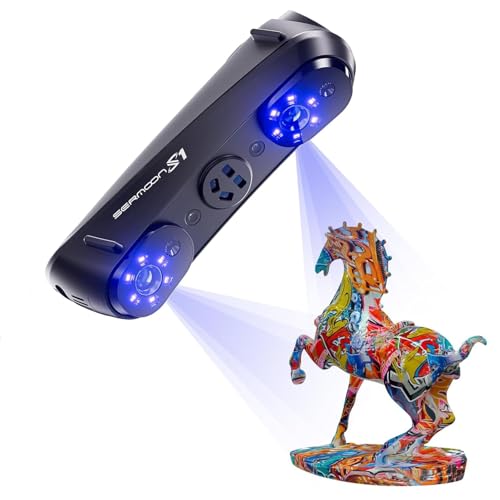
- Scans objects from 5 mm to 4 m
- Triple blue-laser modes cover varied geometries
- Up to 0.02 mm accuracy and 90 FPS
Best For: Engineering, inspection, and large-object scanning
Portable All-Surface Pick

- 0.05 mm accuracy at up to 30 FPS
- Scans dark and metallic surfaces without spray
- Captures 24-bit full-color textures
Best For: Portable automotive, reverse-engineering, and color scanning
Wireless Industrial Pick

- Wireless scanning with included scan bridge
- Up to 1,428,000 points per second
- Designed for lighting up to 100,000 lux
Best For: Mobile industrial scanning and large complex workspaces
Accessible Precision Pick
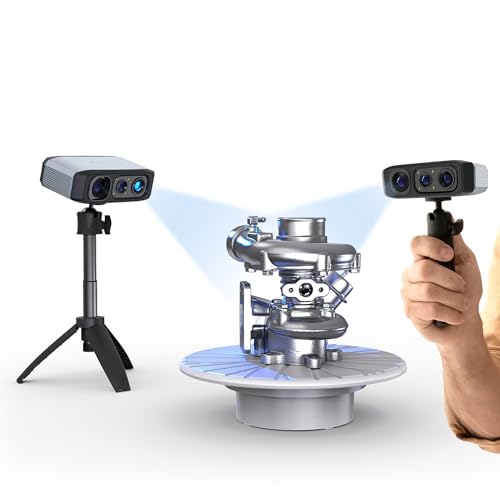
- Up to 0.03 mm accuracy with blue light
- AI tracking and anti-shake assistance
- 24-bit color and common 3D export formats
Best For: Detailed 3D printing and display-model workflows
Precision Laser Pick

- Up to 0.02 mm blue-laser accuracy
- 22 cross lines for larger objects
- Up to 60 fps scanning speed
Best For: Automotive, engineering, and large-part scanning
Portable Versatility Pick

- Up to 0.03 mm accuracy
- 260 g wireless scanner with touchscreen
- Blue laser and NIR scanning modes
Best For: Portable, mixed-size, and body scanning
Industrial Measurement Pick

- Up to 0.01 mm single-frame precision
- Four blue-laser and structured-light modes
- Up to 7 million points per second
Best For: Inspection, reverse engineering, and precision modeling
Wireless All-Rounder

- Scans objects from 5 mm to 4,000 mm
- 34 cross laser lines for larger objects
- Wireless, marker-free NIR, and face/body modes
Best For: Mixed-size engineering, vehicle, mold, and body scans
Speed-Focused Pro

- Up to 60 FPS and 660,000 points per second
- 0.02 mm laboratory-condition accuracy
- Full-color scanning and wireless Scan Bridge
Best For: Fast, detailed, color-aware 3D-printing workflows
High-Speed Large-Format Pick

- Scans objects from 5 mm to 4,000 mm
- Up to 60 FPS laser scanning
- Wi-Fi 6 transfer up to 4.7 Gbps
Best For: Large objects, vehicles, molds, and detailed parts
Professional Range Pick – Creality Sermoon S1
For demanding projects spanning tiny components to full-size structures, the Creality Sermoon S1 stands out as a highly versatile option among 3D scanners for demanding projects. Its broad 5 mm-to-4 m range, multiple blue-laser modes, and fast capture rate are designed for engineering, inspection, and reverse-engineering workflows.
Best For: Professionals scanning everything from fine mechanical details and deep features to automotive parts and large architectural objects.
Pros:
- Handles objects from 5 mm to 4 m with one scanner.
- Offers 34-line, 7-line, and single-line blue-laser modes for different geometries.
- Provides up to 0.02 mm accuracy, 0.08 mm/m volumetric precision, and 90 FPS scanning.
- AI-assisted processing supports alignment, mesh generation, and data cleanup.
Cons:
- Recommended computer specifications are substantial, including 32GB RAM for Windows use.
- At 6.29 pounds, it may be tiring during extended handheld sessions.
The Sermoon S1 is the strongest fit here when project variety matters most. Its combination of scale flexibility, deep-feature scanning, and professional accuracy makes it particularly well suited to production-oriented CAD, inspection, and reverse-engineering work.
Portable All-Surface Pick – Creality Otter Lite Basic
The Creality Otter Lite Basic is a practical choice among 3D scanners for demanding projects when you need portability, color capture, and straightforward scanning of difficult surfaces. Its quad-camera design covers objects from 0.8 to 78 inches, while its structured-light system is designed to scan dark and metallic objects without spray.
Best For: Reverse engineering, automotive work, product visualization, and users who need full-color scans across small and large objects.
Pros:
- Offers 0.05 mm accuracy and scanning speeds up to 30 FPS.
- Scans dark, shiny, and metallic surfaces without powder or spray.
- Captures 24-bit color textures with an RGB camera and LED fill lights.
- Supports marker, geometry, and texture alignment plus several export formats.
Cons:
- The optional Scan Bridge handle costs extra.
- Its accuracy is lower than the 0.02 mm figures listed for the Sermoon models.
Choose the Otter Lite Basic when surface versatility and realistic color are more important than the tightest available dimensional specification. Wi-Fi 6 support, broad device compatibility, and spray-free scanning add convenience for field and workshop use.
Wireless Industrial Pick – Creality Sermoon X1
The Creality Sermoon X1 is aimed at demanding industrial work where high-speed capture, wireless mobility, and stable tracking are priorities. Its combination of blue-laser modes, infrared structured light, marker-free photogrammetry, and the included scan bridge makes it suitable for navigating large parts and complex workspaces.
Best For: Industrial reverse engineering, manufacturing floors, vehicle interiors, heavy machinery, and outdoor scanning.
Pros:
- Provides volumetric precision of 0.02 mm plus 0.04 mm per meter.
- Captures up to 1,428,000 points per second with scanning speeds up to 90 FPS.
- Includes 34-line, 7-line, single-line, and NIR structured-light modes.
- Supports wireless scanning and operation in ambient light up to 100,000 lux.
Cons:
- Its professional feature set may be more than casual users need.
- The supplied notes do not specify the complete system requirements or final software feature list.
The Sermoon X1 is the most compelling option when cables could restrict movement or when scanning must move between controlled and outdoor environments. Its industrial positioning and high acquisition rate make it a strong candidate for large, complex jobs.
Accessible Precision Pick – 3DMakerpro Moose Lite
The 3DMakerpro Moose Lite offers a more approachable route into high-detail scanning for demanding projects. Blue-light capture, AI tracking, optical anti-shake modules, and integrated JMStudio processing help simplify the path from scanning to a usable model for printing or display.
Best For: 3D printing, model reproduction, detailed displays, and users who want guided software and more forgiving handheld operation.
Pros:
- Claims up to 0.03 mm accuracy with 0.07 mm resolution.
- AI tracking and point-cloud processing support smarter scanning.
- Optical anti-shake modules and rescan functionality help with interrupted sessions.
- 24-bit color capture and exports to OBJ, STL, PLY, and ASC are included.
Cons:
- Smart Grip smartphone accessory is optional rather than included.
- Listed compatibility is limited to Windows 10/11 64-bit and macOS 12/13.
- Its supplied scan-size range is not specified.
Moose Lite makes sense for creators who value detailed output without an overly complicated workflow. It is particularly attractive for printing and display projects where color, stabilization, and built-in editing support matter as much as raw scanning speed.
Precision Laser Pick – Raptor Pro
For demanding projects involving automotive parts, engineering components, and larger objects, the Creality Raptor Pro combines high-resolution blue laser scanning with rapid data capture. Its accuracy, tracking stability, and portable design make it a strong option when 3D scanners for demanding projects need to support both detailed inspection and practical fieldwork.
Best For: Automotive modification, engineering inspection, reverse engineering, and medium-to-large components.
Pros:
- 7-line blue laser mode offers up to 0.02 mm accuracy for detailed work.
- 22 cross laser lines help cover medium and large objects with fewer passes.
- Blue laser scanning reaches up to 60 fps and 660,000 points per second.
- Anti-shaking features and CrealityScan tools support more stable handheld workflows.
Cons:
- The scanner’s most specialized capabilities may be more than casual users need.
- Its supplied notes emphasize performance and software features rather than a fully wireless workflow.
The Raptor Pro is best suited to users who value measurement-oriented accuracy and efficient coverage over the smallest possible form factor. Its 405-gram body and outdoor-capable blue laser system also make it practical for work beyond the lab.
Portable Versatility Pick – Pika
The Creality Pika is a compact choice for demanding projects that move between small components, full-body scans, and on-site work. With dual scanning modes, wireless connectivity, a touchscreen, and AI-assisted processing, it offers a flexible approach to 3D scanners for demanding projects without a bulky setup.
Best For: Portable scanning, small mechanical parts, figurines, body scans, and mixed indoor/outdoor workflows.
Pros:
- 7-line blue laser mode provides up to 0.03 mm accuracy and 0.1 mm resolution.
- NIR structured light supports full-body scanning and 24-bit true-color capture.
- Lightweight 260-gram design includes Wi-Fi 6, a touchscreen, and swappable batteries.
- AI tools can complete bodies, fill holes, and retexture models for easier output preparation.
Cons:
- Its stated accuracy is slightly lower than the Raptor Pro and MetroX Pro figures.
- Wireless PC operation depends on Wi-Fi 6, while marker-free scanning is specified for wired PC mode.
Pika stands out when portability and flexibility matter as much as precision. Its broad object-size range, multi-platform support, and ability to scan dark or metallic surfaces without spray make it a convenient all-around option.
Industrial Measurement Pick – MetroX Pro
The Revopoint MetroX Pro is aimed squarely at precision modeling, inspection, and reverse engineering. With multiple blue laser and structured-light modes, high point throughput, and several tracking options, it is a compelling candidate among 3D scanners for demanding projects where surface variety and measurement accuracy are central concerns.
Best For: Industrial measurement, quality inspection, reverse engineering, prototyping, and precision modeling.
Pros:
- Offers up to 0.01 mm single-frame precision and 0.02 mm single-frame accuracy.
- Four scanning modes handle flat, shiny, dark, and feature-rich surfaces.
- Full-field blue structured light captures up to 7 million points per second.
- Turntable scanning and feature, marker, and global-marker tracking support varied workflows.
Cons:
- The package weighs 14.82 pounds, making it less convenient for frequent mobile scanning.
- Revo Design and Revo Measure are paid Windows-only software sold separately.
- Its advanced measurement features may require more setup and workflow knowledge.
MetroX Pro is the strongest fit for users prioritizing industrial-grade measurement capability and surface-handling flexibility. The combination of laser modes, marker-free structured light, and automated turntable scanning supports a broad range of professional applications.
Wireless All-Rounder – RaptorX Handheld 3D Scanner
For demanding projects spanning tiny components to full-size vehicles, the Creality RaptorX combines blue laser lines with infrared structured light. Its wireless design, marker-free NIR mode, and metrology-grade accuracy make it a flexible choice among 3D scanners for demanding projects.
Best For: Engineers, fabricators, designers, and users scanning parts, molds, vehicles, or people in varied sizes.
Pros:
- Scans objects from 5 mm to 4,000 mm.
- 34 cross laser lines support efficient medium-to-large-object scanning.
- Wireless operation, phone mirroring, and marker-free NIR scanning improve portability.
- CrealityScan includes tutorials, one-click processing, and editing tools.
Cons:
- The supplied notes do not specify battery life or wireless operating time.
- Its broad feature set may require time to learn for first-time users.
Choose this model when flexibility matters most. It covers an unusually wide object-size range and adds dedicated face and body scanning, while the laser modes target sharper engineering details.
Speed-Focused Pro – Raptor Pro with Scan Bridge
The Creality Raptor Pro is aimed at detail-heavy workflows that benefit from fast capture and wireless accessories. With up to 60 frames per second and 660,000 points per second, it is a strong candidate among 3D scanners for demanding projects that require efficient scanning and full-color output.
Best For: Users capturing intricate parts, color references, and multi-scan projects for 3D printing or digital modeling.
Pros:
- Up to 0.02 mm accuracy under laboratory conditions.
- Captures at up to 60 FPS and 660,000 points per second.
- Supports full-color 3D scanning for texture reproduction.
- Scan Bridge enables wireless scanning and marker-based alignment.
Cons:
- The stated 0.02 mm accuracy applies under laboratory conditions.
- Its 5 mm-to-2,000 mm scanning range is narrower than the larger RaptorX models here.
- Marker-based alignment may add setup work for multi-scan stitching.
This is the focused choice for speed and color mapping rather than maximum object-size coverage. Consider it when fast frame rates, point throughput, and repeatable marker-based alignment are central to the workflow.
High-Speed Large-Format Pick – Raptor X Wi-Fi 6 Scanner
For projects involving both fine details and large physical objects, this Raptor X pairs 34 cross laser lines with seven finer laser lines and Wi-Fi 6 transfer. Its 5 mm-to-4,000 mm range makes it one of the more versatile 3D scanners for demanding projects.
Best For: Windows and Mac users scanning vehicles, molds, engineering parts, and smaller detailed components.
Pros:
- Scans objects from 5 mm to 4,000 mm.
- Laser scanning reaches up to 60 FPS, while infrared structured light reaches up to 30 FPS.
- Wi-Fi 6 supports up to 4.7 Gbps transfer with stated 10 ms latency.
- Wireless phone mirroring and CrealityScan processing tools support mobile workflows.
Cons:
- Wireless performance depends on the surrounding network environment.
- The supplied notes do not specify included accessories beyond the scanner.
This model stands out when large-object coverage and rapid data transfer are equally important. The combination of wide scanning modes, fine laser lines, and Wi-Fi 6 is well suited to demanding mixed-scale work.
How We Picked the Best 3D Scanners for Demanding Projects
We focused on scanners designed for serious capture work rather than casual scanning alone. Our selection emphasizes published accuracy, resolution, scan speed, tracking technology, working range, portability, and the ability to handle challenging shapes or surfaces. We also considered practical workflow details, including color capture, wireless operation, data transfer, scan processing, and compatibility with common 3D-printing or CAD workflows.
Specifications can vary by scan mode and conditions, so treat quoted accuracy as a useful benchmark—not a guarantee for every object. Calibration, lighting, surface finish, operator technique, and software settings all affect final results.
Quick Comparison
- Highest precision focus: The Creality Raptor Pro, RaptorX, Sermoon S1, and related blue-laser models target demanding engineering and inspection work with quoted accuracy around 0.02mm.
- Balanced versatility: The Creality Pika, Revopoint MetroX Pro, and 3DMakerpro options suit users who need detailed capture across prototypes, parts, and general 3D-printing projects.
- Accessible all-purpose scanning: The Creality Otter Lite emphasizes ease of use, full-color capture, and a broad object-size range for less specialized workflows.
- Wireless convenience: The Sermoon X1, RaptorX, Raptor Pro with Scan Bridge, and Raptor X can reduce cable clutter and make scanning larger objects or moving around a subject easier.
Key Buying Factors for 3D Scanners for Demanding Projects
Accuracy, Resolution, and Repeatability
Choose accuracy based on the smallest features and tolerances you need to preserve. Metrology-oriented blue-laser scanners are generally better suited to inspection and reverse engineering, while less precise models may be sufficient for visual assets, fit checks, and ordinary replacement parts.
Tracking and Surface Handling
Laser lines, structured light, infrared modes, markers, and intelligent tracking each perform differently. Dark, glossy, transparent, thin, or textureless surfaces may require spray, markers, controlled lighting, or additional preparation. Look for a scanner with modes suited to the materials you regularly encounter.
Speed, Range, and Ergonomics
High frame rates can shorten capture sessions, but usable speed depends on tracking stability and processing. Check the minimum and maximum scan sizes, field of view, cable or battery arrangements, and total handheld weight before choosing a model for large parts or extended sessions.
Software and Output Workflow
Confirm that the scanner’s software exports the formats your CAD, inspection, or slicing tools require. Helpful features include alignment, hole filling, mesh editing, texture capture, automatic processing, and reliable data transfer. Wireless scanning is convenient, but wired operation may offer a steadier connection for long, high-resolution captures.
Who Should Buy Which 3D Scanners for Demanding Projects?
Engineering and inspection professionals should prioritize metrology-grade accuracy, stable tracking, calibration support, and dependable software. Automotive and larger-object users should look for long working ranges, fast capture, wireless freedom, and robust tracking. 3D-printing enthusiasts and makers may prefer a balance of accuracy, ease of use, portability, and straightforward mesh cleanup. Users scanning people, household objects, or colorful subjects should favor versatile modes and color capture over maximum laser precision alone.