Choosing among professional 3D scanners can be difficult because accuracy, tracking, scanning speed, portability, and software support vary widely. The right model depends on the size and finish of the objects you scan, plus how much post-processing your workflow requires.
This roundup compares 10 advanced scanners from Creality, Revopoint, and EINSTAR, including blue-laser, infrared, wireless, and all-in-one systems for engineering, inspection, reverse engineering, and 3D printing.
Best 10 Professional 3D Scanners Picks for 2026
Best All-Range Pick
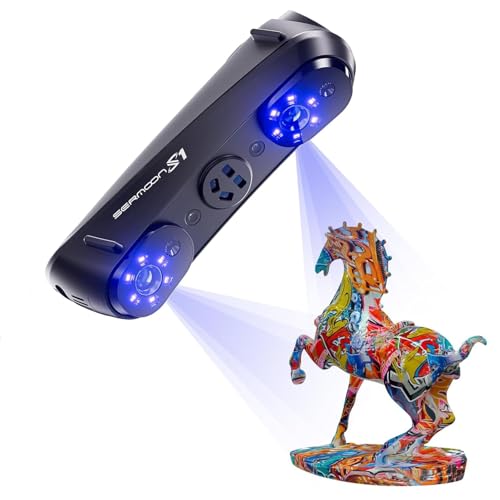
- 5 mm to 4 m scanning range
- Triple blue-laser modes
- Up to 0.02 mm accuracy
Best For: Engineering, inspection, CAD, and mixed-size scanning
Best Portable Metrology Kit

- Integrated photogrammetric metrology
- Near and Far scan modes
- 750 g all-in-one design
Best For: Field measurement and portable large-object scanning
Best Wireless Large-Object Scanner

- Wireless handheld operation
- Scans up to 4 m objects
- Laser and infrared modes
Best For: Automotive, molds, bodies, and large feature-rich objects
Best High-Speed Precision Scanner

- Up to 0.01 mm precision
- Five blue-laser scanning modes
- Up to 7 million points per second
Best For: Industrial inspection and reverse engineering
Best Portable Professional 3D Scanner

- 0.03mm accuracy with blue laser scanning
- Wireless, compact design with dual batteries
- Scans dark and metallic surfaces without spray
Best For: Portable 3D printing, reverse engineering, and body scanning
Best Industrial Professional 3D Scanner

- Up to 0.01mm single-frame precision
- Four blue-laser and structured-light modes
- Automated dual-axis turntable scanning
Best For: Industrial measurement, inspection, and reverse engineering
Best Wireless Professional 3D Scanner

- 17-line blue laser scans at up to 90 FPS
- VCSEL infrared mode handles large and black objects
- Up to three hours of wireless scanning
Best For: Mobile, outdoor, and mixed-material 3D capture
Best Overall

- 0.02mm accuracy and 660,000 points per second
- No-spray scanning for black, reflective, and metal surfaces
- Scans objects from 5mm to 4000mm
Best For: Versatile automotive, industrial, and reverse-engineering workflows
Best for Reverse Engineering

- Metrology-grade accuracy up to 0.02mm
- Blue laser and NIR structured-light modes
- Adjustable 0.05mm–2mm resolution in Creality Scan
Best For: Industrial inspection, CAD development, and reverse engineering
Best Wireless Bundle

- Includes Scan Bridge for wireless scanning
- 60FPS capture at 660,000 points per second
- Full-color mapping and marker-based alignment
Best For: Convenient multi-scan projects with wireless and color workflows
Best All-Range Pick – Creality Sermoon S1
For professionals who need one tool for varied projects, the Creality Sermoon S1 is a flexible choice among professional 3D scanners. Its 5 mm to 4 m range, triple blue-laser modes, and 90 FPS scanning support work ranging from small components to large structures.
Best For: Reverse engineering, inspection, CAD modeling, and users scanning objects across a wide range of sizes.
Pros:
- Supports objects from tiny details to automotive and architectural-scale subjects.
- Offers 34-line, 7-line, and single-line laser modes for speed, detail, and deep geometries.
- Provides up to 0.02 mm accuracy and AI-assisted alignment, meshing, and cleanup.
- Supports marker-free scanning and exports for CAD, CAM, printing, and inspection workflows.
Cons:
- At 6.29 pounds, it is less portable than compact all-in-one scanners.
- Recommended computer specifications are substantial, especially on Windows.
The Sermoon S1 stands out when workflow flexibility matters more than minimum size or weight. It is a strong fit for shops that want broad scanning coverage without maintaining multiple scanners.
Best Portable Metrology Kit – Revopoint MIRACO Plus
The Revopoint MIRACO Plus is a practical option for professionals who want scanning, processing, and display hardware in one portable unit. Its photogrammetric kit, dual scan ranges, and built-in processing make it especially useful for field work and larger objects requiring accurate detail.
Best For: Portable measurement, large-object detail capture, color models, and workflows that benefit from integrated scanning and processing.
Pros:
- Photogrammetric kit supports length accuracy of 0.02 mm + 0.05 mm x L(m).
- Near and Far modes handle small items through large machinery.
- Integrated 32GB RAM, 256GB storage, 48MP RGB camera, and 6-inch flip display.
- Weighs 750 g, offers up to two hours of scanning, and exports to common formats.
Cons:
- Revo Design for scan-to-CAD conversion is sold separately.
- The supplied notes indicate software compatibility limitations for some systems.
- Photogrammetric work requires targets and scale bars from the included kit.
MIRACO Plus is compelling when portability and self-contained operation are priorities. Its photogrammetry features add value for professionals measuring large subjects while retaining fine detail.
Best Wireless Large-Object Scanner – Creality RaptorX
The Creality RaptorX combines blue-laser scanning with infrared structured light in a wireless handheld format. For professional 3D scanners buyers focused on cars, molds, bodies, and other medium-to-large objects, its broad size range and marker-free tracking can simplify capture.
Best For: Automotive parts, molds, human-body scans, and feature-rich objects where wireless operation and quick repositioning are useful.
Pros:
- Scans objects from 5 × 5 × 5 mm³ to 4000 × 4000 × 4000 mm³.
- Uses 34 cross-laser lines for larger surfaces and 7 parallel lines for sharper detail.
- NIR structured-light mode supports marker-free scanning of feature-rich workpieces.
- Wireless handle and phone mirroring improve mobility and scan monitoring.
Cons:
- The supplied notes do not specify a complete accuracy figure for every scanning mode.
- Wireless operation may require attention to the connection and viewing setup.
- Its feature set is oriented toward broad capture rather than a stated ultra-fine metrology specification.
RaptorX is a strong practical choice for mobile scanning of large or irregular subjects. Its combination of laser modes, infrared tracking, and wireless handling reduces friction during physical capture.
Best High-Speed Precision Scanner – Revopoint MetroY Pro
The Revopoint MetroY Pro targets demanding professional workflows with blue-laser precision, five scanning modes, and high point-capture rates. It is well suited to users who need detailed reverse-engineering or metrology data and can provide a capable Windows workstation.
Best For: Industrial inspection, reverse engineering, precision 3D printing, and repeatable scanning of complex parts.
Pros:
- Delivers up to 0.01 mm precision and up to 0.02 mm accuracy.
- Five modes include cross lines, parallel lines, deep-hole scanning, full-field structured light, and auto turntable capture.
- Supports high-speed scanning up to 2,000,000 points per second and marker-free capture up to 7 million points per second in the specified mode.
- Includes temperature monitoring, Wi-Fi 6 streaming, and integration with professional software platforms.
Cons:
- Revo Design and Revo Measure are paid separately and support Windows only.
- Recommended Windows requirements include a 13th-generation Intel i7 or equivalent, 32GB RAM, and an RTX 3060 GPU.
- The scanner uses a USB connection, while wireless features depend on Wi-Fi 6 streaming.
MetroY Pro is the strongest fit here for buyers prioritizing precision, speed, and specialized scanning modes. Its workstation requirements and separate software costs should be included in the purchasing budget.
Best Portable Professional 3D Scanner – Creality Pika
The Creality Pika is a practical choice for professional 3D scanners buyers who need high accuracy without being tied to a workstation. Its compact wireless design combines blue laser and NIR structured-light modes, allowing it to handle small parts, full-body scans, dark surfaces, and metallic objects.
Best For: Portable scanning, 3D printing, reverse engineering, figurines, mechanical parts, and body capture.
Pros:
- Up to 0.03mm accuracy and 0.1mm resolution for detailed captures.
- Dual scanning modes cover small objects through life-size scans.
- Wireless Wi-Fi 6 operation, dual batteries, and support for bright outdoor environments.
- Exports STL, OBJ, PLY, and ASC files and works across Windows, macOS, iOS, and Android.
Cons:
- Some advanced AI features may be more specialized than necessary for basic scanning.
- The compact body may offer less hands-on control than a larger industrial scanner.
Pika stands out when portability and versatility matter as much as precision. Its marker-free operation, broad device compatibility, and AI-assisted cleanup make it a flexible professional tool for mobile workflows.
Best Industrial Professional 3D Scanner – Revopoint MetroX Pro
The Revopoint MetroX Pro is aimed at demanding professional 3D scanners applications where dimensional accuracy and repeatable workflows are priorities. Its multiple blue-laser modes, structured light, tracking options, and automated turntable support inspection, reverse engineering, prototyping, and precision modeling.
Best For: Industrial measurement, quality inspection, reverse engineering, manufacturing, and detailed prototypes.
Pros:
- Up to 0.01mm single-frame precision and 0.02mm single-frame accuracy.
- Four scanning modes accommodate flat, shiny, dark, and feature-rich objects.
- Scans shiny or dark surfaces without spray in applicable laser modes.
- Dual-axis turntable enables one-click automated scans with color capture.
Cons:
- At 14.82 pounds, the package is less portable than compact scanners.
- Revo Design and Revo Measure software are sold separately and support Windows only.
MetroX Pro is the strongest fit for users who value measurement capability and controlled scanning workflows over portability. Its accuracy specifications and broad tracking options make it well suited to technical production environments.
Best Wireless Professional 3D Scanner – EINSTAR 2
The EINSTAR 2 is a flexible option among professional 3D scanners for users who need wireless operation and coverage from small components to large objects. It combines a 17-line blue-laser array with VCSEL infrared scanning, helping it adapt to reflective, metallic, black, and outdoor subjects.
Best For: Wireless scanning of small-to-large objects, outdoor capture, reflective surfaces, and fast production workflows.
Pros:
- 17 parallel blue-laser lines capture detail at up to 90 frames per second.
- VCSEL infrared mode supports large objects, black surfaces, and outdoor scanning.
- Swappable battery provides up to three hours of wireless scanning.
- Works in bright conditions up to 110,000 lux in laser HD mode and 70,000 lux in IR Rapid mode.
Cons:
- Wireless performance can be affected by interference, though cable operation is also available.
- The scanner requires markers in supported 3mm, 6mm, or 12mm sizes for marker-based workflows.
EINSTAR 2 is a sensible choice for mobile teams that scan in varied environments. Its dual light technologies and strong outdoor specifications provide useful flexibility, while EXStar Hub supports model processing and workflow management.
Best Overall – Creality CR-Scan Raptor Pro
For buyers comparing professional 3D scanners, the Creality CR-Scan Raptor Pro stands out as a versatile handheld option with blue laser scanning, 0.02mm accuracy, and capture speeds up to 660,000 points per second. Its broad size range and no-spray scanning support make it suitable for both detailed components and large objects.
Best For: Automotive work, reverse engineering, industrial design, 3D printing preparation, and users who need full-color scans across widely varying object sizes.
Pros:
- Combines 22 crossed and 7 parallel blue lasers for broad coverage and fine detail.
- Scans black, reflective, and metal surfaces without surface spray.
- Handles objects from 5mm to 4000mm and includes face and full-body modes.
- Supports full-color capture and integration with software such as Geomagic, SolidWorks, ZBrush, Maya, and Verisurf Inspect.
Cons:
- Its professional capabilities require a compatible computer and software workflow.
- The listed package weight is 8.91 pounds, despite the scanner itself weighing 405 grams.
The Raptor Pro is a strong all-purpose choice when scan speed, material flexibility, and compatibility with professional design tools matter more than a simple plug-and-play setup.
Best for Reverse Engineering – Creality Raptor Pro
Among professional 3D scanners, this Creality Raptor Pro is geared toward users who need metrology-grade detail and structured software workflows. It combines blue laser modes with NIR structured light, supports wireless connection, and offers adjustable resolution for multi-project scanning and post-processing.
Best For: Reverse engineering, industrial inspection, automotive components, molds, and detailed body or artifact scanning.
Pros:
- Provides accuracy up to 0.02mm plus 0.08mm/m and scans at 660,000 points per second.
- Uses 22 cross laser lines for larger objects and 7 finer lines for detailed areas.
- NIR structured light supports marker-free scanning on feature-rich workpieces.
- Creality Scan supports multi-project stitching, real-time preview, and 0.05mm–2mm resolution adjustment.
Cons:
- Recommended Windows systems require substantial hardware, including a dedicated Nvidia graphics card and up to 32GB RAM.
- Mac users are advised to use an M1, M2, or M3 processor with 16GB memory.
This version is most compelling for technical users who already have a capable computer and want detailed scanning modes plus adjustable processing controls for engineering-oriented work.
Best Wireless Bundle – Raptor Pro with Scan Bridge
For shoppers seeking professional 3D scanners with a wireless setup, this Raptor Pro bundle includes the Scan Bridge accessory for added convenience. It retains 0.02mm accuracy, 60FPS scanning, and 22+7 blue laser lines while adding full-color mapping and marker-based alignment.
Best For: Users who prioritize wireless scanning, realistic color capture, and straightforward alignment for multi-scan projects.
Pros:
- Includes the Raptor Pro scanner, Scan Bridge, calibration board, and quick-start guide.
- Scans at up to 60FPS and 660,000 points per second.
- Supports 0.02mm accuracy and full-color 3D texture reproduction.
- Marker-based alignment helps stitch multiple scans together.
Cons:
- The stated scanning range is 5mm to 2000mm, narrower than some other Raptor Pro listings.
- The package weighs 12.17 pounds, which may be less convenient for frequent transport.
This bundle makes sense when wireless convenience and color mapping are priorities, particularly for creators and technicians who regularly combine multiple scans into a larger model.
How We Picked These Professional 3D Scanners
We focused on scanners designed for demanding hobbyist, maker, engineering, fabrication, and professional workflows. Our selection considers stated accuracy, scan speed, optical technology, supported object sizes, tracking methods, portability, connectivity, and the software or hardware included with each system.
Because published specifications are measured under different conditions, accuracy figures should be treated as useful comparisons rather than guarantees for every object. Surface finish, lighting, scanning distance, alignment technique, and operator skill can all affect results.
Quick Comparison
| What to Compare | Best Fit |
|---|---|
| Blue laser scanning | Detailed parts, dark surfaces, and precision inspection |
| Infrared or NIR scanning | People, larger objects, color capture, and more comfortable tracking |
| Wireless or all-in-one design | Portable work away from a powerful computer |
| High scan speed | Repeated captures, production work, and moving subjects |
| Metrology-oriented accuracy | Reverse engineering, dimensional checks, and tight-tolerance parts |
Key Buying Factors for Professional 3D Scanners
Accuracy and Resolution
Accuracy describes how closely the scan matches the real object, while resolution affects the smallest visible details. For engineering parts, compare both specifications and confirm whether the stated figure applies to a single-frame scan, a volume, or a specific working distance.
Scanning Technology
Blue lasers are often favored for fine geometric detail and controlled industrial scanning. Structured light and infrared systems can be more versatile for larger objects, people, and surfaces that are difficult to track. Hybrid scanners provide flexibility but may require more setup and software adjustment.
Object Size and Tracking
Check the scanner’s recommended range before buying. A compact scanner may excel at small mechanical components but become inefficient on furniture or vehicle panels. Marker tracking, feature tracking, and hybrid modes each perform differently on plain, reflective, transparent, or repetitive surfaces.
Workflow and Connectivity
Wireless operation and onboard processing improve portability, while a wired connection may deliver steadier throughput for long sessions. Also verify computer requirements, export formats, calibration procedures, color capture, and compatibility with your CAD, mesh-editing, or slicer software.
Who Should Buy Which Professional 3D Scanners?
Choose a precision-focused blue-laser model for reverse engineering, inspection, and detailed mechanical parts. A hybrid blue-laser and infrared scanner is better if you need one device for both small components and larger objects. An all-in-one or wireless scanner suits field technicians, educators, and makers who value portability and quick setup.
For frequent production work, prioritize stable tracking, fast capture, repeatable calibration, and dependable software over headline resolution alone. For occasional 3D printing, a simpler dual-mode scanner may offer the best balance of capability and cost. Before purchasing, confirm the included accessories, scan-processing requirements, and whether the scanner’s accuracy is sufficient for your intended tolerances.