Choosing among the best 3D scanners for detailed work means balancing resolution, tracking reliability, scanning speed, portability, and the surfaces or objects you plan to capture. A scanner that excels at small mechanical parts may not be the right choice for full-body scans, artwork, or large automotive components.
This roundup compares 10 standout scanners across precision levels, scanning technologies, workflows, and budgets. Use the buying guide below to narrow the list by detail requirements, portability, software features, and the type of 3D models you need to create.
Best 10 3D Scanners for Detailed Work Picks for 2026
Precision Laser Pick

- 0.02 mm laboratory accuracy
- Up to 60 FPS and 660,000 points per second
- Wireless scanning and full-color mapping
Best For: Fine-detail scanning of small to large objects in a dedicated workspace
All-in-One Metrology Choice

- Near and Far modes for varied object sizes
- Photogrammetric kit for detailed large-object scans
- Built-in processing, storage, and broad file export
Best For: Portable measurement and scanning across small parts, large objects, and color models
Portable High-Speed Pick

- 0.03 mm accuracy with 7-line blue laser
- Up to 110 FPS and marker-free wired scanning
- 260 g body with Wi-Fi 6 and swappable batteries
Best For: On-the-go scanning of detailed parts, collectibles, and full-size subjects
Beginner-Friendly Detail Option
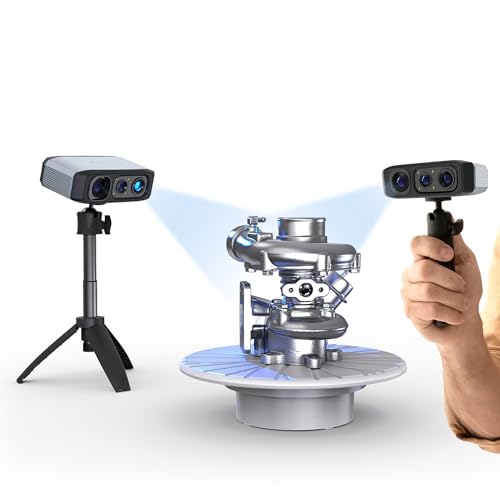
- 0.03 mm accuracy and 0.07 mm resolution
- AI tracking with marker-free scanning support
- 24-bit color and integrated JMStudio processing
Best For: Beginner-friendly detailed models for printing, display, and color-rich projects
Portable Precision Pick

- Claimed 0.03mm blue-laser accuracy
- Wireless 260g design with swappable batteries
- Scans 5mm–2000mm objects without spray
Best For: Portable precision parts and scan-to-print workflows
Color Detail Workhorse

- Point distance up to 0.1mm
- RGB color camera and Hair Mode
- Detail enhancement with guided software tools
Best For: Body scans, hair, color capture, and 3D printing
Industrial Accuracy Choice

- Claimed 0.01mm single-frame precision
- Four modes for shiny, dark, and detailed surfaces
- Automated turntable and professional workflow support
Best For: Inspection, reverse engineering, and precision modeling
Best All-Around Detail Capture

- 0.05mm accuracy with 30fps scanning
- Handles dark and metallic objects without spray
- Four cameras cover objects from 0.8 to 78 inches
Best For: Reverse engineering, prototyping, inspection, and color scanning
Best for Precision and Outdoor Work
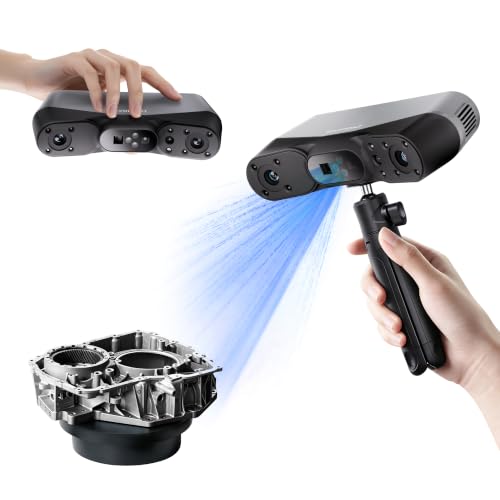
- Up to 0.03mm single-frame accuracy
- Five modes include reflective and deep-hole scanning
- Supports objects from 10mm to 2m
Best For: Precision modeling, industrial parts, and outdoor fieldwork
Best Lightweight Beginner Option

- 0.1mm precision with anti-shake stabilization
- Scans dark and metallic objects without spray
- 105g body and one-click operation
Best For: Beginners, portable scanning, and everyday modeling
Precision Laser Pick – Raptor Pro with Scan Bridge
For intricate parts, prototypes, and reverse-engineering tasks, the Creality Raptor Pro is one of the more precision-focused 3D scanners for detailed work. Its blue-laser system combines reported 0.02 mm accuracy with scanning speeds up to 60 FPS, while the included Scan Bridge supports wireless scanning.
Best For: Capturing fine details on small to medium objects, especially when speed, color mapping, and marker-based alignment matter.
Pros:
- Reported 0.02 mm accuracy in laboratory conditions for intricate details.
- Scans at up to 60 FPS and 660,000 points per second.
- Supports objects from 5 mm to 2,000 mm and includes full-color scanning.
- Includes wireless Scan Bridge and marker-based alignment for multi-scan stitching.
Cons:
- The listed package weight is 12.17 pounds, so it is less travel-friendly than compact handheld options.
- Marker-based alignment may require additional preparation for some projects.
The Raptor Pro stands out when maximum detail and fast point capture take priority. Its broad size range adds flexibility, but the larger package and marker-based workflow may be better suited to a dedicated workspace than casual scanning.
All-in-One Metrology Choice – MIRACO Plus
The Revopoint MIRACO Plus is a portable all-in-one option for 3D scanners for detailed work, combining Near and Far scanning modes with photogrammetric metrology. It is designed to capture small features on large objects while also handling larger surfaces and color-rich scans.
Best For: Professionals and serious makers who need portable scanning, photogrammetric measurements, color capture, and multiple export formats.
Pros:
- Photogrammetric kit supports small-detail capture on large objects, with listed accuracy of 0.02 mm + 0.05 mm x L(m).
- Near mode handles tiny objects such as screws, while Far mode covers large machinery.
- 48MP RGB camera, flash LEDs, and optical infrared zoom support detailed color scans.
- Built-in processing, 32GB RAM, 256GB storage, and exports including STL, OBJ, PLY, 3MF, GLTF, and FBX.
Cons:
- Revo Design for scan-to-CAD conversion is sold separately.
- Continuous scanning is listed at up to 20 FPS, slower than some high-speed alternatives.
- The photogrammetric workflow uses scale bars and coded targets for complex measurements.
MIRACO Plus offers an unusually complete portable workflow, especially for projects that move between tiny details and large assemblies. Its separate scan-to-CAD software and target-based metrology accessories should be considered when budgeting.
Portable High-Speed Pick – Creality Pika
For makers who want 3D scanners for detailed work without being tied to a desk, the Creality Pika combines a 7-line blue-laser mode with NIR structured light. It weighs 260 g, supports wireless PC use, and is rated for up to 0.03 mm accuracy and 110 FPS scanning.
Best For: Portable scanning of small parts, collectibles, mechanical components, and full-size subjects with a mix of precision and convenience.
Pros:
- Blue-laser mode is designed for fine details, with reported 0.03 mm accuracy and 0.1 mm resolution.
- Dual modes cover objects from 10 mm parts to life-size scans up to 2,000 mm.
- Compact 260 g body, Wi-Fi 6, touchscreen, and dual swappable batteries support mobile use.
- Offers marker-free scanning in wired PC mode and exports STL, OBJ, PLY, and ASC files.
Cons:
- The listed 0.03 mm accuracy is less precise than the Raptor Pro’s stated 0.02 mm laboratory accuracy.
- Some AI body-completion and retexturing features are specialized toward people and appearance-focused models.
Pika is a strong fit when portability and scanning speed matter as much as detail. Its dual-mode design makes it more versatile than a small-part-only scanner, while the marker-free wired mode can simplify preparation.
Beginner-Friendly Detail Option – 3DMakerpro Moose Lite
The 3DMakerpro Moose Lite focuses on accessible, high-detail scanning for makers using Windows or macOS. Its blue-light system is listed at 0.03 mm accuracy with 0.07 mm resolution, while AI tracking, anti-shake hardware, and integrated JMStudio processing help simplify the workflow.
Best For: Beginners and hobbyists creating detailed models for 3D printing or display, particularly when color capture and straightforward software are priorities.
Pros:
- Blue-light scanning offers listed 0.03 mm accuracy and 0.07 mm resolution.
- AI tracking and single-frame encoded structured light support smooth, marker-free scanning.
- Optical anti-shake modules and a re-scanning function can make interrupted sessions easier to manage.
- 24-bit color capture and JMStudio editing, optimization, and export support add workflow convenience.
Cons:
- The official software compatibility is listed for Windows 10/11 64-bit and macOS 12/13.
- The optional Smart Grip is sold separately for smartphone scanning.
- Its listed 0.07 mm resolution is less fine than the accuracy figures of some higher-end options.
Moose Lite emphasizes ease of use rather than a large built-in feature set. It is a sensible starting point for detailed 3D printing scans, especially if marker-free tracking, color, and integrated data cleanup are more valuable than advanced metrology.
Portable Precision Pick – Creality Pika
For 3D scanners for detailed work, the Creality Pika stands out for combining claimed 0.03mm accuracy with a compact, wireless design. Its blue-laser mode targets fine details, while infrared scanning handles faster full-body captures across a broad object-size range.
Best For: Portable scanning of precision parts, larger objects, and scan-to-print projects.
Pros:
- Blue-laser mode offers claimed 0.03mm accuracy for fine details.
- Scans objects from 5mm to 2000mm and supports black or metal objects without spray.
- Lightweight 260g body, Wi-Fi 6, swappable batteries, and STL/OBJ/PLY/ASC export.
- AI hole-filling, body completion, and retexturing can streamline model preparation.
Cons:
- Some AI-assisted features may be most useful after learning the software workflow.
- The compact design may prioritize portability over a larger, more workstation-oriented setup.
The Pika is a flexible choice when portability matters as much as detail. Its dual-light approach and broad scanning range make it appealing for users moving between small components, full-size objects, and 3D printing.
Color Detail Workhorse – Shining 3D Einstar
The Shining 3D Einstar is designed for 3D scanners for detailed work that need dense point clouds and color capture. Its detail enhancement technology, RGB camera, and dedicated Hair Mode make it especially suited to people and other subjects where surface completeness matters.
Best For: Body scanning, hair capture, color-rich models, and general 3D printing or design work.
Pros:
- Collects high-density data with point distance up to 0.1mm.
- Built-in RGB camera captures high-color-fidelity 3D data.
- Detail enhancement, automatic alignment, and data-quality indicators support a guided workflow.
- Hair Mode, outdoor scanning capability, and support for OBJ, STL, PLY, ASC, 3MF, and P3 formats add versatility.
Cons:
- At 3.08 pounds, it is considerably less portable than compact handheld alternatives.
- Power and data use a single USB cable, so a suitable connected computer setup is required.
The Einstar is a strong fit for users who value complete, color-aware scans over the smallest possible hardware. Its software guidance and body-oriented features make it particularly practical for scanning people, hair, and larger subjects.
Industrial Accuracy Choice – Revopoint MetroX Pro
For demanding 3D scanners for detailed work, the Revopoint MetroX Pro focuses on measurement-grade capture. Its blue-laser modes offer claimed single-frame precision up to 0.01mm, while multiple tracking and scanning options address shiny, dark, flat, and feature-rich surfaces.
Best For: Precision modeling, inspection, reverse engineering, prototyping, and detailed scans of challenging surfaces.
Pros:
- Claims up to 0.01mm single-frame precision and 0.02mm single-frame accuracy.
- Four scan modes cover shiny, dark, flat, and feature-rich objects.
- Dual-axis turntable supports one-click automated scanning and color capture.
- Real-time PC-to-mobile streaming and multiple tracking modes can improve monitoring and alignment.
Cons:
- Its 14.82-pound package weight suggests a substantially less portable setup.
- Revo Design and Revo Measure are paid separately and support Windows only.
- The advanced feature set may be more than casual 3D-printing users need.
The MetroX Pro is the most measurement-oriented option in this group. It makes the most sense when dimensional precision, difficult surfaces, automated turntable scanning, and professional software workflows outweigh simplicity and portability.
Best All-Around Detail Capture – Creality Otter Lite Basic
For shoppers comparing 3D scanners for detailed work, the Creality Otter Lite Basic stands out for its combination of 0.05mm accuracy, 30fps scanning, and four-camera coverage. It can capture objects ranging from small coins to large components, while its no-spray scanning and full-color texture capture make it versatile for practical workflows.
Best For: Reverse engineering, 3D printing, prototyping, inspection, and full-color object scanning.
Pros:
- Up to 0.05mm accuracy and 30fps scanning for detailed, efficient capture.
- Four-camera design supports objects from 0.8 inches to 78 inches.
- Scans dark and metallic surfaces without spray, including in bright outdoor conditions.
- Captures 24-bit color textures and supports multiple alignment modes and export formats.
Cons:
- The optional Scan Bridge handle is sold separately.
- Its broad feature set may be more than needed for simple scanning tasks.
The Otter Lite Basic is a strong flexible choice when detailed geometry, color, portability, and difficult surface handling all matter in one scanner.
Best for Precision and Outdoor Work – Revopoint POP 4 Premium
The Revopoint POP 4 Premium is built for demanding 3D scanners for detailed work, offering single-frame accuracy up to 0.03mm and multiple scanning modes. Its laser options, AI-assisted cleanup, and strong outdoor-light performance make it especially capable for precision parts and field projects.
Best For: Precision modeling, 3D printing, reverse engineering, industrial components, and outdoor scanning.
Pros:
- Up to 0.03mm single-frame accuracy for fine surface detail and complex geometry.
- Supports five scanning modes, including deep-hole and reflective-surface scanning.
- Handles objects from 10mm minimum volume to 2m maximum volume.
- AI segmentation and wireless operation can streamline capture and post-processing.
Cons:
- AI object segmentation is available on Windows only.
- The advanced modes and features may require more time to learn.
Choose the POP 4 Premium when accuracy, scanning-mode flexibility, and outdoor capability take priority over a simple entry-level workflow.
Best Lightweight Beginner Option – Creality CR-Ferret SE
The Creality CR-Ferret SE is a practical pick for shoppers seeking approachable 3D scanners for detailed work. Its 0.1mm precision, anti-shake technology, one-click workflow, and lightweight body make it convenient for beginners who want stable scans without a complicated setup.
Best For: Beginner 3D modeling, portable scanning, design work, and automotive or industrial objects.
Pros:
- Anti-shake technology helps maintain stable scans with unsteady hands.
- Scans dark, black, and metallic objects without spray or markers.
- 24-bit full-color capture records vivid object textures.
- Lightweight 105g design is easy to carry between workspaces.
Cons:
- Its 0.1mm precision is lower than the other scanners in this roundup.
- Supplied compatibility is listed for Mac and Windows rather than mobile platforms.
The CR-Ferret SE favors ease of use and portability, making it a sensible starting point for detailed scanning projects that do not require the highest listed accuracy.
How We Picked the Best 3D Scanners for Detailed Work
We evaluated these scanners by comparing their stated accuracy, scanning technology, capture speed, tracking features, supported object sizes, color capabilities, and intended workflows. Laser and structured-light systems are generally better suited to fine geometry, while wireless all-in-one models can be more convenient for field work or larger subjects. We also considered whether each scanner supports features such as AI-assisted completion, marker-based tracking, texture capture, and direct use with 3D-printing software.
Specifications are useful starting points, but real-world results also depend on lighting, surface reflectivity, object geometry, calibration, scan distance, and post-processing skill.
Quick Comparison
- Highest-detail mechanical work: Consider blue-laser models such as the Revopoint MetroX Pro or Creality Raptor Pro.
- Portable all-in-one scanning: The Revopoint MIRACO Plus and Creality Pika models reduce reliance on a computer during capture.
- General-purpose object scanning: The Revopoint POP 4, 3DMakerpro scanner, and Creality Otter Lite offer flexible workflows for makers and designers.
- People, hair, and full-color subjects: The Shining 3D Einstar is designed around larger subjects and detail-oriented body scanning.
- Entry-level desktop use: The Creality CR-Ferret SE is a practical option for smaller projects where extreme accuracy is not essential.
Key Buying Factors for 3D Scanners for Detailed Work
Accuracy and Resolution
Accuracy describes how closely a scan represents an object’s dimensions, while resolution affects how finely surface features are captured. For precision parts, compare the manufacturer’s accuracy claims with the scanner’s recommended working distance and scan mode rather than relying on a single headline number.
Scanning Technology and Tracking
Blue lasers can capture crisp edges and fine mechanical features, while structured light is often versatile for general objects and people. Reliable tracking matters just as much as raw precision; marker support, feature tracking, and anti-shake processing help prevent alignment errors during longer scans.
Object Size, Surface, and Lighting
Check the scanner’s supported object range before buying. Small parts may require a close-range precision mode, while large subjects need a wider field of view. Dark, glossy, transparent, or textureless surfaces can challenge optical scanners and may require spray, markers, controlled lighting, or extra post-processing.
Workflow and Software
Look for software that can align frames, remove unwanted data, fill holes, edit meshes, and export common formats such as STL, OBJ, or PLY. Wireless screens and onboard processing improve portability, while computer-connected scanners may offer more control and faster editing on demanding projects.
Who Should Buy Which 3D Scanners for Detailed Work?
Engineers, fabricators, and reverse-engineering users should prioritize repeatable accuracy, strong edge capture, stable tracking, and exports compatible with CAD or inspection workflows. 3D-printing hobbyists may prefer a versatile scanner with easy alignment, color capture, and software that simplifies mesh cleanup. Artists and prop makers should look for texture capture, broad object-size support, and dependable performance on irregular shapes. Users scanning people or full-body subjects will benefit from portable systems with body-oriented tracking, hair support, and fast capture. Finally, occasional makers can save money with a simpler desktop scanner if their projects do not require sub-0.05mm detail or advanced inspection features.