Carbon dioxide levels can rise quickly in bedrooms, offices, classrooms, and other occupied spaces, often before the air feels noticeably stale. A monitor with remote access helps you check conditions from your phone and respond sooner with ventilation.
We compared 10 options across sensor technology, connectivity, alerts, display quality, portability, and broader air-quality tracking to help you choose the right fit for your space.
Best 10 Carbon Dioxide Monitors with Remote Monitoring Picks for 2026
Most Comprehensive
ALAZUR Smart WiFi Air Quality Monitor

- Tracks CO2, HCHO, TVOC, temperature, humidity, and pressure
- Remote app access with email and SMS alerts
- E-Ink display plus historical reports and exports
Best For: Multi-room homes, offices, classrooms, and detailed air-quality tracking
Best for Detailed History
GoveeLife H5140 Smart CO2 Monitor

- Five-second refresh rate with SCD4x sensing
- Stores up to two years and exports CSV reports
- Supports app, email, buzzer, and smart-home alerts
Best For: Bedrooms, nurseries, offices, and data-focused smart homes
Best Matter Integration
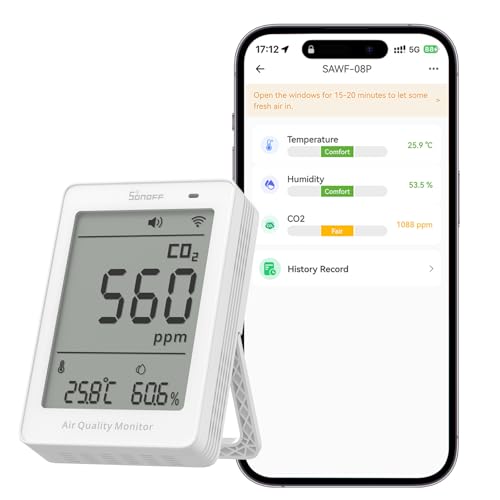
- Matter-compatible with leading smart-home platforms
- Five-second updates from an NDIR CO2 sensor
- App, sound, and multicolor LED notifications
Best For: Connected homes built around Matter and voice assistants
Best Battery Life
INKBIRD IAM-T2 NDIR CO2 Monitor

- Runs for more than six months per full charge
- Bluetooth app access up to 100 meters unobstructed
- Stores offline data and supports long-term export
Best For: Portable use and rooms without convenient outlets
Best Wireless Pick
Aranet4 Indoor Air Quality Monitor
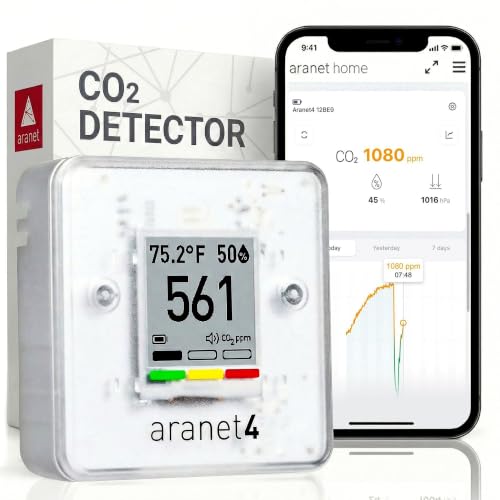
- Wireless, cable-free design
- Up to four-year battery life
- App history for up to 90 days
Best For: Homes and offices wanting simple app-based CO2 trend tracking
Best Remote-Access Choice

- Wi-Fi remote access and app alerts
- Monitors six indoor air metrics
- Selectable logging and data export
Best For: Remote monitoring and detailed indoor air-quality analysis
Best Plug-In Value

- No-battery plug-and-play setup
- Two-second refresh rate
- Audible and visual alarms
Best For: Local, outlet-powered CO2 monitoring in compact spaces
Best Connected Monitor
Smart WiFi Indoor Air Quality Monitor

- Remote app access over dual-band WiFi
- Custom app, email, and SMS alerts
- Tracks CO2 plus five other conditions
Best For: Homes, offices, classrooms, and multi-location monitoring
Best Portable Pick

- NDIR sensor measures up to 9,999 ppm
- Audible and visual high-CO2 alarms
- Battery-powered with backlit LCD
Best For: Portable indoor spot checks without app connectivity
Best Large-Screen Air Tester
16-in-1 Indoor Air Quality Monitor

- Tracks CO2, particles, HCHO, TVOC, and AQI
- Large 7-inch adjustable-brightness display
- Built-in buzzer, mute function, and calibration support
Best For: At-a-glance local monitoring across multiple air-quality metrics
Most Comprehensive – ALAZUR Smart WiFi Air Quality Monitor
For shoppers comparing carbon dioxide monitors with remote monitoring, the ALAZUR stands out for its broad sensor coverage and flexible alerts. It tracks CO2, HCHO, temperature, humidity, TVOC, and air pressure, while dual-band WiFi enables app access from virtually anywhere.
Best For: Homes, bedrooms, offices, classrooms, and users monitoring multiple locations.
Pros:
- Monitors six indoor-environment metrics, including CO2 and HCHO.
- Supports app, email, and SMS notifications with customizable thresholds.
- Offers historical trends, report export, shared access, and multiple-device management.
- Readable 3.7-inch, low-power E-Ink display shows key readings and device status.
Cons:
- Corded operation is recommended for regular use.
- The sensor may need 20–30 minutes to adapt after placement.
The ALAZUR is a strong choice when remote CO2 access is only part of the requirement. Its extra sensors, notification channels, and reporting tools make it especially useful for ongoing ventilation and indoor-environment tracking.
Best for Detailed History – GoveeLife H5140 Smart CO2 Monitor
The GoveeLife H5140 is a practical pick among carbon dioxide monitors with remote monitoring, combining a clear display with app alerts and long-term data tools. Its SCD4x sensor refreshes every five seconds, and the unit also reports temperature and humidity.
Best For: Bedrooms, nurseries, offices, and users who want long-term records and smart-home connectivity.
Pros:
- Provides CO2 accuracy of ±(40ppm + 5%) with pressure compensation.
- Offers buzzer, app, and email alerts for customizable conditions.
- Stores up to two years of historical data and supports CSV export.
- Works with Alexa and Google Assistant and can link with compatible humidifiers and tower fans.
Cons:
- Requires continuous AC power rather than battery operation.
- The clock requires an app connection.
- Outdoor calibration may be needed through the app.
Choose this model if historical analysis and household automation matter as much as live CO2 readings. The programmable display and day/night brightness settings are also useful in sleep spaces and nurseries.
Best Matter Integration – SONOFF AirGuard SAWF-08P
The SONOFF AirGuard is a good fit for shoppers seeking carbon dioxide monitors with remote monitoring inside a broader smart-home setup. Its NDIR sensor measures CO2, temperature, and humidity, while 2.4GHz WiFi and Matter compatibility connect it with several major platforms.
Best For: Matter-enabled homes using Apple Home, Alexa, Google Home, SmartThings, or Home Assistant.
Pros:
- Supports Matter across multiple smart-home ecosystems.
- Uses an NDIR sensor with stated accuracy of ±(50ppm + 5%).
- Updates data every five seconds with continuous power.
- Provides sound, multicolor LED, and app notifications with adjustable thresholds.
Cons:
- Requires continuous power and a 2.4GHz WiFi connection.
- Measures fewer air-quality factors than models that also track TVOC or formaldehyde.
The AirGuard is most compelling when interoperability is a priority. It keeps the feature set focused, but Matter support, voice queries, app notifications, and a year of historical data make it a capable connected CO2 monitor.
Best Battery Life – INKBIRD IAM-T2 NDIR CO2 Monitor
The INKBIRD IAM-T2 offers a portable alternative for shoppers comparing carbon dioxide monitors with remote monitoring. Its Bluetooth 5.0 connection lets you check CO2, temperature, and humidity through the app within an unobstructed range of up to 100 meters, while the built-in battery can run for more than six months after charging.
Best For: Portable monitoring, rooms without convenient outlets, and users prioritizing long battery life.
Pros:
- Built-in 3000 mAh battery provides more than six months of stated use.
- Bluetooth 5.0 supports app access within up to 100 meters unobstructed.
- Stores 30 days of offline data, with app storage and export for one year.
- Uses sound and indicator alarms with green, yellow, and red status colors.
Cons:
- Bluetooth range is more limited than WiFi-based remote monitoring.
- Tracks only CO2, temperature, and humidity.
- Charging takes about six hours.
The IAM-T2 is the better match for mobility and low-maintenance operation rather than true anywhere-access monitoring. Its long battery life and offline storage make it convenient for moving between rooms or checking spaces away from an outlet.
Best Wireless Pick – Aranet4 Indoor Air Quality Monitor
The Aranet4 is a practical choice for shoppers seeking carbon dioxide monitors with remote monitoring through a smartphone app. Its wireless, battery-powered design measures CO2, temperature, humidity, and atmospheric pressure, while the app provides up to 90 days of historical data.
Best For: Homes and offices that want a cable-free CO2 monitor with straightforward app-based data review.
Pros:
- Wireless design uses included AA batteries and can run for up to four years.
- NDIR sensor technology is designed for precise CO2 measurement.
- Color-coded display, prominent readings, and optional buzzer make high CO2 easier to notice.
- App displays and graphs up to 90 days of historical data.
Cons:
- The notes specify smartphone app access but do not describe Wi-Fi or alerts from anywhere.
- It focuses on CO2, temperature, humidity, and pressure rather than a broader pollutant lineup.
Choose the Aranet4 if long battery life and a simple wireless setup matter more than continuous cloud-style remote access. It is especially appealing for users who want to review trends on a phone without keeping the monitor plugged in.
Best Remote-Access Choice – Temtop M10+ WiFi CO2 Monitor
The Temtop M10+ is the strongest fit for shoppers specifically comparing carbon dioxide monitors with remote monitoring. It connects to the Temtop app over Bluetooth and 2.4GHz Wi-Fi, allowing remote readings, customizable thresholds, push notifications, historical trends, and data export.
Best For: Users who want to monitor multiple indoor air metrics remotely and analyze long-term data.
Pros:
- Tracks CO2, PM2.5, TVOC, AQI, temperature, and humidity in one device.
- Wi-Fi app access supports remote viewing, threshold customization, and push notifications.
- Logs data at selectable 1-, 5-, 10-, or 30-minute intervals and supports export.
- Rechargeable battery provides up to 40 days in power-saving mode.
Cons:
- Remote access requires Bluetooth and 2.4GHz Wi-Fi setup.
- The broader feature set may be more than needed if CO2 is your only concern.
For genuine away-from-home monitoring, the M10+ offers the most complete feature set in this group. Its combination of Wi-Fi access, alerts, logging, and export makes it well suited to tracking changing air quality over time.
Best Plug-In Value – VETOUCH Wall CO2 Detector
The VETOUCH L6088 is a compact plug-in option for shoppers who want always-on carbon dioxide monitoring without battery maintenance. It displays CO2, temperature, and humidity in real time, with a fast refresh rate, adjustable brightness, and audible and visual alarms.
Best For: Home, office, school, garage, RV, or travel setups that need an outlet-powered local monitor.
Pros:
- Plug-and-play operation requires no batteries.
- Large color display is readable from up to 15 feet, with adjustable brightness.
- NDIR sensor is rated for five years and refreshes readings every two seconds.
- Customizable threshold, flashing red light, and 85dB buzzer provide clear alerts.
Cons:
- The supplied notes describe local display and alarms, not Wi-Fi, app access, or remote monitoring.
- It monitors only CO2, temperature, and humidity.
- It is a CO2 monitor, not a carbon monoxide or smoke alarm.
The L6088 is a sensible choice when simple, outlet-powered monitoring is the priority. However, shoppers specifically needing carbon dioxide monitors with remote monitoring should consider a Wi-Fi-equipped model instead.
Best Connected Monitor – Smart WiFi Indoor Air Quality Monitor
For shoppers seeking carbon dioxide monitors with remote monitoring, this ALAZUR model combines CO2 tracking with temperature, humidity, TVOC, air pressure, and power-status information. Dual-band WiFi enables app access, alerts, historical trends, and multi-location monitoring.
Best For: Homes, bedrooms, offices, classrooms, and users who want app-based access and customizable notifications.
Pros:
- Remote access over 2.4GHz and 5GHz WiFi
- Tracks CO2, TVOC, temperature, humidity, and air pressure
- Custom alerts through the app, email, and SMS
- Clear, low-power 3.7-inch E-Ink display with historical data export
Cons:
- Recommended to remain plugged in for dependable power-status monitoring
- Requires 20–30 minutes to adapt after placement for the most accurate reading
- More features than needed if you only want a basic CO2 meter
This is the strongest choice here for connected monitoring. Its app, alerts, reports, and multi-device support make it practical for tracking ventilation and indoor conditions when you are away.
Best Portable Pick – TEKCOPLUS Portable CO2 Meter
This TEKCOPLUS meter is a straightforward option for buyers comparing carbon dioxide monitors with remote monitoring but ultimately preferring a portable, self-contained device. It uses an NDIR sensor and displays CO2, temperature, and humidity readings with audible and visual alarms.
Best For: Portable checks in homes, offices, grow rooms, classrooms, and other indoor spaces where local alarms matter more than app access.
Pros:
- NDIR CO2 sensor with a range up to 9,999 ppm
- Audible and visual alarms for elevated CO2
- Large backlit LCD shows CO2, temperature, and humidity together
- Battery-powered design is convenient for portable use
Cons:
- No WiFi, app, or remote-monitoring features are listed
- Provides fewer air-quality measurements than the multi-sensor models
- Its alarm is designed for nearby, immediate awareness rather than off-site notifications
Choose this model when portability and simple on-device warnings are priorities. It is not a true remote-monitoring solution, but its broad measurement range and NDIR sensor suit routine spot checks.
Best Large-Screen Air Tester – 16-in-1 Indoor Air Quality Monitor
For shoppers who want more than CO2 data, this 16-in-1 monitor pairs a precision NDIR CO2 sensor with particle, chemical, temperature, humidity, and AQI readings. Its large 7-inch display makes it easy to review local conditions, although the supplied details do not list WiFi or remote access.
Best For: Home, office, and bedroom users who want a broad, at-a-glance view of indoor air quality on a large screen.
Pros:
- Monitors CO2, PM1.0, PM2.5, PM10, HCHO, TVOC, temperature, humidity, and AQI
- Large 7-inch full-view display with adjustable brightness
- Real-time alerts with a built-in buzzer and mute function
- Built-in calibration support for ongoing monitoring
Cons:
- Remote monitoring or app connectivity is not listed
- Its many measurements may be unnecessary for buyers focused only on CO2
- Sensors should be protected from perfumes and strong odors, and not touched
This model is a strong local-display choice for broad air-quality awareness. If off-site access is essential, verify connectivity before buying; based on the supplied details, it is better suited to in-room monitoring.
How We Picked the Best Carbon Dioxide Monitors with Remote Monitoring
We focused on monitors that measure carbon dioxide and provide either Wi-Fi, Bluetooth app access, or smart-home connectivity. We also considered whether each model uses an NDIR CO2 sensor, which is generally preferred for dependable carbon dioxide measurement, and whether it offers useful supporting data such as temperature, humidity, particulate matter, formaldehyde, or TVOCs.
Other selection criteria included alert options, display readability, data logging, remote access, setup requirements, portability, power source, and value. Because product capabilities can vary by app, firmware, region, and smart-home platform, confirm current specifications before purchasing.
Quick Comparison
| Best For | Look For | Useful Advantage |
|---|---|---|
| Whole-home monitoring | Wi-Fi and cloud access | Check readings remotely from anywhere |
| Smart-home integration | Matter or platform compatibility | Automate fans, alerts, or ventilation |
| Portable testing | Battery power and Bluetooth | Move the monitor between rooms |
| Detailed air-quality tracking | Multi-sensor measurement | See CO2 alongside particles and gases |
| Simple plug-in use | Large display and audible alarm | Easy at-a-glance monitoring |
Key Buying Factors for Carbon Dioxide Monitors with Remote Monitoring
Connectivity and Remote Access
Wi-Fi is usually the most convenient choice when you want to check readings while away from home. Bluetooth models can be excellent for nearby monitoring and lower power use, but they may require your phone to remain within range. If you plan to connect a monitor to automations, verify compatibility with your preferred ecosystem, such as Matter, Google Home, Alexa, or a manufacturer-specific app.
Sensor Quality and Calibration
Prioritize an NDIR sensor and look for clear calibration guidance. Automatic baseline correction can be convenient, but it may be less suitable in spaces that regularly stay at elevated CO2 levels. A monitor should be placed away from windows, vents, kitchens, and direct breath for more representative readings.
Alerts, History, and Placement
Useful alerts can include push notifications, audible alarms, color indicators, or customizable thresholds. Data history helps identify patterns, such as overnight buildup or poor ventilation during meetings. Choose a visible screen for shared spaces, or a compact battery-powered model when you need to test multiple rooms.
Who Should Buy Which Carbon Dioxide Monitors with Remote Monitoring?
Choose a Wi-Fi monitor with app notifications if you manage a home, office, rental property, nursery, or classroom and need remote checks. A Matter-compatible model is the better choice for smart-home users who want ventilation or fan automations. Pick a portable Bluetooth monitor for spot checks and travel. If you want broader diagnostics, select a multi-sensor unit that also measures particles, formaldehyde, TVOCs, temperature, and humidity. For straightforward wall or desk monitoring, a plug-in model with a large display and alarm may offer the simplest experience.