The best single-board computer kits for students make it easier to learn coding, electronics, robotics, and IoT without sourcing every component separately. This roundup includes beginner-friendly Arduino bundles, versatile ESP32 kits, and Raspberry Pi 5 systems for more advanced projects.
Use the guide below to match each kit’s processor, included accessories, learning resources, and expansion potential to the student’s experience level and goals.
Best 10 Single-Board Computer Kits for Students Picks for 2026
Best Beginner Build Kit
UNO R3 Project Super Starter Kit

- 22+ guided Arduino projects
- Sensors, motors, displays, and controls included
- Solderless setup for beginners
Best For: First electronics lessons, homeschool, and STEM clubs
Best Performance Option

- 8GB RAM and 2.4GHz quad-core CPU
- Dual 4K display and modern connectivity
- Case and active cooler included
Best For: Advanced programming, robotics, IoT, and media projects
Best Guided Curriculum

- 34 lessons and 40+ video courses
- Original Arduino Uno R3 included
- 200+ components plus multimeter
Best For: Classrooms, beginners age 8+, and structured learning
Best for Complex Builds

- 35+ guided electronics projects
- 54 digital I/O pins and 256 KB flash
- 200+ components for larger prototypes
Best For: Intermediate robotics, RFID, sensor, and automation builds
Best Beginner-Friendly Pick

- Pre-installed Debian and Python simplify setup
- Built-in touchscreen and sensors support interactive projects
- Mind+ helps students move from blocks to Python
Best For: STEM classes and beginner Python learners
Best Hands-On Electronics Kit
ELEGOO ESP-32 Super Starter Kit

- ESP-32 provides dual-core Wi-Fi and Bluetooth
- Includes 35-plus modules and components
- Tutorial covers 30-plus guided projects
Best For: Arduino, electronics, and IoT practice
Best Full-Computer Option
Raspberry Pi 5 4GB Starter Kit

- 4GB Raspberry Pi 5 supports demanding projects
- Active cooler helps with sustained workloads
- Case and screwdriver provide a protected starting setup
Best For: Programming, robotics, media, and Raspberry Pi OS projects
Best with Extra Features
Raspberry Pi 5 Starter Kit PRO
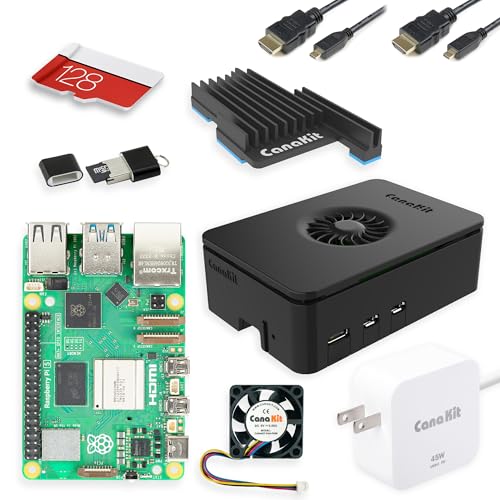
- 8GB RAM and 128GB preloaded storage
- Includes case, cooling, power supply, and cables
- Supports GPIO, Bluetooth, and four USB ports
Best For: Students tackling demanding Raspberry Pi projects
AI & Embedded Learning Pick
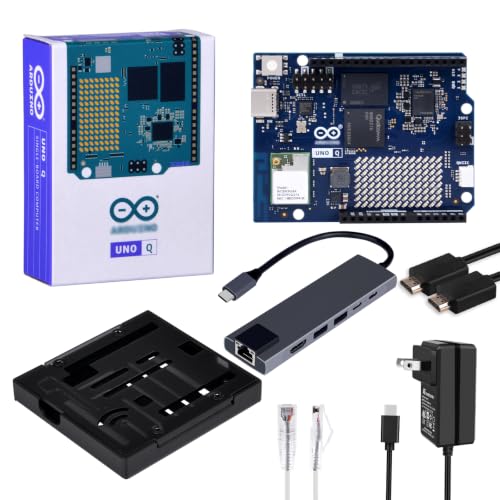
- 2GB RAM and 16GB eMMC storage
- Works standalone or through a PC via USB-C
- Includes aluminum case, hub, cables, and power supply
Best For: Arduino, AI, and embedded development students
Beginner-Friendly Complete Kit
Raspberry Pi 5 Starter Kit MAX

- 8GB RAM with 128GB preloaded Raspberry Pi OS
- Includes cooling, case, power supply, and guide
- Two display cables support up to 4K at 60p
Best For: Students wanting a ready-to-use Raspberry Pi setup
Best Beginner Build Kit – UNO R3 Project Super Starter Kit
For students looking for single-board computer kits for students, the ELEGOO UNO R3 Project Super Starter Kit offers a structured introduction to Arduino coding and hands-on electronics. Its 22+ guided lessons cover LEDs, sensors, displays, motors, and input devices, while the solderless setup keeps early projects approachable.
Best For: Beginners, homeschool units, coding clubs, family weekend builds, and STEM classrooms.
Pros:
- Includes 22+ guided projects with example code and tutorials.
- Wide component selection covers sensors, motors, displays, and controls.
- Solderless breadboard and pre-soldered LCD simplify setup.
Cons:
- Limited to 2 KB of installed RAM and a 16 MHz processor.
- Requires an Arduino-compatible computer setup and careful wiring.
- Younger learners may need adult supervision.
This is a practical starter choice when the priority is learning core Arduino concepts through many small, repeatable builds rather than running a full desktop operating system.
Best Performance Option – Raspberry Pi 5 8GB Kit
Among single-board computer kits for students, the RasTech Raspberry Pi 5 kit is the strongest option for students who need a more capable general-purpose computer. Its 8GB memory, quad-core 2.4GHz processor, wireless connectivity, dual 4K display support, and included cooling hardware suit programming, web development, IoT, and robotics projects.
Best For: Older students, advanced coding, robotics, AI experimentation, home automation, and media projects.
Pros:
- 8GB RAM and a 2.4GHz quad-core Arm Cortex-A76 processor provide substantial headroom.
- Supports dual 4K displays, Gigabit Ethernet, Wi-Fi, Bluetooth, and PCIe expansion.
- Includes an active cooler, case, screwdriver, and installation instructions.
Cons:
- Requires a separate M.2 HAT for PCIe SSD storage.
- The kit listing does not include a complete storage or power bundle.
- Its capabilities may be more than needed for basic electronics lessons.
This kit makes the most sense for students ready to move beyond simple microcontroller exercises and work with Raspberry Pi OS, networking, displays, and more demanding software projects.
Best Guided Curriculum – Inventor Lab Arduino Kit
The SunFounder Inventor Lab is a strong classroom-oriented choice among single-board computer kits for students. It pairs an original Arduino Uno R3 with 34 lessons, more than 40 video courses, circuit diagrams, code examples, a multimeter, and over 200 components for a more guided learning path.
Best For: Beginners age 8 and up, structured classes, engineering practice, and learners who benefit from video instruction.
Pros:
- Provides 34 lessons and 40+ video courses with step-by-step support.
- Includes an original Arduino Uno R3, multimeter, RAB holder, sensors, and actuators.
- Projects connect electronics concepts to practical builds such as smart dispensers and remote lights.
Cons:
- More components can mean more inventory and setup time.
- Arduino projects require a separate computer for programming.
- Its curriculum-focused design may be unnecessary for experienced makers.
Choose this kit when instructional depth and organized practice matter as much as the hardware. The multimeter and video-supported lessons add useful support for students building confidence with circuits.
Best for Complex Builds – Mega 2560 Project Starter Kit
Students who have outgrown basic Arduino projects may prefer the ELEGOO Mega 2560 kit. It is one of the more expandable single-board computer kits for students, with 54 digital I/O pins, 16 analog inputs, four hardware serial ports, 256 KB of flash, and more than 200 components for larger multi-part builds.
Best For: Intermediate students, robotics, sensor networks, RFID projects, alarms, and coding clubs.
Pros:
- 35+ guided projects provide a clear progression from basics to more involved systems.
- MEGA 2560 offers substantially more I/O and memory than an entry-level UNO board.
- Includes RFID, RTC, motion, environmental, distance, motor, and display components.
- Storage case and small-parts box help organize the large component collection.
Cons:
- The large number of parts may feel overwhelming for absolute beginners.
- Projects require careful wiring and component management.
- It is a USB-connected Arduino kit rather than a standalone desktop computer.
This is the better fit for students ready to combine several sensors, controls, and displays in one project. Its expanded I/O makes it more suitable than an UNO for ambitious prototypes and robotics-style builds.
Best Beginner-Friendly Pick – UNIHIKER M10 Python Dev Kit
For students seeking single-board computer kits for students that minimize setup time, the UNIHIKER M10 is a practical choice. Its pre-installed Debian system and Python environment let beginners start coding through Jupyter Notebook or VS Code, while the built-in touchscreen and sensors support interactive projects without a separate breadboard.
Best For: STEM classes, beginner Python learners, and students transitioning from block-based programming to text-based code.
Pros:
- Pre-installed Debian and Python reduce initial setup.
- Built-in 2.8-inch touchscreen, microphone, motion sensors, light sensor, and buzzer enable standalone projects.
- Wi-Fi, Bluetooth, micro:bit compatibility, and Gravity interfaces support IoT expansion.
- Mind+ provides a graphical-to-Python learning path.
Cons:
- Its 512 MB of RAM and 1.2 GHz ARM processor are more suited to learning and embedded projects than demanding computing.
- The kit includes the board and listed cables, but not a broad assortment of external project components.
The UNIHIKER M10 stands out when easy setup and integrated hardware matter more than maximum performance. It gives students a compact platform for visual, sensor, and Python-based experimentation.
Best Hands-On Electronics Kit – ELEGOO ESP-32 Super Starter Kit
The ELEGOO ESP-32 Super Starter Kit is a strong option for students who want single-board computer kits for students centered on wiring, sensors, and electronics experiments. Its ESP-32 board works with the Arduino IDE, and the included components and guided projects provide a structured way to build from basic circuits to connected IoT devices.
Best For: Students learning Arduino-style programming, electronics fundamentals, and practical IoT development.
Pros:
- ESP-32 includes dual-core processing, Wi-Fi, and Bluetooth 4.2.
- Includes more than 35 modules and components, including displays, motors, sensors, and input devices.
- Online tutorial provides 30-plus projects with code, diagrams, and step-by-step instructions.
- Supports progression from beginner circuits to intermediate and advanced IoT projects.
Cons:
- Projects require hands-on wiring and component assembly, which may be less convenient than an integrated board.
- The kit is designed around the Arduino IDE rather than a general-purpose desktop operating system.
This kit is especially useful when the learning goal is understanding how electronics and code work together. The broad component selection gives students room to practice rather than limiting them to one built-in project.
Best Full-Computer Option – Raspberry Pi 5 4GB Starter Kit
Students who need a more capable general-purpose computer may prefer this Raspberry Pi 5 kit among single-board computer kits for students. It combines a 4GB Raspberry Pi 5 with active cooling, an ABS case, and a screwdriver, providing a protected starting point for programming, robotics, IoT, media, and retro-gaming projects.
Best For: Students who want to explore Raspberry Pi OS, programming, robotics, media projects, and more demanding applications.
Pros:
- 4GB RAM and a quad-core Arm Cortex-A76 processor support programming and heavier projects.
- Active cooling helps maintain performance during extended workloads.
- ABS case protects the board while leaving access to its ports and buttons.
- Includes Wi-Fi, Bluetooth 5.0, Gigabit Ethernet, HDMI, USB, and GPIO connectivity.
Cons:
- The case cannot accommodate an M.2 HAT add-on board and solid-state drive.
- Unlike the ESP-32 kit, it does not include a large assortment of sensors, motors, or electronic modules.
- Students may need additional peripherals or accessories depending on the intended project.
The Raspberry Pi 5 kit is the most versatile choice here for students who want a Linux-based computer rather than a focused electronics trainer. Its cooling and case make it a convenient foundation, while the Raspberry Pi community adds access to guides and project support.
Best with Extra Features – Raspberry Pi 5 Starter Kit PRO
CanaKit Raspberry Pi 5 Starter Kit PRO - Turbine Black (128GB Edition) (8GB RAM)
Check Price On AmazonFor students who want a powerful starting point, this Raspberry Pi 5 bundle is one of the most complete single-board computer kits for students. It combines 8GB of RAM, 128GB of preloaded storage, cooling hardware, a case, power supply, and display cables for a streamlined setup.
Best For: Students working on coding, desktop-style projects, media setups, and more demanding Raspberry Pi experiments.
Pros:
- Includes the 8GB Raspberry Pi 5 board and 128GB Micro SD card with Raspberry Pi OS.
- Includes a 45W PD power supply, Turbine Black case, fan system, and heat sink.
- Two six-foot display cables support resolutions up to 4K at 60p.
- Offers four USB ports plus GPIO and Bluetooth connectivity.
Cons:
- The large bundle may include more accessories than students need for basic introductory lessons.
- A 45W power supply and advanced cooling setup can add unnecessary cost for simple projects.
This is a strong choice when performance and convenience matter more than keeping the initial setup minimal. The included storage and accessories reduce the number of separate purchases needed before getting started.
AI & Embedded Learning Pick – Arduino UNO Q Starter Kit
This Arduino UNO Q bundle offers a different approach to single-board computer kits for students, combining a 2GB, 16GB-eMMC board with both standalone and PC-connected operating modes. Its aluminum case and included USB-C hub make it suitable for students exploring embedded development and AI-oriented projects.
Best For: Students learning Arduino workflows, embedded development, and projects that benefit from USB-C, Ethernet, and wireless connectivity.
Pros:
- Includes 2GB of RAM and 16GB of eMMC storage for embedded and AI projects.
- Can operate independently with a monitor and keyboard or connect to a PC through USB-C.
- Aluminum housing helps protect the board while supporting heat dissipation.
- Bundle includes a USB-C hub, power supply, HDMI cable, Ethernet cable, screws, and screwdriver.
Cons:
- It has less RAM and storage than the Raspberry Pi 5 kits in this roundup.
- The kit is designed for the Arduino UNO Q, so its ecosystem differs from Raspberry Pi-based coursework.
- The listed warranty is six months.
Choose this kit if the student’s coursework centers on Arduino and embedded systems rather than general-purpose Raspberry Pi projects. Its dual operating modes provide useful flexibility as skills develop.
Beginner-Friendly Complete Kit – Raspberry Pi 5 Starter Kit MAX
Students who want a ready-to-use setup may appreciate this Raspberry Pi 5 bundle. Among single-board computer kits for students, it stands out for including Raspberry Pi OS on a 128GB Micro SD card along with the board, case, cooling, power supply, cables, and a quickstart guide.
Best For: Beginners and advanced students who want to move quickly from unboxing to coding, robotics, smart-home, or media projects.
Pros:
- Includes the official Raspberry Pi 5 with 8GB of RAM and 128GB preloaded storage.
- Comes with a case, power supply, fan, heat sinks, Micro SD card reader, and quickstart guide.
- Includes two Micro HDMI-to-HDMI cables supporting up to 4K at 60p.
- Provides GPIO, HDMI, Ethernet, Bluetooth, and four USB ports.
Cons:
- The complete bundle may be more than needed for students who already own peripherals.
- The case and cooling accessories make it less compact than a bare-board setup.
This kit is a practical all-in-one option for students who value easy setup and broad project flexibility. The preloaded operating system and included guide can reduce initial configuration work without limiting future experimentation.
How We Picked the Best Single-Board Computer Kits for Students
We focused on kits that combine a capable development board with the practical accessories students need to start building. Our comparisons consider included power supplies, cases, cooling, storage, breadboards, sensors, displays, cables, and other components that can otherwise add cost and setup time.
We also looked at the learning curve, documentation, project variety, operating-system support, programming compatibility, and room for future expansion. Arduino-based kits are often the simplest entry point for electronics, while Raspberry Pi, UNIHIKER, and ESP32 options can support Linux, Python, wireless projects, computer applications, and more advanced IoT work.
Quick Comparison
| Best For | Recommended Type | Why It Stands Out |
|---|---|---|
| First electronics projects | Arduino Uno starter kit | Simple programming, extensive tutorials, and many components |
| Large robotics and sensor projects | Arduino Mega kit | More pins and expansion capacity than an Uno |
| Wireless IoT projects | ESP32 kit | Integrated connectivity and Arduino IDE compatibility |
| Python and touchscreen learning | UNIHIKER M10 | Built-in display, Debian, and classroom-friendly controls |
| Linux, media, and advanced computing | Raspberry Pi 5 kit | Strong performance, broad software support, and accessories |
| AI and embedded experimentation | Arduino UNO Q kit | Modern processing hardware for more advanced development |
Key Buying Factors for Single-Board Computer Kits for Students
Board Type and Programming Language
Arduino Uno kits are approachable for block-based or C/C++-style microcontroller lessons. Mega boards suit projects that need many inputs and outputs. ESP32 kits add wireless capability, while UNIHIKER and Raspberry Pi systems are better suited to Python, Linux, networking, and multitasking.
Included Components and Setup
Check whether the package includes a reliable power supply, USB cable, storage, case, cooling, breadboard, jumper wires, LEDs, sensors, and motors. A complete bundle is especially useful for students because it reduces delays between lessons and projects.
Performance, Storage, and Cooling
Raspberry Pi 5 kits benefit from active cooling and adequate power, particularly when running a desktop, compiling code, or handling robotics and media tasks. Compare RAM and microSD capacity, but also verify that the kit includes the correct power adapter and a case with suitable ventilation.
Documentation and Expansion
Beginner tutorials, video courses, wiring diagrams, and sample code can make a major difference. Choose a board with a large community and compatible add-ons if the student is likely to continue beyond the included projects.
Who Should Buy Which Single-Board Computer Kits for Students?
Choose an ELEGOO UNO R3 or SunFounder Inventor Lab kit for a first electronics course or hands-on STEM introduction. The ELEGOO Mega 2560 is a better fit for students planning larger robotics builds with many components.
For wireless sensors, connected devices, and compact IoT projects, an ESP32 starter kit offers strong flexibility. Students focused on Python and interactive hardware may prefer the UNIHIKER M10 with its touchscreen and pre-installed Debian environment.
Choose a Raspberry Pi 5 kit for Linux, programming, networking, robotics, desktop applications, or media projects. Compare RAM, storage, cooling, and included accessories among the 4GB and 8GB packages. Finally, the Arduino UNO Q kit is best for students ready to explore AI and more advanced embedded development.