Healthy greenhouse plants depend on the conditions below the surface as much as the light and temperature above it. The right digital soil tester can help you monitor moisture, pH, temperature, light, humidity, and fertility before small problems become costly crop issues.
We selected 10 versatile testers ranging from simple pH meters to multi-function analyzers. Use the comparison and buying advice below to find the best fit for your plants, growing media, and maintenance routine.
Best 10 Digital Soil Testers for Greenhouses Picks for 2026
Most Comprehensive
7-in-1 Dual-Screen Soil Tester

- Measures moisture, pH, fertility, light, and temperatures
- Also monitors air humidity and ambient temperature
- Adjustable viewing head and single-probe design
Best For: Greenhouse growers wanting broad soil and environmental readings
Simple Battery-Powered Pick
Luster Leaf Rapitest Digital Kit

- Battery-powered digital soil testing kit
- Compact and lightweight at about 0.21 kg
- Specific measurement functions are not listed
Best For: Gardeners seeking a basic portable digital kit
Best Large-Screen Option

- Measures moisture, pH, fertility, temperature, sunlight, and humidity
- Features a 3.6-inch digital display
- Runs on two AAA batteries, not included
Best For: Users wanting readable multi-function greenhouse checks
Best for pH Tracking

- Tests soil pH directly across several soil types
- Also measures hydroponic solution and water
- App stores up to 1,000 readings with notes
Best For: Greenhouse growers focused on pH monitoring and records
Versatile 4-Way Pick
Luster Leaf Rapitest Digital Soil Analyzer
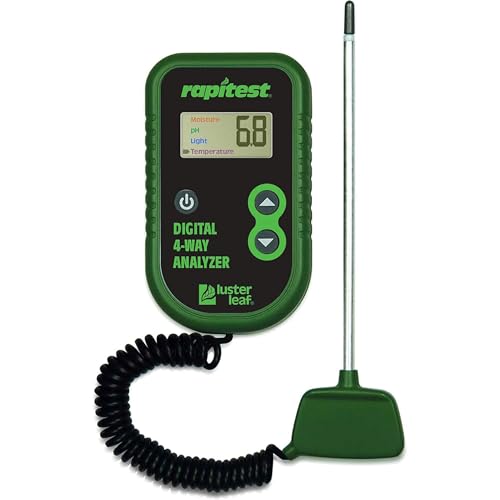
- Tests pH, moisture, light, and temperature
- Digital output with a corded probe
- Includes guidance and a 450+ plant pH list
Best For: Routine greenhouse checks of core soil and light conditions
Connected pH Specialist

- Tests soil, potting media, and liquid solutions
- App supports automatic data storage
- Includes calibration supplies and a replaceable electrode
Best For: Greenhouse pH management and nutrient-solution testing
All-in-One Greenhouse Pick

- Measures six soil and air factors
- Deep 180 mm dual-needle probe
- Rotating backlit LCD
Best For: Broad greenhouse condition checks
Calibratable Multi-Use Pick

- Three-point pH calibration
- Tests soil and liquids
- Includes alloy probe cap
Best For: Experienced growers needing flexible pH testing
Most Comprehensive – 7-in-1 Dual-Screen Soil Tester
For growers comparing digital soil testers for greenhouses, this 7-in-1 model provides a broad snapshot of both root-zone and surrounding conditions. It measures moisture, pH, fertility, light intensity, soil temperature, air temperature, and humidity, with readings shown across a dual-display design.
Best For: Greenhouse growers who want one tool for soil and ambient plant-care readings.
Pros:
- Measures seven useful soil and environmental conditions.
- Dual display shows key readings at a glance.
- 90-degree adjustable head offers six viewing angles.
- Single probe is designed to minimize root disturbance.
Cons:
- Requires insertion at least 5 inches into moist soil for optimal accuracy.
- Should not be used in water, stones, or very loose soil.
- Probe should be cleaned after use and not left in soil for extended periods.
This is a versatile choice when greenhouse monitoring involves more than moisture alone. Its combination of soil and air readings makes it especially practical for checking conditions across beds, pots, and other growing areas.
Simple Battery-Powered Pick – Luster Leaf Rapitest Digital Kit
The Luster Leaf 1605 Rapitest is a straightforward option for shoppers seeking digital soil testers for greenhouses without a long list of stated functions. Its supplied details identify it as a battery-powered digital soil testing kit with a compact, lightweight design.
Best For: Gardeners who prefer a basic, portable digital soil testing kit.
Pros:
- Battery powered for convenient use away from outlets.
- Compact weight of approximately 0.21 kg.
- Designed as a dedicated digital soil testing kit.
Cons:
- The supplied specifications do not list specific measurement functions.
- No greenhouse-specific features are detailed in the provided notes.
This model may suit buyers who want a recognizable, uncomplicated digital kit, but shoppers needing explicit readings such as pH, moisture, or temperature should confirm the current product details before purchasing.
Best Large-Screen Option – 6-in-1 Soil Tester
This 6-in-1 model is a practical contender among digital soil testers for greenhouses, combining measurements for moisture, pH, fertility, temperature, sunlight, and air humidity. Its 3.6-inch display is designed to make results easier to read while moving between garden, greenhouse, and farm areas.
Best For: Greenhouse and garden users who prioritize a large, direct-read display.
Pros:
- Checks six soil and environmental conditions.
- Large 3.6-inch digital screen supports quick reading.
- Helps assess moisture below the surface before watering.
- Compact and portable for checking multiple growing areas.
Cons:
- Requires two AAA batteries, which are not included.
- Fertility readings are described as a reference for fertilizer adjustments.
For greenhouse users who want several measurements without switching tools, this tester offers a useful balance of coverage and readability. The missing batteries are a small setup consideration, but the large screen can be valuable during routine checks.
Best for pH Tracking – YINMIK Digital Soil pH Meter
For greenhouse growers focused specifically on acidity and alkalinity, the YINMIK digital soil pH meter offers direct probe-based testing. It works with soil types including potting mixes, coco coir, sandy soil, and loam, and its app can store readings for later review.
Best For: Growers who need focused soil pH testing with mobile data tracking.
Pros:
- Provides direct digital soil pH readings without preparing a slurry.
- Protective tapered dibber supports testing across different soil types.
- Can also test hydroponic nutrient solution and several water sources.
- App supports automatic storage of up to 1,000 data points and notes.
Cons:
- It is primarily a pH tester rather than a multi-function soil meter.
- App connectivity is required for the stated data-storage features.
- Uses three LR44 batteries, so replacement batteries may be needed.
This is a strong specialized option when pH management is central to greenhouse growing. The included calibration powders, dibbers, brush, and dropper add useful testing support, while app history can help track changes over time.
Versatile 4-Way Pick – Luster Leaf Rapitest Digital Soil Analyzer
For gardeners comparing digital soil testers for greenhouses, the Luster Leaf Rapitest offers a straightforward way to check four core growing conditions: pH, moisture, light, and temperature. Its digital output and corded probe are practical for routine greenhouse checks.
Best For: Greenhouse growers who want one simple tester for four basic soil and light readings.
Pros:
- Measures soil pH, moisture, light, and temperature.
- Digital readout is designed for easy reading.
- Corded probe lets you handle the probe and view the output at the same time.
- Includes instructions, gardening tips, and a pH plant list covering more than 450 plants.
Cons:
- Provides four test categories rather than the broader environmental measurements offered by some multi-function meters.
- The supplied notes do not specify automatic calibration or app connectivity.
This is a practical all-around option when greenhouse monitoring centers on basic soil and light conditions, especially if you value included plant-reference guidance.
Connected pH Specialist – YINMIK Digital Soil pH Meter
Among digital soil testers for greenhouses, the YINMIK stands out for growers who want focused pH testing in soil, potting media, or liquid nutrient solutions. Its direct-probe design, app support, and included calibration supplies suit more involved greenhouse routines.
Best For: Serious greenhouse growers who need pH readings for both growing media and nutrient solutions.
Pros:
- Measures pH directly in soil and can also test liquids.
- App connectivity supports automatic data storage for tracking changes over time.
- Features automatic temperature compensation, backlight, hold function, and three-point auto calibration.
- Includes a replaceable electrode, stainless-steel dibber, calibration powders, batteries, brush, and dropper.
Cons:
- It is primarily a pH meter rather than a multi-parameter soil analyzer.
- Using the app adds a setup step beyond taking an on-device reading.
The YINMIK is the more specialized choice here, offering useful measurement flexibility and recordkeeping for growers who regularly adjust nutrient or soil pH.
Broad-Range Monitor – 7-in-1 Soil Test Kit
For growers seeking broad coverage from digital soil testers for greenhouses, this 7-in-1 kit combines soil and ambient readings in one probe-based device. Its dual display and rotating head make it convenient for checking several conditions without switching instruments.
Best For: Greenhouse users who want a wide snapshot of soil conditions and nearby air conditions.
Pros:
- Measures soil moisture, pH, fertility, light intensity, soil temperature, air humidity, and ambient temperature.
- Dual displays show selected readings and mode information at a glance.
- A 90-degree adjustable head provides six viewing angles.
- Single-probe design is intended to minimize root disturbance.
Cons:
- Should not be used for testing water, stones, or very loose soil.
- The probe should not be left in soil for extended periods.
- Requires insertion at least five inches into moist soil for optimal accuracy and cleaning after use.
This model offers the broadest measurement range of the three, making it appealing for greenhouse scouting, provided you follow its placement and care instructions.
Industrial Precision Pick – LUVCOSY Digital Soil pH Meter
For growers comparing digital soil testers for greenhouses, the LUVCOSY focuses on straightforward, dedicated soil-pH measurement. Its double-needle stainless-steel probes, portable handheld design, and included AA batteries make it convenient for routine checks in beds, pots, or greenhouse soil.
Best For: Gardeners and greenhouse growers who primarily need soil pH readings rather than a multifunction soil analysis.
Pros:
- Designed specifically for soil pH measurement with high-precision positioning.
- Double-needle stainless-steel probes are described as sensitive and corrosion-resistant.
- Lightweight 160-gram handheld design is easy to carry.
- Three included AA batteries are claimed to support up to five years of use.
Cons:
- It measures soil pH only and is not intended for liquid testing.
- It does not provide moisture, temperature, humidity, or fertility readings.
This is a focused option for greenhouse users who want one dedicated pH tool and do not need broader environmental measurements. The one-year warranty adds some reassurance for routine use.
All-in-One Greenhouse Pick – 6-in-1 Digital Soil Test Kit
Among digital soil testers for greenhouses, this 6-in-1 model stands out for covering several growing conditions with one handheld device. It measures moisture, pH, temperature, sunlight, fertility, and air humidity, while its deep dual-needle probe and rotating backlit display support quick checks around a greenhouse.
Best For: Growers who want a broad snapshot of soil and surrounding greenhouse conditions from one tester.
Pros:
- Combines six measurements, including soil moisture, pH, temperature, fertility, sunlight, and air humidity.
- 180 mm dual-needle probe is designed for deeper soil penetration.
- Backlit LCD rotates 90 degrees for easier viewing in different positions.
- Readings are reported in about three seconds, with no calibration required according to the product notes.
Cons:
- Requires two AAA batteries, which are not included.
- Its pH accuracy is listed as ±0.5, so it may be less suitable when highly precise pH control is essential.
This is the most versatile choice of the three for everyday greenhouse monitoring. It trades specialized pH calibration features for convenience and a wider set of measurements.
Calibratable Multi-Use Pick – Tadeto Digital Soil pH Tester
For greenhouse growers who want greater control over pH accuracy, the Tadeto combines soil testing with liquid and solution measurement. It includes three-point calibration, manual value adjustment, a temperature display, and a protective alloy cap, making it a more maintenance-oriented option for repeated testing.
Best For: Experienced growers who need calibratable pH testing for soil, water, nutrient solutions, or other supported materials.
Pros:
- Supports pH testing for soil, water, plants, solutions, food, and other liquids.
- Three-point calibration uses acidic, neutral, and alkaline buffer solutions.
- Backlit LCD shows pH and real-time temperature, with data hold functionality.
- Zinc-alloy protective cap helps shield the electrode during harder-material testing.
Cons:
- Requires calibration before first use and manual adjustment when readings do not match buffer values.
- The probe needs rinsing after measurements and KCl solution for storage.
- It is a pH-focused meter rather than a multifunction soil tester.
The Tadeto is a strong fit when calibration and cross-use flexibility matter more than plug-and-play simplicity. Its maintenance requirements are worth considering for greenhouse users who test frequently.
How We Picked the Best Digital Soil Testers for Greenhouses
We focused on testers that measure one or more conditions greenhouse growers commonly monitor: soil moisture, pH, temperature, light, humidity, and estimated fertility. We also considered display readability, probe design, portability, calibration requirements, measurement versatility, and how practical each device is for routine checks.
Because digital readings can vary with soil texture, moisture distribution, fertilizer concentration, and probe placement, we favored products that offer useful measurement coverage without making claims that exceed what a handheld tester can reliably provide.
Quick Comparison
| Tester type | Best for | Typical measurements |
|---|---|---|
| 4-way analyzer | Routine greenhouse monitoring | pH, moisture, temperature, light |
| 6- or 7-in-1 tester | Broad environmental checks | Moisture, pH, fertility, light, temperature, humidity |
| Dedicated pH meter | Frequent pH testing | Soil or solution pH, sometimes temperature |
| Digital soil test kit | General plant care | Several basic soil and air readings |
Key Buying Factors for Digital Soil Testers for Greenhouses
Measurements and Intended Use
Choose based on the decisions you need to make. A pH-focused meter suits growers adjusting nutrient solutions or troubleshooting nutrient lockout. A multi-function unit is more useful when you want a quick overview of moisture, temperature, light, and humidity across several growing areas.
Accuracy and Calibration
Look for clear calibration instructions, especially when pH matters. Test meters with appropriate buffer solutions or known reference samples, and avoid treating “fertility” readings as a laboratory soil analysis. Use repeated readings from multiple points for a more dependable picture.
Probe Design and Operation
A sturdy probe and a readable screen matter in dense potting mixes and raised beds. Check the recommended insertion depth and whether the probe is intended for direct soil use, liquid solutions, or both. Clean and dry the probe between tests, and never force it through stones, roots, or compacted media.
Greenhouse Practicality
Large displays, dual readings, automatic shutoff, portability, and simple controls can save time during frequent checks. Battery type and replacement availability are also worth confirming before purchase.
Who Should Buy Which Digital Soil Testers for Greenhouses?
Choose a multi-function 6-in-1 or 7-in-1 model if you manage varied crops and want quick spot checks from one tool. A 4-way analyzer is a sensible middle ground for growers who mainly need pH, moisture, temperature, and light. Choose a dedicated digital pH meter if nutrient management and pH consistency are your primary concerns. For occasional plant care, a straightforward tester with a large display may provide the best value and easiest operation.