Digital angle finders make it easier to measure, transfer, and verify angles without relying on hard-to-read analog scales. The right model can speed up trim work, confirm miter settings, and improve accuracy on the jobsite or in the workshop.
These 10 options include compact angle gauges, magnetic models, programmable tools, and units with helpful features such as miter calculations, LED alerts, and laser guides.
Best 10 Digital Angle Finders Picks for 2026
Versatile Magnetic Pick
Klein Tools 935DAG Digital Angle Gauge
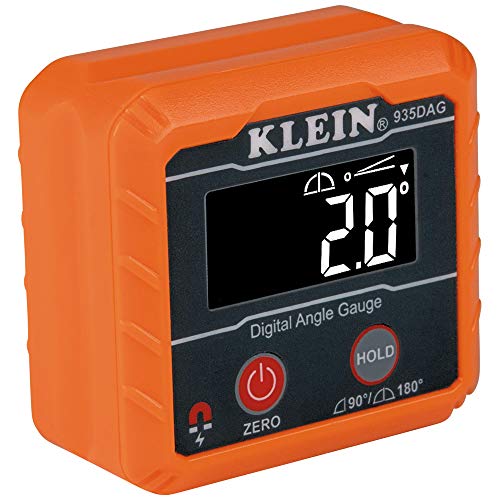
- Measures 0–90° and 0–180° angles
- Magnetic base with V-groove edges
- Functions as both gauge and digital level
Best For: Conduit, pipe, woodworking, and alignment tasks
Ruler-Style Precision Pick
GemRed 82305 Digital Angle Finder

- Stainless steel ruler and protractor design
- Locks at any measured angle
- Rated accuracy of ±0.3°
Best For: Woodworking, crown molding, and general angle measurement
Angle-Alert Jobsite Pick
Klein Tools 935DAA Digital Angle Gauge

- LED and audio target-angle alerts
- Magnetic base with V-groove edges
- IP54 water- and dust-resistant design
Best For: Jobsite angle setup, leveling, and alignment
Compound-Cut Specialist
S&F STEAD & FAST Digital Angle Finder

- Miter and bevel calculation button
- 0–360° range with ±0.2° accuracy
- Stainless steel arms with etched rulers
Best For: Miter saw setup, trim work, and compound cuts
Best Repeatability
GemRed DAG-V1 Digital Angle Gauge

- ±0.2° accuracy with 0.1° resolution
- Measures 0° to 360° in two modes
- Aluminum frame with magnetic base and backlit display
Best For: General woodworking, construction, and layout measurements
Best for Pitch and Alignment
Klein Tools 935DAGL Digital Level

- Offers 90°, 180°, and dual-axis bullseye ranges
- Includes programmable common pitch settings
- Uses visual and audible target-angle alerts
Best For: Conduit, pipe, pitch, and trade alignment work
Best Protractor Design
LEXIVON LX-DAF7 Digital Angle Finder

- 360° range with inside, outside, and reverse readings
- 0.05° resolution and ±0.3° accuracy standard
- 7-inch aluminum rule with large display and carrying pouch
Best For: Detailed woodworking, flooring, and tile layout
Best Magnetic Pick
Klein Tools 935DGGP Digital Angle Finder

- Converts degrees, grade, mm/m, and in/ft
- Strong magnetic base with V-groove edges
- High-contrast display and digital-level function
Best For: Hands-free pipe, conduit, duct, and layout work
Best Laser-Equipped Option
Coobeast Digital Angle Finder with Dual Laser

- Four-sided magnets support varied mounting positions
- Adds dual laser lines to angle and level functions
- Backlit display, hold, zeroing, and auto-flip features
Best For: Woodworking, home decoration, and alignment tasks
Best for Miter Cuts
Klein Tools 935DAF Digital Angle Finder

- Measures angles and lengths with ruler edges
- Calculates miter-saw cut angles
- Bright LED display and etched markings
Best For: Miter-saw setup, trim work, and precision joints
Versatile Magnetic Pick – Klein Tools 935DAG Digital Angle Gauge
For buyers comparing digital angle finders, the Klein Tools 935DAG combines angle measurement with digital leveling in a compact, jobsite-friendly design. Its zero-calibration feature, magnetic base, and V-groove edges make it practical for conduit, pipe, woodworking, and general alignment tasks.
Best For: Electricians, woodworkers, and DIY users who need a compact magnetic angle gauge and level.
Pros:
- Measures 0–90° and 0–180° ranges.
- Strong magnetic base supports hands-free use on ferromagnetic surfaces.
- V-groove edges help align conduits and pipes.
- Auto-rotating, reverse-contrast display improves viewing flexibility.
Cons:
- Its small display and compact body may be less convenient for users wanting a full-length ruler-style tool.
- Designed for magnetic surfaces, so the hands-free feature is limited on nonferromagnetic materials.
The 935DAG is a strong choice when portability, magnetic mounting, and dual angle-and-level functionality matter more than ruler-style angle measurement.
Ruler-Style Precision Pick – GemRed 82305 Digital Angle Finder
GemRed 82305 Digital Angle Finder Protractor Stainless Steel 7inch 200mm | Black Button
Check Price On AmazonThe GemRed 82305 is a practical option among digital angle finders for users who want a ruler and protractor in one tool. Its stainless steel arms, laser-etched markings, locking function, and stated ±0.3° accuracy suit woodworking, crown molding, and everyday angle measurements.
Best For: Woodworkers and DIY users measuring inside or outside angles while also needing ruler markings.
Pros:
- Combines a ruler and protractor for inside and outside angles.
- Stainless steel rulers feature laser-etched measurements.
- Locks at any angle for easier reading and transfer.
- Offers stated accuracy of ±0.3°.
Cons:
- Does not include a reverse-angle or reverse-display function.
- Uses a CR2032 battery, which may be less convenient for users who prefer common alkaline cells.
Choose the GemRed when a longer ruler-style layout and locking measurement are more useful than magnetic mounting or advanced angle calculations.
Angle-Alert Jobsite Pick – Klein Tools 935DAA Digital Angle Gauge
For digital angle finders that provide guidance while you work, the Klein Tools 935DAA adds LED and audio angle alerts to a digital level and gauge. Its magnetic base, V-groove edges, auto-rotating display, and IP54 water- and dust-resistant design support shop and jobsite use.
Best For: Contractors and DIY users who want visual and audible help reaching a target angle.
Pros:
- LEDs and audio indicate proximity to the desired angle.
- Measures and sets angles while also functioning as a digital level.
- Rare-earth magnets secure it to magnetic surfaces.
- IP54 rating provides resistance against water and dust.
Cons:
- The alert features may be unnecessary for users who only need a basic angle readout.
- Magnetic mounting is useful only on compatible magnetic surfaces.
The 935DAA stands out for target-angle feedback and added jobsite durability, making it a useful upgrade for repeated setup and alignment work.
Compound-Cut Specialist – S&F STEAD & FAST Digital Angle Finder
The S&F STEAD & FAST is one of the more feature-rich digital angle finders for trim and saw setup. Along with a 0–360° range and ±0.2° stated accuracy, its miter button calculates miter and bevel angles for compound cuts, while etched inch and metric markings add ruler functionality.
Best For: Woodworkers, trim installers, and renovators setting up miter saws and compound joints.
Pros:
- Provides ±0.2° accuracy with 0.1° resolution.
- Calculates miter and bevel angles with the dedicated miter button.
- Measures inside, outside, supplementary, and relative angles across 0–360°.
- Uses stainless steel arms with etched inch and metric markings.
Cons:
- Its broader feature set may be more than needed for simple angle checks.
- At 7 inches, it is less compact than small electronic angle gauges.
If compound-cut calculations and a ruler-style stainless steel body are priorities, this model offers a particularly practical combination for detailed woodworking and renovation tasks.
Best Repeatability – GemRed DAG-V1 Digital Angle Gauge
For shoppers comparing digital angle finders, the GemRed DAG-V1 emphasizes repeatable readings, straightforward operation, and a durable aluminum framework. It measures across a full 0° to 360° range, offers true-level and relative-angle modes, and includes a magnetic flat base for convenient positioning.
Best For: Woodworkers, construction users, and DIYers who want a compact digital gauge for general angle checking and layout.
Pros:
- ±0.2° accuracy with 0.1° resolution.
- Full 0° to 360° measuring range and two measuring modes.
- Aluminum framework, magnetic base, backlit reversible display, and error indicator.
- Includes an AAA battery and supports about 50 hours of use.
Cons:
- Displays measurements in degrees only.
- Its error indicator signals incorrect positioning rather than correcting it automatically.
The DAG-V1 is a practical choice when repeatability and simple digital readings matter. Its magnetic base and clear backlit display add convenience, while the aluminum construction is suited to regular workshop use.
Best for Pitch and Alignment – Klein Tools 935DAGL Digital Level
The Klein Tools 935DAGL is one of the more versatile digital angle finders for users who need selectable ranges and guided alignment. It measures 0° to 90°, 0° to 180°, or dual-axis bullseye angles, while its programmable pitch settings and audible target alarm help speed up repeat tasks.
Best For: Electricians, installers, and tradespeople checking conduit, pipes, pitch, and horizontal or vertical alignment.
Pros:
- Supports 0° to 90°, 0° to 180°, and dual-axis bullseye ranges.
- Programmable common pitches from 1/8-inch to 1/2-inch per foot.
- Audible alarm and color-changing LCD signal when the target angle is reached.
- Auto-rotating display works in horizontal or vertical orientations.
Cons:
- The supplied notes do not specify an accuracy or resolution rating.
- Its ABS plastic housing may be less suited to heavy-duty abuse than a metal-bodied gauge.
Choose the 935DAGL when workflow features are more important than a full 360° protractor range. The pitch presets, bullseye orientation, and target alerts make it especially useful for alignment-focused trade work.
Best Protractor Design – LEXIVON LX-DAF7 Digital Angle Finder
The LEXIVON LX-DAF7 combines a digital angle finder with a 7-inch anodized aluminum rule, making it useful when angle readings and dimensional layout are part of the same task. Its 360° range, angle-lock knob, zero function, and outside-angle display support inside, outside, and reverse measurements.
Best For: Woodworkers, flooring installers, and tile users who want an extended aluminum rule with a large, easy-to-read display.
Pros:
- Measures across a 360° range and supports inside, outside, and reverse angles.
- 0.05° display resolution with a stated ±0.3° accuracy standard.
- 7-inch aluminum rule has laser-etched millimeter and inch markings.
- Four-button interface, angle-lock knob, and heavy-duty zippered pouch.
Cons:
- The longer rule format may be less compact than a small standalone angle gauge.
- The supplied notes do not specify battery life.
The LX-DAF7 stands out for combining a full-range digital protractor with a useful measuring rule. Its large display and protective pouch make it a strong fit for detailed layout work where portability and readable markings both matter.
Best Magnetic Pick – Klein Tools 935DGGP Digital Angle Finder
The Klein Tools 935DGGP is a practical choice among digital angle finders when you need hands-free positioning on ferromagnetic surfaces. It combines angle measurement, relative-angle checking, and digital-level functionality with flexible unit conversions for framing, landscaping, slope finding, and trade work.
Best For: Pipe, conduit, duct, saw-blade, and general layout work where a strong magnetic hold matters.
Pros:
- Converts readings between degrees, percent grade, mm/m, and in/ft.
- Strong magnetic base supports hands-free measurements on compatible surfaces.
- V-groove edges help align the tool on conduits and pipes.
- High-contrast display improves readability in dim work areas.
Cons:
- The magnetic base is intended for ferromagnetic surfaces.
- Its compact display and controls may be less suited to users wanting a longer ruler-style tool.
Choose this model if flexible readouts and secure placement are more important than measuring length with the angle finder itself. Its V-groove and magnetic base make it especially useful for trade-oriented alignment tasks.
Best Laser-Equipped Option – Coobeast Digital Angle Finder with Dual Laser
The Coobeast is one of the more feature-packed digital angle finders for home projects and woodworking. Along with angle and level measurements, it adds dual red laser lines, four-sided magnets, a backlit display, and rechargeable power for positioning and alignment work.
Best For: Home decoration, woodworking, table-saw setup, and jobs needing visible horizontal or symmetrical laser lines.
Pros:
- Four-sided magnetic attachment helps secure the tool in different orientations.
- Combines digital level, angle finder, and dual laser-line functions.
- Offers automatic display flipping, hold, zeroing, and relative-angle measurement.
- Provides stated ±0.2° accuracy, 0.05° resolution, and a backlit LCD.
Cons:
- The laser output is Class II and should be used appropriately.
- IP54 protection is useful for general work but does not indicate full waterproofing.
- Rechargeable operation requires keeping its battery charged.
This is a strong fit when a digital angle reading alone is not enough. The lasers and multi-side magnets add useful alignment flexibility, while the hold and auto-flip features help in tight or inverted spaces.
Best for Miter Cuts – Klein Tools 935DAF Digital Angle Finder
The Klein Tools 935DAF is a ruler-style choice among digital angle finders, designed for measuring inside and outside angles as well as lengths. Its miter-saw calculation feature and machined ruler edges make it especially relevant to trim, framing, and precision cutting tasks.
Best For: Miter-saw setup, measuring angles and lengths, and creating accurate miter joints.
Pros:
- Measures inside and outside angles plus lengths.
- Calculates miter-saw cut angles for joint work.
- Machined ruler edges provide stated ±0.2° precision.
- Bright LED display and deeply etched markings support clear readings.
Cons:
- It requires one AAA battery, though one is included.
- The longer ruler-style body is less compact than small gauge-style angle finders.
- The notes do not specify a magnetic base.
If your main goal is accurate cutting rather than magnetic mounting, this model offers a useful combination of digital angle measurement, length measurement, and miter calculations. The stainless-steel ruler construction also suits repeated workshop use.
How We Picked These Digital Angle Finders
We focused on practical features that affect measurement accuracy, workflow, and durability. The selection includes models with different display styles, measurement ranges, magnetic bases, miter functions, programmable angle alerts, and construction materials. We also considered whether each tool suits occasional DIY use, detailed woodworking, or demanding professional work.
Accuracy matters, but so do readability, control placement, battery access, and the ability to hold a measurement while you work. A strong digital angle finder should be simple to calibrate and stable enough to use against a workpiece, blade, frame, or other surface.
Quick Comparison
| Best For | Features to Prioritize |
|---|---|
| General layout | Clear display, simple calibration, broad measuring range |
| Woodworking and trim | Miter calculation, angle hold, compact profile |
| Metalwork and fabrication | Rigid construction, strong magnets, dependable accuracy |
| Jobsite use | Durable housing, visible alerts, easy battery replacement |
| Complex setups | Programmable angles, memory or reference functions, laser guidance |
Key Buying Factors for Digital Angle Finders
Accuracy and Calibration
Check the manufacturer’s stated accuracy and calibration procedure. Automatic calibration is convenient, while manual calibration can be useful when you need to confirm a reference surface yourself. For precision work, look for a tool that can be zeroed reliably and maintains readings consistently.
Display and Alerts
A large, high-contrast display is easier to read when the tool is mounted or held at an awkward angle. LED or audible alerts can help identify level, plumb, or a target angle without requiring constant attention to the screen.
Magnets, Size, and Construction
A magnetic base helps keep the gauge attached to saw blades, metal framing, and other ferrous surfaces. However, magnets are not useful on every material, so consider the tool’s weight and grip as well. Aluminum or reinforced housings generally provide a useful balance of durability and portability.
Special Functions
Miter buttons, programmable angle settings, data hold, dual lasers, and reverse-reading displays can save time, but they may add cost and complexity. Choose features that match your regular work rather than paying for functions you will rarely use.
Who Should Buy Which Digital Angle Finders?
DIYers and occasional users should prioritize straightforward controls, a readable screen, and dependable calibration. Woodworkers may benefit most from a model with miter calculations and a compact 7-inch form factor. Contractors should look for durable construction, strong magnetic attachment, visible alerts, and controls that are easy to operate while wearing gloves.
For fabrication, framing, or repeated professional measurements, prioritize accuracy, stability, and a housing that can withstand frequent transport. If you regularly work alone or need to transfer angles across a larger setup, laser guidance or programmable target alerts may justify the additional expense. Before choosing, compare the tool’s physical length, measuring range, display orientation, battery type, and warranty with the spaces and materials you work with most often.