Managing a large garden is easier when you can measure growing conditions instead of relying on guesswork. The best digital soil testers for large gardens combine several readings in one tool, helping you spot dry zones, pH issues, temperature changes, and uneven light.
We gathered versatile 3-in-1, 4-in-1, and 7-in-1 meters for gardens, lawns, farms, indoor plants, and mixed growing spaces. Use the comparison and buying advice below to choose a tester that matches your garden’s size, crop variety, and maintenance routine.
Best 10 Digital Soil Testers for Large Gardens Picks for 2026
Best All-Around Digital Tester

- Measures moisture, pH, temperature, and sunlight
- Backlit LCD with a 45-degree rotating head
- Useful for indoor and outdoor garden checks
Best For: Gardeners wanting four core readings in one tester
Best Guided Choice
Rapitest 4-Way Digital Analyzer
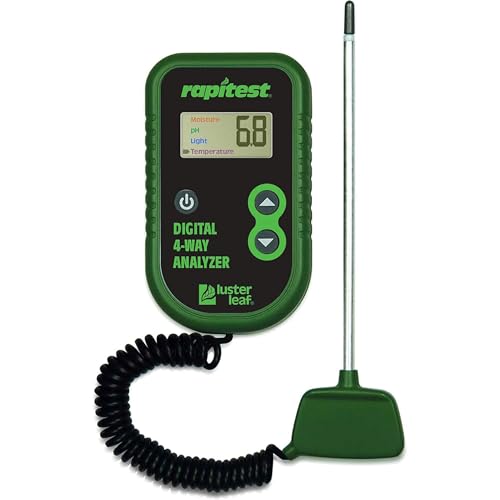
- Measures pH, moisture, light, and temperature
- Includes instructions and gardening tips
- Comes with a 450-plus-plant pH reference list
Best For: Gardeners wanting simple readings with plant guidance
Best for Broad Monitoring
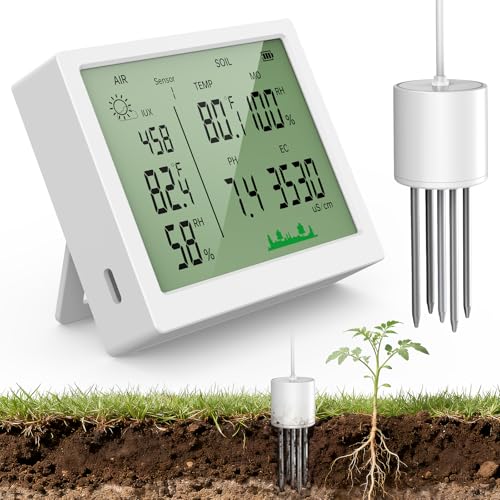
- Tracks seven key growing-condition measurements
- Five-probe system and large split display
- Designed for gardens, farms, lawns, and greenhouses
Best For: Advanced growers monitoring varied or larger areas
Best No-Battery Option

- Measures moisture, pH, nutrients, and light
- Needs no batteries
- 90-degree dial helps reduce bending
Best For: Gardeners wanting battery-free checks in mixed soil
Most Comprehensive

- Measures seven soil and environmental conditions
- LCD shows temperature and humidity data
- Long, three-metal probe for larger planting areas
Best For: Gardeners wanting one tool for detailed soil and growing-condition checks
Best Battery-Free Pick

- Checks moisture, pH, and sunlight
- Needs no batteries
- Compact for garden, lawn, farm, and indoor use
Best For: Routine three-way soil checks without battery maintenance
Best for Growing-Condition Tracking

- Tracks seven soil and air conditions
- LCD displays temperature and humidity
- Corrosion-resistant metal probes support quick testing
Best For: Beginners monitoring soil and environmental conditions across varied plantings
Best All-Around Coverage
2026 7-in-1 Digital Soil Tester

- Measures seven soil and environmental conditions
- Clear LCD with temperature and humidity readings
- Single 6.8-inch probe for garden and farm use
Best For: Routine checks across large gardens, lawns, farms, and greenhouse spaces
Best for Comfortable Viewing
7-in-1 Dual-Screen Soil Tester

- Dual display separates soil and air readings
- Rotating head provides six viewing angles
- Measures seven key growing conditions
Best For: Repeated checks in raised beds, lawns, greenhouses, and outdoor gardens
Best All-Around Digital Tester – 4-in-1 Soil Meter
For gardeners comparing digital soil testers for large gardens, this 4-in-1 meter offers a practical way to check moisture, pH, temperature, and sunlight. Its backlit, rotating display is useful when testing multiple areas outdoors or reading results in less-than-ideal light.
Best For: Gardeners who want four core readings in one portable tester.
Pros:
- Measures moisture, pH, temperature, and sunlight.
- Large backlit LCD with a 45-degree rotating head.
- Designed for indoor and outdoor gardens, farms, pots, and succulents.
- Provides readings after inserting the probe about 4 inches and waiting roughly 10 seconds.
Cons:
- Requires four AAA batteries, which are not included.
- Should not be used to test liquids.
- For better pH and moisture results, the manufacturer recommends testing at least five locations and averaging the readings.
This is a versatile choice for routine garden checks, especially if display visibility matters. Its multi-location testing guidance makes it more suitable for surveying a large bed than relying on a single spot.
Best Guided Choice – Rapitest 4-Way Digital Analyzer
Among digital soil testers for large gardens, the Luster Leaf Rapitest 4-Way Digital Soil Analyzer stands out for its straightforward four-reading setup and included guidance. It measures pH, moisture, light, and temperature, making it useful for checking different growing areas systematically.
Best For: Gardeners who value simple digital output and plant-specific reference information.
Pros:
- Tests soil pH, moisture, light, and temperature.
- Digital output is designed for easy reading.
- Corded probe makes it easier to handle the probe while viewing the display.
- Includes instructions, gardening tips, and a pH plant list covering more than 450 plants.
Cons:
- Only four soil and growing-condition measurements are listed.
- The corded design may be less convenient than a fully integrated handheld unit in some garden layouts.
Its strongest advantage is the supporting reference material, which can help translate pH readings into practical planting decisions. It is a sensible option for gardeners who prefer a focused analyzer rather than a broader multi-parameter kit.
Best for Broad Monitoring – 7-in-1 Soil Meter
For large gardens, lawns, farms, and greenhouse spaces, this 7-in-1 soil meter provides a wider set of growing-condition data than the other testers here. Its split large display and five-probe system are aimed at faster, more detailed checks across varied growing areas.
Best For: Advanced gardeners who want pH, sunlight, fertility, temperature, humidity, and moisture-related data in one system.
Pros:
- Monitors seven categories, including pH, sunlight, fertility, soil and air temperature, humidity, and moisture.
- Uses five metal probes and an optimized calibration algorithm.
- Large split display is designed to reduce crouching and bending.
- Supports testing in soil, growing media, gardens, lawns, farms, and greenhouses.
Cons:
- pH readings require evenly moist soil and about 60 seconds to settle.
- Readings should be compared across three to five spots for a clearer trend, adding time in large beds.
- It should not be immersed in water for extended periods.
This is the most data-focused option in the group. Its multi-point monitoring potential makes it especially appealing for larger or more varied growing areas, provided you are comfortable following the extra testing steps.
Best No-Battery Option – 4-in-1 Soil Moisture Meter
Gardeners looking for digital soil testers for large gardens without battery maintenance may prefer this no-battery 4-in-1 model. It checks moisture, pH, nutrients, and light, while its rotating dial helps keep readings visible without repeated bending or squatting.
Best For: Gardeners who want a simple, battery-free tester with a back-friendly adjustable display.
Pros:
- Measures moisture, pH, nutrients, and light.
- Requires no batteries.
- 90-degree rotating dial can be positioned at a comfortable viewing angle.
- Single probe is designed to reduce potential root disturbance.
Cons:
- May not work effectively in loose soils.
- Designed for garden and mixed soils rather than every growing medium.
- The notes specify readings after insertion deeper than 4 inches, which may be less convenient around shallow-rooted plants.
This tester is a practical pick for mixed or compact garden soil, particularly when avoiding batteries is a priority. The adjustable dial and single-probe design add comfort and may be helpful for repeated checks across established beds.
Most Comprehensive – HSLGOVE 7-in-1 Soil Tester
For gardeners comparing digital soil testers for large gardens, the HSLGOVE stands out as a broad monitoring tool. It measures soil moisture, pH, fertility, light, soil temperature, and indoor air temperature and humidity, with results shown through a dial and LCD screen.
Best For: Gardeners who want one tester for outdoor beds, lawns, farms, and indoor growing areas.
Pros:
- Seven measurements cover soil and surrounding growing conditions.
- LCD display provides soil temperature, air temperature, and humidity readings.
- Approximately 6.8-inch, three-metal probe is designed for medium to large pots and broader garden use.
- Single-probe design may disturb plant roots less than multi-probe tools.
Cons:
- Requires replacing or installing all three batteries each time.
- Readings can take 3–5 minutes, and the air temperature/humidity display takes about three minutes.
- It is designed for soil, not liquid testing.
The HSLGOVE is the most feature-rich option here, particularly for users who want more than moisture and pH readings. Its larger probe and multiple environmental measurements make it a practical choice for monitoring varied planting areas, provided you are comfortable managing batteries and waiting for readings.
Best Battery-Free Pick – SONKIR MS02 3-in-1 Soil Meter
If you want a simple option among digital soil testers for large gardens, the SONKIR MS02 focuses on three core readings: soil moisture, pH, and sunlight. Its compact, battery-free design is easy to move between garden beds, lawns, farms, and containers.
Best For: Gardeners who need straightforward soil moisture, pH, and light checks without batteries.
Pros:
- Tests soil moisture, pH, and sunlight in one compact tool.
- Requires no batteries; insert it into the soil and wait a few minutes.
- Portable design suits indoor and outdoor gardens, lawns, and farms.
- Sturdy construction and upgraded technology are intended for long-term use.
Cons:
- Provides fewer measurements than the 7-in-1 alternatives.
- Dry soil may prevent the indicator from moving, so watering may be needed before testing.
- It cannot test the pH of water or other liquids.
The SONKIR is the least complicated choice in this group. It does not provide temperature, humidity, or fertility readings, but its battery-free operation and three essential measurements make it convenient for routine checks across a large garden.
Best for Growing-Condition Tracking – 7-in-1 LCD Soil Test Kit
This 7-in-1 kit is a strong contender for digital soil testers for large gardens when you want soil readings alongside temperature and humidity data. It measures moisture, pH, sunlight intensity, fertility, soil temperature, air temperature, and air humidity through a clearly readable LCD display.
Best For: Beginners and growers managing gardens, lawns, greenhouses, farms, or multiple planting environments.
Pros:
- Combines seven soil and air measurements in one tester.
- LCD display makes air and soil temperature plus humidity easy to monitor.
- Metal probes are described as corrosion-resistant, conductive, and sensitive.
- Supports varied uses including vegetable, flower, greenhouse, potted, and home gardening.
Cons:
- It is not intended for water or other liquid testing.
- Not suitable for rocks, excessively hard soil, or sandy and other loose soils.
- The probe should not be left in soil, reused in the same spot, or handled with excessive force.
The kit offers broad information for gardeners who want to adjust growing conditions scientifically rather than rely on moisture alone. Its usage limitations matter in large gardens, so keep the probe clean and dry and test suitable soil areas carefully.
Best All-Around Coverage – 2026 7-in-1 Digital Soil Tester
For gardeners comparing digital soil testers for large gardens, this 7-in-1 meter provides a broad snapshot of soil and surrounding conditions. It measures moisture, pH, fertility, soil temperature, air temperature, humidity, and light, making it useful for checking different areas of beds, lawns, farms, and greenhouse spaces.
Best For: Gardeners who want one compact tester for soil readings plus basic air and light measurements across indoor and outdoor growing areas.
Pros:
- Measures seven soil and environmental conditions.
- Clear LCD display shows temperature and humidity readings.
- Single 6.8-inch alloy probe is designed to reduce root disturbance.
- Suitable for pots, raised beds, lawns, farms, and greenhouses.
Cons:
- Requires three batteries before use.
- The probe should be inserted more than 3 inches for best results.
- Not designed for testing liquids.
This model is a practical choice when broad coverage matters more than specialized lab-style testing. Its single-probe format and quick readings make it convenient for routine checks throughout a large garden.
Best for Comfortable Viewing – 7-in-1 Dual-Screen Soil Tester
When evaluating digital soil testers for large gardens, a readable display can make repeated checks easier. This 7-in-1 model combines an upper dial for moisture, fertility, pH, and light with an LCD screen for temperatures and humidity, while its rotating head helps you view readings from a more comfortable angle.
Best For: Gardeners who regularly inspect raised beds, lawns, greenhouses, and outdoor plantings and want flexible viewing during testing.
Pros:
- Dual display presents soil and environmental readings at a glance.
- Measures moisture, pH, fertility, light, temperatures, and humidity.
- 90-degree rotating head offers six viewing angles.
- Single multi-metal probe is designed to minimize root disturbance.
Cons:
- Requires insertion at least 5 inches into moist soil for optimal accuracy.
- Should not be used in water, stones, or very loose soil.
- Probe should not be left in soil for extended periods.
The adjustable head is the standout feature for large garden work, where checking multiple locations can involve frequent bending or squatting. Follow the insertion and cleaning guidance to support consistent readings.
Best for Large Readouts – 7-in-1 Dual-Display Soil Test Kit
For large gardens where you may be checking several planting zones, this 7-in-1 soil tester emphasizes quick, easy-to-see readings. Its large dual-display layout shows moisture, light, fertility, and pH on the upper dial while the lower LCD reports the selected mode, temperatures, and air humidity.
Best For: Gardeners who want large, organized readouts for comparing conditions in vegetable beds, lawns, farms, and other indoor or outdoor growing areas.
Pros:
- Seven-in-one testing covers soil and ambient conditions.
- Large dual display makes multiple readings easier to review.
- 90-degree adjustable head provides six viewing angles.
- Single multi-metal probe is intended to limit root disturbance.
Cons:
- Designed for soil testing, not water or liquid testing.
- Requires insertion at least 5 inches into moist soil for optimal accuracy.
- Probe should be cleaned after use and not left in soil for extended periods.
This is a useful option for gardeners who prioritize display visibility and quick mode changes. Its broad measurement range can help organize routine checks across multiple beds, provided the probe is used in suitable soil.
How We Picked the Best Digital Soil Testers for Large Gardens
We focused on meters that combine multiple useful measurements in a single handheld device. The shortlist includes testers for soil moisture, pH, light, temperature, humidity, and fertility, with extra attention to readable displays and practical use across outdoor beds, lawns, containers, and greenhouse areas.
Because product specifications and included features can vary, confirm the listing before purchase. A “fertility” reading, for example, may be an estimated conductivity-based indicator rather than a complete laboratory nutrient analysis.
Quick Comparison
| Tester type | Best suited to | Typical measurements |
|---|---|---|
| 3-in-1 | Basic garden monitoring | Moisture, pH, light |
| 4-in-1 | Everyday plant care | Moisture, pH, temperature, light |
| 7-in-1 | Large or varied growing spaces | Moisture, pH, fertility, light, soil and air temperature, humidity |
Key Buying Factors for Digital Soil Testers for Large Gardens
Measurement Range and Purpose
Choose the functions you will actually use. Moisture and pH are the most broadly useful, while temperature and light readings help with seed starting, greenhouse management, and diagnosing uneven growth. Fertility readings can support routine checks but should not replace professional soil testing when nutrient accuracy matters.
Display and Usability
A large LCD or dual-screen display is useful when you are working outdoors or moving between multiple beds. Backlighting can improve visibility in shaded areas, while simple controls reduce the time spent switching between measurement modes.
Coverage and Sampling Routine
Large gardens often have several soil types and microclimates. A meter is most useful when you can take readings at consistent depths and in multiple locations. Look for a probe design that is easy to insert without forcing it into compacted or rocky soil, and clean the probe between samples.
Power and Durability
Check the battery type, automatic shutoff, water resistance, and construction details. Digital meters are generally intended for testing soil rather than remaining outdoors, so store the unit dry and follow the manufacturer’s cleaning instructions.
Who Should Buy Which Digital Soil Testers for Large Gardens?
Choose a 3-in-1 meter if you mainly need quick moisture, pH, and light checks for beds, lawns, or houseplants. Choose a 4-in-1 model if soil temperature is important for seasonal planting and routine garden care. Choose a 7-in-1 tester if you manage a large, mixed garden and want air temperature, humidity, fertility, and soil readings in one device.
For serious crop planning, use these tools for fast spot checks, then confirm persistent pH or fertility concerns with a laboratory soil test. The best Digital Soil Testers for Large Gardens are decision-making aids: they help you identify where to water, investigate inconsistent growth, and decide when more precise testing is worthwhile.