The best beginner-friendly digital soil testers make it easier to understand what your plants need before you add water, fertilizer, or amendments. This roundup compares simple meters and multifunction testers for houseplants, gardens, lawns, and seedlings.
We focus on readable displays, useful measurements, straightforward operation, and practical value so new gardeners can choose a tester without guessing which features matter.
Best 10 Beginner-Friendly Digital Soil Testers Picks for 2026
Simple 3-in-1 Pick

- Checks moisture, pH, and sunlight
- Battery-free operation
- Compact for indoor or outdoor use
Best For: Basic soil checks for gardens and houseplants
Classic Digital Option

- Dedicated digital soil testing kit
- Battery-powered operation
- Single-kit format
Best For: Gardeners wanting a basic digital tester
Guided Four-Way Tester
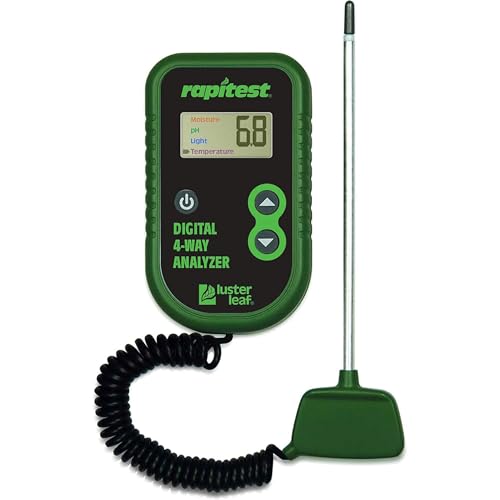
- Measures pH, moisture, light, and temperature
- Corded probe aids handling
- Includes guidance for 450+ plants
Best For: Beginners who want readings plus plant-care guidance
All-Around Starter

- Tests pH plus three key nutrients
- Includes 20 tests total
- Plant guide covers over 450 plants
Best For: Gardeners wanting simple, at-home nutrient and pH testing
Multi-Reading Option

- Measures soil and air conditions
- Replaceable removable probe
- Adjustable rotating head and LCD
Best For: Plant owners monitoring moisture, pH, light, and humidity together
Best All-in-One Starter

- Measures moisture, pH, fertility, light, and temperatures
- Rotating backlit display is easy to read
- No calibration required; two AAA batteries needed
Best For: Beginners who want broad plant-care readings in one tool
Best Dual-Display Design

- Displays seven soil and air measurements
- Dual screens organize readings clearly
- Single probe suits medium to large potted plants
Best For: Beginners who value a clear dial-and-LCD layout
Best for Comfortable Viewing

- Measures seven soil and air conditions
- Dual display makes data easy to scan
- Adjustable head offers six viewing angles
Best For: Gardeners who want broad readings with less bending
Simple 3-in-1 Pick – SONKIR MS02 Soil pH Meter
For shoppers seeking beginner-friendly digital soil testers, the SONKIR MS02 offers a straightforward way to check moisture, soil pH, and sunlight. Its function switch and battery-free design keep routine plant checks simple, though the probe must be used in moist soil and only for soil testing.
Best For: Houseplant owners, lawn care, gardens, farms, and other indoor or outdoor soil checks.
Pros:
- Combines moisture, pH, and sunlight testing in one compact tool.
- Requires no batteries; insert it into soil and wait for the reading.
- Portable design suits house gardens, lawns, farms, and indoor plants.
Cons:
- Cannot test the pH of liquids other than soil.
- Very dry soil may prevent the indicator from moving, so watering may be necessary first.
The MS02 is a practical entry-level option for gardeners who want several basic readings without managing batteries. Follow the soil-moisture guidance for more usable results.
Classic Digital Option – Luster Leaf Rapitest 1605
The Luster Leaf Rapitest 1605 is a battery-powered digital soil testing kit for gardeners who prefer a dedicated digital tool. Its supplied information is focused on the kit itself, making it a straightforward choice for shoppers comparing beginner-friendly digital soil testers.
Best For: Gardeners who want a compact, battery-powered digital soil testing kit.
Pros:
- Uses a digital output for straightforward reading.
- Battery-powered design avoids reliance on manual test components.
- Sold as a single, dedicated digital soil kit.
Cons:
- The supplied details do not specify the measurements or testing range.
- Requires batteries for operation.
Choose the Rapitest 1605 when a simple battery-powered digital kit fits your gardening routine. Confirm the included functions and battery requirements before purchase if you need specific measurements.
Most Comprehensive Display – 7-in-1 Soil Test Kit
For beginners who want more than moisture and pH, this 7-in-1 tester combines soil and environmental readings in one device. Its dual display and rotating head make the information easier to view, while accurate use depends on inserting the probe into moist soil and cleaning it afterward.
Best For: Indoor plants, raised beds, greenhouses, lawns, farms, and gardeners who want broad soil and climate data.
Pros:
- Measures moisture, pH, fertility, light, soil temperature, air humidity, and ambient temperature.
- Dual display presents several readings at once.
- 90-degree adjustable head offers six viewing angles.
- Single probe is designed to minimize root disturbance.
Cons:
- Should not be used to test water, stones, or very loose soil.
- Requires insertion at least five inches into moist soil for optimal accuracy.
- Should not be left in soil for extended periods.
This is the feature-rich choice for gardeners who want a fuller snapshot of growing conditions. Its extra readings are useful, but the required testing and cleaning routine is more involved than with a basic meter.
Guided Four-Way Tester – Luster Leaf Rapitest 1885
The Luster Leaf Rapitest 1885 provides digital readings for soil pH, moisture, light, and temperature. A corded probe helps you handle the sensor while viewing the output, and the included instructions, gardening tips, and plant list make it approachable for beginners comparing digital soil testers.
Best For: New gardeners who want four core measurements plus detailed guidance for plant-specific soil care.
Pros:
- Tests soil pH, moisture, light, and temperature.
- Modern digital output is designed for easy reading.
- Corded probe makes handling and viewing the output more convenient.
- Includes instructions, gardening tips, and a pH list covering more than 450 plants.
Cons:
- Offers four measurements rather than the broader seven-function coverage of some testers.
- The corded probe may be less compact than an integrated design.
The Rapitest 1885 stands out for combining core readings with unusually extensive plant-reference guidance. It is a strong fit when easy digital output and learning support matter as much as the measurements.
Industrial-Grade Pick – LUVCOSY Digital Soil pH Meter
For gardeners who want a straightforward digital option, the LUVCOSY is a beginner-friendly digital soil tester focused specifically on soil pH. Its handheld design, LCD display, and included batteries make it practical for routine garden, lawn, and plant checks.
Best For: Beginners who want a dedicated digital soil pH meter for soil—not liquid testing.
Pros:
- Designed for soil pH measurement with a clear LCD display.
- Double-needle stainless-steel probes are described as sensitive and anticorrosive.
- Lightweight, portable design at about 9.9 ounces.
- Includes three AA batteries, with low-power operation rated by the manufacturer for up to five years.
Cons:
- Measures soil pH only; it does not test liquids.
- Focused on pH rather than broader nutrient or moisture readings.
The LUVCOSY is a focused choice for new gardeners who prefer a digital readout and do not need a multi-function soil analyzer. Its portability and included batteries add convenience for repeated pH checks.
All-Around Starter – Rapitest Soil Test Kit
The Rapitest kit is a beginner-friendly alternative for gardeners who want more than a single pH reading. Its capsule system and color comparators test soil pH plus nitrogen, phosphorus, and potash, with enough supplies for 20 tests.
Best For: New and experienced gardeners who want an affordable, at-home way to check pH and key soil nutrients.
Pros:
- Tests soil pH, nitrogen, phosphorus, and potash.
- Includes components for 20 total tests—five for each measurement.
- Uses an easy-to-use capsule system with patented color comparators.
- Includes detailed instructions and a preference list covering more than 450 plants.
Cons:
- Uses color comparison rather than a digital display.
- Requires separate testing steps for the different soil variables.
Choose Rapitest if you want a broader snapshot of soil conditions without buying a digital multi-function meter. The included instructions and plant reference list make it especially approachable for first-time soil testing.
Multi-Reading Option – 7-in-1 Soil and Plant Tester
For beginners who want several plant-care readings in one tool, this 7-in-1 tester combines soil moisture, fertility, and pH checks with air temperature, humidity, sunlight intensity, and BGR light readings. Its probe and rotating head are designed to make routine checks easier indoors or outdoors.
Best For: Plant owners who want a broad view of soil and surrounding growing conditions from one portable tester.
Pros:
- Combines seven soil and environmental measurements.
- Probe readings for moisture, fertility, and pH do not require batteries.
- Backlit LCD displays air temperature, humidity, sunlight, and BGR light data.
- Removable probe is replaceable, and the rotating head can angle from 0 to 75 degrees.
Cons:
- LCD functions require two AAA batteries, which are not included.
- Requires switching between measurement positions and waiting about 10 seconds for a stable reading.
- Its multiple functions may be more information than a beginner needs for simple pH testing.
This tester suits users who want more context than soil pH alone can provide. The removable probe and adjustable display add practical convenience, while the many readings may appeal to indoor plant owners and gardeners managing varied conditions.
Best All-in-One Starter – 6-in-1 Digital Soil Tester
For gardeners seeking beginner-friendly digital soil testers, this 6-in-1 model combines moisture, pH, fertility, sunlight, soil temperature, and air humidity readings in one handheld device. Its backlit, rotating display and no-calibration design make routine plant checks straightforward.
Best For: Beginners caring for houseplants, lawns, gardens, farms, or greenhouse plants who want multiple readings from one tool.
Pros:
- Measures six soil and environmental conditions in one device.
- 180mm dual-needle probe provides deeper soil penetration.
- Backlit LCD rotates 90° for easier viewing, including in low light.
- Designed for quick readings without calibration.
Cons:
- Requires two AAA batteries, which are not included.
- The stated pH accuracy range is ±0.5.
This is a practical entry-level choice when convenience matters more than highly specialized testing. The broad measurement range and readable display give new gardeners useful information for watering, fertilizing, and general plant care.
Best Dual-Display Design – HSLGOVE 7-in-1 Soil Tester
This HSLGOVE model is among the beginner-friendly digital soil testers designed to make several readings accessible through a dial-and-LCD layout. It measures soil moisture, pH, fertility, light, soil temperature, air temperature, and humidity, with separate displays for easier monitoring.
Best For: New gardeners who want a seven-function tester for medium to large pots, indoor plants, lawns, farms, and outdoor gardens.
Pros:
- Seven-in-one design covers soil and surrounding air conditions.
- Dual-dial and LCD layout separates soil readings from temperature and humidity data.
- Single probe is about 6.8 inches long and is intended to reduce root disturbance.
- One-button function switching keeps operation relatively simple.
Cons:
- Requires all three batteries to be replaced or installed together.
- Readings may take three to five minutes, depending on the function.
- It is designed for soil, not for testing liquid water.
The dual-display format is useful for beginners who prefer seeing several measurements without navigating a complex menu. Allow time for readings to settle, and use it in soil rather than water for the intended results.
Best for Comfortable Viewing – 7-in-1 Rotating Soil Tester
For gardeners comparing beginner-friendly digital soil testers, this 7-in-1 model pairs a dual display with a 90-degree adjustable viewing head. It tracks moisture, pH, fertility, light intensity, soil temperature, air temperature, and humidity to support everyday watering and fertilizing decisions.
Best For: Indoor and outdoor gardeners who want a multi-reading tester that is easier to view in pots, raised beds, greenhouses, lawns, and garden beds.
Pros:
- Seven measurements provide a broad overview of soil and environmental conditions.
- Dual display shows soil readings separately from temperature and humidity.
- Six viewing angles can reduce bending or squatting while checking readings.
- Single multi-metal probe is designed to minimize root disturbance.
Cons:
- The probe should be inserted at least five inches into moist soil for optimal accuracy.
- It should not be used in water, stones, or very loose soil.
- The probe should not be left in soil for extended periods.
This tester stands out for viewing comfort and broad coverage rather than simple moisture-only checks. Following the recommended insertion and cleaning guidance should make it a convenient option for regular plant monitoring.
How We Picked the Best Beginner-Friendly Digital Soil Testers
We selected testers that cover common beginner needs: checking soil moisture, estimating pH, monitoring light, and identifying temperature or humidity conditions. We also considered display readability, probe design, portability, measurement range, ease of use, and whether the device is better suited to occasional checks or repeated garden monitoring.
Multifunction meters can be convenient, but extra readings are useful only when they are clearly presented and easy to interpret. We favored products that offer a practical balance between accessible controls and helpful information.
Quick Comparison
| Tester type | Best for | Common readings |
|---|---|---|
| Basic analog meter | Simple plant checks | Moisture, light, pH |
| Digital 3-in-1 or 4-way meter | Houseplants and garden beds | Moisture, pH, light, temperature |
| 6-in-1 or 7-in-1 tester | Detailed monitoring | Moisture, pH, fertility, temperature, humidity, light |
| Digital pH pen | Focused pH testing | Soil pH, often with a numeric display |
Key Buying Factors
Readability and Controls
A large LCD or dual display is helpful for beginners, especially when comparing readings outdoors. Look for clear labels, uncomplicated buttons, and instructions that explain what the numbers mean.
Measurement Priorities
Moisture is usually the most useful first reading for new plant owners. pH matters for soil-sensitive plants and gardening projects, while light, temperature, humidity, and fertility readings provide broader context. Do not assume a tester’s extra “fertility” feature replaces a laboratory soil test.
Probe Design and Maintenance
A sturdy, cleanable probe should enter the soil without excessive force. Follow the instructions for insertion depth, avoid rocks and roots, and wipe the probe between samples. Digital pH meters may require calibration or careful sample preparation; calibration-free designs can be simpler for casual users but should still be used according to their instructions.
Accuracy and Expectations
These tools are best for quick comparisons and routine checks, not definitive agricultural analysis. Take readings from several areas, allow the meter time to stabilize, and confirm unusual results with a professional soil test before making major amendments.
Who Should Buy Which Beginner-Friendly Digital Soil Testers?
Houseplant beginners: Choose a straightforward moisture-focused or 3-in-1 meter that is compact and easy to read.
Vegetable and flower gardeners: A 4-way tester adds pH, temperature, and light information without overwhelming most users.
Gardeners managing several conditions: A 6-in-1 or 7-in-1 model is useful when you want moisture, pH, fertility, air conditions, and light in one device.
Users focused on soil chemistry: Select a dedicated digital pH tester and prioritize clear numeric readings, dependable probe care, and calibration guidance.
Whichever model you choose, use it as a decision aid rather than an automatic diagnosis. Pair readings with plant symptoms, watering history, soil type, and the growing environment for better results.