The best keyboard workstations for practice make it easier to sit down, stay organized, and build consistent playing habits. This roundup includes complete beginner kits alongside digital pianos, adjustable stands, and note-learning accessories.
Whether you need a full-size practice instrument or a compact setup for lessons and home use, compare the features that affect comfort, versatility, and long-term value before buying.
Best 10 Keyboard Workstations for Practice Picks for 2026
Complete Beginner Kit
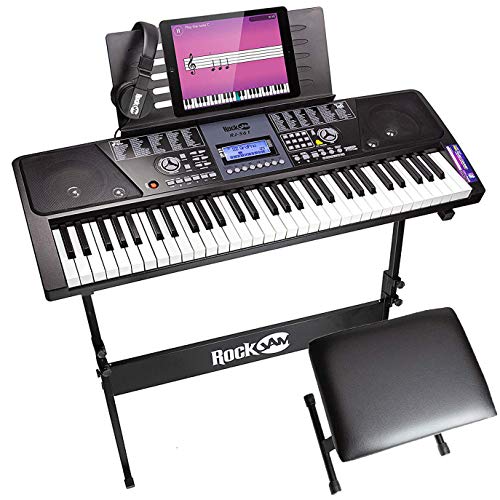
- Includes stand, stool, headphones, and note stickers
- 100 rhythms, 50 tones, and teaching functions
- Headphone output enables quiet practice
Best For: Beginners wanting a complete home practice setup
Full-Range Practice Piano
Alesis Recital 88-Key Digital Piano

- 88 semi-weighted keys with adjustable touch response
- Lesson, split, layer, and standard modes
- Headphone output plus 20W built-in speakers
Best For: Beginners practicing piano technique across the full range
Feature-Packed Bundle
Casio CT-X700 Portable Keyboard

- Bundle includes stand, bench, headphones, and sustain pedal
- 600 tones and 195 rhythms offer extensive variety
- Touch-responsive keys and backlit LCD aid practice
Best For: Players seeking an accessory-rich, versatile keyboard setup
Compact Starter Option

- Compact 49-key design suits smaller spaces
- Includes power supply, music stand, and note stickers
- Built-in sounds, beats, demos, and headphone output
Best For: Young or new players needing a space-saving starter keyboard
Stable Z-Frame Pick
Adjustable Keyboard Workstation Stand

- Heavy-duty steel Z frame
- Adjustable for 49–88 keys
- Rubber feet for stable play
Best For: Home, studio, lesson, and stage setups
Beginner Learning Aid

- Covers four octaves
- Color-coded for note learning
- Places behind keys without stickers
Best For: Beginners and visual learners
Heavy-Duty Table Stand
Foldable Keyboard Workstation Base

- Supports up to 180 pounds
- Fits 54–88-key instruments
- Expandable with stand accessories
Best For: Studios and expandable keyboard setups
Visual Note Mapping Tool
Practice Keyboard & Note Chart

- Covers all 88 keys in a 48-inch format
- Two-sided design for key or tabletop practice
- Uses staff notes and 3D key illustrations
Best For: Beginners learning note locations visually
Portable Beginner Guide
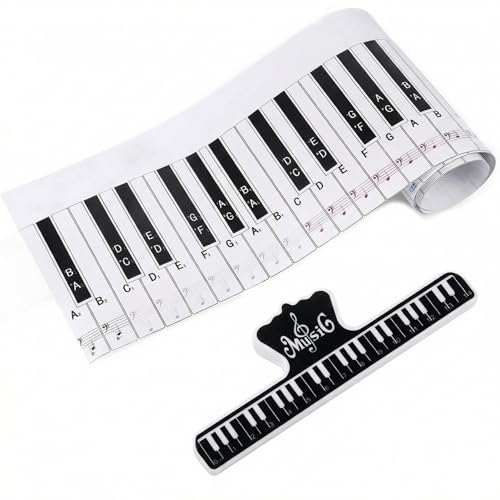
- 1:1-style layout covers the full 88 keys
- Rolls up for lessons and travel
- Includes a music book clip
Best For: Beginner students needing portable note practice
Clip-Ready Note Trainer

- Full 88-key, approximately 1:1 layout
- Designed to sit on the keyboard while practicing
- Includes two music book clips
Best For: Visual learners practicing basic note recognition
Complete Beginner Kit – RockJam RJ561 61-Key Keyboard
The RockJam RJ561 is a practical all-in-one choice for keyboard workstations for practice, combining a 61-key keyboard with a stand, stool, headphones, note stickers, and lesson access. Its 100 rhythms, 50 tones, teaching functions, and demo songs give beginners plenty to explore.
Best For: Kids and adults who want a ready-to-use home practice setup with private listening.
Pros:
- Includes the keyboard stand, bench, headphones, and note stickers.
- Offers 100 rhythms, 50 tones, recording, and built-in teaching features.
- Headphone output supports quiet practice in shared rooms.
Cons:
- The 61-key layout is less extensive than an 88-key piano.
- Its included stool and stand add convenience but make the kit less compact than the keyboard alone.
For beginners who want fewer separate purchases, the RJ561 delivers a complete workstation-style arrangement and useful learning aids in one package.
Full-Range Practice Piano – Alesis Recital 88-Key Digital Piano
The Alesis Recital is a strong foundation for keyboard workstations for practice when a full 88-key range matters. Its semi-weighted, touch-sensitive keys offer adjustable response, while lesson, split, layer, and standard modes support different practice approaches.
Best For: Beginners who want a full-size digital piano for home practice and lessons.
Pros:
- Provides 88 full-sized semi-weighted keys with adjustable touch response.
- Includes five voices, 128-note polyphony, lesson mode, split mode, and layer mode.
- 20W speakers and a headphone output support both room-filling and private practice.
- Supports Skoove and Melodics learning subscriptions.
Cons:
- A sustain pedal is not included.
- The full-size body takes more space than a compact 49- or 61-key keyboard.
Choose the Recital if realistic range and adjustable key response are more important than having a bundled stand or bench. Its educational modes make it especially useful for structured practice.
Feature-Packed Bundle – Casio CT-X700 Portable Keyboard
The Casio CT-X700 bundle is designed for keyboard workstations for practice that include the main accessories from the start. Along with 61 touch-responsive keys, it supplies an adjustable stand, bench, headphones, sustain pedal, power supply, instructional DVD, and polishing cloth.
Best For: Players who want broad sound variety and a bundled practice station.
Pros:
- Includes an adjustable stand, bench, headphones, sustain pedal, and power supply.
- Offers 600 tones and 195 rhythms for varied practice and creative playing.
- Touch-responsive keys support more expressive playing.
- Headphone output allows silent practice, while the backlit LCD simplifies navigation.
Cons:
- Its 61-key layout does not provide the full range of an 88-key piano.
- The bundle includes an instructional DVD rather than a stated interactive lesson subscription.
The CT-X700 stands out for convenience and variety. It is a sensible pick when you want a complete setup, many sounds and rhythms, and both private and speaker-based practice options.
Compact Starter Option – RockJam RJ549 49-Key Keyboard
The RockJam RJ549 is a compact option for keyboard workstations for practice in bedrooms, classrooms, or shared family spaces. It includes a power supply, sheet music stand, note stickers, and Simply Piano lesson access, making it easy to begin without assembling a larger setup.
Best For: Children, teens, and beginners who need an affordable, space-conscious practice keyboard.
Pros:
- Compact 49-key design is easy to fit and move.
- Includes a power supply, sheet music stand, note stickers, and lesson access.
- Built-in tones, beats, demo songs, and speakers keep practice engaging.
- Headphone jack supports private practice.
Cons:
- The 49-key layout offers less range than 61- or 88-key alternatives.
- The supplied notes identify a sheet music stand but not a full keyboard stand or bench.
- Its battery-powered design may require separate batteries when away from a power outlet.
The RJ549 is best when portability and simplicity take priority. It covers the basics for early lessons while using less space than a full workstation bundle.
Stable Z-Frame Pick – Adjustable Keyboard Workstation Stand
For keyboard workstations for practice, the RockJam RJZZ363 provides a broad, stable platform with adjustable height and width. Its Z-style steel frame suits 49- to 88-key instruments and accommodates either seated or standing playing.
Best For: Home practice, lessons, studios, and players who want a flexible stand for digital pianos, stage pianos, MIDI controllers, or workstations.
Pros:
- Heavy-duty alloy-steel Z frame with a wide base and 45-pound load capacity.
- Height and width adjust for different keyboards and playing positions.
- Rubber feet and secure fittings help keep the stand planted during play.
Cons:
- Its 45-pound capacity may not suit heavier keyboard setups.
- The stand weighs 15.2 pounds, so it is not the lightest portable option.
The RJZZ363 is a practical all-purpose stand when stability and adjustability matter more than an especially compact design. Its universal fit makes it a useful foundation for a practice or performance setup.
Beginner Learning Aid – Color-Coded Piano Note Chart
For keyboard workstations for practice, the QMG Piano and Keyboard Note Chart adds a simple visual reference behind the keys. Its color-coded layout covers four octaves and is designed to help beginners identify and memorize notes without interfering with playing.
Best For: Beginners, children, and visual learners practicing on medium- to full-size keyboards or pianos.
Pros:
- Fits popular piano and keyboard models and sits behind the keys.
- Bright color coding supports quick note recognition and memorization.
- Easy to place and remove, with no adhesive sticker installation.
- Covers four octaves in a lightweight, portable format.
Cons:
- It is a learning chart rather than a physical keyboard stand or workstation.
- Its beginner-focused four-octave layout may be limited for advanced players.
This chart is a low-complexity way to make practice more approachable. It is especially useful when the main goal is building note familiarity while keeping the keys unobstructed.
Heavy-Duty Table Stand – Foldable Keyboard Workstation Base
For keyboard workstations for practice, the Liquid Stands table-style model offers a sturdy, expandable base for larger instruments. It adjusts for 54- to 88-key keyboards, folds flat for transport, and supports up to 180 pounds.
Best For: Home studios, practice spaces, recording setups, and performers who need a strong stand with optional second-tier, tabletop, or wheel accessories.
Pros:
- Heavy-duty steel construction supports up to 180 pounds.
- Height adjusts from 27 to 38.5 inches and width from 16.5 to 33.5 inches.
- Foldable design helps with storage and transport.
- Compatible accessories can add a tabletop, second keyboard tier, or wheels.
Cons:
- It is designed for 54- to 88-key instruments, so smaller keyboards may not be an ideal fit.
- Accessories for expanded setups are separate additions.
- At 16.5 pounds, it may be less convenient to carry than a lighter stand.
The Liquid Stands model is a strong choice when your practice workstation may grow over time. Its high load capacity and accessory options make it more versatile than a basic single-tier stand.
Visual Note Mapping Tool – Practice Keyboard & Note Chart
For shoppers comparing keyboard workstations for practice, this 48-inch note chart is a compact visual aid designed to span all 88 piano keys. Its two-sided layout supports learning behind the keys or practicing from a tabletop.
Best For: Beginner players who want a full-keyboard note and staff reference for home practice.
Pros:
- Covers all 88 keys at 48 inches long.
- Shows note positions on the music staff and keys.
- Two-sided design supports behind-key and tabletop use.
- Made from heavy, coated paper for durability.
Cons:
- It is a chart rather than a playable keyboard workstation.
- The format is geared toward beginners.
This is a straightforward choice for learners who benefit from visual reinforcement. The three-dimensional key illustration and two practice orientations make it useful when a full instrument is not available.
Portable Beginner Guide – BENBO 88-Key Practice Chart
Among keyboard workstations for practice, the BENBO guide stands out as a lightweight, rollable reference for beginners. It matches the approximate 1:1 scale of a standard 88-key piano and includes a music book clip for lesson or home use.
Best For: Beginner students and children who need a portable, color-coded aid for identifying piano keys.
Pros:
- Covers 88 keys at approximately real-keyboard scale.
- Lightweight and designed to roll up for transport.
- Bright colors help beginners identify and memorize notes.
- Coated paper resists water, dust, and ink.
Cons:
- It is a cardboard practice guide, not an electronic instrument.
- The learning focus is primarily beginner-level key recognition.
The BENBO is a practical pick when portability matters. Its full-length layout and included clip make it convenient for carrying to lessons or keeping with sheet music during practice.
Clip-Ready Note Trainer – 88-Key Piano Practice Guide
For keyboard workstations for practice that emphasize quick visual training, this foldable 88-key chart provides a full-length reference without requiring electronics. It can sit on a piano keyboard without interfering with playing and includes two music book clips.
Best For: Beginners and visual learners practicing note recognition at a piano or carrying a reference between sessions.
Pros:
- Matches the approximate scale of a standard 88-key keyboard.
- Can be placed on the keyboard during practice.
- Lightweight, foldable, and easy to carry.
- Includes two plastic music book clips.
Cons:
- It is a visual training chart rather than a playable keyboard.
- The product is primarily intended to teach basic key principles.
This chart is well suited to learners who want a simple, portable practice reference. Its foldable format and included clips add convenience, while the coated surface is designed to resist water, dust, and ink.
How We Picked the Best Keyboard Workstations for Practice
We selected these products for the parts of a useful home practice setup: the keyboard itself, playing position, included accessories, and learning support. Complete bundles can simplify shopping for beginners, while standalone digital pianos and adjustable stands may be better for players who already own some equipment.
We also considered key count, portability, stand stability, included seating and headphones, note-learning aids, and whether each item suits short practice sessions or more committed development. A “workstation” does not have to be one all-in-one product; it can be a practical combination of compatible gear.
Quick Comparison
| Setup type | Best for | What to prioritize |
|---|---|---|
| Complete keyboard bundle | Beginners starting from scratch | Included stand, bench, headphones, and pedal |
| 88-key digital piano | Piano-focused practice | Full range, weighted or semi-weighted feel, and realistic sound |
| 49- or 61-key keyboard | Casual learning and portability | Useful lesson features, manageable size, and easy storage |
| Adjustable stand | Existing keyboard owners | Height range, weight capacity, stability, and folding design |
| Note chart or practice aid | Early learners | Clear labeling, correct key layout, and simple positioning |
Key Buying Factors for Keyboard Workstations for Practice
Key Count and Playing Feel
Choose 88 keys if you want to develop traditional piano technique, play a broad repertoire, or avoid upgrading soon. A 61-key model offers a useful middle ground for beginners, while 49 keys are easier to store and transport. Semi-weighted or weighted keys generally provide a more piano-like response than lightweight synth-action keys.
Ergonomics and Stability
Your bench and stand should place your elbows and wrists comfortably, with the keyboard stable during playing. Adjustable Z-style and table-style stands can accommodate different users, but check the stated width, height range, and weight capacity. A suitable bench is preferable to an improvised chair for regular practice.
Features That Support Learning
For beginners, look for lesson functions, metronome controls, recording options, sustain-pedal compatibility, and headphone output. Note charts and key-labeling aids may help with early orientation, but they should support—not replace—learning to read music and identify notes independently.
Included Accessories and Space
Bundles can offer strong value when you need several essentials at once. Confirm exactly what is included, such as the power supply, headphones, pedal, stand, stool, or instructional materials. Measure your available space and consider whether the setup can be folded or moved after each session.
Who Should Buy Which Keyboard Workstations for Practice?
Choose a complete bundle if you are a first-time player who needs an instrument and basic furniture in one purchase. Choose an 88-key digital piano if piano technique and a full keyboard range matter most. Choose a 49- or 61-key keyboard if portability, lower cost, or limited space is your priority.
Choose an adjustable stand when your existing keyboard is the right instrument but lacks a stable playing surface. Choose a note chart or finger-practice aid when a beginner needs visual reinforcement during early lessons. Before ordering, verify dimensions, compatibility, included accessories, and return terms so your chosen setup fits both your room and your practice goals.