The best keyboard workstations for live performance combine dependable playability, fast sound selection, hands-on controls, and the connections needed for a demanding stage setup. The right choice depends on whether you prioritize arranger features, deep synthesis, weighted keys, portability, or an integrated stand.
This roundup compares 10 selected instruments and support options across Yamaha, Korg, Arturia, and practical stand brands, helping you narrow your shortlist by playing style, setup, and budget.
Best 10 Keyboard Workstations for Live Performance Picks for 2026
Most Versatile Stand
Adjustable Piano Keyboard and DJ Controller Desk
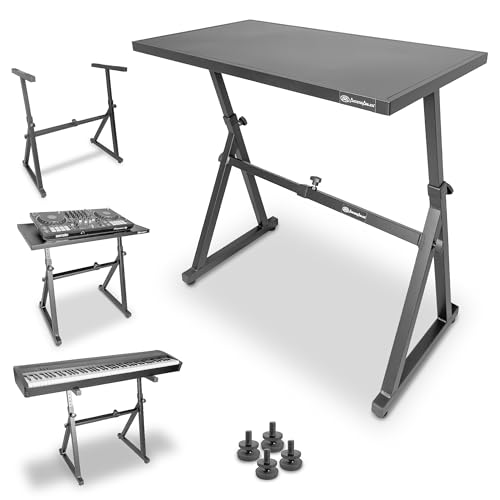
- Converts between keyboard stand and workstation
- 200-pound steel-frame load capacity
- Adjustable and collapsible for mobile setups
Best For: Performers and DJs needing a flexible equipment platform
Best 88-Key Stage Instrument

- Full 88-key stage keyboard layout
- Two split points for three simultaneous sounds
- Built-in speakers with piano, organ, and synth sounds
Best For: Performers who need full-range keys and onboard sounds
Best Arranger Workstation
Korg Pa700 61-Key Arranger Workstation

- 370-plus built-in music styles
- More than 1,700 sounds and MP3 playback
- Integrated 50-watt speaker system
Best For: Solo performers needing accompaniment and broad sound options
Best Modern Synth Platform
Arturia AstroLab 61-Key Stage Keyboard

- Built-in virtual synthesis for DAW-free performance
- 34 instruments and more than 1,300 presets
- Portable 61-key design with USB connectivity
Best For: Synth players moving between studio production and live performance
Versatile Arranger

- 2,000+ sounds, 500+ Styles, and 400+ Keyboard Sets
- 8-inch tilting touchscreen and dual sequencers
- 160-voice polyphony with 76 semi-weighted keys
Best For: Live arrangers and performers needing extensive onboard accompaniment
Expressive Synth Platform

- Three engines for analog, FM, and instrument sounds
- Eight faders, Super Knob, touchscreen, and display knobs
- 76 semi-weighted keys with ESP DAW integration
Best For: Professional performers and producers seeking hands-on synthesis control
Weighted Performance Workstation

- 88-key weighted hammer action with aftertouch
- Nine sound engines and class-leading effects
- Set List Mode for organized live sound changes
Best For: Pianists and performers needing expressive full-range stage control
Expressive Arranger

- 61-key arranger with accompaniment Styles
- Super Articulation 2 Voices for realistic expression
- Joystick, knobs, chord looper, and sequencer
Best For: Live performers building full arrangements from the keyboard
Multi-Engine Workstation
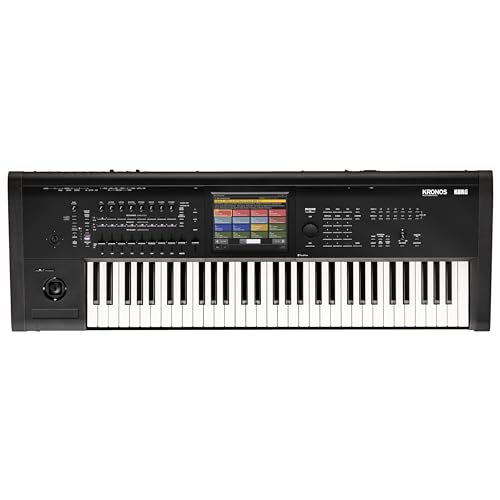
- 61-key semi-weighted Natural Touch action
- Nine sound engines for broad sound capability
- TouchView display, ribbon, and joystick controls
Best For: Players seeking deep live sound control in one workstation
Rolling Performance Stand

- Adjustable 26–36.5-inch height
- 250-pound capacity with locking casters
- Expandable with tiers, tabletops, and clamps
Best For: Mobile keyboard, synth, and production workstation setups
Most Versatile Stand – Adjustable Piano Keyboard and DJ Controller Desk
For musicians comparing keyboard workstations for live performance, the AxcessAbles stand offers a flexible platform that can function as either a keyboard stand or a tabletop workstation. Its adjustable steel frame accommodates seated or standing setups and supports keyboards, controllers, mixers, laptops, and other gear.
Best For: Performers, DJs, sound engineers, and event professionals who need a portable, adaptable workstation.
Pros:
- Dual-purpose design converts between a keyboard stand and a 36-by-19.4-inch tabletop workstation.
- Adjustable height from 26.25 to 37.5 inches and width from 21.5 to 35 inches.
- Supports up to 200 pounds and includes foot levelers for uneven surfaces.
- Collapsible design is suited to mobile setups and events.
Cons:
- At 30.4 pounds, it may be heavier to transport than a basic keyboard stand.
- The tabletop configuration may take more setup space than a conventional stand.
This is a strong choice when your live rig needs to support more than a single keyboard. The height and width adjustments, heavy-duty frame, and removable tabletop make it especially practical for varied performance and production layouts.
Best 88-Key Stage Instrument – Yamaha CK88
The Yamaha CK88 is a practical option for players seeking keyboard workstations for live performance with a full 88-key layout. Built-in speakers, flexible splits, piano and organ sounds, and real-time synth control give it a broad stage-oriented feature set.
Best For: Intermediate to professional performers who want full-range keys, onboard speakers, and versatile stage sounds.
Pros:
- Full 88-key keyboard supports an expansive playing range.
- Two split points allow three different sounds across the keyboard.
- Includes piano, organ, string, brass, and synth sounds.
- Built-in speakers and USB connectivity support flexible performance and production use.
Cons:
- Its 28.9-pound weight and 43.3-inch width may be less convenient for compact setups.
- It is an instrument rather than a separate workstation stand or desk.
Choose the CK88 if expressive full-range playing is more important than tabletop workspace. Its sound variety and split functionality make it suitable for performers covering multiple parts from one stage keyboard.
Best Arranger Workstation – Korg Pa700 61-Key Arranger Workstation
The Korg Pa700 brings arranger-focused features to keyboard workstations for live performance, with more than 370 music styles, over 1,700 sounds, and a built-in MP3 player. Its 61 velocity-sensitive keys and integrated 2-by-25-watt speaker system support standalone playing and accompaniment.
Best For: Performers who want extensive accompaniment styles, onboard sounds, and integrated playback features.
Pros:
- Offers more than 370 built-in music styles and over 1,700 sounds.
- Built-in MP3 player includes a vocal remover function.
- Integrated 2-by-25-watt speaker system supports standalone use.
- 61 velocity-sensitive keys and a TFT TouchView display provide a performance-focused interface.
Cons:
- The 61-key layout provides less range than an 88-key instrument.
- At 31.1 pounds, it is relatively substantial for a 61-key workstation.
- Its feature-rich arranger design may be more than needed for players seeking a simple stage keyboard.
The Pa700 is particularly compelling for solo performers and entertainers who rely on accompaniment rather than a separate backing setup. Its large style and sound libraries make it a capable all-in-one performance keyboard.
Best Modern Synth Platform – Arturia AstroLab 61-Key Stage Keyboard
The Arturia AstroLab is designed for musicians who want keyboard workstations for live performance that bridge studio production and stage use. It combines built-in virtual synthesis, hands-on controls, 61 keys, and a large preset ecosystem in a portable, DAW-free format.
Best For: Synth players and producers seeking modern sounds, studio-to-stage workflow, and portable performance control.
Pros:
- Includes built-in virtual synthesis and access to 34 instruments with more than 1,300 presets.
- Designed for DAW-free live performance while supporting Analog Lab Pro and V Collection software.
- Portable 61-key design weighs 13.22 kilograms.
- Provides USB connectivity and essential controls for hands-on sound shaping.
Cons:
- The 61-key layout may not suit players who require a full 88-key range.
- Its synthesis-focused design may be less appropriate for players seeking arranger styles or acoustic-piano specialization.
AstroLab stands out for performers who want a streamlined alternative to taking a computer-based studio rig onstage. Its built-in instruments, extensive presets, and portable design make it a focused modern performance keyboard.
Versatile Arranger – Korg Pa5X 76
The Korg Pa5X 76 is a strong option for keyboard workstations for live performance when you want arranger functionality, broad onboard sounds, and hands-on control in a 76-key format. Its touchscreen, dual sequencers, and large sound and style library support both live playing and music production.
Best For: Performers who want an arranger workstation with extensive sounds, styles, and Keyboard Sets.
Pros:
- Includes more than 2,000 sounds, 500+ Styles, and 400+ Keyboard Sets.
- 8-inch high-resolution tilting touchscreen supports straightforward control.
- 160-voice polyphony and 24 stereo oscillators suit layered arrangements.
- Dual sequencers add music-production and performance flexibility.
Cons:
- Its 17.4 kg weight may be substantial for frequent transport.
- The 76-key design requires more setup space than compact keyboards.
The Pa5X 76 emphasizes all-in-one arranging and live control rather than minimal stage portability. It is particularly appealing if you need a large palette of ready-to-use accompaniment and performance sounds.
Expressive Synth Platform – Yamaha MODX M7
The Yamaha MODX M7 is designed for keyboard workstations for live performance where expressive control and quick sound access matter. Its 76 semi-weighted keys, three sound engines, physical faders, Super Knob, and color touchscreen provide a flexible stage-and-studio setup in a lightweight design.
Best For: Professional keyboardists who want deep synthesis, real-time controls, and DAW integration.
Pros:
- Three engines cover analog-style synthesis, FM synthesis, and realistic instruments.
- Eight physical faders and the Super Knob provide hands-on expression.
- Color touchscreen and six dedicated display knobs support efficient editing.
- ESP software extends MODX M7 sound work into compatible DAW workflows.
Cons:
- The feature-rich design may be more than beginners need.
- It is a 76-key synth-action instrument rather than a weighted piano-style keyboard.
The MODX M7 is a practical choice for players who prioritize sound design and immediate performance manipulation. Its combination of stage controls and softsynth integration also makes it useful beyond live gigs.
Weighted Performance Workstation – Korg Nautilus 88
Korg Nautilus 88 Key Workstation with Aftertouch | Aftertouch for expressive control
Check Price On AmazonThe Korg Nautilus 88 is a compelling choice among keyboard workstations for live performance when realistic piano response and expressive control are priorities. Its 88-key weighted hammer action with aftertouch, nine sound engines, effects, and Set List Mode make it suited to demanding stage programs.
Best For: Players who need a full-range weighted keyboard with aftertouch and organized live sound selection.
Pros:
- 88-key four-stage weighted hammer action provides a piano-oriented playing experience.
- Aftertouch adds expressive control for performance gestures.
- Nine sound engines and extensive effects support varied sounds.
- Set List Mode organizes Programs, Combinations, and Sequences for live use.
Cons:
- Its 50.9-pound weight makes frequent transport less convenient.
- The 88-key chassis takes considerable space on a stage or stand.
- Weighted action may be less suitable for players who prefer fast synth action.
The Nautilus 88 favors authentic piano feel and expressive performance over portability. Its Set List Mode is especially useful for players who need to move quickly among prepared sounds and sequences during a show.
Expressive Arranger – Yamaha PSR-SX920
Yamaha 61-Key Arranger Keyboard with Premium Sound, Live Control Knobs and Included Content PSRSX920
Check Price On AmazonFor keyboard workstations for live performance, the Yamaha PSR-SX920 is an arranger-focused option built around accompaniment Styles, expressive Voices, and hands-on controls. Its 61-key layout, joystick, programmable knobs, chord looper, and advanced sequencer support detailed live arrangements without requiring a separate backing band.
Best For: Performers who want flexible accompaniment, realistic instrument sounds, and real-time control during live sets.
Pros:
- Accompaniment Styles provide a controllable backing-band experience.
- Super Articulation 2 Voices add expressive details such as vibrato, legato, and brass attacks.
- Real-time knobs, a joystick, chord looper, and sequencer support hands-on performance control.
Cons:
- Its 61-key design may be limiting for players who require a full 88-key range.
- The arranger feature set may be more extensive than needed for simple keyboard setups.
The PSR-SX920 stands out when live performance depends on changing arrangements and adding nuanced expression on the fly. USB connectivity, recording features, and the included one-year manufacturer warranty add practical support for a professional setup.
Multi-Engine Workstation – Korg Kronos 3 61
The Korg Kronos 3 61 is a dedicated music workstation for keyboard workstations for live performance, combining a 61-key natural-touch semi-weighted action with deep control hardware. Its color TouchView display, ribbon controller, four-way joystick, and nine sound engines provide a broad platform for performance and sound shaping.
Best For: Keyboardists who want multiple sound engines and tactile controllers in a professional 61-key workstation.
Pros:
- Nine sound engines provide a broad workstation architecture.
- Natural Touch semi-weighted action offers a more substantial playing feel than a basic keyboard.
- TouchView display, ribbon controller, and four-way joystick support direct performance control.
Cons:
- The 61-key range may not suit players who need full piano range.
- At 39.4 pounds, it is a substantial instrument to transport.
With its combination of sound engines, display-based control, and physical controllers, the Kronos 3 61 is suited to players who want one central instrument for complex live sound duties. Its USB connector and two-year warranty add useful practical considerations.
Rolling Performance Stand – Liquid Stands MS1111
The Liquid Stands MS1111 is a rolling support platform for keyboard workstations for live performance, synthesizers, MIDI controllers, mixers, and other production gear. Its adjustable height, locking casters, security straps, headphone hook, and accessory-ready construction make it useful for building a flexible stage or studio workstation.
Best For: Performers and producers who need a mobile, expandable stand for keyboards and related equipment.
Pros:
- Adjusts from 26 to 36.5 inches for flexible playing and working positions.
- Locking three-inch wheels, security straps, and a 250-pound capacity support substantial setups.
- Compatible with optional tiers, tabletop and speaker attachments, plus clamp-on third-party accessories.
- Includes a headphone hook and a full 10-year warranty.
Cons:
- At 27 pounds, the stand is heavier than a basic folding keyboard stand.
- Accessories and tabletop components may require additional purchases.
The MS1111 is best viewed as a configurable workstation foundation rather than a keyboard itself. Its casters and 250-pound load limit suit larger live rigs, while the many mounting points allow the setup to expand as your production needs grow.
How We Picked the Best Keyboard Workstations for Live Performance
We selected these models to cover the main types of stage keyboard: arranger workstations for solo and band performance, synthesizer-focused instruments for sound design, stage keyboards for streamlined live control, and full workstations for complex production. We also included dedicated stands because stability, height adjustment, and usable stage space can affect performance as much as the keyboard itself.
Our comparison focuses on key count and action, sound-generation depth, live controls, accompaniment and sequencing features, connectivity, portability, and practical setup requirements. Built-in speakers can be useful for rehearsal, while aftertouch, assignable controls, and dependable patch access matter more during a show.
Quick Comparison
- Best for weighted-key players: Yamaha CK88 or Korg Nautilus 88.
- Best for arranger performance: Korg Pa5X 76, Korg Pa700, or Yamaha PSR-SX920.
- Best for modern synthesis: Arturia AstroLab or a Yamaha performance synthesizer.
- Best for deep workstation production: Korg Kronos 3 61.
- Best for compact stage setups: Yamaha CK88, AstroLab, or a 61-key model.
- Best for adding stable support: AxcessAbles or Liquid Stands keyboard desks.
Key Buying Factors for Keyboard Workstations for Live Performance
Choose the Right Key Count and Action
Sixty-one keys are easier to transport and leave more room for other gear. Seventy-six keys provide a useful middle ground for split parts and wider arrangements. Eighty-eight weighted keys suit pianists but add size and weight. Check whether the action supports aftertouch if expressive control is important to your playing.
Match the Sound Engine to Your Set
Arranger keyboards are valuable for solo performers, cover players, and entertainers who need styles, fills, chord recognition, and quick song control. Synth-focused instruments are better for evolving pads, leads, basses, and electronic textures. Traditional workstations generally offer broader sequencing, layering, and production tools.
Prioritize Fast Live Control
Look for clear displays, dedicated knobs, assignable buttons, scene or registration memories, and straightforward set-list navigation. These features reduce menu diving between songs. Also confirm the outputs, MIDI or USB audio options, pedal inputs, and whether your PA or monitor system supports the connections provided.
Plan the Physical Setup
Measure the keyboard and stand together, including space for pedals, a laptop, music, or a second instrument. A desk-style stand may be useful for production gear, while a simpler X-style or table-style support can be faster to transport. Verify weight capacity and height range before placing a large 76- or 88-key instrument on any stand.
Who Should Buy Which Keyboard Workstations for Live Performance?
Solo entertainers and cover performers should start with an arranger such as the Pa700, Pa5X 76, or PSR-SX920. Pianists will likely prefer the CK88 or Nautilus 88 for their longer key ranges and piano-oriented feel. Synth players and electronic performers should consider AstroLab or a Yamaha synthesizer with hands-on performance controls. Producers who also perform may benefit most from the Kronos 3 61 because its workstation features support both arrangement and stage use. Players building a hybrid rig should choose a reliable stand based on total equipment weight, available floor space, and how quickly the setup needs to be assembled.