The best smart aquarium controllers help automate critical equipment, stabilize tank conditions, and alert you when something needs attention. From temperature-focused thermostats to connected power strips and reef equipment hubs, the right choice depends on your setup.
We compare 10 options for freshwater, saltwater, reef, breeding, and specialty aquariums, with practical advice on compatibility, sensors, app features, and everyday reliability.
Best 10 Smart Aquarium Controllers Picks for 2026
Best Overall

- Controls heating and cooling
- Remote app access over 2.4 GHz Wi-Fi
- Temperature and sensor-failure alarms
Best For: Aquarium keepers managing both heating and cooling
Best for ReefRun Equipment
Red Sea ReefRun Dual Controller

- Works with the ReefBeat app
- Controls up to two ReefRun devices
- Includes feed, maintenance, and emergency modes
Best For: Red Sea ReefRun pump and skimmer setups
Best Heater Safety
Inkbird ITC-306A WiFi Thermostat

- Heating-focused aquarium controller
- Dual relays help protect against overheating
- Two probes provide comparison alerts
Best For: Wi-Fi monitoring and protection for aquarium heaters
Best Smart-Home Integration
Meross Smart Temperature Controller

- Supports four major smart-home platforms
- Handles heating and cooling up to 1800 W
- Offers scheduling, history, and alerts
Best For: Aquarium setups using voice assistants or smart-home routines
Best Lighting Controller
NICREW HyperReef Gen 2 Light Controller

- Five independent channels with 0–100% stepless dimming
- Easy Set and Pro Set lighting programs
- Daisy-chain control for compatible lights
Best For: Compatible NICREW reef-lighting setups
Best Temperature Controller
Inkbird ITC-308S Aquarium Temperature Controller

- Controls heating and cooling devices
- Displays measured and set temperatures
- Includes multiple temperature alarms
Best For: Aquariums focused on dependable temperature control
Best Smart Power Hub
AC Infinity Outlet AI+ Environment Controller
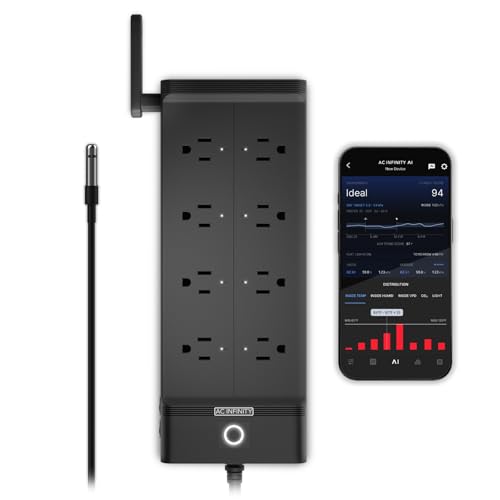
- Independently controls eight smart outlets
- WiFi app with alerts, charts, and AI insights
- Supports climate triggers and optional sensors
Best For: Multi-device aquariums needing connected automation
Best Heating Controller

- Dual display for current and set temperatures
- Separate day and night temperature settings
- Heating-only control up to 1,200 watts
Best For: Scheduled aquarium heating with local temperature control
Best Smart Power Strip

- Individually controls four outlets over Wi-Fi
- Supports climate triggers, schedules, and AI targeting
- Includes dual-zone monitoring and surge protection
Best For: Multi-device aquarium automation and remote monitoring
Best Wi-Fi Temperature Switch

- Includes a waterproof temperature probe
- Offers remote app control and temperature history
- Supports timers, voice assistants, and up to 3,500 watts
Best For: Remote aquarium temperature monitoring and automatic switching
Best Overall – Inkbird WiFi ITC-308
The Inkbird ITC-308 is a versatile choice among smart aquarium controllers for managing both heating and cooling. Its app connectivity, dual relay outputs, and temperature alarms make remote monitoring practical for aquarium keepers.
Best For: Aquarium keepers who need Wi-Fi temperature control for both heating and cooling equipment.
Pros:
- Supports remote control through the Inkbird app on iOS and Android over 2.4 GHz Wi-Fi.
- Dual relay outputs automatically control heating and refrigeration equipment.
- Includes high- and low-temperature alarms plus a sensor-malfunction alert.
- Plug-and-play design supports Celsius or Fahrenheit readings and temperature calibration.
Cons:
- Maximum output load is 1100 W at 110 V.
- Uses a corded electric design rather than a battery-powered setup.
For buyers wanting one controller to handle temperature changes in either direction, the ITC-308 offers a straightforward feature set with useful app access and safety alerts.
Best for ReefRun Equipment – Red Sea ReefRun Dual Controller
The Red Sea ReefRun Dual is one of the more specialized smart aquarium controllers in this roundup. It connects with the ReefBeat app and is designed to manage up to two compatible ReefRun devices, including return and skimmer pumps.
Best For: Reef aquarium owners using compatible Red Sea ReefRun return or skimmer pumps.
Pros:
- Integrates with Red Sea’s ReefBeat app.
- Controls up to two ReefRun devices.
- Supports customized feed, maintenance, and emergency modes.
Cons:
- Compatibility is focused on ReefRun return and skimmer pumps.
- It is not presented as a general-purpose aquarium temperature controller.
This controller makes the most sense within a Red Sea ReefRun setup, where its app integration and dedicated operating modes can simplify pump management.
Best Heater Safety – Inkbird ITC-306A WiFi Thermostat
The Inkbird ITC-306A is a heater-focused option among smart aquarium controllers. It uses two probes, dual relay protection, and app notifications to help monitor aquarium temperature and identify overheating or probe-related issues.
Best For: Aquarium owners who want Wi-Fi monitoring and added protection for a single plugged-in heater.
Pros:
- Dual relays can turn off the heater if overheating is detected.
- Two probes can trigger an alarm and app notification when their readings differ by more than 3°C.
- Allows heating-time settings from 1 to 72 hours and warns if the target temperature is not reached.
- Plug-and-play design supports heaters up to 1100 W.
Cons:
- Designed for heating only, not heating and cooling.
- Temperature setting range is limited to 20°C–35°C (68°F–95°F).
- The two probes need to be placed in the tank at a distance from each other.
Choose the ITC-306A when heater protection and redundant temperature sensing matter more than controlling cooling equipment. Its focused design is well suited to aquarium heating applications.
Best Smart-Home Integration – Meross Smart Temperature Controller
The Meross Smart Temperature Controller stands out among smart aquarium controllers for its broad smart-home compatibility. It offers Wi-Fi remote access, voice control, scheduling, temperature history, and a stainless steel sensor that can be placed in water.
Best For: Aquarium keepers who want temperature control connected to Apple Home, Alexa, Google Home, or SmartThings.
Pros:
- Works with Apple Home, Alexa, Google Home, and SmartThings.
- Supports heating and cooling equipment with a maximum 15 A, 1800 W load at 120 V.
- Provides scheduling, temperature history, energy monitoring, and power-off memory.
- Includes sensor-failure notifications and compressor protection.
Cons:
- The listed default control range reaches up to 95°F unless modified in the Meross app.
- The LCD may turn off after inactivity and must be reactivated with the Mode button.
- Its included feature set may be more extensive than needed for simple heater control.
For a connected aquarium or household setup, the Meross offers the broadest automation options here. Its app, voice controls, scheduling, and water-compatible sensor make it flexible beyond basic temperature switching.
Best Lighting Controller – NICREW HyperReef Gen 2 Light Controller
The NICREW HyperReef Gen 2 Light Controller is a focused option for aquarists seeking smart aquarium controllers for compatible reef lighting. It provides five-channel dimming, programmable lighting changes, and centralized control for compatible lights.
Best For: HyperReef Gen 2 or NavaReef setups requiring adjustable, multi-channel lighting control.
Pros:
- Controls five independent channels with stepless 0% to 100% dimming.
- Easy Set and Pro Set programs support straightforward or more customized photoperiods.
- Can control multiple compatible lights through a daisy chain.
Cons:
- Its primary compatibility is limited to HyperReef and NavaReef lights.
- With HyperReef Gen 1, it supports only two channels and requires a 3.5mm TRRS cable, which is not included.
This controller is best viewed as a dedicated lighting accessory rather than a complete aquarium automation hub. Its five-channel programming and daisy-chain capability make it useful when your setup already uses compatible NICREW fixtures.
Best Temperature Controller – Inkbird ITC-308S Aquarium Temperature Controller
The Inkbird ITC-308S is a practical choice among smart aquarium controllers when temperature management is the main priority. It can operate heating and cooling equipment, display current and set temperatures, and provide several temperature-related alarms.
Best For: Freshwater, saltwater, coral, shrimp, and tropical aquariums needing dual-stage temperature control.
Pros:
- Controls heating and cooling devices simultaneously, or operates either one independently.
- LCD display shows measured and set temperatures in Celsius or Fahrenheit.
- Includes high- and low-temperature alarms plus a sensor-failure alarm.
- Supports a maximum output load of 1200 watts at 110 volts.
Cons:
- It is designed for temperature control rather than broader aquarium automation.
- The controller has a stated maximum load of 10 amps.
Choose the ITC-308S if stable heating and cooling are more important than app-based control or multi-device scheduling. Its dual-stage operation and alarm functions offer useful safeguards for temperature-sensitive aquarium inhabitants.
Best Smart Power Hub – AC Infinity Outlet AI+ Environment Controller
The AC Infinity Outlet AI+ is a broad-use option for shoppers comparing smart aquarium controllers with WiFi-connected power management. Its eight individually controlled outlets can coordinate aquarium equipment using schedules, timers, climate triggers, or AI-assisted targeting.
Best For: Aquariums with multiple devices that need remote control, environmental monitoring, and coordinated outlet automation.
Pros:
- Provides independent control of eight outlets for heaters, lights, fans, pumps, and other equipment.
- WiFi app access includes real-time alerts, data charts, guides, and AI-powered insights.
- Supports dual-zone temperature and humidity monitoring, with optional additional sensors.
- Offers an 1800-watt maximum capacity and built-in surge protection.
Cons:
- Optional CO₂, hydro, and soil sensors are sold separately.
- Its broader feature set may be more than needed for a simple aquarium setup.
The Outlet AI+ stands out when you want one WiFi-connected system to coordinate several aquarium devices. It is especially appealing for complex setups, although its advanced monitoring capabilities may require additional sensors.
Best Heating Controller – Inkbird ITC-306T-A
The Inkbird ITC-306T-A is a straightforward option for aquarium keepers who need smart aquarium controllers focused on heating rather than full environmental automation. Its plug-and-play design, dual display, and day/night temperature settings make routine temperature management simple.
Best For: Aquariums and other setups that need scheduled heating control without cooling functionality.
Pros:
- Displays measured and set temperatures at the same time.
- Supports separate day and night temperature settings.
- Includes temperature calibration, over-temperature alerts, and sensor-fault alarms.
- Handles heating loads up to 1,200 watts at 110 volts.
Cons:
- Heating-only design; it cannot control cooling equipment.
- Both outlets control heating devices rather than functioning as independent heating and cooling outlets.
This is a focused temperature controller rather than a Wi-Fi ecosystem. Choose it when dependable scheduled heating and clear local readings matter more than app access or broader aquarium automation.
Best Smart Power Strip – AC Infinity Outlet AI
The AC Infinity Outlet AI is a versatile choice among smart aquarium controllers, combining Wi-Fi control with individual outlet programming and environmental monitoring. It can coordinate heaters, lights, fans, pumps, and other compatible equipment through schedules, climate triggers, or AI-based targeting.
Best For: Aquariums and multi-device environments where remote control, outlet-level automation, and sensor-based monitoring are priorities.
Pros:
- Provides independent control of four smart outlets.
- Supports Wi-Fi control, alerts, data charts, guides, and app-based insights.
- Tracks dual-zone temperature, humidity, and VPD; additional sensors are available separately.
- Offers 1,800 watts of capacity and built-in surge protection.
Cons:
- Advanced CO₂, hydro, and soil monitoring requires separately sold sensors.
- Its broader feature set may be more than needed for a basic heater-only setup.
For aquariums using several devices, the Outlet AI offers substantially broader control than a dedicated thermostat. Its individual outlets and remote monitoring are especially useful when equipment needs to work together toward shared environmental targets.
Best Wi-Fi Temperature Switch – eWeLink TH-16RF
The eWeLink TH-16RF brings app-based temperature control to setups that need remote access and automatic switching. As smart aquarium controllers go, it stands out for its waterproof probe, temperature history, energy monitoring, timer options, and compatibility with Alexa and Google Home.
Best For: Aquarium owners who want remote temperature monitoring, automatic heating cycles, and voice-control options.
Pros:
- Includes a DS18B20 waterproof temperature probe.
- Supports 2.4GHz Wi-Fi, remote control, alerts, and real-time status monitoring.
- Offers automatic temperature-range switching, schedules, countdowns, and loop timers.
- Supports loads up to 16 amps or 3,500 watts and works with Alexa and Google Home.
Cons:
- The probe measures temperature but not humidity.
- Wi-Fi connection requires a 2.4GHz network.
- Its listed capabilities center on temperature switching rather than multi-outlet control.
This controller is a practical middle ground between a basic thermostat and a larger automation platform. It suits users who want app history, energy information, and remote temperature control without needing multiple independently managed outlets.
How We Picked the Best Smart Aquarium Controllers
We evaluated these Smart Aquarium Controllers by focusing on the functions that matter most in real aquarium setups: temperature accuracy, control options, probe design, wireless connectivity, equipment compatibility, and safety features. We also considered whether each model is designed for a specific task or can manage several devices at once.
The lineup includes dedicated heater and cooler thermostats, dual-stage controllers, smart Wi-Fi outlets, reef equipment controllers, and lighting controls. Because these products are not interchangeable, the best option is the one that matches your equipment and the level of automation you actually need.
Quick Comparison
| Controller type | Best suited for | What to check |
|---|---|---|
| Temperature controller | Heaters, fans, and cooling equipment | Probe count, temperature range, and outlet capacity |
| Smart power strip or outlet | Remote switching and schedules | App ecosystem, load rating, and outlet grouping |
| Reef equipment controller | Return pumps, skimmers, and reef systems | Supported devices and required app |
| Light controller | Compatible aquarium fixtures | Exact light-model compatibility |
Key Buying Factors for Smart Aquarium Controllers
Temperature Control and Probe Accuracy
For heater-focused systems, look for dependable probes, readable displays, adjustable set points, and separate heating and cooling control when needed. Dual-stage models can run a heater and cooling device without requiring two independent thermostats. A second probe may add redundancy or improve monitoring, but confirm how the controller uses each sensor.
Electrical Capacity and Safety
Check the wattage and amperage rating before connecting heaters, chillers, pumps, or multiple devices. High-wattage aquarium heaters can place significant demand on an outlet. Waterproof probes are useful around tanks, but the controller and power connections should still remain dry, elevated, and protected from splashes. Built-in alarms and fail-safe behavior are valuable if a probe disconnects or temperatures move outside the set range.
App, Network, and Ecosystem Compatibility
Wi-Fi controllers can provide remote alerts, schedules, and temperature history, but app quality and smart-home compatibility vary. Apple HomeKit support may matter more to some users than broad third-party integration. Confirm whether the controller requires a 2.4 GHz network, a particular app, or an account before buying.
Device Compatibility
Some controllers are universal outlets, while others work only with specific lights, pumps, skimmers, or aquarium product families. Verify the exact model generation and supported accessories. A specialized controller can provide deeper control than a generic smart plug, but it may be unsuitable for unrelated equipment.
Who Should Buy Which Smart Aquarium Controllers?
Choose a dedicated temperature controller if your priority is keeping a heater, fan, or cooling system within a stable range. These are a practical fit for freshwater tanks, saltwater aquariums, breeding systems, reptiles, and other temperature-sensitive setups.
Choose a smart power strip or outlet if you want remote on/off control, schedules, or alerts for several standard devices. This approach works well for established systems where the equipment already has its own controls.
Choose a reef-specific controller if you use compatible pumps or skimmers and want centralized management through a dedicated aquarium app. Choose a lighting controller only when it matches your exact fixture family.
For any setup, prioritize dependable temperature protection over extra app features, and consider pairing automation with an independent thermometer or alarm for added peace of mind.