As you explore the landscape of wireless video encoders in 2025, you’ll find a diverse range of options tailored for content creators and live streamers. Each encoder boasts unique features like 4K resolution, low latency, and customizable settings. These elements are essential for achieving high-quality streams. But with so many choices available, how do you decide which one suits your needs best? Let’s uncover the top picks that can elevate your streaming game.
Solo Wireless Live Video Streaming Encoder

If you’re a content creator looking to stream high-definition live video seamlessly to platforms like Facebook Live or YouTube, the Solo Wireless Live Video Streaming Encoder is an excellent choice. This encoder supports H.264 AVC high profile video encoding, offering resolutions up to 1080p at various frame rates. Plus, it bonds up to four network links, including 4G LTE, WiFi, and Ethernet, ensuring reliable connectivity. With its portable design and an internal battery lasting up to three hours, you can stream on-the-go. Just remember, USB modems aren’t included, so you’ll need to get those separately through Solo Connect.
Best For: Content creators and live streamers who need a reliable and portable solution for high-definition streaming on platforms like Facebook Live and YouTube.
Pros:
- Supports high-quality video encoding with resolutions up to 1080p at multiple frame rates.
- Offers simultaneous bonding of up to four network links for enhanced connectivity.
- Portable design with an internal rechargeable battery that lasts up to three hours.
Cons:
- USB modems are not included and must be purchased separately.
- Battery life may be limiting for extended streaming sessions.
- Requires a stable data plan for optimal performance when using cellular connections.
Wireless HDMI Transmitter and Receiver, 1080P Full HD Video Transmission System

The Wireless HDMI Transmitter and Receiver is ideal for content creators and professionals who need seamless video transmission without the hassle of cables. With a range of 1300FT and support for 1080P Full HD at 60Hz, you’ll experience minimal latency of just 0.05 seconds. This system lets you easily connect devices like DSLRs and laptops to TVs or projectors using a simple plug-and-play setup. Plus, the included IR remote control allows you to operate your HDMI source from a distance. Users appreciate its signal stability and ease of setup, making it a top choice for any video production needs.
Best For: Content creators and professionals seeking seamless video transmission without the hassle of cables.
Pros:
- Plug and Play setup makes installation quick and easy with no software needed.
- Long transmission range of 1300FT in open areas ensures flexibility in positioning devices.
- IR remote control functionality allows operation of HDMI source devices from a distance.
Cons:
- Signal interference may occur when walls, metal, bricks, or glass are present.
- Reduced transmission distance when switching between multiple receiver devices.
- May require specific power supplies like NP-F Series batteries or 5V2A type-C adapters, limiting compatibility.
Wireless HD 1080P HDMI Video Live Streaming Encoder
For content creators looking to elevate their streaming game, the Wireless HD 1080P HDMI Video Live Streaming Encoder stands out with its ability to broadcast four video streams simultaneously. This encoder supports multiple streaming protocols like RTMP, SRT, and HLS, letting you choose the best fit for your needs. You can easily customize your streams by adding logos, text, or adjusting resolution and bitrate. Plus, with free lifetime technical support and thorough SDK documentation, you’ll have the resources to enhance your setup. Whether you’re streaming on YouTube or Twitch, this encoder guarantees high-quality, reliable performance.
Best For: Content creators and streamers who require a versatile and high-quality solution for live broadcasting across multiple platforms.
Pros:
- Supports simultaneous streaming of four video outputs with various protocols for optimized performance.
- Offers extensive customization options including the addition of logos, text, and adjustable video settings.
- Includes free lifetime technical support and comprehensive SDK documentation for easy integration and development.
Cons:
- May require a learning curve for users unfamiliar with streaming protocols and technical setups.
- The device’s advanced features might be overwhelming for casual users or those new to live streaming.
- Higher initial investment compared to simpler streaming solutions.
Wireless H.265 HDMI to IP Video Streaming Encoder
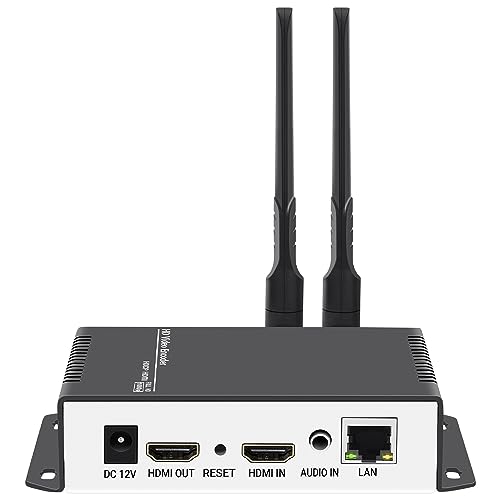
Engineers and content creators seeking a versatile solution for live streaming will appreciate the Wireless H.265 HDMI to IP Video Streaming Encoder. This device supports multiple streaming protocols like RTSP and RTMP, making it perfect for platforms like YouTube and Twitch. You can output four video streams simultaneously, each customizable with static text, logos, and various settings. While users report smooth operation, some experience latency of 2-5 seconds at higher quality. With lifetime technical support and a user-friendly setup process, this encoder offers reliability and functionality, catering to both novice and experienced users alike.
Best For: Engineers and content creators looking for a reliable and versatile live streaming solution for platforms like YouTube and Twitch.
Pros:
- Supports multiple streaming protocols, allowing for flexible output options.
- Customizable video streams with options for text, logos, resolution, and more.
- Lifetime technical support ensures users have assistance when needed.
Cons:
- Some users experience latency of 2-5 seconds at higher quality settings.
- Does not support remote control commands without external solutions.
- H.265 encoding may introduce more complexity compared to H.264 models.
HEVC H.265 H.264 Live HDMI Video Encoder for IPTV and Live Broadcast
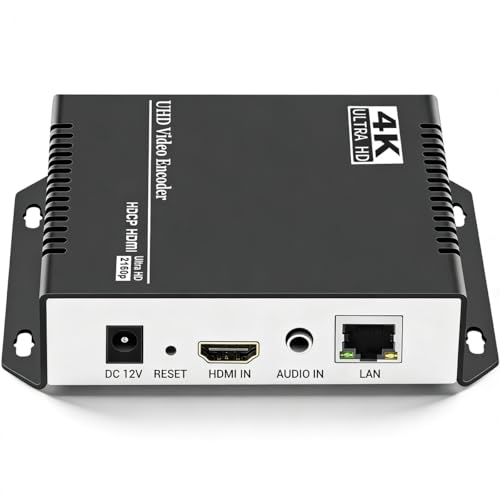
With its support for multiple streaming protocols, the HEVC H.265 H.264 Live HDMI Video Encoder is perfect for content creators looking to broadcast high-quality video across various platforms like YouTube, Facebook, and Twitch. It can simultaneously output four video streams using different protocols, ensuring flexibility in bandwidth management. You can easily customize display settings by adding text, logos, and adjusting parameters like resolution and bitrate. Plus, with lifetime technical support and development documentation, you’ll have everything you need for smooth integration. This encoder is ideal for IPTV and live broadcasting, making it a valuable tool in your streaming toolkit.
Best For: Content creators and broadcasters looking for a high-quality live video encoding solution for platforms like YouTube, Facebook, and Twitch.
Pros:
- Supports simultaneous output of four video streams using various streaming protocols for enhanced flexibility.
- Offers extensive customization features, including text overlays, logos, and adjustable video parameters.
- Provides lifetime technical support and comprehensive development documentation for easy integration.
Cons:
- May require a learning curve for users unfamiliar with video encoding technologies and streaming protocols.
- Initial setup and configuration could be complex for less tech-savvy users.
- The need for a stable internet connection to fully utilize streaming capabilities may limit usage in certain locations.
N2 Portable Wireless HDMI to NDI Video Encoder

The N2 Portable Wireless HDMI to NDI Video Encoder by Kiloview is perfect for content creators on the go, offering impressive 1080p60 video input and lossless quality transmission. Weighing just 0.01 ounces, its compact design makes it easy to carry. You can output your signal over Wi-Fi or Ethernet using a USB expansion adapter. It supports multiple protocols like NDI-HX, RTMP, and SRT, ensuring versatility for your streaming needs. With a built-in battery for long-lasting performance and the ability to remember previous networks, this encoder is truly a top choice for seamless, high-quality broadcasting wherever you are.
Best For: Content creators and live streamers looking for a portable, high-quality video encoding solution.
Pros:
- Lossless quality video transmission ensures superior output for professional streaming.
- Compact and lightweight design makes it easy to transport for on-the-go broadcasting.
- Supports multiple streaming protocols (NDI-HX, RTMP, SRT) for versatile broadcasting options.
Cons:
- Limited input resolution of 1080p60 may not meet the needs of users requiring higher resolutions.
- Weight might be misrepresented as 0.01 ounces seems unusually low for a device of this size.
- Potential learning curve for users unfamiliar with video encoding and streaming protocols.
4K Wireless HDMI Video Transmission System

For content creators and professionals in the audiovisual industry, the K Wireless HDMI Video Transmission System stands out as an ideal choice. It supports true 4K video at 30Hz and offers an impressive range of up to 656 feet without barriers. You’ll love its plug-and-play feature—no software needed! This system is compatible with various HDMI devices, making it versatile for cinematography, live broadcasts, and home entertainment. With multiple power options and a low battery indicator, you’ll stay powered up during critical moments. Plus, the responsive customer support and 365-day warranty guarantee peace of mind with your purchase.
Best For: Content creators and audiovisual professionals seeking a reliable and versatile wireless video transmission solution.
Pros:
- True 4K support at 30Hz for high-quality video output.
- Long-range transmission capabilities of up to 656 feet for flexible setups.
- Multiple power options ensure continuous operation during critical projects.
Cons:
- Transmission distance decreases significantly with additional receivers.
- NP-F series batteries are not included, requiring separate purchase for portable use.
- Limited to 4 RXs, which may not suffice for larger setups.
Solo Pro HDMI 4K Video/Audio Encoder

If you’re a content creator looking for a portable streaming solution, the Solo Pro HDMI 4K Video/Audio Encoder stands out with its support for high-resolution video up to 4K60. Weighing just 2.06 pounds, it’s compact and easy to carry. With HDMI 2.0 support, you can connect seamlessly to your camera. The built-in rechargeable battery offers up to three hours of streaming, while bonded connectivity guarantees reliable transmission to platforms like Facebook and YouTube. Plus, its plug-and-play technology makes setup a breeze. Monitor everything easily and enjoy high-quality streaming wherever you go with this powerful encoder.
Best For: Content creators and streamers who need a portable and high-quality video encoding solution for live streaming.
Pros:
- High-resolution support for video up to 4K60, ensuring top-notch video quality.
- Compact and lightweight design makes it easy to transport for on-the-go streaming.
- Built-in rechargeable battery provides up to three hours of continuous streaming without needing a power source.
Cons:
- Limited battery life of three hours may not be sufficient for longer streaming sessions.
- Additional costs for external 4G/5G modems needed for optimal connectivity.
- Potential complexity for first-time users due to various connectivity options and setup requirements.
MPEG4 H.264 Live HDMI Video Encoder for Live Streaming

Designed for content creators and broadcasters, the MPEG4 H.264 Live HDMI Video Encoder is an excellent choice when you need versatile streaming capabilities. It supports multiple protocols like RTSP, RTMP, and HTTP, allowing you to stream across platforms such as YouTube and Twitch. You can simultaneously output four video streams, enhancing your live broadcasting flexibility. Customize your streams with static text, logos, and adjustable settings for resolution and bitrate. Plus, with lifetime technical support and extensive documentation for development, you’ll have all the tools you need to create high-quality, engaging content effortlessly.
Best For: Content creators and broadcasters looking for a versatile and reliable solution for live streaming across multiple platforms.
Pros:
- Supports simultaneous output of four video streams using various streaming protocols, enhancing flexibility.
- Customizable video settings allow for personalization, including text overlays, logos, and adjustable resolution and bitrate.
- Offers lifetime technical support and comprehensive documentation for easy integration and development.
Cons:
- May require technical knowledge to fully utilize all customization options and features.
- Initial setup can be complex for users unfamiliar with streaming technology.
- Limited compatibility with some older streaming platforms or protocols.
J-Tech Digital H.264 HDMI Video Encoder/Extender/Matrix Over Ethernet

The J-Tech Digital H.264 HDMI Video Encoder/Extender/Matrix Over Ethernet stands out as an excellent choice for those needing to transmit high-quality video signals over long distances. With a range of up to 400 feet, it supports various configurations, including point-to-point and many-to-many broadcasting. Utilizing H.264 compression, it efficiently transmits 1080p video via standard TCP/IP over Ethernet, ensuring minimal bandwidth consumption. You can control it through the front panel, remote, or mobile app. While customer reviews are mixed, the one-year warranty and free lifetime technical support offer peace of mind for potential buyers.
Best For: Those seeking a reliable solution for transmitting high-definition video signals over long distances in various network configurations.
Pros:
- Supports HDMI signal extension up to 400 feet, making it ideal for large setups.
- Utilizes H.264 compression for efficient bandwidth use while maintaining video quality.
- Offers multiple control methods, including a mobile app for convenience.
Cons:
- Mixed customer reviews regarding setup complexity and reliability.
- Some users reported issues with signal transmission, which may require troubleshooting.
- Documentation may not be comprehensive enough for all users to navigate setup easily.
Factors to Consider When Choosing Wireless Video Encoders
When you’re choosing a wireless video encoder, there are several key factors to keep in mind. You’ll want to evaluate streaming protocol compatibility, video quality, and connectivity options to guarantee it meets your needs. Additionally, think about portability, power sources, and how easy it is to set up.
Streaming Protocol Compatibility
Choosing the right wireless video encoder involves careful consideration of streaming protocol compatibility, as it directly impacts your broadcast’s reach and quality. You’ll find protocols like RTSP, RTMP, SRT, and HLS essential for ensuring compatibility with various platforms, enhancing your live broadcasts’ flexibility. Some encoders support multiple protocols simultaneously, allowing you to stream to several platforms at once, optimizing bandwidth and improving viewer experience. Be mindful of latency; while H.265 offers higher compression, it might introduce delays compared to H.264. Also, understanding each protocol’s supported resolutions and frame rates is significant, as some may limit output quality. Customization options, such as adding logos, can enhance branding while complying with platform requirements.
Video Quality and Resolution
Selecting a wireless video encoder requires careful attention to video quality and resolution. You’ll want encoders that support high-definition resolutions like 1080p at various frame rates (50/60/25/30/24 fps) for clear, detailed output. The encoding format matters too; H.264 and H.265 are popular for their efficient compression while maintaining quality, especially in live streams. Check if the encoder allows simultaneous output of multiple video streams, enhancing your broadcasting flexibility. Customization features, such as adjusting resolution, frame rate, and bitrate, can considerably improve viewer experience. Finally, low latency is essential for live streaming—aim for delays around 2-5 seconds to keep your video synchronized with real-time events. Choose wisely for the best results!
Connectivity Options Available
Connectivity options play an essential role in the effectiveness of wireless video encoders. When choosing an encoder, consider models that offer multiple connectivity options like HDMI, Ethernet, Wi-Fi, and cellular networks. This flexibility allows you to adapt to various setups and environments. Look for devices that support simultaneous bonding of different network links, such as 4G LTE and Wi-Fi, to boost reliability and streaming performance. Additionally, guarantee the encoder supports various streaming protocols like RTSP, RTMP, HTTP, and SRT for compatibility with many platforms. The ability to switch between different input/output configurations, like HDMI loop-out and dual HDMI outputs, can also enhance your broadcasting capabilities, making your streaming experience smoother and more efficient.
Portability and Power Source
When it comes to wireless video encoders, portability and power source are key factors that can make or break your streaming experience. You’ll want a model that’s compact and lightweight, allowing for easy transport and quick setup at various locations. A built-in rechargeable battery is essential for uninterrupted streaming, with some encoders offering up to three hours on a single charge. Make certain to take into account power options, like compatibility with NP-F series batteries or USB-C power supplies, to maximize flexibility in different environments. Additionally, check the dimensions and weight of the encoder to guarantee it suits your needs during live events. Some encoders even remember previously connected networks, enhancing usability when network changes happen frequently.
Ease of Setup
To guarantee a smooth streaming experience, you should prioritize ease of setup in your choice of wireless video encoders. Look for encoders that offer plug-and-play functionality, letting you get started quickly without software installations. Choose devices that come with user-friendly guides and clear instructions to simplify configuration. It’s also important to select encoders supporting multiple connection options, like HDMI, Ethernet, and Wi-Fi, to fit your existing setup. Features like automatic network detection and easy firmware updates can further enhance usability and maintenance. Finally, check customer feedback regarding setup experiences; user reviews often highlight common installation challenges, helping you avoid potential pitfalls and ensuring a hassle-free setup process.