If you’re looking to elevate your streaming game, understanding the landscape of SDI video encoders in 2025 is essential. With so many options available, each offering unique features and capabilities, it can be tough to find the right fit for your needs. From low-latency performance to support for various protocols, the choice can feel overwhelming. Let’s explore the top picks that promise to enhance your live streaming experience considerably.
ZowieBox 3G SDI Native NDI|HX3 Video Streaming Encoder Decoder

The ZowieBox 3G SDI Native NDI|HX3 Video Streaming Encoder Decoder stands out as an ideal choice for content creators and broadcasters who need a compact yet powerful solution for live streaming. Measuring just 4.84 x 2.68 x 0.87 inches and weighing only 6 ounces, it’s easy to transport. This encoder/decoder supports various NDI formats and seamlessly integrates AVoIP video streams. You’ll appreciate its standalone live streaming capabilities, which preserve your computer’s performance. The user-friendly ZowieUI lets you control connected devices effortlessly. While some users report latency issues, the overall streaming quality remains impressive, making it a solid choice for your NDI workflows.
Best For: Content creators and broadcasters seeking a compact and versatile live streaming solution.
Pros:
- High-quality 1080p real-time livestreams with minimal frame drops.
- Compact design with aluminum casing, making it portable and durable.
- User-friendly ZowieUI allows easy control of connected devices and configurations.
Cons:
- Some users report latency issues, particularly with RTMP streams.
- Challenges with frame rate conversions and NDI protocol limitations.
- Mixed experiences with customer support, including delays and inadequate documentation.
HEVC H.265 H.264 SD HD Video Audio Live Streaming Encoder

For those looking to elevate their live streaming experience, the URayCoder HEVC H.265 H.264 SD HD 3G SDI to IP Encoder stands out with its ability to support up to four simultaneous video streams. It’s compatible with platforms like YouTube, Facebook, and Twitch, making it versatile for any user. With customizable options like logos and text, you can personalize your streams effortlessly. Weighing just 1.1 pounds and measuring 6.69 x 5.12 x 1.18 inches, it’s portable too. Users appreciate its easy setup and high-quality output, earning it a solid 4.6-star rating from satisfied customers.
Best For: Live streamers and content creators looking for a reliable and customizable solution for broadcasting high-quality video across multiple platforms.
Pros:
- Supports up to four simultaneous video streams with various streaming protocols.
- Easy setup and user-friendly operation, ideal for both beginners and professionals.
- High-quality video output with customizable options such as logos and text overlays.
Cons:
- Some users may find the need for technical knowledge if utilizing SDK or advanced customization features.
- Limited warranty information may require inquiry for details, which could be inconvenient.
- Size may not accommodate all setups; users with space constraints should consider dimensions.
ISEEVY 4 Channel 1080P H.265 H.264 SDI Video Encoder

With its ability to support multiple streaming protocols, the ISEEVY 4 Channel 1080P H.265 H.264 SDI Video Encoder stands out for broadcasters and content creators looking for versatility in live streaming. You can effortlessly convert four channels of HD/3G-SDI video and audio into IP, ensuring high-quality transmission. Plus, it supports advanced video codecs like H.265 and H.264, along with various audio formats. The customizable watermarking feature lets you add logos or text to each channel, enhancing your branding. Whether you’re broadcasting or streaming, this encoder provides reliable performance and flexibility, making it an excellent choice for your needs.
Best For: Broadcasters and content creators seeking a versatile and high-quality solution for live streaming.
Pros:
- Supports multiple streaming protocols for flexibility in broadcasting.
- High-quality video and audio transmission with advanced codecs.
- Customizable watermarking feature enhances branding opportunities.
Cons:
- May require technical expertise for setup and configuration.
- Limited to 4 channels, which may not be sufficient for larger productions.
- Higher cost compared to basic video encoders on the market.
E3 Dual-Channel 4K HDMI & 3G-SDI HEVC Video Encoder

Streamlining your live production workflow just got easier, thanks to the E3 Dual-Channel 4K HDMI & 3G-SDI HEVC Video Encoder from Kiloview. This compact, lightweight device allows you to simultaneously encode two channels of video, supporting both HDMI up to 4K at 30 fps and 3G-SDI up to 60 fps. With advanced H.265 and H.264 encoding, you’ll enjoy superior video quality while saving bandwidth. The E3 also offers versatile output options like Picture-in-Picture and Picture-by-Picture modes, making it perfect for live streaming and remote transmissions. Experience enhanced audio performance and seamless protocol compatibility for your projects.
Best For: The E3 Dual-Channel 4K HDMI & 3G-SDI HEVC Video Encoder is best for professionals in live production and streaming who require high-quality video encoding and flexibility in their workflows.
Pros:
- Dual-channel encoding allows simultaneous processing of two video streams, enhancing productivity.
- Bandwidth efficiency with H.265 encoding reduces the required bitrate while maintaining excellent video quality.
- Versatile output options like Picture-in-Picture and Picture-by-Picture provide creative flexibility for live streaming setups.
Cons:
- Average customer rating of 3.6 out of 5 stars may indicate mixed user experiences.
- Limited information on warranty details may raise concerns for potential buyers regarding product support.
- Relatively compact size might limit the cooling efficiency during extended use, potentially affecting performance.
iseevy H.265 H.264 SDI Video Encoder

The iseevy H.265 H.264 SDI Video Encoder stands out for its ability to seamlessly convert SDI signals to IP with loopout support, making it an excellent choice for live streaming professionals. It supports video input up to 1080P at 60FPS and offers both H.265 and H.264 codecs for high-quality streaming. With audio support for AAC and MP3, you won’t compromise on sound quality. It’s compatible with various streaming protocols, including RTMP and SRT, ensuring flexibility in your broadcasts. Weighing just 14.1 ounces and measuring 4.33 x 5.12 x 1.3 inches, it’s portable and easy to integrate into your setup.
Best For: Live streaming professionals looking for a reliable SDI to IP converter with high-quality video encoding.
Pros:
- Supports high-definition video input up to 1080P at 60FPS for superior streaming quality.
- Versatile streaming protocol compatibility, including RTMP, RTSP, and SRT, offering flexibility for different broadcasting needs.
- Compact and lightweight design makes it easy to transport and integrate into various setups.
Cons:
- Limited customer ratings with only 2 reviews, which may not provide a comprehensive view of product performance.
- Warranty information is only available upon request, potentially causing inconvenience for customers seeking assurance.
- No mention of additional features such as onboard storage or advanced user controls, which might be beneficial for more complex streaming setups.
H.265 HEVC SDI Video Encoder for Live Broadcast

For content creators and broadcasters looking to elevate their live streaming experience, the H.265 HEVC SDI Video Encoder (Model No.: ES901) stands out as an exceptional choice. Weighing just 1.39 pounds and measuring 6.42 x 4.37 x 1.26 inches, its compact design makes it highly portable. With support for up to four simultaneous streams across platforms like YouTube and Twitch, you’re set for multi-platform broadcasting. The high-definition OLED display guarantees real-time monitoring, while audio/video separation offers flexibility. Backed by a 3-year warranty and stellar customer ratings, the ES901 is a reliable partner for your live broadcast endeavors.
Best For: Content creators and broadcasters seeking a compact, high-performance solution for multi-platform live streaming.
Pros:
- Supports up to 4 simultaneous video streams to popular platforms like YouTube, Facebook, and Twitch.
- High-definition OLED display enables real-time monitoring for uninterrupted streaming.
- 3-year limited warranty and positive customer feedback ensure reliability and support.
Cons:
- Limited to specific streaming protocols, which may not cater to all broadcasting needs.
- Compact size may limit input/output options compared to larger encoders.
- Firmware upgrades required for some functionalities like picture flipping, which may require technical knowledge.
4K Video Streaming Encoder for Live Broadcast

Offering 4K UHD video input/output, the K Video Streaming Encoder is an exceptional choice for live broadcasters who demand high-quality streaming. With a maximum resolution of 3840×2160 and the ability to output four video streams simultaneously, it supports various streaming protocols like RTMP, SRT, and HLS. You can customize video and audio settings to suit your needs, making it perfect for live events on platforms like YouTube and Twitch. While the setup has a learning curve, the mobile app helps with remote configuration. Plus, enjoy free lifetime technical support for smooth operation.
Best For: Live broadcasters who require high-quality 4K streaming capabilities for events on platforms like YouTube, Facebook, and Twitch.
Pros:
- Supports 4K UHD video input/output with customizable video and audio settings.
- Simultaneous output of four video streams per SDI port, enhancing flexibility for live broadcasting.
- Free lifetime technical support and responsive customer service for troubleshooting assistance.
Cons:
- Initial setup may have a steep learning curve for users unfamiliar with encoding parameters.
- Some users reported difficulties with smartphone setup for remote configuration via the mobile app.
- Specific streaming account issues, particularly with Facebook, may require a perpetual stream key for ease of use.
ZowieBox 4K Video Encoder/Decoder for Live Streaming

Designed for content creators and live event producers, the ZowieBox 4K Video Encoder/Decoder delivers exceptional HDMI encoding and decoding capabilities. You can easily transform HDMI signals into SRT, RTMP, or RTSP formats for live streaming on platforms like YouTube and Twitch. With UVC conversion, it connects HDMI cameras to computers for crisp video calls. Plus, its secure video transmission feature guarantees low-latency broadcasts, even over unstable networks. You’ll appreciate the HDMI extender functionality for seamless point-to-point transmission, while the 4K signal handling allows you to stream at impressive resolutions. The ZowieBox is a game-changer for your live streaming needs.
Best For: Content creators and live event producers seeking high-quality, low-latency live streaming solutions.
Pros:
- High-quality encoding and decoding: Supports SRT, RTMP, and RTSP formats for seamless live streaming.
- UVC conversion capability: Easily connects HDMI cameras to computers, enhancing video call quality.
- Versatile 4K signal handling: Streams at impressive resolutions while maintaining high-quality output.
Cons:
- Potential compatibility issues: May require additional setup for certain devices or configurations.
- Cost considerations: Higher investment compared to basic streaming equipment.
- Learning curve: May take time to fully understand and utilize all features effectively.
BirdDog 4K 12G-SDI NDI Encoder/Decoder
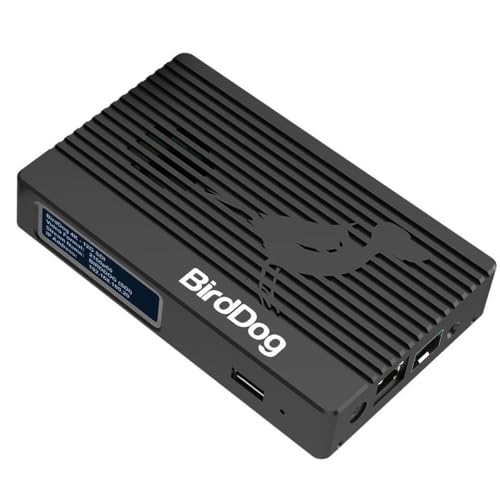
The BirdDog 4K 12G-SDI NDI Encoder/Decoder stands out as an exceptional choice for content creators seeking high-quality video performance. With superior UHD 4K video at up to 60fps, it utilizes a proprietary NDI silicon chip for enhanced encoding and decoding. You’ll appreciate its versatile connectivity options, featuring 12G-SDI, HDMI, and a 10GbE SFP+ slot. Audio integration is seamless, thanks to 2-channel audio embedding and a dedicated TRS port. Plus, its PoE+ support simplifies your setup, while the tally light keeps you informed about your on-air status. This device truly elevates your streaming experience.
Best For: Content creators and live streamers seeking high-quality UHD 4K video encoding and decoding with versatile connectivity options.
Pros:
- Superior UHD 4K video at up to 60fps for exceptional image quality.
- Versatile connectivity with 12G-SDI, HDMI, and 10GbE SFP+ slot for flexible integration.
- Seamless audio integration and management with 2-channel audio embedding and dedicated TRS port.
Cons:
- Weighs 1.45 pounds, which may be slightly heavier for portable setups.
- Requires knowledge of NDI technology for optimal configuration and use.
- Price point may be higher compared to basic video encoders/decoders.
HAS-101 MPEG4 HD Video Encoder for Live Streaming
For those seeking a reliable solution to stream high-quality video content, the HAS-101 MPEG4 HD Video Encoder stands out with its ability to convert SDI signals to H.264 for seamless streaming across various platforms like Facebook, YouTube, and Twitch. It supports resolutions up to 1920×1080 at 60 FPS and offers smart encoding to adapt to video fluctuations. Weighing just 1 pound and measuring 4.72 x 2.76 x 1.97 inches, it’s compact and easy to handle. While it comes with a 5-year warranty and lifetime technical support, user feedback highlights some connectivity challenges, so proceed with caution.
Best For: Content creators and live streamers looking for a compact and efficient solution to stream high-quality video content across multiple platforms.
Pros:
- Compact design makes it easy to transport and set up.
- Supports high-resolution streaming up to 1080P at 60 FPS.
- Includes a 5-year warranty and free lifetime technical support.
Cons:
- User feedback indicates difficulty with connectivity and logging onto units.
- Limited documentation and user manual can lead to confusion.
- Some users report issues with analog camera connectivity and signal output.
Factors to Consider When Choosing Sdi Video Encoders
When you’re choosing an SDI video encoder, several key factors can make or break your streaming experience. You’ll want to take into account streaming protocol compatibility, video quality standards, and latency to guarantee smooth performance. Additionally, look at input and output options and audio integration features to meet your specific needs.
Streaming Protocol Compatibility
Choosing the right SDI video encoder involves more than just looking at the hardware; you’ll need to pay close attention to streaming protocol compatibility. Make certain your encoder supports essential protocols like RTMP, RTSP, SRT, and HLS, as this will expand your streaming options and flexibility. Some encoders even allow multiple output streams simultaneously, letting you reach various platforms without extra devices. Additionally, consider how customizable streaming settings—like bitrate, resolution, and frame rate—depend on protocol support, as this can impact broadcast quality. It’s important to verify the encoder can handle multicast and unicast streaming for efficient bandwidth management. Finally, future-proof your investment by selecting an encoder compatible with emerging protocols and standards.
Video Quality Standards
Understanding video quality standards is vital for selecting the right SDI video encoder. You’ll want to evaluate resolution first, with common formats like 1080p at 60 fps and 4K at 30 fps delivering high-definition content. The choice of codec matters too; H.264 is popular, but H.265 (HEVC) offers superior quality at lower bitrates, making it a smart choice for efficiency. Frame rate consistency is important for smooth playback, especially during live streaming—aim for 30 fps for 1080p and 60 fps for 1080p60. Finally, verify your encoder supports various streaming protocols like RTMP, RTSP, and SRT for compatibility across platforms. These factors together will help you achieve outstanding video quality.
Latency and Performance
Latency and performance are vital factors to evaluate in SDI video encoders, especially if you’re planning to deliver high-quality live broadcasts. You should be aware that latency can vary greatly, with some encoders showing decoder latency around 3 seconds when using protocols like RTMP. Furthermore, audio-video sync issues may arise from frame rate conversions, affecting your broadcast’s quality. It’s also important to take into account encoding capabilities; some encoders support simultaneous multi-streaming, which can impact performance under heavy loads. Additionally, bandwidth efficiency matters—advanced codecs like H.265 offer better quality at lower bitrates. Finally, the choice of streaming protocol can influence overall performance, especially in unstable network conditions, so choose wisely for reliable transmission.
Input and Output Options
When it comes to selecting an SDI video encoder, input and output options play an essential role in ensuring compatibility with your video sources and streaming platforms. Make sure the encoder supports multiple input formats like HD/3G-SDI, accommodating various video resolutions, from 1080p@60fps to 4K@30fps. Look for output options that support streaming protocols like RTMP, RTSP, SRT, and HLS, making it easier to broadcast across different platforms. It’s also beneficial if the encoder allows simultaneous output of multiple video streams per input channel, enhancing your streaming capabilities. Additionally, check for loopout support for monitoring and connecting to other devices without signal interruption, ensuring seamless operation during your broadcasts.
Audio Integration Features
As you explore SDI video encoders, don’t overlook the significance of audio integration features. Look for encoders that offer multi-channel audio embedding and extraction capabilities. This allows for seamless integration of audio from various sources during live broadcasts. Verify the encoder supports standard audio codecs like AAC, MP3, and AC3, as these are fundamental for high-quality streaming. It’s also beneficial to reflect on encoders with dedicated audio inputs and outputs, such as 3.5mm TRS ports, to connect external audio devices and enhance management. Evaluate audio synchronization features to maintain lip-sync accuracy between audio and video, which is vital for a smooth viewer experience. Finally, check for advanced features like multi-channel audio encoding for complex productions.
Support and Warranty Options
While evaluating SDI video encoders, it is crucial to reflect on the support and warranty options that come with your choice. Many encoders offer warranties ranging from one to five years, which can provide peace of mind during your investment. Look for manufacturers that include lifetime technical support, ensuring you have assistance whenever needed. Some models also highlight free firmware upgrades and remote technical service, enhancing usability over time. Additionally, consider customization services like SDK/API access and user interface personalization for a tailored experience. Finally, check customer feedback to gauge the responsiveness and effectiveness of technical support, as user experiences can greatly vary between products. This information can help you make a well-informed decision.