The best virtual reality headsets for immersive gaming balance visual clarity, comfort, tracking, performance, and setup simplicity. This roundup spans affordable standalone headsets, PC-powered options, and specialized models for simulation enthusiasts.
Whether you want a convenient wireless headset for everyday play or a premium display for racing and flight simulators, the picks below highlight the features that matter most before you buy.
Best 10 Virtual Reality Headsets for Immersive Gaming Picks for 2026
Best Overall
Meta Quest 3 512GB Gorilla Tag Bundle

- 512GB storage with 8GB of RAM
- Sharp display with up to 120Hz refresh
- Wireless mixed-reality gaming
Best For: High-capacity standalone VR gaming and mixed reality
Best for Simulators
Pimax Crystal Super Ultrawide VR Headset

- 3840x3840 resolution per eye
- Wide 140-degree field of view
- PC-connected design with eye tracking
Best For: Flight and racing simulators on Windows PCs
Best Value Standalone
Meta Quest 3S 128GB Gorilla Tag Bundle

- Wireless standalone VR gaming
- Snapdragon XR2 Gen 2 and 8GB RAM
- Full-color passthrough cameras
Best For: First-time and casual standalone VR players
Best for PC VR Library Access
Oculus Rift S PC-Powered VR Headset

- Access to hundreds of Oculus games
- Built-in room-scale Insight tracking
- Comfort-focused Halo headband
Best For: Windows PC gamers using a wired VR setup
Best Wireless Upgrade
- Standalone, cord-free gaming
- Snapdragon XR2 Gen 2 and 8GB RAM
- Full-color passthrough cameras
Best For: Wireless gaming and mixed-reality experiences
Best High-Resolution PC VR

- 2880 x 1660 OLED display
- Precise 360-degree tracking
- Built-in noise-canceling headphones
Best For: Dedicated PC-based room-scale gaming
Best Large-Storage Value

- 256GB standalone storage
- No PC or console required
- Hand tracking and 3D positional audio
Best For: Accessible wireless VR with room for a large library
All-In-One VR Pick

- Wireless standalone VR with no PC or console
- Includes Touch controllers and hand tracking
- 128GB storage with up to 90Hz refresh rate
Best For: Portable gaming, fitness, multiplayer, and entertainment
Accessory Bundle Choice

- Standalone and PC VR compatibility
- Includes grip covers and knuckle straps
- High-resolution display with 90Hz refresh rate
Best For: Quest buyers wanting included controller comfort accessories
Best Overall – Meta Quest 3 512GB Gorilla Tag Bundle
The Meta Quest 3 is a strong all-around choice for virtual reality headsets for immersive gaming, combining standalone wireless play with mixed-reality features. Its 512GB storage, improved resolution, Snapdragon XR2 Gen 2 processor, and 120Hz refresh rate give demanding players plenty of room for games and smooth visuals.
Best For: Gamers who want a high-capacity standalone headset with sharp graphics, mixed reality, and bundled Gorilla Tag content.
Pros:
- 512GB of storage and 8GB of RAM support a large game library.
- 4K+ Infinite Display, 2064×2208 resolution per eye, and up to 120Hz refresh deliver detailed gameplay.
- Wireless standalone operation, full-color passthrough, and dual RGB cameras support immersive mixed-reality play.
- Includes a three-month Meta Horizon+ trial and Gorilla Tag bundle extras.
Cons:
- Battery life is listed at approximately 2.2 hours.
- The higher-capacity configuration may be more than casual players need.
For buyers seeking a versatile headset rather than a PC-only setup, the Quest 3 offers a well-rounded blend of storage, performance, wireless freedom, and mixed reality.
Best for Simulators – Pimax Crystal Super Ultrawide VR Headset
The Pimax Crystal Super is designed for PC-based virtual reality headsets for immersive gaming, particularly flight and racing simulators. Its 3840×3840-per-eye QLED and Mini-LED display, 140-degree field of view, eye tracking, and DisplayPort connection prioritize visual clarity and peripheral awareness.
Best For: PC sim racers and flight-simulation enthusiasts who prioritize resolution, wide viewing angles, and detailed visuals.
Pros:
- 3840×3840 resolution per eye and 50 pixels per degree target highly detailed imagery.
- 140-degree field of view expands peripheral vision for simulator awareness.
- Eye tracking, inside-out tracking, and dynamic field-of-view optimization support responsive PC VR play.
- Integrated 3D spatial audio and a noise-canceling microphone support communication.
Cons:
- Requires a Windows 10 PC and wired DisplayPort and USB connectivity.
- Its up-to-90Hz refresh rate may be less suitable than higher-refresh options for some fast-action players.
- The feature set is geared more toward enthusiasts than casual VR users.
This is the specialist pick for players with a capable PC who want an ultrawide, high-resolution view for cockpit-focused gaming and long simulator sessions.
Best Value Standalone – Meta Quest 3S 128GB Gorilla Tag Bundle
The Meta Quest 3S makes virtual reality headsets for immersive gaming more accessible with wireless standalone play and the Snapdragon XR2 Gen 2 platform. It also adds full-color passthrough, motion-sensing controllers, and a three-month Meta Horizon+ trial, making it a practical entry point for gaming and mixed-reality experiences.
Best For: New or casual VR players who want a wireless headset with current-generation processing and bundled content.
Pros:
- Standalone wireless design avoids the need for a gaming PC.
- Snapdragon XR2 Gen 2 processing and 8GB of RAM support responsive gaming.
- Dual RGB cameras enable full-color passthrough and mixed-reality play.
- Includes Touch Plus controllers, a three-month Meta Horizon+ trial, and Gorilla Tag extras.
Cons:
- 128GB storage provides less room than the 512GB Quest 3.
- Battery life is listed at approximately 2.5 hours.
- Its listed 1832×1920-per-eye resolution is lower than the Quest 3’s.
The Quest 3S is a sensible starting point for wireless VR, especially if you value current processing and mixed reality more than maximum storage or display resolution.
Best for PC VR Library Access – Oculus Rift S PC-Powered VR Headset
The Oculus Rift S remains a PC-focused option for virtual reality headsets for immersive gaming, offering access to a broad Oculus Store library through a wired Windows setup. Its improved optics, Halo headband, Touch controllers, and built-in Oculus Insight tracking are aimed at comfortable room-scale play without external tracking sensors.
Best For: PC gamers who already have a compatible Windows computer and want access to Oculus Rift games and exclusives.
Pros:
- Supports hundreds of games and exclusives in the Oculus Store.
- Improved optics provide sharper visuals, vivid colors, and reduced screen-door effect.
- Oculus Insight enables room-scale tracking without external sensors.
- Halo headband and updated Touch controllers support stable, precise gameplay.
Cons:
- Requires a Windows PC and a wired USB 3.0 connection.
- Its 2560×1440 resolution is lower than newer high-resolution headsets in this roundup.
- Requires a Facebook account for login and social features.
Choose the Rift S when PC compatibility and access to its established game library matter more than wireless convenience or newer standalone hardware.
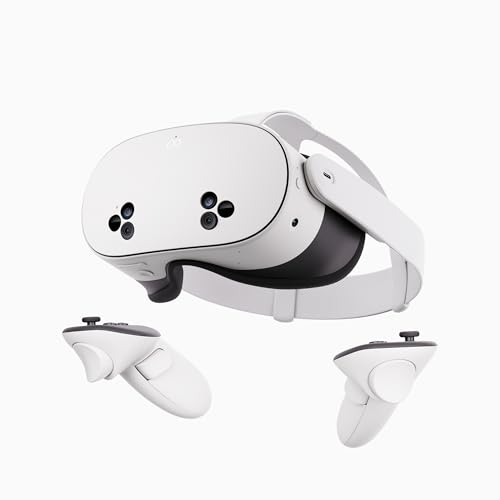
Best Wireless Upgrade – Meta Quest 3S 128GB
The Meta Quest 3S 128GB is a practical choice for shoppers comparing virtual reality headsets for immersive gaming. Its standalone design eliminates the need for a PC or console, while the Snapdragon XR2 Gen 2 processor, 8GB of RAM, and full-color passthrough support responsive games and mixed-reality experiences.
Best For: Wireless gaming, mixed-reality play, fitness, and users who want newer processing hardware in a standalone headset.
Pros:
- No wires or external PC required for gaming and exploration.
- Snapdragon XR2 Gen 2 processor and 8GB of RAM support smooth performance.
- Dual RGB cameras provide full-color passthrough for blending virtual and physical spaces.
- Includes a 3-month trial offering access to 40+ games.
Cons:
- 128GB of storage may be limiting for users with large game libraries.
- Battery life is rated at roughly 2 to 3 hours.
- This is a renewed premium product rather than a new unit.
Choose this model if modern standalone performance and mixed reality matter more than maximum storage. Its limited battery runtime and renewed condition are the main factors to weigh before buying.
Best High-Resolution PC VR – HTC VIVE Pro
The HTC VIVE Pro is aimed at shoppers seeking virtual reality headsets for immersive gaming with detailed visuals, room-scale tracking, and built-in audio. Its 2880 x 1660 resolution, 615 PPI, 110-degree field of view, and support for spaces up to 22’11” x 22’11” make it suited to a dedicated VR setup.
Best For: PC-based room-scale gaming, players who prioritize display detail and tracking, and longer play sessions where headset comfort matters.
Pros:
- 2880 x 1660 resolution and 615 PPI deliver sharp, detailed visuals.
- 360-degree headset and controller tracking supports precise movement.
- Built-in high-resolution headphones include active noise cancellation.
- Can be used seated, standing, or in a large room-scale play area.
Cons:
- Its Windows-based platform is less turnkey than a standalone headset.
- The supplied notes do not identify a bundled PC or base-station setup.
- At 1.8 pounds, it is heavier than some standalone alternatives.
The VIVE Pro makes the most sense for buyers building a dedicated PC VR environment. Its display and tracking strengths are compelling, but the surrounding setup should be confirmed before purchase.
Best Large-Storage Value – Meta Quest 2 256GB
The Meta Quest 2 256GB remains a flexible option for shoppers comparing virtual reality headsets for immersive gaming. It is an all-in-one wireless system with no PC or console requirement, 256GB of storage, hand tracking, 3D positional audio, and access to gaming, fitness, social, and entertainment experiences.
Best For: Families and players who want generous storage, simple setup, and a broad standalone library across gaming and non-gaming activities.
Pros:
- 256GB of storage accommodates a larger collection of games and apps.
- Standalone wireless design works without a PC or console.
- Hand tracking, haptic feedback, and 3D positional audio add immersion.
- Supports gaming, fitness, multiplayer, social spaces, and live events.
Cons:
- Its 1832 x 1920-per-eye resolution is lower than the VIVE Pro’s listed resolution.
- The supplied battery specification is 3000 mAh, but no runtime is provided.
- Meta Quest is intended for ages 13 and above.
This Quest 2 configuration is worth considering when storage and broad content access are priorities. It offers straightforward standalone VR, though buyers seeking newer display or processing specifications may prefer a more recent model.
Switch VR Starter – Orzly VR Headset for Nintendo Switch
If you want virtual reality headsets for immersive gaming on Nintendo Switch, this Orzly model is a straightforward console-focused option. It is designed for Switch and Switch OLED, with adjustable lenses and a head strap to help tailor the fit.
Best For: Nintendo Switch owners seeking an entry-level VR accessory for compatible games, Labo VR, and VR-enabled video content.
Pros:
- Designed specifically for Nintendo Switch and Switch OLED consoles.
- Adjustable lens and head strap support a more personalized fit.
- Includes a solid headset design with USB connectivity and a 110-degree field of view.
Cons:
- Requires a compatible Nintendo Switch console rather than operating as a standalone headset.
- Its listed 1,280 × 720 maximum display resolution is modest compared with dedicated standalone VR systems.
- The product notes recommend watching setup information before buying.
This is best viewed as a Switch accessory rather than a full VR platform. Choose it if you already own a compatible console and want an accessible way to experiment with Switch-based VR.
All-In-One VR Pick – Meta Quest 2 128GB
For shoppers comparing virtual reality headsets for immersive gaming, the Meta Quest 2 stands out as a wireless standalone system. Its built-in battery, controllers, hand tracking, and library of more than 500 titles make it suitable for gaming, fitness, social experiences, and entertainment without a PC or console.
Best For: Players who want portable, all-in-one VR with built-in tracking, wireless play, and access to a broad range of experiences.
Pros:
- Standalone design needs no PC or console for setup and play.
- Includes two Touch controllers, hand tracking, positional audio, and headset casting.
- 128GB storage, up to 90Hz refresh rate, and 1,832 × 1,920 resolution per eye support smooth, detailed gameplay.
- Supports gaming, fitness, multiplayer, social, and entertainment applications.
Cons:
- Play time depends on its built-in battery.
- Some applications and experiences may be intended for mature audiences.
- Accounts are listed as being for users aged 10 and over, with child-safety guidance to review.
The Quest 2 offers the most complete standalone experience in this selection. Its wireless setup and varied content library make it a flexible choice for households that want more than console-specific VR.
Accessory Bundle Choice – Oculus Quest 2 128GB Set
Oculus Quest 2 Advanced All-in-One Virtual Reality Gmaing VR Headset 128GB Set, White
Check Price On AmazonThis Oculus Quest 2 set is a practical contender among virtual reality headsets for immersive gaming, combining standalone and PC VR compatibility with included comfort and grip accessories. It offers 128GB storage, high-resolution displays, and two Touch controllers for a ready-to-use setup.
Best For: Quest users who want a 128GB headset bundle with controller grip covers, knuckle straps, and a glasses spacer included.
Pros:
- Supports both standalone and PC VR use.
- Provides 1,832 × 1,920 resolution per eye and a listed 90Hz refresh rate.
- Includes two Touch controllers, silicone grip covers, adjustable knuckle straps, and a glasses spacer.
- Wireless connectivity and headset casting add flexibility for gaming and video.
Cons:
- Its 128GB storage may require managing installed content as a game library grows.
- The bundle is still based on the Quest 2 platform rather than a newer headset generation.
- The supplied specifications list a 95-degree field of view, which may feel narrower than some alternatives.
Compared with a basic headset-only package, this set is appealing if the included controller grips and knuckle straps matter to you. It is a versatile option for standalone play, with PC VR support when you want to expand how you use it.
How We Picked the Best Virtual Reality Headsets for Immersive Gaming
We compared these headsets by looking at display resolution, field of view, tracking, comfort, controller support, platform compatibility, storage, and overall value. Standalone models were assessed for ease of use and wireless flexibility, while PC-powered headsets were considered for their ability to take advantage of stronger gaming hardware.
Because the list includes current and older models, buyers should also consider availability, software support, condition, and whether a renewed or used headset includes the essential accessories.
Quick Comparison
- Best all-around choice: Meta Quest 3 512GB, with strong standalone performance and ample storage.
- Best value for casual VR: Meta Quest 3S or a well-priced Quest 2.
- Best for simulation enthusiasts: Pimax Crystal Super, with high resolution and a wide field of view.
- Best for PC VR on a budget: Oculus Rift S, provided your computer and software are compatible.
- Best for Nintendo Switch owners: The Orzly headset, which offers a simpler console-based VR experience.
Key Buying Factors
Standalone or PC-Powered
Standalone headsets include their own processor, battery, storage, and operating system, so they are easier to use and do not require a gaming PC. PC-powered models can deliver higher-end graphics but require a compatible computer, cables or wireless networking, and more setup.
Resolution, Lenses, and Field of View
Higher resolution can make text, distant objects, and cockpit instruments easier to see. Lens quality affects edge clarity and glare, while a wider field of view can feel more natural in racing and flight games. These benefits often come with greater weight, cost, or performance demands.
Tracking, Comfort, and Controllers
Inside-out tracking is convenient because it generally avoids external base stations. Check how well the headset fits your face, how adjustable the head strap is, and whether replacement straps or prescription-lens inserts are available. A comfortable fit matters more during long sessions than a small specification advantage.
Storage, Battery, and Ecosystem
Storage determines how many games you can keep installed, while battery life affects wireless play. Also check the headset’s app store, multiplayer compatibility, accessories, and support history. Older Quest and Rift models may be inexpensive, but newer software and accessories can favor current hardware.
Who Should Buy Which Virtual Reality Headsets for Immersive Gaming?
Choose the Meta Quest 3 if you want the strongest balance of modern features, standalone convenience, and storage. The Quest 3S is better suited to first-time buyers who want current software at a lower price, while a Quest 2 can make sense when discounted and in good condition.
Choose the Pimax Crystal Super if visual detail and a broad field of view matter more than simplicity, particularly for demanding simulators. The Rift S or HTC VIVE Pro may suit PC VR users who already have compatible equipment. Finally, the Orzly model is best treated as an inexpensive, limited console accessory rather than a substitute for a full standalone or PC VR system.