Choosing among professional music synthesizers means balancing keyboard feel, synthesis architecture, hands-on control, connectivity, and the workflow you use most. The right instrument can become the centerpiece of a studio, a dependable stage tool, or a focused sound-design machine.
This roundup compares 10 options ranging from flagship workstations and expressive polyphonic instruments to compact desktop, portable, and beginner-friendly synthesizers. Use the buying guide below to narrow the field by musical role, feature set, and budget.
Best 10 Professional Music Synthesizers Picks for 2026
Flagship Expression

- 88-key GEX action with polyphonic aftertouch
- 400-note total polyphony across three engines
- AN-X engine and DAW softsynth integration
Best For: Expressive stage and studio players who want maximum keyboard range
Analog Hands-On Control

- 40 knobs and 74 switches for tactile editing
- Two-note paraphonic 37-key keyboard
- CV/GATE, MIDI, USB, and audio connections
Best For: Hands-on analog sound design and performance
Portable Performance Power

- 61 semi-weighted keys in a 22.7-pound design
- Three engines cover analog, FM, and instrument sounds
- Touchscreen, eight faders, and Super Knob control
Best For: Mobile performers needing versatile sounds and workflow
Polyphonic Analog Centerpiece
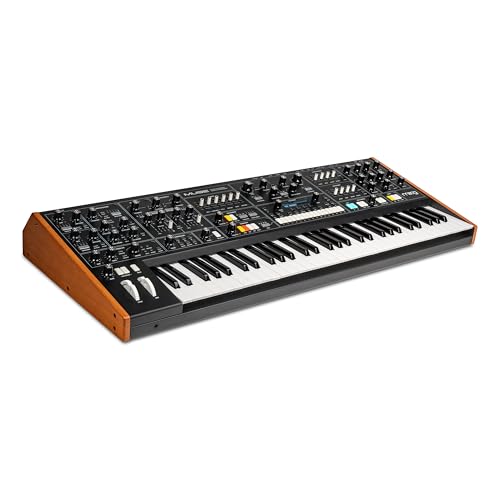
- Eight analog voices with dual oscillators and filters
- 61 keys, sequencer, arpeggiator, and chord memory
- Stereo Diffusion Delay for spacious sound design
Best For: Analog polyphony, studio production, and performance
Versatile Production Workstation

- 61 keys with 128-note polyphony
- USB audio/MIDI without driver installation
- Motif Sound Engine and vintage-style effects
Best For: Players and producers needing a flexible 61-key workstation
Hands-On Desktop Powerhouse

- 11 oscillator models and four synth parts
- Multitimbral sequencer with motion recording
- USB-C interface supports 12 discrete audio channels
Best For: Sound designers and performers wanting compact, direct-control synthesis
Expressive Analog Monosynth

- Two wavefolding VCOs plus a sub-oscillator
- 32 full-size keys with velocity and aftertouch
- 64-step sequencer, CV, MIDI, and 256 presets
Best For: Players wanting hands-on analog basses, leads, and sequences
Portable Analog Creativity

- Battery-powered with built-in speaker and headphone output
- Analog LFO, filter, envelope, PWM, delay, and sub-octaves
- CV/Gate outputs and expressive control strip
Best For: Portable analog sound design and modular integration
Guitar-Ready FM Power

- Six-operator FM engine with 32 algorithms and 128 presets
- Arpeggiator, sequencer, 12-voice polyphony, and six effects
- USB-C, Bluetooth MIDI, and 3.5mm MIDI connectivity
Best For: Guitarists and producers needing portable FM synthesis
Wireless FM Workstation

- Portable battery-powered design with speaker and 27 silicone keys
- Six-operator FM engine, 32 algorithms, 128 presets, and SYSEX import
- Effects, arpeggiator, sequencer, and simultaneous three-channel MIDI
Best For: Portable FM composition and wireless MIDI control
Flagship Expression – Yamaha Montage M8X
The Yamaha Montage M8X is a professional music synthesizer built for expressive performances, deep sound exploration, and complex stage or studio setups. Its 88-key GEX action, polyphonic aftertouch, three sound engines, and 400-note total polyphony give advanced players substantial control and headroom.
Best For: Pianists, performing keyboardists, and producers who want flagship sound design with highly expressive 88-key control.
Pros:
- 400-note total polyphony across three engines supports dense arrangements.
- Polyphonic aftertouch enables independent pressure control for held notes.
- AN-X engine, Seamless Sound Switching, and dedicated performance controls expand live possibilities.
- Expanded Softsynth Plugin can replicate the instrument in a DAW.
Cons:
- At 61.9 pounds, it is demanding to transport.
- Its 88-key flagship format may be more instrument than compact setups require.
The M8X is a strong choice when expressive keyboard action and broad production capability matter more than portability. Its extensive controls and DAW integration also make it suitable as a central studio instrument.
Analog Hands-On Control – MOOG Subsequent 37
The MOOG Subsequent 37 is a professional music synthesizer for players who prefer direct, hands-on analog sound shaping. Its 40 knobs, 74 switches, two-note paraphonic keybed, and extensive modulation options make it particularly suited to detailed performance and sound design.
Best For: Analog enthusiasts, electronic musicians, and producers who want tactile controls, rich tones, and flexible sequencing.
Pros:
- Two variable waveshape oscillators, a square-wave sub oscillator, and analog noise generator provide multiple sound sources.
- Two modulation busses with LFOs and programmable routing support complex tones.
- 37 semi-weighted keys include velocity and aftertouch for expressive playing.
- MIDI, USB, audio, and CV/GATE connections support varied studio setups.
Cons:
- The keybed is two-note paraphonic rather than fully polyphonic.
- Its 37-key layout offers less range than larger keyboard synthesizers.
The Subsequent 37 is a focused analog instrument with an unusually immediate control surface. Choose it when shaping sounds from the front panel and integrating hardware connections are higher priorities than broad polyphony.
Portable Performance Power – Yamaha MODX M6
The Yamaha MODX M6 is a professional music synthesizer designed for stage and studio use where sound variety and manageable weight are important. Its 61 semi-weighted keys, three sound engines, color touchscreen, faders, and Super Knob provide a practical balance of control and portability.
Best For: Gigging keyboardists, producers, and synthesists who need broad sounds and hands-on performance control in a lightweight format.
Pros:
- Three engines cover analog-style, FM, and realistic instrument sounds.
- Eight physical faders and the Super Knob provide real-time control.
- Color touchscreen and dedicated display knobs streamline editing.
- Expanded Softsynth Plugin supports sound work inside a DAW.
Cons:
- Its 61-key layout provides less range than an 88-key instrument.
- The supplied notes do not specify a warranty beyond Yamaha’s one-year manufacturer warranty.
At 22.7 pounds, the MODX M6 is the practical pick for players who regularly move between rehearsals, stages, and studios. It retains substantial synthesis and control features without the bulk of a flagship 88-key board.
Polyphonic Analog Centerpiece – MOOG Muse
The MOOG Muse is a professional music synthesizer built as a studio or performance centerpiece around eight analog voices. With two VCOs per voice, dual filters, a stereo VCA, knob-per-function controls, sequencing, and diffusion delay, it combines classic analog architecture with modern performance tools.
Best For: Producers, sound designers, and performers seeking substantial analog polyphony with sequencing and onboard spatial effects.
Pros:
- Eight analog voices support polyphonic playing, with two VCOs and dual VCFs per voice.
- Knob-per-function layout keeps core sound shaping immediate.
- Arpeggiator, chord memory, and polyphonic sequencer encourage generative performance.
- Stereo Diffusion Delay adds multi-tap, filtered, and diffused sound treatments.
Cons:
- At 32 pounds, it is less portable than compact synthesizers.
- Only 32 of the 256 patch locations are reserved for user patches, according to the supplied notes.
The Muse suits musicians who want a dedicated analog polyphonic instrument with enough sequencing and effects depth to anchor a production. Its 61-key format and performance controls also make it viable beyond the studio.
Versatile Production Workstation – Yamaha MX61BK
The Yamaha MX61BK is a practical choice among professional music synthesizers for players who want a 61-key instrument with substantial polyphony and straightforward computer integration. Its Motif Sound Engine, USB audio/MIDI connectivity, and broad sequencing support make it suitable for both live performance and production workflows.
Best For: Keyboardists, producers, and performers who need a full-size 61-key synthesizer with flexible sounds and plug-and-play USB connectivity.
Pros:
- 128-note polyphony supports live playing and full 16-track sequences with fewer dropouts.
- Class-compliant USB records stereo audio and 16 channels of MIDI through one cable.
- Motif Sound Engine supports layering, zoning, switching, and control of up to eight elements in one voice.
- Virtual Circuit Modeling adds vintage-style effects and signal-processing behavior.
Cons:
- Software remote-control functions vary by compatible DAW and operating system.
- The plastic body may feel less substantial than an all-metal instrument.
Choose the MX61BK if you prioritize polyphony, traditional keyboard range, and an easy USB-based studio setup. It is a strong all-purpose option for combining stage performance with computer-based production.
Hands-On Desktop Powerhouse – Roland SH-4D
The Roland SH-4D brings a compact, hands-on approach to professional music synthesizers. With 11 oscillator models, four independent synth parts, a rhythm part, onboard sequencing, extensive effects, and USB-C audio/MIDI, it is designed for quickly developing sounds and complete musical patterns.
Best For: Studio creators, live performers, and traveling musicians who prefer direct controls and multitimbral desktop synthesis.
Pros:
- Eleven oscillator models provide broad sound-design options.
- Four synth parts plus a dedicated rhythm part offer up to 60 voices of total polyphony.
- Multitimbral sequencer includes 128 patterns, real-time recording, step entry, and motion recording.
- USB-C audio/MIDI can send 12 discrete audio channels directly to a DAW.
Cons:
- Its compact desktop format does not include a built-in keyboard.
- The extensive controls and synthesis features may require time to master.
The SH-4D is especially compelling when immediacy matters: its knobs, sliders, buttons, sequencer, and effects encourage experimentation without depending entirely on software. It is a flexible choice for portable setups and evolving electronic arrangements.
Expressive Analog Monosynth – MOOG Messenger
The MOOG Messenger is a focused option among professional music synthesizers for players who want hands-on analog basses, leads, and sequences. Its two wavefolding VCOs, sub-oscillator, ladder filter, full-size keys, and expressive aftertouch combine classic monosynth architecture with modern performance and connectivity features.
Best For: Performers and producers seeking a portable, expressive monophonic analog synthesizer with extensive sound shaping and sequencing.
Pros:
- Two continuously variable-shape VCOs include sync and frequency modulation, plus a sub-oscillator.
- Next-generation ladder filter offers low-pass, band-pass, and high-pass responses with resonance bass compensation.
- Thirty-two semi-weighted full-size keys provide velocity and aftertouch control.
- Integrated 64-step sequencer, arpeggiator, 256 presets, CV patch points, and MIDI connectivity support performance workflows.
Cons:
- Its monophonic design is intended for one note at a time rather than chords.
- At 27.6 inches wide, it requires more space than a compact desktop synth.
The Messenger is a strong fit when tactile analog control and expressive keyboard response take priority. Its filter options, modulation tools, CV connections, and generative sequencer give a dedicated monosynth a particularly broad performance role.
Portable Analog Creativity – Stylophone GENX-2
The Stylophone GENX-2 is a compact option for musicians seeking professional music synthesizers with hands-on analog sound shaping. Its battery operation, built-in speaker, stylus keyboard, and CV/Gate connectivity make it suitable for both spontaneous sketching and integration with a larger hardware setup.
Best For: Portable sound design, expressive leads and basses, and modular or semi-modular setups.
Pros:
- Portable, battery-powered design with a built-in speaker, headphone output, and audio output.
- Analog-style sound shaping with an LFO, resonant low-pass filter, attack/decay envelope, PWM, and dual sub-octave switches.
- CV and Gate outputs support external hardware, while the expression strip adds pitch, modulation, and filter control.
- Built-in analog delay adds slapback and atmospheric effects.
Cons:
- The stylus-powered keyboard and compact two-octave layout may not suit players wanting a conventional full-size keyboard.
- Its feature set is focused on synthesis and hardware connectivity rather than extensive preset storage.
The GENX-2 stands out when portability and tactile experimentation matter more than traditional keyboard ergonomics. It is a practical creative instrument for shaping distinctive analog textures and controlling compatible external gear.
Guitar-Ready FM Power – M-VAVE FM-1
The M-VAVE FM-1 brings a six-operator FM engine to a highly portable keyboard, making it an appealing choice among professional music synthesizers for guitarists, producers, and mobile performers. It combines 128 presets with sequencing, arpeggiation, effects, and multiple MIDI connection options.
Best For: Guitar rigs, DAW production, portable performance, and classic DX-style FM sounds.
Pros:
- Six-operator FM synthesis with 32 algorithms and 128 factory presets.
- Includes a seven-mode arpeggiator, 16-step sequencer, and six effects including reverb, delay, chorus, and distortion.
- USB-C, Bluetooth BLE MIDI, and 3.5mm MIDI IN support flexible rig and DAW connections.
- Rechargeable battery offers up to 12 hours of play, with a built-in speaker and 12-voice polyphony.
Cons:
- The 27-key silicone keyboard may feel different from a conventional piano-style keybed.
- FM synthesis can require more sound-design familiarity than simpler subtractive instruments.
With its color TFT display and broad connectivity, the FM-1 offers a capable mobile workflow without requiring extra equipment for many setups. It is especially compelling for musicians who want FM tones and guitar-friendly MIDI integration in one compact unit.
Wireless FM Workstation – M-VAVE FM Synthesizer
The white M-VAVE FM Synthesizer is a compact, battery-powered instrument for shoppers comparing professional music synthesizers with wireless control and built-in sequencing. Its 27 silicone keys, six-operator engine, presets, effects, and three-channel MIDI design support quick production away from a traditional studio.
Best For: Portable composition, beginner-friendly FM exploration, and wireless MIDI setups.
Pros:
- Portable battery-powered format with a built-in speaker and 27 full-range silicone keys.
- Six operators, 32 algorithms, 128 presets, and FM SYSEX import provide substantial FM sound variety.
- Six built-in effects, seven arpeggiator modes, and a 16-step sequencer support complete musical sketches.
- USB MIDI, Bluetooth MIDI, and 3.5mm MIDI IN can be used simultaneously.
Cons:
- The silicone keybed and compact dimensions may not provide the feel of a standard keyboard.
- Its plastic construction may appeal less to buyers seeking a metal-bodied instrument.
The FM Synthesizer is a practical grab-and-go choice for creating FM parts, practicing, or controlling other devices wirelessly. Its combination of presets and accessible performance tools makes it approachable while retaining deeper algorithm and SYSEX-based sound options.
How We Picked These Professional Music Synthesizers
We selected instruments across the main categories serious players consider: flagship workstations, analog monophonic and polyphonic synthesizers, performance keyboards, desktop sound modules, and portable FM or experimental instruments. We focused on synthesis capability, playability, hands-on control, sequencing or production features, stage practicality, connectivity, and the kind of sounds each instrument is designed to produce.
Because “professional” depends on context, the list includes both high-end performance instruments and compact tools that can earn a place in a professional studio. A portable synthesizer may not replace a workstation, but it can be valuable for sketching ideas, live improvisation, or adding a distinctive voice to a larger setup.
Quick Comparison
| Best For | Recommended Type | What to Prioritize |
|---|---|---|
| Complete studio and stage centerpiece | Flagship workstation | Keybed, polyphony, multi-timbral control, production features |
| Expressive analog leads and basses | Monophonic analog synthesizer | Oscillator character, filter response, modulation, performance controls |
| Rich chords and evolving pads | Analog polyphonic synthesizer | Voice count, tuning stability, patch memory, effects |
| Hands-on sound design | Desktop or compact synthesizer | Control layout, synthesis engines, sequencing, connectivity |
| Portable experimentation | Battery-powered or compact instrument | Built-in speaker, portability, preset variety, external sync |
Key Buying Factors for Professional Music Synthesizers
Keyboard and Playing Expression
Keyboard quality affects both comfort and musical control. Consider key count, action type, aftertouch, velocity response, and whether the instrument supports the playing techniques you use. An 88-key weighted action suits piano-style performance, while 61 keys often provide a useful balance for synth parts, splits, and portability.
Synthesis Architecture and Sound Character
Analog instruments are often chosen for immediate controls and organic filter and oscillator behavior. Digital, FM, and hybrid designs can provide broader timbral range, complex modulation, layered sounds, and efficient preset recall. Look beyond marketing labels and check whether the architecture supports the basses, leads, pads, textures, or production sounds you actually need.
Polyphony, Multitimbrality, and Workflow
Higher polyphony helps with sustained chords, layered patches, and dense arrangements, while multitimbral operation can make one keyboard more useful in a complete production. Also evaluate patch storage, sequencing, arpeggiation, effects, and screen navigation. A powerful synthesizer is less useful if its workflow slows down your sessions or performances.
Connectivity and Live Practicality
Check MIDI, USB, CV/gate, audio outputs, pedal connections, and integration with your computer or modular system. For stage use, consider weight, build quality, visibility of controls, preset organization, and whether the instrument can be operated reliably without menu diving.
Who Should Buy Which Professional Music Synthesizers?
Choose the Yamaha Montage M8X if you want a premium, full-range performance and production centerpiece with an expansive keyboard. The other Yamaha performance-oriented 61-key option is better suited to players who want expressive control with less size and weight, while the Yamaha MX61 is a practical choice for accessible workstation-style production.
Choose the Moog Subsequent 37 or Moog Messenger for focused monophonic analog basses, leads, and sequences. The Moog Muse is the stronger fit for players who need analog polyphony, chords, and pads. Roland’s SH-4d is a compelling choice for hands-on desktop sound design and compact studio or stage setups.
Finally, choose the Stylophone GENX-2, M-VAVE FM-1, or M-VAVE wireless FM synthesizer when portability, experimentation, built-in sound, or low-cost access matters more than a full-size professional keyboard. Before buying, match the instrument to your main role rather than simply choosing the largest feature list.