Indoor air can look clean while elevated CO2, fine particles, VOCs, or radon affect comfort and health. The right monitor turns those hidden conditions into useful, timely readings.
We compared 10 indoor air quality monitors across sensor coverage, display and app features, power options, smart-home compatibility, and ease of use so you can choose the best fit for your rooms and routines.
Best 10 Indoor Air Quality Monitors Picks for 2026
Best for CO2-Focused Ventilation
Aranet4 Indoor Air Quality Monitor
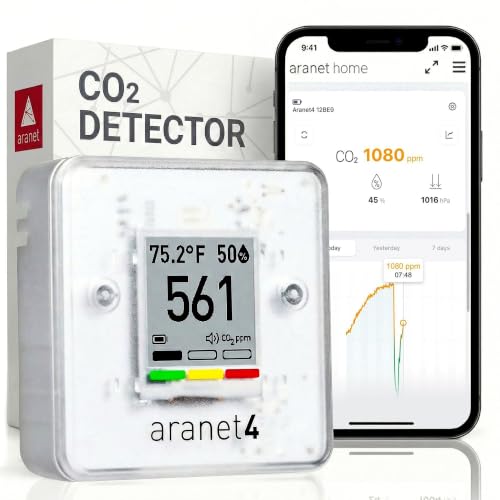
- NDIR CO2 measurement with temperature and humidity readings
- Wireless e-ink display with up to four years of battery life
- App provides graphs and up to 90 days of historical data
Best For: Homes and offices focused on ventilation and CO2 tracking
Best for Alexa Homes
Amazon Smart Air Quality Monitor

- Tracks PM2.5, VOCs, CO, humidity, and temperature
- Offers Alexa app scores and color-coded status
- Can trigger notifications and smart-home routines
Best For: Alexa-connected homes seeking automated air-quality alerts
Best for Detailed Air Analysis

- Measures CO2, PM1, PM2.5, PM10, TVOC, and formaldehyde
- Includes 90-day history, alerts, and CSV data export
- Rechargeable and usable while connected to USB-C power
Best For: Detailed home, office, or classroom air-quality investigations
Best for Portable Multi-Sensor Monitoring

- Measures particles, CO2, CO, HCHO, TVOC, AQI, temperature, and humidity
- Works without Wi-Fi, Bluetooth, or app setup
- 2000mAh battery offers up to 96 hours of monitoring
Best For: Portable, app-free checks across rooms, vehicles, and offices
Best Overall

- Measures radon, PM2.5, CO2, VOCs, and more
- Battery-powered with customizable eInk display
- App offers alerts and long-term trend tracking
Best For: Homeowners seeking comprehensive, connected monitoring with radon detection
Best Large Display
YNAK 16-in-1 Air Quality Monitor

- Large 7-inch LED screen shows readings clearly
- Tracks CO2, particulates, HCHO, TVOC, and more
- Includes configurable AQI alerts and mute control
Best For: Users who want visible, room-level readings and audible alerts
Best Portable Option
QXZFFF 10-in-1 Air Quality Monitor

- Tracks gases, particulates, AQI, temperature, and humidity
- Up to 20 hours of monitoring per charge
- Color screen and voice alerts flag air-quality changes
Best For: Portable checks across rooms, vehicles, offices, and other spaces
Best with Extra Features
AirGradient ONE Open-Source Monitor
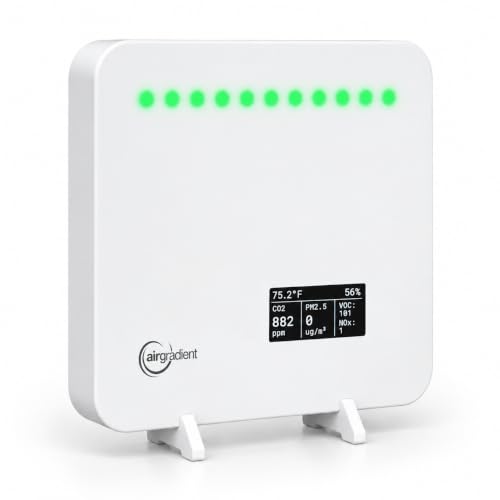
- Measures six key indoor air metrics, including PM2.5 and CO2.
- Subscription-free dashboard, API, app, and Home Assistant support.
- Individually PM2.5-calibrated with a digital test report.
Best For: Connected homes and detailed multi-pollutant monitoring
Best Heavy-Duty Pick
16-in-1 High-Precision Air Monitor
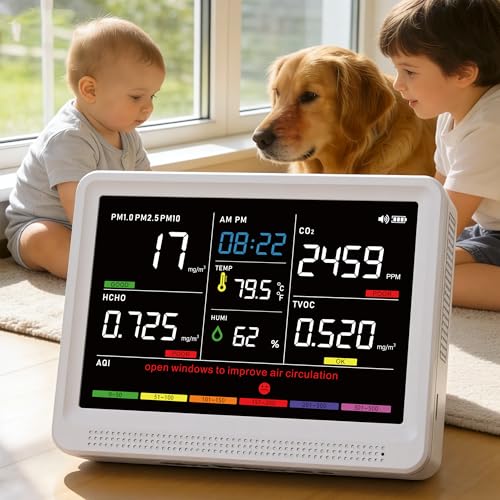
- Shows nine air-quality measurements on a 5.5-inch HD screen.
- Includes seven AQI alert functions with a mute option.
- Rechargeable design provides up to 10 hours of portable use.
Best For: At-a-glance monitoring in rooms, cars, and campsites
Best Simple Pick

- Tracks gases, particulates, temperature, humidity, and AQI.
- Three-color screen makes changing conditions easy to notice.
- Compact design suits homes, vehicles, offices, and travel.
Best For: Portable everyday checks across multiple indoor spaces
Best for CO2-Focused Ventilation – Aranet4 Indoor Air Quality Monitor
The Aranet4 is a straightforward choice among indoor air quality monitors if your main priority is tracking carbon dioxide and knowing when to ventilate. Its wireless e-ink display also shows temperature, humidity, and atmospheric pressure, while the companion app provides up to 90 days of historical data.
Best For: Homes, offices, and bedrooms where clear CO2 readings and long battery life matter most.
Pros:
- Uses NDIR technology for CO2 measurement.
- Wireless design with an e-ink display and battery life of up to four years.
- Color coding, a prominent CO2 reading, and an optional buzzer make high levels easier to notice.
- App supports graphs and up to 90 days of historical data.
Cons:
- Focuses on CO2, temperature, humidity, and pressure rather than particulate or VOC measurements.
- Its app requires a smartphone for historical analysis.
The Aranet4 is especially appealing for users who want dependable, easy-to-read CO2 feedback without keeping the monitor plugged in. Choose a broader-sensing model if you also need particle, VOC, or formaldehyde readings.
Best for Alexa Homes – Amazon Smart Air Quality Monitor
The Amazon Smart Air Quality Monitor is a practical option for households already using Alexa. It tracks five factors—PM2.5, VOCs, carbon monoxide, humidity, and temperature—and presents an air quality indication on the device or an air quality score in the Alexa app.
Best For: Alexa users who want notifications and automated responses from compatible smart-home devices.
Pros:
- Monitors PM2.5, VOCs, carbon monoxide, humidity, and temperature.
- Provides a color-coded LED and an easy-to-understand Alexa app score.
- Can send phone notifications or announcements through Echo devices when air quality is poor.
- Supports Alexa Routines for controlling purifiers, dehumidifiers, and fans.
Cons:
- Its smart-home features are most useful within the Alexa ecosystem.
- The supplied notes do not specify battery operation or portable use.
This monitor stands out when air-quality readings need to trigger convenient household actions. It is less compelling if you want a standalone monitor with detailed historical analysis or a long-running wireless design.
Best for Detailed Air Analysis – BREATHE Airmonitor Plus Gen 2
The BREATHE Airmonitor Plus Gen 2 is one of the more comprehensive indoor air quality monitors in this lineup. It combines NDIR CO2 measurement with PM1, PM2.5, PM10, TVOC, and formaldehyde sensing, plus temperature and humidity readings, then adds app alerts, data export, and 90-day history.
Best For: Users who want to investigate how cooking, cleaning, furnishings, smoke, or ventilation affect indoor air.
Pros:
- Eight-in-one monitoring covers CO2, three particle sizes, TVOC, formaldehyde, temperature, and humidity.
- Combines NDIR CO2, laser particle, VOC, and formaldehyde sensors.
- App supports configurable CO2 and PM2.5 alerts, graphs, 90-day history, and CSV export.
- Rechargeable design provides up to six hours of portable use and can run from USB-C power.
Cons:
- Six-hour battery life is considerably shorter than a cable-free monitor designed for multi-year operation.
- App connectivity uses 2.4 GHz Wi-Fi, which adds setup requirements.
Choose the BREATHE model when breadth of measurement and data review are more important than maximum battery life. Its exportable history is useful for spotting patterns and evaluating changes over time.
Best for Portable Multi-Sensor Monitoring – 10-in-1 Air Quality Monitor
This 10-in-1 monitor is designed for quick, broad checks across rooms, vehicles, and other indoor spaces. It measures particle sizes, CO2, carbon monoxide, formaldehyde, TVOC, AQI, temperature, and humidity, with readings updated every 1.2 seconds and shown on a color display.
Best For: People who want a portable, app-free monitor covering particles, gases, and basic comfort conditions.
Pros:
- Tracks PM0.3, PM2.5, PM10, CO2, CO, HCHO, TVOC, AQI, temperature, and humidity.
- Color-coded levels make changes easier to recognize at a glance.
- Requires no Wi-Fi, Bluetooth, or app setup and includes an audible alert.
- 2000mAh rechargeable battery provides up to 96 hours of continuous monitoring.
Cons:
- The supplied notes do not mention historical data storage or a companion app.
- It provides many measurements, but the notes do not identify specific sensor technologies.
This is a flexible choice for moving between bedrooms, kitchens, cars, offices, and new rooms. Its long stated battery life and simple controls favor on-the-go checks, while users needing trends or remote alerts may prefer a connected model.
Best Overall – Airthings View Plus
The Airthings View Plus is a strong all-around choice among indoor air quality monitors, especially if radon tracking is important. It continuously measures radon, PM2.5, CO2, VOCs, humidity, temperature, and air pressure, with readings available through its app and customizable eInk display.
Best For: Homeowners who want broad, continuous monitoring with dedicated radon detection and remote app access.
Pros:
- Tracks radon alongside PM2.5, CO2, VOCs, humidity, temperature, and pressure.
- Battery-powered design supports flexible, cable-free placement.
- App provides live readings, trend analysis, notifications, and pollen information.
- Optional free registration extends the warranty to five years.
Cons:
- The monitor requires the Airthings app, an account, and internet access.
- Its battery-powered design uses six AA batteries, with an average battery life of about two years.
The View Plus stands out for combining radon measurement with a broad set of everyday air-quality readings. Choose it if cloud-connected monitoring and long-term tracking matter more than a completely offline setup.
Best Large Display – YNAK 16-in-1 Air Quality Monitor
The YNAK 16-in-1 is a practical indoor air quality monitor for anyone who wants many readings visible at once. Its 7-inch LED screen displays CO2, particulate matter, HCHO, TVOC, temperature, humidity, AQI, and time, while built-in alerts flag changing conditions.
Best For: Bedrooms, offices, and shared spaces where a large at-a-glance display and audible AQI alerts are useful.
Pros:
- Monitors CO2, PM1.0, PM2.5, PM10, HCHO, TVOC, temperature, humidity, and AQI.
- Large 7-inch LED display offers three brightness settings.
- Seven AQI alert functions provide audible notifications, with a mute option.
- USB-C charging and the included adapter support flexible use.
Cons:
- Battery runtime is listed at up to eight hours.
- The claimed “16-in-1” count combines nine detected parameters with seven alert types.
- External sensors should be kept away from perfumes and strong odors to help maintain accuracy.
This model prioritizes visibility and immediate alerts rather than remote app connectivity. Its large screen makes it a good fit for monitoring a room from across the space, while its rechargeable design also supports occasional portable use.
Best Portable Option – QXZFFF 10-in-1 Air Quality Monitor
The QXZFFF 10-in-1 is a compact indoor air quality monitor designed for checking conditions in multiple locations. It measures CO2, HCHO, TVOC, benzene, AQI, PM1.0, PM2.5, PM10, temperature, and humidity, and combines a color display with voice alerts.
Best For: Users who want a lightweight, rechargeable monitor for homes, offices, vehicles, basements, or other spaces.
Pros:
- Measures gases, particulate matter, AQI, temperature, and humidity in one device.
- 2000mAh battery provides up to 20 hours of continuous monitoring.
- Color-coded screen and voice alerts help highlight abnormal readings.
- One-button controls include unit switching, alarm control, calibration, and screen sleep.
Cons:
- It does not offer the app connectivity or cloud tracking described for the Airthings model.
- The supplied notes do not specify a warranty period.
The QXZFFF is appealing when portability and longer battery runtime are priorities. Its auto-calibration feature and simple controls make it convenient for routine spot checks, though buyers seeking remote monitoring should consider a connected alternative.
Best with Extra Features – AirGradient ONE Open-Source Monitor
The AirGradient ONE is a highly capable choice among indoor air quality monitors, combining readings for PM2.5, CO2, TVOCs, NOx, temperature, and humidity with a subscription-free dashboard and open-source flexibility. Its tested and individually calibrated design makes it particularly appealing for buyers who want detailed, connected monitoring.
Best For: Home Assistant users, serious air-quality tracking, and homes, offices, classrooms, or workshops needing multi-pollutant data.
Pros:
- Measures PM2.5, CO2, TVOCs, NOx, temperature, and humidity.
- Includes a subscription-free dashboard, free API access, and mobile app.
- Works with Home Assistant and supports local control and self-hosting.
- Individually calibrated for PM2.5 and includes a digital test report.
Cons:
- Requires USB power rather than offering battery operation.
- The feature set and open-source options may be more than casual users need.
With its broad sensor coverage, strong evaluation history, and integration options, the AirGradient ONE is a well-rounded pick for buyers who want actionable data without a required subscription.
Best Heavy-Duty Pick – 16-in-1 High-Precision Air Monitor
This 16-in-1 model is a practical option among indoor air quality monitors for people who prefer a large, readable screen and audible alerts. It displays nine detected measurements, including CO2, particulate matter, HCHO, TVOC, temperature, humidity, and AQI, while remaining portable and rechargeable.
Best For: Users who want at-a-glance readings, configurable AQI alerts, and portable monitoring for rooms, vehicles, or campsites.
Pros:
- Tracks CO2, PM1.0, PM2.5, PM10, HCHO, TVOC, temperature, humidity, and AQI.
- Large 5.5-inch HD display with three brightness levels.
- Offers seven AQI alert functions and a mute button.
- Provides up to 10 hours of runtime and USB-C charging.
Cons:
- The “16-in-1” designation combines nine measurements with seven alert types.
- Sensor guidance advises avoiding perfumes and strong odors around the device.
- Portable battery runtime is limited to up to 10 hours.
Its large display and alert system make this monitor easy to check across a room, while rechargeable operation adds flexibility for spot-checking different indoor spaces.
Best Simple Pick – MT13S Smart 10-in-1 Monitor
The MT13S is a compact choice among indoor air quality monitors, providing real-time readings for CO2, HCHO, TVOC, PM1.0, PM2.5, PM10, temperature, humidity, and AQI. Its three-color display, automatic startup detection, and Bluetooth time calibration keep operation straightforward for everyday use.
Best For: Buyers seeking a portable monitor for bedrooms, offices, cars, schools, hotels, or other changing indoor environments.
Pros:
- Measures CO2, HCHO, TVOC, three particulate sizes, temperature, humidity, and AQI.
- Three-color visualization helps flag changing air-quality conditions from a distance.
- Supports smart calibration and dedicated sensing for CO2, HCHO, and TVOC.
- Compact controls include temperature-unit selection, sound control, sleep mode, and calibration access.
Cons:
- Bluetooth is used to connect a phone for automatic clock calibration.
- The supplied notes do not specify battery runtime or charging details.
- Manual calibration and settings rely on multi-press button controls.
The MT13S focuses on portability and simple visual feedback, making it a useful everyday detector when you want broad pollutant coverage without a larger desktop display.
How We Picked the Best Indoor Air Quality Monitors
We focused on the measurements that are most useful in everyday homes and offices: carbon dioxide (CO2), PM2.5 particulate matter, volatile organic compounds (VOCs), radon, temperature, and humidity. We also considered whether each monitor provides readings locally, through a mobile app, or through smart-home platforms.
Because no single device is ideal for every household, the selection includes simple CO2-focused monitors, broad multi-sensor models, battery-powered options, and products designed for dashboards or home-automation systems. Accuracy claims, sensor coverage, calibration requirements, alert options, and long-term usability all matter more than the number of measurements listed on the box.
Quick Comparison
Use the product specifications above to compare the most important differences before buying. CO2 monitors are useful for managing ventilation, while PM2.5 sensors help identify smoke, cooking particles, and other fine pollutants. VOC monitoring can reveal changes caused by cleaning products, furnishings, or poor ventilation. Radon detection requires a compatible sensor and enough time for meaningful trends.
Also check power and connectivity. Battery-powered models are easier to move between rooms, but displays and wireless features can reduce battery life. Plug-in monitors are better for continuous placement. Wi-Fi, Bluetooth, Alexa, Home Assistant, or other integrations may be valuable if you want alerts and automation rather than occasional manual checks.
Key Buying Factors for Indoor Air Quality Monitors
Sensor Coverage
Choose the measurements that match your concern. CO2 is the priority for stale air and ventilation. PM2.5 is important in areas affected by wildfire smoke, traffic, candles, or cooking. VOC and radon coverage can add useful context, but each sensor has limitations and should not be treated as a substitute for certified testing or professional advice.
Accuracy and Calibration
Look for transparent specifications, calibration guidance, and clear explanations of how readings are calculated. Sensors can drift, and placement near windows, vents, kitchens, or direct sunlight can distort results. A monitor is most useful when it shows trends and responds consistently in a stable location.
Alerts, History, and Connectivity
Readable thresholds, audible or phone alerts, historical charts, and export options make it easier to act on changes. Smart-home compatibility is especially helpful for triggering ventilation, air purifiers, or reminders when readings rise.
Placement and Usability
Place the unit at breathing height in a representative room, away from vents and drafts. A clear screen is useful for quick checks, while an app can provide deeper history. Consider whether the monitor needs constant power, frequent charging, or an ongoing subscription.
Who Should Buy Which Indoor Air Quality Monitors?
For straightforward ventilation tracking: Choose a dependable CO2-focused monitor such as the Aranet4 if portability and simple readings matter most.
For Alexa households: The Amazon Smart Air Quality Monitor is a practical choice for users who want voice access and smart-home alerts.
For broad pollutant coverage: Consider a multi-parameter model that combines CO2, PM2.5, VOCs, humidity, and temperature.
For radon awareness: The Airthings View Plus is the clearest fit when radon monitoring is a central requirement.
For open smart-home systems: AirGradient ONE is worth considering for users who want Home Assistant compatibility and detailed environmental data.
For large, easy-to-read displays: The 7-inch and HD-screen models suit shared spaces, workshops, classrooms, or anyone who prefers at-a-glance readings over a phone app.