The best heart rate monitors make workout intensity easier to understand, whether you train with a bike computer, smartwatch, phone, or fitness app. Chest straps typically deliver the most responsive readings, while armbands and smartwatches offer added comfort and convenience.
We compared leading Polar, Garmin, Wahoo, and COOSPO options across sensor accuracy, connectivity, comfort, water resistance, and intended use to help you choose the right monitor for your training routine.
Best 10 Heart Rate Monitors Picks for 2026
Most Accurate Chest Strap

- Highly precise heart rate measurement
- Bluetooth, ANT+, and 5 kHz connectivity
- Waterproof with up to 400 hours of battery life
Best For: Athletes who want precise chest-strap tracking and broad compatibility
Best for Data-Driven Training

- Real-time heart rate and HRV data
- Records workouts without a watch
- Tracks running dynamics and swim data
Best For: Garmin athletes who want detailed training metrics and onboard recording
Best Wrist-Free Option

- Comfortable upper-arm or forearm placement
- Works with Bluetooth and ANT+ devices
- Includes swimming goggle clip and session recording
Best For: Swimmers and athletes seeking lightweight, wrist-free monitoring
Best Simple Garmin Strap

- Accurate heart rate and HRV transmission
- Up to one year of replaceable-battery life
- Machine-washable strap with 3 ATM water rating
Best For: Garmin users who want dependable everyday heart rate tracking
Reliable Chest-Strap Pick
- High-accuracy chest-strap tracking
- Works with compatible equipment and smartphone apps
- Up to 400 hours of battery life
Best For: Everyday exercise and connected training
Comfortable Armband Option

- Optical armband design without a chest strap
- Bluetooth and ANT+ connectivity
- Tracks heart rate, calories, and workout time
Best For: App-connected workouts and GPS-device users
All-in-One Wearable
TRAUSI Smartwatch with Heart Rate Tracking

- Tracks heart rate, sleep, and 120 workout modes
- 1.83-inch display with smartwatch features
- Five to seven days of normal-use battery life
Best For: Everyday activity tracking and smartwatch functionality
Women’s Training Pick

- Clips onto medium- and high-support sports bras
- Tracks heart rate, HRV, and select running dynamics
- Up to one year of battery life
Best For: Women’s running, gym, and fitness-class workouts
Rechargeable Performance Pick

- ECG chest sensor for real-time heart rate data
- Bluetooth and ANT+ connectivity
- Over 100 hours of rechargeable battery life
Best For: Multi-device training and frequent workouts
Budget Connectivity Pick
- Bluetooth and ANT+ dual-mode connectivity
- Works with apps, bike computers, watches, and gym equipment
- Up to 300 hours with a replaceable CR2032 battery
Best For: Cyclists and multi-platform indoor training
Most Accurate Chest Strap – Polar H10
The Polar H10 is a strong choice for athletes who prioritize precision from their heart rate monitors. Its chest-strap design, broad connectivity, waterproof construction, and built-in memory make it suitable for workouts using phones, tablets, fitness equipment, and compatible apps.
Best For: Athletes seeking highly accurate chest-strap heart rate tracking with flexible device connections.
Pros:
- Recognized for highly precise heart rate measurement.
- Supports Bluetooth, ANT+, and 5 kHz connections, including simultaneous Bluetooth connections.
- Waterproof design with internal memory for multiple hours of data.
- Battery provides up to 400 hours of use.
Cons:
- Chest-strap format may be less convenient than an arm-worn monitor.
- Requires a CR2025 button cell battery.
Choose the H10 if measurement accuracy and compatibility matter more than having a screen or a wrist-free optical design. The included Polar Pro strap adds silicone dots and an easy-use buckle for a secure fit.
Best for Data-Driven Training – Garmin HRM 600
The Garmin HRM 600 is one of the most feature-rich heart rate monitors in this roundup. It sends real-time heart rate and HRV data to compatible Garmin devices, records workouts when a watch is unavailable, and adds running dynamics for athletes focused on detailed performance analysis.
Best For: Garmin users and performance athletes who want workout recording, HRV data, running dynamics, and swim support.
Pros:
- Transmits real-time heart rate and HRV data to compatible devices, equipment, and apps.
- Records workouts without a watch and syncs data to Garmin Connect.
- Supports running dynamics, indoor pace and distance, and swim heart rate data.
- Machine-washable strap and rechargeable battery lasting up to two months.
Cons:
- Advanced running dynamics require a compatible smartwatch.
- Its feature set may be more than casual exercisers need.
The HRM 600 is a compelling pick when heart rate is only part of your training data. Its Garmin ecosystem integration and onboard recording make it especially useful for structured training and activities where wearing a watch is impractical.
Best Wrist-Free Option – Polar Verity Sense
Polar Verity Sense - Optical Heart Rate Monitor Armband - ANT+, Dual Bluetooth, Black, S-L
Check Price On AmazonThe Polar Verity Sense offers a comfortable alternative to chest-strap heart rate monitors. Worn on the upper or lower arm—or clipped to swimming goggles—it keeps the wrist free while providing live broadcasting or session recording through a compact optical sensor.
Best For: Swimmers and athletes who prefer a lightweight, wrist-free optical heart rate monitor.
Pros:
- Can be worn on the upper arm, forearm, or swimming goggles.
- Supports two simultaneous Bluetooth channels and unlimited ANT+ connections.
- Records sessions for later transfer or broadcasts live heart rate data.
- Compact 19-gram design with included armband and swimming goggle clip.
Cons:
- Optical placement must be snug against the skin for accurate tracking.
- Unlike a chest strap, it may not suit users who prefer chest-based sensing.
The Verity Sense is a versatile choice for training sessions where comfort and freedom of movement are priorities. Its swimming accessories and flexible connection options broaden its usefulness beyond standard gym workouts.
Best Simple Garmin Strap – Garmin HRM 200
The Garmin HRM 200 is a straightforward option for heart rate monitors users who want accurate real-time heart rate and HRV data without the extra features of a performance-focused model. It works with compatible Garmin devices, fitness equipment, apps, and smartphones.
Best For: Garmin users who want reliable heart rate and HRV tracking with long battery life and easy maintenance.
Pros:
- Transmits accurate real-time heart rate and HRV data.
- Compatible with Garmin smartwatches, cycling computers, fitness equipment, apps, and smartphones.
- Offers up to one year of battery life with a user-replaceable battery.
- Machine-washable strap with a 3 ATM water rating.
Cons:
- Provides fewer specialized training features than the Garmin HRM 600.
- Uses a replaceable battery rather than a rechargeable design.
The HRM 200 makes sense for everyday training and Garmin users who value simplicity. Its long battery life, washable strap, and durable water rating keep routine ownership uncomplicated.
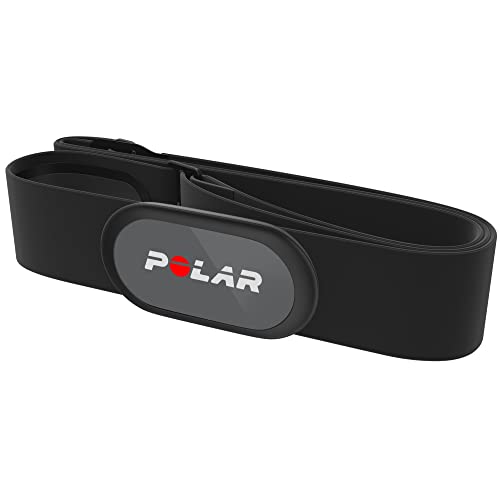
Reliable Chest-Strap Pick – Polar H9 Heart Rate Sensor
Polar H9 Heart Rate Sensor – ANT + / Bluetooth - Waterproof HR Monitor with Soft Chest Strap, M-XXL
Check Price On AmazonThe Polar H9 is a practical choice among heart rate monitors for users who want accurate chest-strap tracking without unnecessary extras. It works with compatible equipment and popular smartphone apps, making it useful for everyday workouts and connected training.
Best For: Everyday exercise, app-based training, and users who prefer chest-strap heart rate sensing.
Pros:
- Designed for high-accuracy heart rate tracking.
- Works with HRM-compatible equipment and popular smartphone apps.
- Offers up to 400 hours of battery life with the included CR2025 battery.
- Includes a soft strap and comes with a two-year manufacturer warranty.
Cons:
- Requires wearing a chest strap.
- Does not provide a built-in display for viewing metrics.
- Battery replacement requires the specified CR2025 button cell.
The Polar H9 focuses on dependable sensor performance and broad compatibility. It is a strong fit if accurate heart rate data matters more to you than smartwatch features or an on-device screen.
Comfortable Armband Option – Wahoo TICKR FIT Armband HRM
The Wahoo TICKR FIT is an optical armband option for shoppers comparing heart rate monitors that avoid a chest strap. It sends real-time heart rate, calorie, and workout-duration data to compatible smartphones, GPS devices, and training apps through Bluetooth or ANT+.
Best For: Athletes who want an adjustable armband with wireless app and GPS-device connectivity.
Pros:
- Optical sensor design eliminates the need for a chest strap.
- Supports both Bluetooth Smart and ANT+ connections.
- Tracks heart rate, calories, and workout duration in real time.
- Includes small and large adjustable bands for a more flexible fit.
Cons:
- Battery life is listed at about 30 to 35 hours.
- Requires a compatible smartphone, GPS device, or training app for connected use.
- Offers a one-year manufacturer warranty.
With its arm-based design and dual-band connectivity, the TICKR FIT is a convenient alternative to chest-strap heart rate monitors. Consider it when comfort and broad wireless compatibility are priorities.
All-in-One Wearable – TRAUSI Smartwatch with Heart Rate Tracking
This TRAUSI smartwatch combines heart rate monitoring with everyday smartwatch functions for shoppers who want more than a standalone sensor. Its 1.83-inch display supports workout tracking, sleep monitoring, notifications, Bluetooth calling, and 120 workout modes.
Best For: Users seeking a general-purpose smartwatch with heart rate and activity tracking for iPhone or Android.
Pros:
- Tracks heart rate and sleep quality alongside more than 120 workout modes.
- Includes a 1.83-inch HD display with customizable watch faces.
- Supports Bluetooth calling, music and camera controls, and app notifications.
- Offers five to seven days of normal-use battery life and IP67 water resistance.
Cons:
- GPS functionality is provided through a connected smartphone rather than built in.
- Its IP67 rating is intended for sweat, rain, and splashes, not deep-water use.
- Comes with a relatively short 90-day manufacturer warranty.
The TRAUSI is a versatile choice if heart rate tracking is only one part of what you want from a wearable. It is less specialized than dedicated heart rate monitors, but its screen, communications features, and broad activity support add everyday convenience.
Women’s Training Pick – Garmin HRM-Fit
The Garmin HRM-Fit is a purpose-built option among heart rate monitors for women who train in medium- or high-support sports bras. Its clip-on design provides real-time heart rate data for compatible Garmin devices, fitness equipment, and supported apps.
Best For: Women who want a sports-bra-mounted heart rate monitor for running, cycling, strength training, HIIT, and fitness classes.
Pros:
- Clips directly onto compatible medium- and high-support sports bras.
- Transmits heart rate and heart rate variability data to compatible devices and apps.
- Supports running dynamics, plus pace and distance for treadmill or indoor-track workouts with compatible Garmin devices.
- Offers up to one year of battery life and stores activity data when out of smartwatch range.
Cons:
- Not recommended for longline, front-zip, or light-support sports bras.
- Some advanced metrics require a compatible Garmin device.
The HRM-Fit is a particularly focused choice if a chest strap is inconvenient and your workout wardrobe includes compatible sports bras. Garmin users get the broadest feature set, including running dynamics and activity syncing.
Rechargeable Performance Pick – Wahoo TRACKR HEART RATE
The Wahoo TRACKR HEART RATE is a rechargeable chest-strap option for athletes who want precise heart rate data and broad device compatibility. Bluetooth and ANT+ support make it suitable for smartphones, fitness equipment, training apps, and accessories.
Best For: Regular trainers who prefer a comfortable ECG chest strap with rechargeable power and multiple wireless connections.
Pros:
- Uses an ECG chest sensor for real-time heart rate monitoring.
- Supports Bluetooth and ANT+, including three simultaneous Bluetooth connections.
- Provides over 100 hours of active battery life from a rechargeable battery.
- Soft, slim strap and LED indicators help with comfort and connection awareness.
Cons:
- Requires periodic recharging rather than a replaceable coin-cell battery.
- The chest-strap design may be less convenient than clip-on or wrist-based options.
Choose the TRACKR if you regularly move between apps and training devices or want to avoid replacing batteries. Its rechargeable design and multi-connection support are useful for structured training setups.
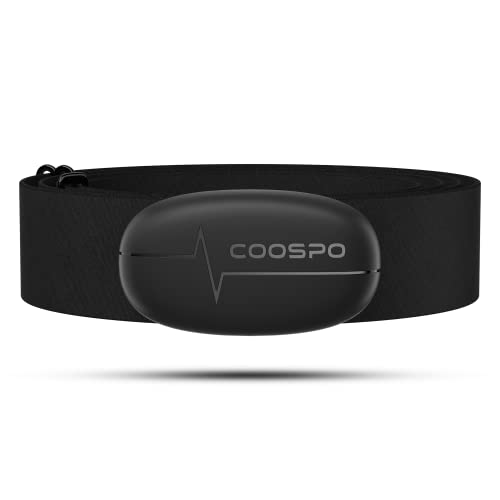
Budget Connectivity Pick – COOSPO H6 Heart Rate Monitor
The COOSPO H6 is a versatile chest-strap choice for shoppers comparing affordable heart rate monitors with Bluetooth and ANT+ connectivity. It is designed to work with many fitness apps, bike computers, sports watches, and gym machines.
Best For: Cyclists, indoor riders, and app-based trainees who need broad compatibility and long battery life.
Pros:
- Provides real-time heart rate data with claimed accuracy of plus or minus 1 BPM.
- Supports both Bluetooth and ANT+ connections for multiple device types.
- Works with listed apps, GPS bike computers, sports watches, and equipment such as Peloton and Concept2.
- Offers up to 300 hours of use with a replaceable CR2032 battery and IP67 protection for rain and sweat.
Cons:
- It is not intended for swimming or soaking.
- The electrode areas should be moistened before use for stable transmission.
- The sensor should be separated from the strap after each workout.
The H6 makes the most sense when compatibility is the priority. Its dual wireless modes and replaceable battery suit varied training equipment, though the strap requires a little more preparation and care than some alternatives.
How We Picked These Heart Rate Monitors
We focused on monitors that support reliable heart-rate tracking across common workouts and devices. Our selection includes ECG-style chest straps, optical armbands, a women-specific strap, and a smartwatch-style option for shoppers who want broader fitness features. We considered Bluetooth and ANT+ compatibility, fit, battery expectations, water resistance, app support, and the type of training each design suits best.
Because no single sensor style is ideal for everyone, the roundup balances high-intensity accuracy with comfort and everyday usability. Chest straps generally respond fastest to rapid changes in effort, while optical armbands can be easier to wear for casual workouts or users who dislike chest bands.
Quick Comparison
| Type | Best For | Main Advantage |
|---|---|---|
| Chest strap | Intervals, cycling, running | Fast, responsive readings |
| Optical armband | Comfort-focused training | No chest-band fit |
| Smartwatch | Everyday wellness | Heart rate plus broader features |
Key Buying Factors for Heart Rate Monitors
Sensor Type and Accuracy
Choose a chest strap if precise response during intervals, racing, or structured training is your priority. Optical armbands can be more comfortable and often perform well for steady-state exercise, but movement, skin contact, tattoos, and fit may affect readings.
Connectivity
Bluetooth works with many phones, tablets, watches, and fitness apps. ANT+ is especially useful when pairing with cycling computers, gym equipment, or multiple compatible devices. If you switch between platforms, dual Bluetooth and ANT+ support offers more flexibility.
Fit, Durability, and Maintenance
Look for an adjustable strap or secure armband that stays in place without feeling restrictive. Water resistance matters for sweaty workouts and outdoor use, but check whether the model is suitable for swimming rather than assuming every waterproof rating supports it. Removable sensors and washable straps can also make regular use easier.
Battery and Features
Compare replaceable-battery designs with rechargeable models based on your routine. Also consider onboard storage, workout broadcasting, app compatibility, and whether you need only heart rate or additional smartwatch functions such as sleep tracking, alarms, and calls.
Who Should Buy Which Heart Rate Monitors?
For maximum training precision: Choose a quality chest strap such as the Polar H10, Garmin HRM 600, or Wahoo TRACKR HEART RATE. These are strong choices for interval work, cycling, and serious performance tracking.
For a comfortable alternative: Consider the Polar Verity Sense or Wahoo TICKR FIT. An upper-arm optical sensor avoids the feel of a chest band while remaining practical for gym sessions, running, and general cardio.
For women-specific fit: The Garmin HRM-Fit is designed to work with compatible sports bras, making it worth considering if conventional chest straps are uncomfortable or inconvenient.
For flexible value: The Garmin HRM 200, Polar H9, and COOSPO H6 provide straightforward heart-rate broadcasting for compatible devices and apps.
For everyday wellness features: A smartwatch-style option is the better fit if you want heart rate alongside sleep tracking, workout modes, notifications, alarms, and calls. It is less specialized than a dedicated sensor but more versatile for all-day use.