Limited space does not mean limited sound. The best music synthesizers for small spaces deliver expressive controls, useful sounds, and flexible connectivity without demanding a full studio setup.
We’ve selected 10 compact options for different players, including beginners, mobile producers, keyboardists, bass enthusiasts, and anyone who wants a fun instrument that can be stored almost anywhere.
Best 10 Music Synthesizers for Small Spaces Picks for 2026
Best Pocket Hybrid

- Compact battery- or USB-powered design
- Vector, wavetable, and analog-filter synthesis
- Built-in sequencer and arpeggiator
Best For: Portable desktop sound design and compact setups
Best Micro Polysynth

- Compact hands-on format
- SH-101-inspired bass and lead sounds
- Wave manipulation and onboard sequencing
Best For: Portable electronic music creation and sound exploration
Best Mini-Keyboard Synth

- 37 mini keys with initial touch
- Four-operator FM synthesis
- Built-in speakers and phrase looper
Best For: Portable playing and compact songwriting
Best All-in-One Controller

- 25 keys, pads, knobs, and arpeggiator
- Over 100 built-in sounds and speaker
- Standalone battery or USB MIDI operation
Best For: Compact beat making and hybrid computer setups
Most Versatile Portable Pick

- Battery-powered with built-in speaker
- Six-operator FM engine with 128 presets
- Effects, arpeggiator, sequencer, and three MIDI options
Best For: Portable FM synthesis and compact music-making setups
Smallest Retro Choice
Stylophone Original Pocket Synthesizer

- Pocket-sized battery-powered design
- Distinctive vintage analog sound with three octaves
- Built-in speaker, headphone socket, and 3.5mm connectivity
Best For: Beginners and retro-sound experimentation in extremely tight spaces
Best for Acid Basslines

- Analog acid-focused 1-VCO, 1-VCF, 1-VCA engine
- 128-pattern memory with Song Mode
- Haptic pads, arpeggiator, effects, and MIDI connectivity
Best For: Compact pattern-based bass production and acid-style performances
Playful Pick

- Touch-sensitive stem with roughly four octaves per pitch setting
- Wah and vibrato effects from expressive physical controls
- 3.5mm connection for headphones, amps, or speakers
Best For: Musicians and families wanting an unusual, portable instrument
Experimental Choice
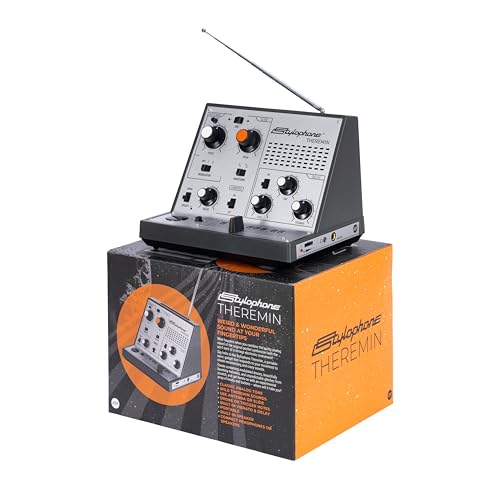
- Portable, battery-powered design with built-in speaker
- Slider control, pitch antenna, delay, and vibrato
- Headphone and audio outputs for practice or recording
Best For: Experimental melodies, drones, and cinematic soundscapes
Compact Sound-Designer

- Analogue synthesis with LFO, filter, envelope, and PWM
- CV/Gate outputs for modular and semi-modular setups
- Battery operation, built-in speaker, and expression strip
Best For: Portable sound design and compact hardware production setups
Best Pocket Hybrid – Behringer Pro VS Mini
The Behringer Pro VS Mini is a practical choice for music synthesizers for small spaces, especially when portability matters. Its compact 8.45-by-5.45-inch footprint combines hybrid synthesis, vector oscillators, an analog low-pass filter, sequencing, and an arpeggiator in a battery- or USB-powered module.
Best For: Portable sound design, compact desktop setups, and beginners or experienced players who want a small hybrid synth module.
Pros:
- Compact 8.45 x 5.45 x 2.35-inch design suits limited workspace.
- Combines four vector oscillators per voice with wavetable synthesis and an analog low-pass filter.
- Includes a 16-step sequencer, arpeggiator, sync input, and USB-C connectivity.
- Can run from batteries or USB power.
Cons:
- The listed 27-key specification may not suit players seeking a full-size keyboard.
- Its feature-rich synthesis workflow may take time to learn.
Choose the Pro VS Mini when you want substantial synthesis and sequencing features without giving up much desk space. Battery and USB operation also make it flexible for mobile use.
Best Micro Polysynth – Roland AIRA Compact S-1
Roland AIRA Compact S-1 Tweak Synth | Ultra-Portable Micro Polysynth. Advanced Tools
Check Price On AmazonFor music synthesizers for small spaces, the Roland AIRA Compact S-1 Tweak Synth offers a compact way to explore basses, leads, wave manipulation, and sequencing. Its small-format design and hands-on controls make it suitable for quick ideas without requiring a large keyboard workstation.
Best For: Beginners and experienced creators who want a portable micro polysynth for basses, leads, sequencing, and experimental sounds.
Pros:
- Compact product dimensions of 10.25 x 6.6 x 3.5 inches.
- Offers a micro polysynth workflow inspired by the Roland SH-101.
- Includes futuristic wave manipulation, onboard sequencing, and performance features.
- Hands-on controls support an intuitive, immediate workflow.
Cons:
- The supplied notes do not specify a built-in keyboard size or speaker system.
- Its compact workflow may be less suitable for players who prefer traditional full-size keys.
The S-1 is a strong space-conscious option when hands-on experimentation matters more than a conventional keyboard layout. It is particularly appealing for portable jams and modern electronic sound creation.
Best Mini-Keyboard Synth – Yamaha REFACE DX
The Yamaha REFACE DX brings a 37-key mini keyboard, built-in speakers, and battery power to the music synthesizers for small spaces category. Its four-operator FM engine supports dynamic sounds, while phrase looping and voice memories make it useful for both practice and compact songwriting setups.
Best For: Players who want a portable synthesizer with playable mini keys, onboard speakers, FM synthesis, and phrase-looping capabilities.
Pros:
- 37 mini keys with initial touch provide a more traditional playing surface.
- Four-operator FM sound engine offers dynamic and expressive synthesis.
- Built-in speaker system and battery power support play-anywhere use.
- Includes 32 voice memory locations and an integrated phrase looper.
Cons:
- At 29.52 inches wide, it requires more desk length than the smaller module-style options.
- Its 6-pound weight is less convenient for ultra-light travel.
The REFACE DX is best when limited space still allows room for a proper keyboard. It trades extreme compactness for a more playable interface, built-in sound, and flexible FM-based tones.
Best All-in-One Controller – Akai MPK Mini Play MK3
The Akai Professional MPK Mini Play MK3 is a space-efficient option for music synthesizers for small spaces when you also need a keyboard controller. Its 25-key layout, built-in sounds and speaker, drum pads, arpeggiator, and battery operation support standalone beat making as well as USB MIDI work with a computer.
Best For: Beat makers, songwriters, and musicians who want a compact keyboard controller with built-in sounds, pads, speaker, and computer connectivity.
Pros:
- Compact 12.5 x 7.1 x 1.9-inch design fits small desks and travel bags.
- Includes over 100 internal drum and instrument sounds with a built-in speaker.
- Provides 25 velocity-sensitive mini keys, eight MPC pads, eight knobs, and an arpeggiator.
- Works standalone with batteries or as a USB MIDI controller with included software.
Cons:
- Batteries are not included.
- The 25-key layout offers less range than the Yamaha REFACE DX’s 37 keys.
- It is designed as a compact controller and sound source rather than a dedicated synthesis-focused instrument.
Pick the MPK Mini Play MK3 if your small-space setup needs both playable controls and immediate standalone sounds. Its pads, software support, and built-in speaker make it especially versatile for portable beat-making workflows.
Most Versatile Portable Pick – M-VAVE FM Synthesizer
For music synthesizers for small spaces, the M-VAVE FM Synthesizer combines a compact footprint with battery power and a built-in speaker. Its 27 silicone keys, presets, effects, arpeggiator, and sequencer make it a flexible option for creating music away from a full-size setup.
Best For: Portable FM synthesis, beginners, and producers who want multiple connection options in a compact instrument.
Pros:
- Battery-powered design with built-in speaker for playing almost anywhere.
- Six-operator FM engine, 32 algorithms, and 128 factory presets offer substantial sound variety.
- Includes six effects, an arpeggiator, and a 16-step sequencer.
- Supports USB MIDI, Bluetooth MIDI, and 3.5mm MIDI input.
Cons:
- The compact 27-key layout may feel limited for two-handed playing.
- FM synthesis can take time to master beyond the included presets.
The M-VAVE is a strong choice when desk space and portability matter but you still want a broad sound palette and hands-on sequencing features.
Smallest Retro Choice – Stylophone Original Pocket Synthesizer
Among music synthesizers for small spaces, the Stylophone stands out for its pocket-sized design and simple touch-surface interface. It delivers a distinctive vintage sound, built-in speaker, headphone output, and battery operation without taking up meaningful desk or bag space.
Best For: Beginners, casual experimentation, retro-sound fans, and musicians who want an exceptionally portable instrument.
Pros:
- At less than 12cm wide, it fits easily in a coat pocket or small storage space.
- Touch-sensitive stylus interface is straightforward and quick to learn.
- Offers three octaves, optional vibrato, an iconic analog sound, and a built-in speaker.
- Headphone socket and 3.5mm connectivity support quieter practice and recording setups.
Cons:
- The stylus-based playing method is less like a conventional keyboard.
- Its sound-shaping and performance features are more limited than those of larger synthesizers.
The Stylophone is best viewed as a compact musical sketchpad and conversation piece rather than a complete studio centerpiece, especially if vintage character and minimal size are priorities.
Best for Acid Basslines – Donner Essential B1
The Donner Essential B1 is a practical pick for music synthesizers for small spaces when your focus is compact bass production and pattern-based performance. Its analog signal path, step sequencer, haptic pads, effects, and MIDI connections provide a focused workflow without requiring a large keyboard.
Best For: Acid-style basslines, pattern sequencing, electronic music production, and compact hardware setups.
Pros:
- Fully analog 1-VCO, 1-VCF, and 1-VCA signal path is designed for classic acid sounds.
- Stores 128 patterns and includes Song Mode for chaining phrases.
- Haptic performance pads and an eight-mode arpeggiator support hands-on jamming.
- USB-C MIDI, two 5-pin MIDI ports, and Sync I/O provide flexible integration.
Cons:
- Its focused bass-synth architecture is less versatile for broad polyphonic sounds.
- The sequencer-centered design may be less suitable for players seeking a conventional keyboard.
The Essential B1 makes the most sense when you want a compact, dedicated acid-bass workstation with sequencing and hardware connectivity rather than an all-purpose synthesizer.
Playful Pick – Otamatone Deluxe
If you want music synthesizers for small spaces with an unusual, hands-on playing style, the Otamatone Deluxe is a compact, characterful choice. Its touch-sensitive stem covers roughly four octaves at each of three pitch settings, while the face adds a distinctive wah effect.
Best For: Musicians, families, and gift shoppers who want a portable, unconventional instrument.
Pros:
- Touch-sensitive stem supports sliding melodies and a wide note range.
- Face squeeze and stem shake controls add wah and vibrato effects.
- 3.5mm stereo jack works with headphones, amplifiers, and speakers.
- Includes batteries, auxiliary cable, instructions, and strap.
Cons:
- Its 18-inch length may require more storage room than ultra-compact synths.
- The playful design may not suit users seeking a conventional keyboard layout.
The Deluxe combines portability with expressive controls and external-audio connectivity. It is a strong fit when entertainment value and unusual performance techniques matter as much as traditional synthesis.
Experimental Choice – Stylophone Theremin
For music synthesizers for small spaces that focus on texture and experimentation, the Stylophone Theremin offers a compact setup with a built-in speaker. Its pitch antenna, touch slider, delay, and vibrato controls support drones, glides, and cinematic soundscapes without requiring a larger keyboard rig.
Best For: Sound explorers who want portable theremin-style tones, expressive pitch control, and quiet headphone practice.
Pros:
- Battery-powered design supports playing at home, in the studio, or on the go.
- Touch slider allows accurate notes, smooth glides, and moving melodies.
- Built-in delay and vibrato add depth to experimental sounds.
- Headphone and audio outputs support silent practice and external gear.
Cons:
- Its experimental sound profile may be less suitable for conventional keyboard parts.
- At 896 grams, it is heavier than some small portable instruments.
The Theremin is best viewed as a compact texture instrument rather than a general-purpose keyboard. It makes efficient use of limited space while offering distinctive modulation and output options.
Compact Sound-Designer – Stylophone GENX-2
The Stylophone GENX-2 is a practical option for music synthesizers for small spaces when hands-on sound design and hardware connectivity are priorities. Its battery operation, built-in speaker, stylus keyboard, and compact 5.12-by-1.57-by-7.28-inch footprint keep a capable analogue synth within reach.
Best For: Producers and synth enthusiasts who want portable analogue synthesis with CV/Gate and DAW-friendly connectivity.
Pros:
- LFO, resonant low-pass filter, envelope, PWM, and sub-octave controls support detailed sound shaping.
- Built-in analogue delay adds slapback and atmospheric effects.
- CV and Gate outputs connect to modular or semi-modular equipment.
- Expression strip supports pitch bends, LFO modulation, and filter sweeps.
Cons:
- The stylus-based keyboard may feel less familiar than a standard keyboard.
- Its advanced routing and synthesis controls may be more than beginners need.
Among these compact instruments, the GENX-2 offers the broadest sound-design and integration potential. It is especially compelling for a small studio where portability, analogue tone shaping, and modular connectivity need to coexist.
How We Picked the Best Music Synthesizers for Small Spaces
We focused on instruments with genuinely compact footprints, practical controls, and features that make sense in apartments, bedrooms, dorms, travel rigs, and small home studios. The selection includes true synthesizers, portable keyboard instruments, pocket devices, and compact controllers with built-in sounds.
We also considered sound-generation options, onboard speakers, battery operation, sequencing, effects, MIDI or USB connectivity, and how approachable each instrument is for its intended user. Because “compact” can mean different things, the list balances playable keyboards with touch interfaces and highly portable desktop designs.
Quick Comparison
| Best For | Look For | Typical Advantage |
|---|---|---|
| Beginners | Simple controls and presets | Shorter learning curve |
| Mobile production | Battery power and built-in speaker | Play almost anywhere |
| Keyboard players | Full-size or velocity-sensitive keys | More familiar performance feel |
| Bass creators | Dedicated filter, sequencer, and effects | Focused low-end sound design |
| Experimental players | Touch controls and unusual interfaces | More immediate, hands-on exploration |
Key Buying Factors for Music Synthesizers for Small Spaces
Size, Storage, and Setup
Measure your available desk or shelf space before buying. A pocket synth may fit beside a laptop, while a 25-key controller needs room for both the instrument and your hands. Also check whether the controls are crowded or easy to access.
Sound Engine and Editing
FM, analog, hybrid, and digital engines each produce different results. Analog-style designs often excel at warm basses and leads, while FM instruments are strong for bright keys, bells, and precise digital textures. Presets are useful, but hands-on editing matters if you want to learn synthesis.
Keys, Pads, or Touch Control
Choose keys if traditional playing technique matters. Touch strips and compact pads save space and can be more expressive for sequences, bass lines, or experimental sounds. Some small instruments are better viewed as sound modules than conventional keyboards.
Power and Connectivity
Battery power and an onboard speaker are valuable for portable practice, but USB, MIDI, CV/Gate, or audio outputs may matter more in a studio. Confirm compatibility with your computer, tablet, headphones, mixer, and other hardware before ordering.
Sequencing, Memory, and Effects
A built-in sequencer can make a small synth feel much more complete, especially when you want to create without a computer. Preset memory, pattern storage, delay, reverb, saturation, and modulation effects can also reduce the need for extra equipment.
Who Should Buy Which Music Synthesizers for Small Spaces?
- Choose a pocket or touch-controlled instrument if portability, experimentation, and instant play are your priorities.
- Choose a compact keyboard synth if you want more conventional note input and better control for melodies or chords.
- Choose an FM synthesizer if you enjoy crisp digital tones, electric-piano sounds, bells, and detailed programming.
- Choose a bass-focused sequencer if your music centers on bass lines, patterns, filters, and groove-based production.
- Choose a controller with built-in sounds if you want a flexible practice instrument that can also control computer-based music software.
For the best fit, prioritize the feature you will use every session rather than choosing solely by the smallest dimensions. The right compact synthesizer should fit your space while still matching the way you actually make music.