Window cleaning robots can take much of the risk and effort out of cleaning large panes, high windows, and hard-to-reach glass. The latest models combine strong suction, automated spray systems, edge detection, and safety backups to work with less supervision.
Our roundup compares 10 window cleaning robots across navigation, cleaning performance, portability, water management, and overall practicality so you can choose the right fit for your home or workspace.
Best 10 Window Cleaning Robots Picks for 2026
Editor's Choice
HUTT Round-Square Dual-Stage Window Cleaning Robot

- Dual wet-lift and dry-polish cleaning system
- 6500Pa suction with constant 55N pressure
- 30-minute UPS protection and 220kg safety rope
Best For: Versatile edge, corner, and polishing performance
Best Hands-Free Cleaning

- Automatic pad washing with 16 high-pressure nozzles
- TruEdge cleaning reaches edges and corners
- WIN-SLAM 5.0 with fast, intensive, and zone modes
Best For: Low-maintenance cleaning of large windows and glass doors
Best for Spray Control and Manual Flexibility
TOSIMA WA9C Pro Window Cleaning Robot

- Four-nozzle dual spray system
- Six cleaning modes with remote control
- Includes mops, replacement nozzles, and tools
Best For: Users needing adjustable spray coverage and targeted remote cleaning
Best Overall
Dual-Spray AI Window Cleaning Robot
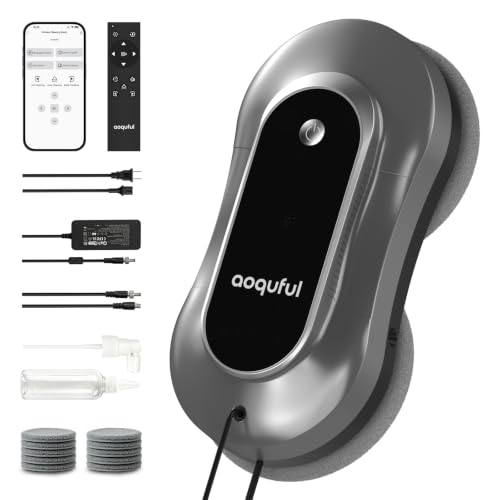
- AI navigation detects frames and obstacles
- 70 ml dual-spray water system
- App, remote, spot clean, and resume modes
Best For: Multi-surface cleaning with flexible controls
Best for Glass-Specific Cleaning
Dual-Spray 3000Pa Window Robot

- Designed for compatible glass surfaces
- 3,000 Pa suction with edge detection
- Includes 10 cloths and two-pass cleaning guidance
Best For: Prepared windows, mirrors, and angled skylights
Editor's Choice – HUTT Round-Square Dual-Stage Window Cleaning Robot
For shoppers comparing window cleaning robots, the HUTT Window Cleaning Robot stands out for its round-and-square dual-stage system. It combines wet lifting with dry wiping and polishing, while navigation sensors, strong suction, and edge-focused cleaning support routine maintenance on glass, mirrors, shower doors, and sliding doors.
Best For: Buyers who want versatile wet-and-dry cleaning with strong edge and corner coverage.
Pros:
- Dual round and square pads support wet cleaning, dry wiping, and polishing.
- 6500Pa suction and constant 55N pressure help maintain stable contact.
- NAVI 7.0 mapping and 14 sensors support edge detection and efficient paths.
- Includes a 220kg safety rope and UPS power-off protection for up to 30 minutes.
Cons:
- Purified water is recommended, and cleaning liquid is not included.
- Wet or dusty drive tracks and overly wet pads can reduce traction.
- Operation is rated at up to 65dB.
The HUTT is a feature-rich choice for users who value polishing and close edge work as much as basic automated cleaning. Its pad-care requirements make setup important, but the combination of suction, pressure control, mapping, and safety features gives it a strong all-around profile.
Best Portable Station – ECOVACS WINBOT W2 PRO OMNI
The ECOVACS WINBOT W2 PRO OMNI is one of the more flexible window cleaning robots for homes where outlets are not always convenient. Its portable multifunction station supports charging, control, stabilization, and storage, while battery or plugged-in operation adapts to different cleaning locations.
Best For: Users who need portable cleaning for balconies, bathrooms, large windows, and varied glass layouts.
Pros:
- Battery mode provides up to 110 minutes of cleaning, or about 55 square meters.
- Plugged-in mode supports continuous cleaning near an outlet.
- Three-nozzle wide-angle spraying works with a wet cloth to loosen dirt.
- WIN-SLAM 4.0 path planning supports edge detection and different window types.
Cons:
- The listed model is intended for indoor use.
- The station and its multiple functions may add storage and setup considerations.
- App control is required for operation.
This model makes the most sense when flexible power options and portability are priorities. Its 12-stage protection system adds reassurance, while the station gives the robot a more complete setup than a basic window-cleaning unit.
Best Water Coverage – Double Helix Ultrasonic Window Cleaner
This Double Helix window cleaning robot focuses on even liquid distribution and extended coverage. Its bidirectional ultrasonic spray, visible 85ml tank, and variable-frequency suction are designed to support hands-free cleaning while edge detection helps manage spraying near window boundaries.
Best For: Shoppers seeking automatic spraying with a larger visible tank and adjustable suction.
Pros:
- Bidirectional ultrasonic atomization helps distribute water across the surface.
- The externally visible 85ml tank supports larger coverage between refills.
- Variable 4800–6400Pa suction adjusts to dirt levels.
- Air-pressure sensing and AI edge detection support anti-drop operation.
Cons:
- The supplied details do not specify a safety-rope rating or backup power duration.
- Its listed dimensions appear incomplete, so fit may require confirmation before purchase.
- Only three cleaning modes are identified in the supplied specifications.
The Double Helix is a practical option for buyers who value spray coverage and adjustable suction over a long list of premium station features. Confirm the unit’s dimensions and included accessories before ordering, especially for specialized or unusually sized windows.
Best Hands-Free Cleaning – ECOVACS WINBOT W3 OMNI
The ECOVACS WINBOT W3 OMNI is designed for shoppers who want more automation from their window cleaning robots. Its station washes the wiping pads after use, while TruEdge technology, triple-nozzle spraying, and WIN-SLAM 5.0 navigation target edges, corners, and larger glass surfaces.
Best For: Users who prioritize automatic pad washing and hands-free maintenance for large windows and glass doors.
Pros:
- Automatic station washing uses 16 high-pressure nozzles in about one minute.
- TruEdge technology actively reaches edges and corners at 200 RPM.
- WIN-SLAM 5.0 provides dynamic obstacle avoidance and multiple cleaning modes.
- Triple-nozzle spraying helps loosen dirt across large glass panels.
Cons:
- The listed unit weight is 12.22 kg, which may make handling less convenient.
- The automatic station requires space and includes a 1.1-liter capacity.
- The supplied details identify indoor use and do not specify outdoor operation.
Among these window cleaning robots, the W3 OMNI is the strongest fit for minimizing hands-on pad maintenance. It is especially compelling for frequent cleaning of large windows, glass doors, and high-traffic surfaces, provided you have room for its station.
Best for Versatile Everyday Cleaning – Tosima X1 Window Cleaning Robot
The Tosima X1 is a practical choice among window cleaning robots for routine indoor glass care. Its dual-nozzle ultrasonic spray, visible 85 ml tank, automatic S-shaped route, and remote control make it suitable for both larger windows and smaller glass surfaces.
Best For: Households wanting flexible automatic cleaning for standard, small, or overhead windows.
Pros:
- Dual nozzles direct ultrasonic water atomization along the cleaning path to help reduce smearing.
- Visible 85 ml water tank makes the remaining water easy to monitor.
- Automatic S-shaped cleaning, remote control, and support for surfaces as small as 30×30 cm.
- Backup battery keeps the robot attached for about 25 minutes during a power outage.
Cons:
- Designed for indoor use and an operating temperature range of 0°C to 40°C.
- At 65 dB and 5 pounds, it may not be the lightest or quietest option.
- A safety tether must be attached to a fixed object.
The X1 balances automated navigation with hands-on remote control, making it a versatile pick for mixed window sizes. Its water tank and backup battery add convenience, while the tether remains essential for safe operation.
Best for Narrow Windows and Edge Coverage – ECOVACS WINBOT MINI 2
The ECOVACS WINBOT MINI 2 stands out among window cleaning robots for compact spaces and detailed edge work. Its small design fits narrow glass areas, while upgraded corner brushes, ultra-thin side wings, and dedicated Edge Clean mode help reduce manual finishing.
Best For: Homes with narrow windows, mirrors, glass doors, and routine light dirt or fingerprint removal.
Pros:
- Compact 8.46-by-8.46-inch footprint is designed for tight glass areas.
- Corner brushes and side wings guide the pad to within 1 mm of edges, with up to 90% edge coverage.
- Offers five cleaning modes through the ECOVACS HOME App, including Fast, Thorough, Deep, Spot, and Edge Clean.
- 8000 Pa suction, edge detection, and over 30 minutes of backup attachment protection support safer operation.
Cons:
- The minimum applicable window size is 8.66 by 9.84 inches.
- For heavily soiled glass, the manufacturer recommends cleaning the pad or running multiple cycles.
- App control and close-range Bluetooth directional control may be less straightforward than a dedicated remote.
With its compact body and edge-focused cleaning hardware, the WINBOT MINI 2 is particularly appealing where larger robots may struggle to maneuver. It is optimized for everyday maintenance rather than a single pass on heavily soiled glass.
Best for Spray Control and Manual Flexibility – TOSIMA WA9C Pro Window Cleaning Robot
The TOSIMA WA9C Pro is one of the more control-oriented window cleaning robots, combining four spray nozzles with multiple navigation patterns and a full manual mode. Its remote lets you adjust spray volume and guide the robot toward stubborn spots on windows, mirrors, and glass doors.
Best For: Users who want adjustable water delivery, remote operation, and several cleaning patterns.
Pros:
- Four precision nozzles provide broad, even water coverage across the glass.
- Offers N-shaped, Z-shaped, and manual cleaning patterns for different tasks.
- Air-pressure monitoring and a bottom drop sensor support secure adhesion.
- Includes four cleaning mops, replacement nozzles, an unclogging kit, water bottle, and remote control.
Cons:
- Backup battery protection lasts up to 25 minutes during a power outage.
- At 6 pounds, it is heavier than the supplied ECOVACS model.
- The safety rope must be anchored securely, especially for overhead cleaning.
The WA9C Pro is a strong fit for buyers who value hands-on control and configurable spray output. Its comprehensive accessory kit is useful for ongoing maintenance, while the shorter backup duration makes careful tethering and setup especially important.
Best Overall – Dual-Spray AI Window Cleaning Robot
For shoppers comparing window cleaning robots, this model stands out for its app control, AI-assisted navigation, and dual water spray system. It is designed for smooth surfaces such as windows, glass doors, tiles, and mirrors, with safety features intended to help during high-up cleaning.
Best For: Homes with multiple smooth glass surfaces and users who want app or remote control, spot cleaning, and automatic resume functionality.
Pros:
- AI navigation detects frames and obstacles while planning cleaning paths.
- Dual water spray system uses a 70 ml tank to help maintain surface dampness.
- Includes spot cleaning, resume cleaning, edge detection, a 2,800 Pa suction motor, and UPS backup.
- Comes with 12 washable microfiber cloths and multilingual voice prompts.
Cons:
- It must remain connected to corded power during normal operation.
- The 6.2-pound body is heavier than some compact window cleaning robots.
This is a feature-rich option for buyers who value flexible controls and thorough coverage. Its washable cloth supply and interruption-resume function add convenience, while the rope and backup battery provide extra reassurance during elevated cleaning.
Best for Glass-Specific Cleaning – Dual-Spray 3000Pa Window Robot
This window cleaning robot is built specifically for suitable glass surfaces, including windows, glass doors, mirrors, and skylights angled at least 30 degrees from horizontal. Its dual-spray system, intelligent path planning, and clear pre-cleaning guidance make it a practical choice for structured two-pass cleaning.
Best For: Users cleaning compatible glass surfaces who are comfortable following pre-cleaning, cloth-replacement, and safety-rope instructions.
Pros:
- Three cleaning paths and a pressure sensor help it detect edges, including on frameless windows.
- 3,000 Pa suction, a 4-meter safety rope, and UPS backup provide triple safety protection.
- Dual atomizing spray nozzles and 10 included microfiber cloths support wet-and-dry cleaning passes.
- Detailed usage guidance explains how to improve results and reduce water spots.
Cons:
- It is not recommended for curved glass, thick trim, raised decorative elements, or horizontal surfaces.
- Heavy dirt, dried stains, bird droppings, and paint require manual pre-cleaning.
- The backup battery is for emergency holding only; the robot is not cordless.
This model makes the most sense for buyers who want a glass-focused robot and are willing to prepare the surface properly. Its guidance is unusually specific, but those limitations should be considered before purchasing.
Best Compact Design – Tosima W5 Adaptive-Suction Robot
The Tosima W5 is a compact window cleaning robot aimed at apartments, condos, and smaller homes. It combines automatic spraying, intelligent navigation, remote control, and adaptive suction that can reach up to 6,400 Pa across smooth glass surfaces.
Best For: Apartment and condo owners who want a lightweight robot with strong adaptive suction and simple remote-controlled operation.
Pros:
- Compact 4-pound design is easier to handle and store than bulkier models.
- Adaptive suction reaches up to 6,400 Pa and adjusts to the surface.
- Dual-spiral cleaning, dual spray, and intelligent navigation help address dust and fingerprints.
- Triple safety system includes edge sensing, a 220 kg-rated rope, and up to 25 minutes of emergency battery power.
Cons:
- Control is listed as remote and button control rather than app control.
- It is intended for glass windows and other smooth surfaces, so broader surface compatibility is not specified.
Choose the W5 if compact storage and powerful adaptive suction matter more than app-based features. Replaceable components may also make routine maintenance easier over the product’s service life.
How We Picked These Window Cleaning Robots
We focused on the features that matter most during real-world glass cleaning: dependable suction, stable movement, edge detection, spray consistency, pad or cloth management, and safety systems. We also considered whether each robot is practical for different window sizes and shapes, how easy it is to control, and whether its station or water tank adds useful convenience.
The selection includes compact models for smaller panes, high-suction options for larger surfaces, and advanced systems with multifunction stations, app controls, smart navigation, or automated cleaning support. Product names and specifications can vary by retailer, so verify current details before buying.
Quick Comparison
| What to Compare | Best For | Why It Matters |
|---|---|---|
| Suction strength | Large or smooth panes | Helps maintain contact while the robot moves |
| Spray system | Frequent or heavy cleaning | Controls how evenly the glass is moistened |
| Navigation and edge detection | Framed or irregular windows | Supports more complete coverage and fewer stops |
| Station and battery features | Convenience-focused users | Can simplify charging, refilling, and operation |
| Safety backup | High or difficult-to-reach windows | Provides extra protection if suction or power is interrupted |
Key Buying Factors for Window Cleaning Robots
Glass Compatibility and Shape
Check whether the robot is designed for the window types you have. Most models work best on smooth, flat glass. Textured, frosted, heavily segmented, or unusually narrow panes may reduce performance. A round-square design or compact body can be helpful when windows have corners, frames, or limited clearance.
Suction, Movement, and Safety
Higher advertised suction is not the only measure of performance, but it can help on larger panes or during movement. Look for adaptive suction, automatic pressure monitoring, a tether, backup power, and clear alerts. Never treat a safety cable as optional when cleaning elevated exterior glass.
Spray and Cleaning Control
Dual-nozzle, multi-nozzle, or ultrasonic atomization systems may distribute moisture more evenly than manual spraying. Compare tank capacity, refill frequency, leak resistance, cleaning modes, and whether the system is intended for light maintenance or more stubborn buildup.
Navigation and Controls
Smart path planning, edge detection, and app control can reduce missed areas and make setup easier. However, navigation cannot replace preparation: remove loose dirt, use suitable cleaning pads, and follow the manufacturer’s instructions for frames and window edges.
Who Should Buy Which Window Cleaning Robots?
Choose a Compact Model for Smaller or Crowded Windows
A compact robot such as the WINBOT MINI 2 is a sensible choice when storage space is limited or windows have tighter working areas.
Choose an Advanced Station Model for Convenience
Models such as the ECOVACS WINBOT W2 PRO Omni or W3 Omni are aimed at buyers who value a more complete station, easier charging, and additional automation.
Choose High-Suction Models for Larger Panes
Options advertising up to 4,800–6,400Pa suction, including the Tosima W5 and Double Helix model, may suit broad, smooth windows, provided their size and safety requirements match your glass.
Choose Stronger Spray Control for Regular Maintenance
Dual-spray, multi-nozzle, or ultrasonic systems can be useful for households that clean frequently or want more consistent moisture distribution. Regardless of model, supervise operation, secure the tether, and inspect the glass and pads before every use.