Keeping office windows clean can be time-consuming, disruptive, and risky when glass is difficult to reach. The best window cleaning robots for office windows automate much of the work while helping reduce ladders, lifts, and repetitive manual cleaning.
This roundup compares 10 models with different combinations of suction power, spray systems, navigation, edge cleaning, safety features, and water-tank capacity. Use the guide below to choose a robot that fits your building’s windows, cleaning schedule, and maintenance needs.
Best 10 Window Cleaning Robots for Office Windows Picks for 2026
Best for Simple Remote Coverage

- 6500Pa suction with 25-minute UPS
- Three directional cleaning paths
- Dual spray and remote control
Best For: Routine cleaning across varied office glass surfaces
Best Overall
HUTT 10 Premium Round-Square Robot

- Dual-stage wet lifting and dry polishing
- 6500Pa suction with 55N constant pressure
- 30-minute UPS and 220kg safety rope
Best For: Offices prioritizing edge coverage and a polished finish
Best for High Windows

- 6400Pa variable suction and dual spray
- 30-minute UPS and anti-fall protection
- Cleans glass, mirrors, tile, and skylights
Best For: Offices with high or difficult-to-reach windows
Best for Spray Control

- Four-nozzle dual-spray system
- Six modes with remote-controlled manual cleaning
- Up to 25 minutes of outage protection
Best For: Offices needing adjustable spray and targeted cleaning
Remote-Control Value
HCR-10 Water-Spray Window Cleaner

- 5600Pa suction with dual spray modes
- Three cleaning paths and remote control
- Includes 10 pads and 300-pound safety rope
Best For: Offices cleaning smooth windows, tiles, and glass doors
Safety-Focused Choice
Tosima W5 Adaptive Window Robot
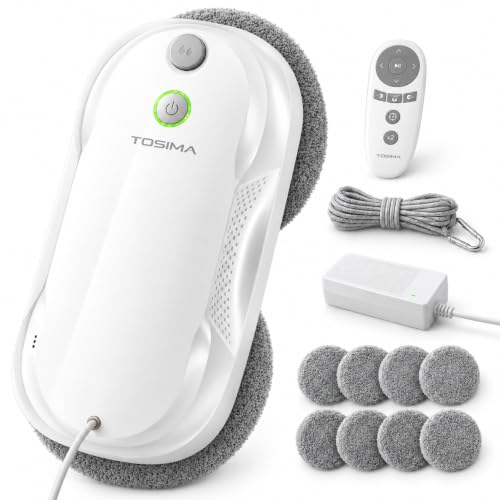
- Up to 6400Pa adaptive suction
- Triple safety system with backup battery
- Intelligent navigation and dual spray
Best For: Offices prioritizing safety and adaptive glass cleaning
Best for Controlled, Deep Cleaning – HUTT S55 Pro
The HUTT S55 Pro is a strong option for offices comparing window cleaning robots for office windows that need more than light dust removal. Its HydroJet pump, adaptive suction, and systematic navigation are designed for stable cleaning across glass and other smooth surfaces.
Best For: High-rise office windows, tiles, glass, and larger routine cleaning jobs where controlled spray and edge recognition are useful.
Pros:
- Up to 6500Pa adaptive suction helps maintain adhesion across different window angles.
- HydroJet pump spray and an 80ml visible tank support wet cleaning sessions.
- SLAM 4.0 provides Z-path cleaning, edge recognition, spot mode, and automatic return.
- Backup battery, safety rope, and pressure compensation add multiple safety measures.
Cons:
- Its 2.6-pound weight may be less convenient for frequent repositioning than a compact model.
- The listed battery life is 30 minutes, so extended jobs may require planning around power access.
The S55 Pro stands out when an office needs systematic coverage and stronger wet-cleaning capability. Its included six cloths and visible tank are practical for repeated maintenance, though operators should still follow the safety-rope and power-use instructions.
Best for Tight Edges and Compact Areas – ECOVACS WINBOT MINI 2
For offices with narrow panes, framed glass, or many corners, the ECOVACS WINBOT MINI 2 is a practical pick among window cleaning robots for office windows. Its compact shape, edge-focused brushes, and app-based cleaning modes are suited to detailed routine maintenance.
Best For: Narrow office windows, mirrors, glass doors, and framed or frameless glass where edge coverage matters.
Pros:
- Compact dimensions help it reach tighter glass areas, with a stated minimum window size of 8.66 by 9.84 inches.
- Corner brushes and thin side wings guide the pad within 1mm of the edge.
- Ultrasonic mist helps reduce over-wetting while the microfiber pad applies 14N of pressure.
- Five cleaning modes and WIN-SLAM 4.0 route planning support flexible maintenance.
Cons:
- The product is optimized for light dirt and dust; heavily soiled glass may need multiple cycles.
- App control and Bluetooth directional control may require more setup than a basic remote.
The MINI 2 is especially compelling for office layouts where corners and restricted panes create the most manual work. Its edge mode can reduce touch-ups, while the safety rope and backup protection support use on elevated glass.
Best for Visible Water Control – Tosima X1
The Tosima X1 suits offices seeking window cleaning robots for office windows with straightforward remote operation and easy water monitoring. Its dual-nozzle atomization directs moisture along the travel path, while the visible 85ml tank helps staff check remaining water at a glance.
Best For: Daily cleaning of large or small office glass, including overhead sunroom-style windows, when remote direction control is preferred.
Pros:
- Dual nozzles spray in the direction of travel to help limit smearing.
- The 85ml tank has a viewing window for quick water-level checks.
- Automatic S-shaped cleaning runs from top to bottom, with manual remote adjustment available.
- A backup battery keeps the unit attached for about 25 minutes during a power outage.
Cons:
- Its 5-pound listed weight is relatively high compared with some compact alternatives.
- The notes specify household use between 0°C and 40°C, which may limit unsuitable work environments.
The X1 emphasizes simple operation rather than app features, making it approachable for routine office maintenance. Its tether, water-resistant materials, and two-year manufacturer warranty add practical reassurance, but the supplied notes do not specify a suction rating.
Best for Simple Remote Coverage – 6500Pa Window Cleaning Robot
This remote-controlled model is a practical budget-style choice for offices evaluating window cleaning robots for office windows. It combines 6500Pa suction, dual-sided spray, three route options, and edge detection for regular cleaning of windows, glass doors, and floor-to-ceiling glass.
Best For: Routine maintenance on varied office glass surfaces where simple remote control and multiple directional paths are priorities.
Pros:
- 6500Pa suction, a 5-meter safety rope, and 25-minute UPS backup support secure operation.
- Top-down, left-down, and right-down paths accommodate different window layouts.
- Dual spray nozzles and a 60ml tank help loosen dust, fingerprints, and light marks.
- Remote control allows operation from a safer distance on high or hard-to-reach glass.
Cons:
- The product is designed for regularly maintained glass; heavy buildup may require pre-cleaning or extra cycles.
- The 60ml tank is smaller than some listed alternatives, potentially requiring more refills.
- Its 4.6-pound weight may make frequent repositioning more demanding.
This model offers useful route flexibility for offices with mixed window sizes and glass doors. It is best treated as a maintenance tool for light dirt and marks, with careful pad preparation and tether attachment before each cycle.
Best Overall – HUTT 10 Premium Round-Square Robot
For office managers seeking window cleaning robots for office windows, the HUTT 10 Premium stands out for its round-and-square dual-stage cleaning system. It combines wet lifting with dry wiping and polishing, while navigation, edge detection, and strong suction support more consistent results on office glass.
Best For: Offices that want stronger edge coverage and a polished, streak-reduced finish.
Pros:
- Dual round and square pads improve edge, corner, and frame-line cleaning.
- 6500Pa suction and constant 55N pressure support stable vertical cleaning.
- Includes a 30-minute power-outage adhesion system and 220kg safety rope.
- Works on glass surfaces as small as 30×30cm and includes multiple cleaning modes.
Cons:
- Purified water is recommended, and cleaning liquid is not included.
- Tracks and pads must be kept appropriately clean and dry to maintain traction.
- At up to 65dB, it may still be noticeable in quiet office areas.
Its dual-pad design makes this a particularly capable choice where office windows need more than basic surface coverage. Proper pad moisture and track maintenance are important for reliable operation.
Best for High Windows – X6 High-Window Cleaning Robot
The X6 is a practical pick for offices with high, floor-to-ceiling, or difficult-to-reach glass. Among window cleaning robots for office windows, its 6400Pa variable suction, dual-spray system, smart navigation, and slim round body are designed for inside and outside surfaces.
Best For: Offices with high windows, skylights, mirrors, and other hard-to-reach smooth surfaces.
Pros:
- 6400Pa variable suction helps maintain adhesion while addressing everyday grime.
- Dual-spray nozzles distribute water across the glass.
- Includes 30-minute UPS protection, edge detection, and a safety cable rated for at least 150 pounds.
- Supports glass, tile walls, and mirrors with one-click remote operation.
Cons:
- The corded design requires access to a power source while cleaning.
- Very dirty windows may require two passes and timely pad replacement.
- Over-wetting the glass can contribute to smears.
The X6 emphasizes reach and convenience, making it well suited to routine maintenance on elevated office glass. For the clearest results, use moderate moisture and change pads as they become dirty.
Best for Spray Control – TOSIMA WA9C Pro
The TOSIMA WA9C Pro offers flexible control for offices that need different cleaning patterns and spray levels. Its four-nozzle system, six cleaning modes, remote control, and safety monitoring make it a versatile option among window cleaning robots for office windows.
Best For: Offices wanting adjustable spray coverage and manual control for targeted cleaning.
Pros:
- Four precision nozzles provide even water coverage across the glass.
- Six cleaning modes include N-shape, Z-shape, and manual operation.
- Air-pressure monitoring, drop sensing, and power-failure protection support safer use.
- Includes four cleaning mops, replacement nozzles, an unclogging kit, and remote control.
Cons:
- Its 2600–3200Pa suction is lower than the other listed models.
- Power-outage adhesion lasts up to 25 minutes.
- The safety rope must be anchored to a reliable object for overhead work.
This model is appealing when cleaning staff need to switch between broad coverage and spot-focused work. Its lower suction range makes careful setup and secure rope anchoring especially important for elevated windows.
Advanced Spray Pick – Double Helix 6400Pa Window Robot
For offices comparing window cleaning robots for office windows, this model stands out for its dual ultrasonic spray system, visible 85ml tank, and variable-frequency suction that reaches 6400Pa. It is designed to automate coverage while adjusting suction to the cleaning task.
Best For: Offices that want automatic water spraying, multiple cleaning modes, and edge and anti-drop features for smooth glass surfaces.
Pros:
- Dual ultrasonic atomization sprays water from the side for broad, even coverage.
- Large 85ml tank automatically sprays twice per movement to reduce refills.
- Variable-frequency 4800-6400Pa suction adjusts to dirt levels.
- Air-pressure sensing and AI edge detection support anti-drop protection.
Cons:
- The supplied dimensions are listed as 1 x 1 x 1 inch, so shoppers should verify the actual footprint before ordering.
- The notes do not specify the supported surface range beyond the product’s window-cleaning use.
Its automated spray and strong adaptive suction make it an appealing option for routine office glass maintenance, particularly where reducing manual refills is important. Confirm compatibility and dimensions for your specific windows before purchase.
Remote-Control Value – HCR-10 Water-Spray Window Cleaner
This HCR-10 is a practical choice for offices seeking window cleaning robots for office windows, tiles, or glass doors. It combines 5600Pa suction, automatic or manual water spraying, remote control, and three cleaning paths for hands-off or guided cleaning.
Best For: Offices needing a versatile robot for smooth windows and other compatible surfaces, with included replacement pads and a substantial safety rope.
Pros:
- 5600Pa suction supports steady movement across smooth surfaces.
- Offers automatic and manual water-spray modes with remote directional control.
- Double-spiral cleaning head and microfiber cloths are designed for deep cleaning without scratching glass.
- Includes a 300-pound-capacity safety rope, four cleaning rings, and 10 cleaning pads.
Cons:
- The 30ml water capacity is smaller than some competing models.
- Its listed battery life is 30 minutes, and it is powered by a corded electric connection.
- The notes recommend smooth surfaces, so it may not suit textured glass.
With remote control, multiple paths, and generous included accessories, the HCR-10 offers flexibility for routine office cleaning. Its smaller tank and corded setup are worth considering when planning larger glass areas.
Safety-Focused Choice – Tosima W5 Adaptive Window Robot
For buyers evaluating window cleaning robots for office windows, the Tosima W5 pairs up to 6400Pa adaptive suction with intelligent navigation and automatic dual spray. Its compact design, remote control, and triple safety system are suited to regular cleaning on smooth glass.
Best For: Offices prioritizing adaptive grip, edge detection, backup power, and a compact robot for glass windows.
Pros:
- Variable-frequency suction reaches up to 6400Pa and adapts to the surface.
- Dual-spiral cleaning and dual spray help loosen dust, fingerprints, and stains.
- Triple safety system includes strong suction, a 220kg-capacity safety rope, and up to 25 minutes of emergency battery power.
- Replaceable spray and tank components can simplify maintenance.
Cons:
- The 25-minute backup battery is intended for outages rather than normal cordless operation.
- At 4 pounds, it is heavier than some compact window-cleaning robots.
- The product is specified for smooth glass windows, so surface compatibility should be checked.
The W5 is a strong fit for office managers who value safety features and adaptive cleaning rather than basic automation alone. Its one-year warranty and replaceable components add practical support for ongoing use.
How We Picked the Best Window Cleaning Robots for Office Windows
We focused on features that matter in commercial and shared workspaces: reliable glass adhesion, consistent cleaning coverage, manageable water use, navigation, edge performance, and practical safety systems. Suction ratings are useful for comparison, but they do not tell the whole story. Pad design, sensors, tether strength, power-loss protection, and performance on framed or partially obstructed windows can be just as important.
We also considered whether each robot is suitable for larger panes, interior glass, doors, tiles, and occasional hard-to-reach areas. Before buying, confirm the manufacturer’s requirements for minimum pane size, glass thickness, frameless surfaces, window coatings, and outdoor use.
Quick Comparison
| What to Compare | Why It Matters in an Office |
|---|---|
| Suction and adhesion | Helps the robot remain stable during vertical or exterior cleaning. |
| Spray system and tank | Controls moisture, streaking, and how often staff must refill the unit. |
| Navigation and modes | Improves coverage and lets you adapt cleaning to pane size and soil level. |
| Edge cleaning | Reduces the unfinished border often left around framed windows. |
| Safety backup | Important for elevated glass, occupied spaces, and power interruptions. |
Key Buying Factors for Window Cleaning Robots for Office Windows
Glass Types and Window Layout
Measure representative windows before ordering. Large uninterrupted panes may suit full-size robots, while narrow panes, mullions, tight frames, and interior partitions may favor a compact model. Check whether the robot can work on frameless glass and whether it can transition across seams or obstructions.
Cleaning Performance and Moisture Control
Higher suction can improve stability, but an effective pad pattern and controlled spray are essential for streak-free results. Visible water tanks make refilling easier, while multiple spray nozzles may help cover broad panes more evenly. Avoid excessive liquid near frames, seals, outlets, and office equipment.
Safety and Operating Routine
Look for a dependable safety tether, backup battery or anti-drop protection, clear alerts, and a power cable long enough for the intended area. Robots still need supervision, pad changes, surface preparation, and occasional manual edge or corner work. Schedule cleaning when employees are least likely to be interrupted.
Noise, Maintenance, and Total Cost
For active offices, quieter operation can matter as much as speed. Check replacement-pad availability, tank cleaning, cable storage, warranty coverage, and the cost of consumables. A slightly more expensive model may be the better value if it reduces setup time and maintenance.
Who Should Buy Which Window Cleaning Robots for Office Windows?
Choose a compact model for narrow panes, interior partitions, and smaller office windows where maneuverability is more important than maximum coverage.
Choose a high-suction model for larger vertical panes or occasional exterior work, provided the glass and frame configuration meet the manufacturer’s requirements.
Choose advanced spray and navigation features for offices with many windows and repeat cleaning schedules, where consistent coverage can save staff time.
Choose a safety-focused setup for elevated glass or public areas. No window-cleaning robot should be left unattended, and exterior or high-rise work may still require professional cleaners and appropriate fall-protection procedures.