Large rooms can develop uneven air quality, especially when ventilation, cooking, cleaning, pets, or wildfire smoke introduce pollutants faster than they clear. The best smart air quality monitors for large rooms help you see those changes in real time and respond before poor conditions become persistent.
This roundup includes dedicated monitors, smart CO detectors, and connected air purifiers with built-in sensing. Use the buying guide below to match sensor coverage, alerts, display preferences, and room size to your home.
Best 10 Smart Air Quality Monitors for Large Rooms Picks for 2026
Best Alexa Monitor
Amazon Smart Air Quality Monitor

- Tracks PM2.5, VOCs, CO, humidity, and temperature
- Alexa app score plus color-coded LED
- Supports alerts and smart-home routines
Best For: Alexa households wanting simple air-quality alerts and automation
Best Large-Room Purifier

- Covers rooms up to 1,875 square feet
- AHAM VERIFIDE with published CADR ratings
- Three-stage filtration for particles, pets, smoke, and odors
Best For: Large rooms and pet households needing active air cleaning
Best Data Tracking

- Tracks eight indoor air and climate measurements
- 90-day app history with CSV data export
- Up to six hours of portable battery use
Best For: Detailed trend tracking across homes, offices, and classrooms
Best Smart Purifier Value

- Covers rooms up to 1,733 square feet
- PM2.5 sensor drives automatic fan adjustment
- App, Alexa, and Google Assistant control
Best For: Large rooms needing smart, particle-focused purification
Most Comprehensive Display
16-in-1 Large-Display Air Quality Monitor

- 7-inch display for easy room-wide viewing
- Tracks pollutants, climate conditions, and AQI
- Includes real-time alerts and up to 8-hour runtime
Best For: Large spaces needing broad, at-a-glance monitoring
Best Connected Sensor
GoveeLife PM2.5 Smart Air Quality Monitor

- Refreshes PM2.5, temperature, and humidity every two seconds
- Supports remote monitoring and long-term data export
- Works with compatible GoveeLife appliances
Best For: Connected homes wanting app monitoring and automation
Best for CO Safety
Kidde Smart CO and Indoor Air Quality Alarm

- Provides 85-dB CO alarms and app notifications
- Adds humidity and TVOC monitoring
- Uses plug-in power with AA battery backup
Best For: Homes prioritizing connected carbon monoxide protection
Alexa-Connected Pick
Amazon Smart Air Quality Monitor 2-Pack
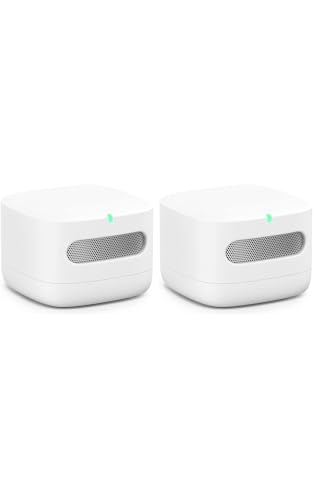
- Tracks PM2.5, VOCs, carbon monoxide, humidity, and temperature.
- Includes app scores, notifications, and color-coded LED feedback.
- Supports Alexa routines for compatible climate devices.
Best For: Alexa households monitoring multiple rooms
Large-Screen Portable Pick
16-in-1 Indoor Air Quality Monitor

- Displays broad air-quality data on an HD color screen.
- Samples readings every 1.5 seconds.
- Rechargeable and portable for home, office, or vehicle use.
Best For: Standalone, wide-range monitoring with portability
Best Alexa Monitor – Amazon Smart Air Quality Monitor
For shoppers comparing smart air quality monitors for large rooms, the Amazon Smart Air Quality Monitor is a straightforward choice for Alexa households. It tracks PM2.5, VOCs, carbon monoxide, humidity, and temperature, then reports the results through a color-coded LED and the Alexa app.
Best For: Alexa users who want alerts and smart-home routines based on indoor air conditions.
Pros:
- Monitors five key indoor air factors, including CO and PM2.5.
- Provides an easy-to-understand air quality score in the Alexa app.
- Can send phone notifications or announcements through Echo devices.
- Supports routines for compatible purifiers, fans, and dehumidifiers.
Cons:
- Requires the Alexa app for detailed readings and setup.
- Does not purify or otherwise treat the air.
This monitor makes the most sense when you already use Alexa and want simple automation rather than extensive historical data or portable operation.
Best Large-Room Purifier – LEVOIT Vital 200S-P
If your priority is improving air—not just measuring it—the LEVOIT Vital 200S-P is a strong option among smart air quality monitors for large rooms. This AHAM VERIFIDE purifier is designed for spaces up to 1,875 square feet and includes an air quality monitor alongside its three-stage filtration system.
Best For: Large living areas, open-concept homes, and pet households needing active particle and odor filtration.
Pros:
- Designed for large rooms up to 1,875 square feet.
- AHAM VERIFIDE CADR ratings provide independently tested performance information.
- Three-stage filtration targets dust, pollen, pet dander, smoke, and odors.
- Quiet operation is rated as low as 27 dB, with a HEPA sleep mode.
Cons:
- It is primarily an air purifier, not a dedicated multi-parameter monitor.
- Its larger 15.6-by-8.5-by-19.8-inch design may require more floor space.
The Vital 200S-P is better suited to shoppers who want sensor-supported purification for a large room than to those seeking detailed air-quality data logging.
Best Data Tracking – BREATHE Airmonitor Plus Gen 2
The BREATHE Airmonitor Plus Gen 2 stands out among smart air quality monitors for large rooms when detailed measurements and trend analysis matter. Its eight-in-one design tracks CO2, three particle sizes, TVOC, formaldehyde, temperature, and humidity, with app alerts, 90-day history, and data export.
Best For: Homeowners, offices, classrooms, or bedrooms where long-term air-quality trends and multiple pollutant readings are useful.
Pros:
- Measures CO2, PM1, PM2.5, PM10, TVOC, formaldehyde, temperature, and humidity.
- Uses NDIR CO2 sensing plus laser particle detection.
- Offers configurable alerts, graphs, 90-day history, and CSV export.
- Provides up to six hours of portable battery use and can run via USB-C.
Cons:
- Requires 2.4 GHz Wi-Fi for app connectivity.
- It monitors air quality but does not clean the air.
Choose this model if you want a deeper view of changing indoor conditions, especially the effects of occupancy, cooking, cleaning products, or ventilation.
Best Smart Purifier Value – LEVOIT Core 400S-P
The LEVOIT Core 400S-P combines large-room air cleaning with basic real-time particle monitoring, making it a practical pick among smart air quality monitors for large rooms. It is designed for spaces up to 1,733 square feet and can automatically adjust fan speed when its laser dust sensor detects changes in PM2.5 levels.
Best For: Large-room users who want app control, voice compatibility, and automatic particle-focused purification.
Pros:
- Designed to refresh rooms up to 1,733 square feet once per hour.
- AHAM VERIFIED with published smoke, dust, and pollen CADR ratings.
- Three-stage filtration targets particles, pollen, dust, pet dander, smoke, and odors.
- Includes Auto Mode, app controls, Alexa and Google Assistant compatibility, and a 24 dB sleep mode.
Cons:
- Its built-in monitoring focuses on PM2.5 rather than gases such as CO2 or VOCs.
- The approximately 20.5-inch height may not suit every placement.
The Core 400S-P is a well-rounded choice for large spaces when hands-free purification and smart controls are more important than broad pollutant measurement.
Most Comprehensive Display – 16-in-1 Large-Display Air Quality Monitor
For shoppers comparing smart air quality monitors for large rooms, this YNAK model stands out for its 7-inch display and broad range of readings. It tracks CO2, particulate matter, HCHO, TVOC, temperature, humidity, AQI, and time, with real-time alerts to make room conditions easy to check at a glance.
Best For: Large living spaces, bedrooms, offices, and users who want many readings on one screen.
Pros:
- Large 7-inch display with three brightness settings
- Monitors CO2, PM1.0, PM2.5, PM10, HCHO, TVOC, temperature, humidity, and AQI
- Seven AQI alert functions with a mute option
- Up to 8 hours of runtime and USB-C charging
Cons:
- Battery runtime is limited to up to 8 hours
- Sensor accuracy can be affected by perfumes and strong odors
This is the most information-rich option of the three, especially for large rooms where a readable display and multiple pollutant measurements are useful. Its portable design and included adapter also allow flexible placement, though it lacks the connected-app ecosystem of the smart models.
Best Connected Sensor – GoveeLife PM2.5 Smart Air Quality Monitor
The GoveeLife H5106 is a practical choice among smart air quality monitors for large rooms when remote tracking and automation matter most. It measures PM2.5, temperature, and humidity, refreshes readings every two seconds, and connects with compatible GoveeLife appliances.
Best For: Connected homes, offices, and users who want app-based monitoring and appliance automation.
Pros:
- Two-second refresh rate for PM2.5, temperature, and humidity
- Remote monitoring through Bluetooth or 2.4GHz Wi-Fi
- Stores 13-day graphs online and supports exporting up to two years of data
- Can trigger compatible GoveeLife purifiers, humidifiers, and heaters
Cons:
- Measures only PM2.5, temperature, and humidity
- Requires a constant power connection and has no built-in battery
- Wi-Fi features require a 2.4GHz network
This monitor is less comprehensive than a multi-sensor air-quality meter, but its app features and Govee automation provide useful ongoing oversight in a large room. Choose it when connected control and historical data are more important than CO2 or VOC readings.
Best for CO Safety – Kidde Smart CO and Indoor Air Quality Alarm
For households prioritizing carbon monoxide protection alongside indoor air insights, the Kidde COPDLQW offers a safety-focused alternative to general smart air quality monitors for large rooms. It sends app notifications, monitors humidity and TVOC, and provides an 85-dB CO alarm with plug-in power and AA battery backup.
Best For: Homes that want connected carbon monoxide protection with additional air-quality and humidity information.
Pros:
- 85-dB audible alarm and real-time Kidde App notifications
- Detects carbon monoxide, including low-level CO alerts from 30–70 ppm
- Plug-in operation with two AA backup batteries for outages
- Compatible with Alexa-enabled devices and Google Home
Cons:
- Focuses on CO, humidity, and TVOC rather than a broad range of particulate readings
- Advanced weekly insights and personalized analyses require an optional subscription
- Designed for a standard 120V outlet
This is the strongest fit when life-safety monitoring is the primary concern. Its app connectivity and backup batteries add reassurance for larger homes, while the optional subscription expands the wellness insights beyond the core alarm functions.
Alexa-Connected Pick – Amazon Smart Air Quality Monitor 2-Pack
For shoppers comparing smart air quality monitors for large rooms, this two-pack is a practical choice when you want coverage in more than one area. It tracks PM2.5, VOCs, carbon monoxide, humidity, and temperature, then surfaces readings and alerts through the Alexa app and compatible Echo devices.
Best For: Alexa households that want to monitor separate rooms and automate compatible purifiers, fans, or dehumidifiers.
Pros:
- Tracks five useful indoor air and comfort factors, including PM2.5 and carbon monoxide.
- Two monitors can help cover different areas of a home.
- Provides color-coded LED feedback, app air-quality scores, and real-time notifications.
- Supports Alexa Routines for compatible climate-control devices.
Cons:
- Its smart features are centered on the Alexa app and compatible Alexa devices.
- The supplied notes do not specify a built-in display for detailed readings on the monitor itself.
This is the strongest fit for connected homes that value alerts and automation over a standalone screen. The included two-monitor format is especially useful for spreading coverage across larger living spaces.
Large-Screen Portable Pick – 16-in-1 Indoor Air Quality Monitor
This 16-in-1 monitor suits shoppers seeking smart air quality monitors for large rooms with readable, real-time information at a glance. Its high-definition color screen displays readings from a broad sensor array, while the compact rechargeable design makes it easy to reposition around the home or office.
Best For: Users who want a broad set of air readings on a standalone screen and occasional portable testing in different spaces.
Pros:
- Measures PM1.0, PM2.5, PM10, TVOC, HCHO, temperature, and humidity among its listed parameters.
- Updates readings every 1.5 seconds for continuous real-time monitoring.
- Large color display and adjustable audio prompt support quick, accessible operation.
- Rechargeable battery, Type-C charging, and included adapter support flexible placement.
Cons:
- Battery runtime is listed at approximately four to five hours per charge.
- The supplied notes do not mention app connectivity or remote phone alerts.
- Its many measurements may be more than needed for shoppers seeking only basic monitoring.
The combination of a wide measurement range and a clear display makes this a versatile option for a large room, office, or shared indoor space. It is better suited to local, hands-on monitoring than app-based automation.
CO2-Focused Display Pick – 10-in-1 Indoor Air Quality Monitor
For large rooms where ventilation is a key concern, this monitor offers a useful mix of CO2, particulate, chemical, temperature, and humidity readings. Its three-color display is designed to make changing conditions visible from a distance, while Bluetooth can be used to calibrate the clock through a phone.
Best For: Home, office, school, or shared-space users who want prominent CO2 and broad air-quality readings without relying on a phone for every check.
Pros:
- Measures CO2, HCHO, TVOC, PM1.0, PM2.5, PM10, temperature, humidity, and AQI.
- Three-color visualization helps signal when readings exceed safety thresholds.
- Uses dedicated CO2 sensing and precision sensors for HCHO and TVOC, according to the supplied notes.
- Offers sound control, screen-sleep, and calibration modes through simple button presses.
Cons:
- The notes specify Bluetooth for clock calibration, not full app-based air-quality monitoring.
- There is no stated battery runtime or charging information in the supplied details.
- Its compact display may require closer viewing for detailed numerical readings.
This model is a sensible choice when CO2 awareness and easy visual status cues matter most. It provides broad coverage for large indoor spaces while remaining portable enough for rooms, vehicles, and other settings.
How We Picked the Best Smart Air Quality Monitors for Large Rooms
We focused on products that provide useful, measurable information for larger living spaces rather than relying only on vague air-quality scores. The selection includes monitors with combinations of CO2, PM2.5, TVOC, carbon monoxide, temperature, and humidity sensors, along with smart alerts, app connectivity, or purifier controls where available.
We also considered practical details such as display readability, portability, power requirements, claimed coverage, and whether a product is best used as an awareness tool, a safety device, or part of an automated air-cleaning setup. Sensor lists vary widely, so buyers should verify exactly which pollutants each model measures.
Quick Comparison
| Best for | Look for | Product types in this roundup |
|---|---|---|
| Whole-room awareness | PM2.5, CO2, TVOC, temperature, and humidity | Multi-parameter indoor monitors |
| Connected air cleaning | Large-room coverage, app control, and automatic fan modes | Smart air purifiers with built-in sensors |
| Carbon monoxide safety | Dedicated alarm, battery backup, and listed safety certifications | Smart CO detectors |
| Simple visual checks | Large screen, clear readings, and high contrast | Display-focused monitors |
Key Buying Factors for Smart Air Quality Monitors for Large Rooms
Measure the Pollutants That Matter
PM2.5 is useful for tracking fine particles from smoke, cooking, and outdoor pollution. CO2 can reveal inadequate ventilation, while TVOC readings may indicate changing chemical compounds from products or furnishings. Temperature and humidity add valuable context. Carbon monoxide requires extra attention: a general air monitor should not replace a dedicated, properly installed CO alarm.
Check Coverage and Placement
A monitor does not clean a room, and a purifier’s stated square-foot rating may assume a particular air-change rate. In a large open-plan space, place the monitor near the breathing zone but away from windows, vents, kitchens, bathrooms, and direct airflow. If rooms are separated by doors, one device may not represent the entire home.
Choose Alerts and Controls You Will Use
App notifications are helpful when you are away, while a bright onboard display is better for quick checks. Alexa or other smart-home compatibility can make readings easier to access and may support routines, but only if the device integrates with the platform you already use. Consider Wi-Fi requirements, subscription features, and whether the product remains useful during an internet outage.
Understand Readings and Maintenance
Look for a clear explanation of thresholds, calibration, and sensor limitations. Keep air inlets unobstructed, clean them as directed, and allow the monitor to acclimate after moving it. Replace batteries or filters on schedule, and avoid treating a single reading as a medical diagnosis.
Who Should Buy Which Smart Air Quality Monitors for Large Rooms?
Choose a multi-parameter monitor if you want a broad picture of ventilation, particles, and indoor conditions without adding an air purifier. Choose a smart purifier if your main goal is reducing airborne particles and you want automatic fan control tied to room readings. Choose a dedicated smart CO detector for life-safety monitoring, especially near sleeping areas, and use other sensors for broader indoor-air context.
For families, prioritize clear displays, dependable alerts, and easy placement. For renters or frequent movers, portable USB-powered models are convenient. For large open spaces, compare both the purifier’s verified coverage and the monitor’s placement options rather than assuming one device can accurately represent every zone.