Indoor air can change quickly due to cooking, cleaning, poor ventilation, combustion, and seasonal humidity. The best smart air quality monitors make those changes easier to see, interpret, and act on.
We compared these 10 models by sensor coverage, connectivity, alerts, display design, power options, and practical home-monitoring features.
Best 10 Smart Air Quality Monitors Picks for 2026
Best Alexa Pick
Amazon Smart Air Quality Monitor

- Measures PM2.5, VOCs, CO, humidity, and temperature
- Shows scores and alerts in the Alexa app
- Automates compatible Alexa climate devices
Best For: Alexa-connected homes needing practical alerts and routines
Best Battery-Powered Radon Monitor

- Continuously measures radon and five other factors
- Runs on two AA batteries for cable-free placement
- Uses color indicators and Bluetooth app insights
Best For: Long-term radon monitoring without a power cable
Best Display and Data Tools
GoveeLife H5106 Air Quality Monitor

- Refreshes PM2.5, temperature, and humidity every two seconds
- Includes a switchable clock and PM2.5 LED display
- Stores and exports up to two years of data
Best For: Room or office monitoring with visible readings and data history
Best Full-Featured Wi-Fi Monitor

- Measures radon, PM2.5, CO2, VOCs, and more
- Provides Wi-Fi remote monitoring and notifications
- Combines batteries with a customizable eInk screen
Best For: Comprehensive whole-home air tracking with remote access
Best for Simple Connected Monitoring

- Tracks CO levels, PM2.5, temperature, and humidity
- Provides practical air-quality suggestions
- Connects via Amazon Sidewalk without a base station
Best For: Ring users seeking basic connected monitoring
Best for Whole-Home IAQ Insights
AprilAire Smart 5-in-1 Monitor
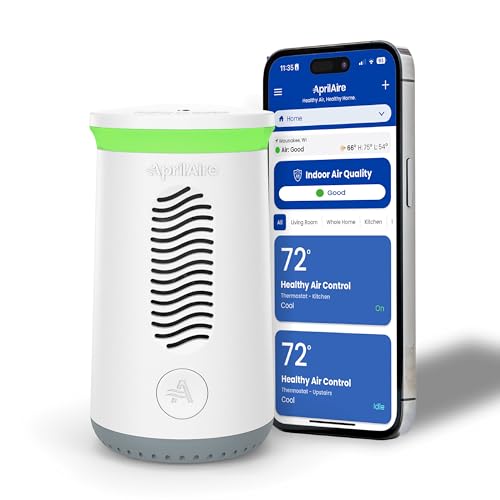
- Measures CO2, VOCs, PM2.5, humidity, and temperature
- Adds app trends, explanations, and smart alerts
- Can integrate with compatible AprilAire systems
Best For: Homeowners wanting guided app-based IAQ tracking
Best for Detailed Data Tracking

- Tracks eight indoor air and comfort measurements
- Offers 90-day history and CSV data export
- Adds alerts, portable battery use, and USB-C operation
Best For: Users needing detailed, reviewable IAQ data
Best Portable CO2 Monitor

- Monitors CO2, temperature, and humidity
- Runs over six months per full charge
- Bluetooth app access and data export
Best For: Portable CO2 monitoring and long battery life
Best Matter-Compatible Monitor
SONOFF SAWF-07P Air Quality Monitor

- Measures PM2.5, PM10, temperature, and humidity
- Works with Matter-compatible smart-home platforms
- Offers customizable sound, LED, and app alerts
Best For: Connected homes needing particulate alerts
Best Feature-Rich Display

- Tracks seven indoor air and comfort metrics
- Features a 4-inch high-resolution touchscreen
- Offers Wi-Fi monitoring and a replaceable PM sensor
Best For: Detailed, powered indoor air-quality monitoring
Best Alexa Pick – Amazon Smart Air Quality Monitor
For shoppers seeking smart air quality monitors with straightforward app control, this Amazon model tracks PM2.5, VOCs, carbon monoxide, humidity, and temperature. Its color-coded indicator, Alexa notifications, and compatible-device routines make it especially practical for connected homes.
Best For: Alexa users who want alerts and automations for air purifiers, fans, dehumidifiers, or compatible climate devices.
Pros:
- Tracks five key indoor air factors, including PM2.5, VOCs, and carbon monoxide.
- Provides an easy-to-understand air quality score in the Alexa app.
- Can announce poor air quality and trigger compatible Alexa routines.
- Simple plug-in setup through the Alexa app.
Cons:
- Requires a power outlet rather than offering battery-powered placement.
- Its strongest automation features are tied to the Alexa ecosystem.
This is a well-rounded choice for households already using Echo devices or other Alexa-compatible products. Choose it when convenient alerts and smart-home automation matter more than radon monitoring or a dedicated display.
Best Battery-Powered Radon Monitor – Airthings Wave Plus
The Airthings Wave Plus stands out among smart air quality monitors for continuous radon measurement alongside CO2, VOCs, humidity, temperature, and air pressure readings. It runs on two AA batteries and offers a quick color-coded status check or more detailed Bluetooth app insights.
Best For: Homeowners prioritizing long-term radon monitoring with flexible, cable-free placement.
Pros:
- Continuously measures radon, with long-term tracking designed for fluctuating levels.
- Monitors six indoor air factors, including CO2, VOCs, and air pressure.
- Battery-powered design offers placement flexibility, with an average battery life of 1.5 years.
- Color-coded visual feedback provides a quick reading before opening the app.
Cons:
- Detailed readings require a Bluetooth connection to the Airthings app.
- It does not include an always-on built-in digital display.
Wave Plus is a focused option for buyers who want radon data without running a power cable. Its broad sensor lineup adds useful context, though shoppers wanting remote Wi-Fi monitoring or a visible screen may prefer another model.
Best Display and Data Tools – GoveeLife H5106 Air Quality Monitor
For shoppers comparing smart air quality monitors with an at-a-glance screen, the wired GoveeLife H5106 displays PM2.5, temperature, and humidity. It refreshes readings every two seconds and adds Wi-Fi or Bluetooth remote monitoring, historical graphs, and data export.
Best For: Users who want a visible display, fast updates, and long-term data tracking for a room or office.
Pros:
- Refreshes PM2.5, temperature, and humidity data every two seconds.
- Switches between clock and PM2.5 displays and includes bright and night modes.
- Supports remote viewing, 13-day online graphs, and exporting up to two years of data.
- Can automate compatible GoveeLife purifiers, humidifiers, and fans.
Cons:
- Requires continuous power through a Type-C cable and has no built-in battery.
- Wi-Fi features require a 2.4GHz network.
- Measures three categories and does not include radon, VOC, or carbon monoxide sensing.
The H5106 is a practical pick when quick PM2.5 updates and a physical display are priorities. Its Govee ecosystem connections are useful, but buyers seeking broader pollutant coverage should consider a more comprehensive monitor.
Best Full-Featured Wi-Fi Monitor – Airthings View Plus
The Airthings View Plus is one of the more comprehensive smart air quality monitors in this group, measuring radon, PM2.5, CO2, VOCs, humidity, temperature, and air pressure. Its Wi-Fi connection, eInk screen, cloud history, and app notifications support ongoing monitoring from home or away.
Best For: Households wanting broad pollutant coverage, remote notifications, and a cable-free monitor with an eInk display.
Pros:
- Measures seven indoor air factors, including radon, PM2.5, CO2, and VOCs.
- Wi-Fi enables live remote monitoring, cloud tracking, and timely notifications.
- Battery-powered design supports flexible placement, with an average battery life of two years.
- Customizable eInk screen provides on-device information without relying only on the app.
Cons:
- The monitor and app require internet access to function as described.
- An Airthings account is required for use.
- Setup and ongoing insights depend on the Airthings app.
View Plus is a strong all-around choice for buyers who want the widest sensor coverage and remote access in a single unit. It costs some convenience in account and internet requirements, but the combination of radon detection, Wi-Fi, history, and an eInk display is compelling.
Best for Simple Connected Monitoring – Ring Air Quality Monitor
The Ring Air Quality Monitor is a straightforward option for shoppers comparing smart air quality monitors. It tracks temperature, humidity, carbon monoxide levels, and PM2.5, then provides suggestions such as opening a window or running a purifier. It connects through Amazon Sidewalk without requiring a base station.
Best For: Ring households that want basic connected monitoring and practical air-quality suggestions.
Pros:
- Tracks temperature, humidity, CO levels, and PM2.5.
- Offers actionable prompts for ventilation, purification, or appliance service.
- Does not require a separate base station.
Cons:
- Requires Amazon Sidewalk, and coverage may vary.
- It does not measure CO2 or radon.
- It is not a certified carbon monoxide alarm and has no speaker or microphone for audible alerts.
This monitor makes sense when convenient connected readings matter more than a broad sensor lineup. Keep a certified carbon monoxide alarm installed separately for safety.
Best for Whole-Home IAQ Insights – AprilAire Smart 5-in-1 Monitor
AprilAire’s monitor is a strong choice among smart air quality monitors for households that want broad indoor-air tracking through an app. It measures CO2, VOCs, TVOC, PM2.5, humidity, and temperature, while its color status system, trends, and notifications help explain when conditions need attention.
Best For: Homeowners who want app-based IAQ trends and may use AprilAire ventilation or filtration equipment.
Pros:
- Measures CO2, VOCs, TVOC, PM2.5, humidity, and temperature.
- Provides trends, explanations, expert tips, and actionable alerts in the Healthy Air App.
- Offers three indicator-light settings and optional integration with compatible AprilAire systems.
Cons:
- Requires the AprilAire Healthy Air App to function.
- Integration with AprilAire ventilation or filtration solutions requires a compatible thermostat sold separately.
- It is corded electric rather than battery-powered.
This is a well-rounded pick for users who want measurements paired with guidance rather than raw numbers alone. Its broader ecosystem benefits are most relevant to existing or planned AprilAire installations.
Best for Detailed Data Tracking – BREATHE Airmonitor Plus Gen 2
The BREATHE Airmonitor Plus Gen 2 stands out among smart air quality monitors for its detailed sensor coverage and historical data tools. It measures CO2, PM1, PM2.5, PM10, TVOC, formaldehyde, temperature, and humidity, with app alerts, up to 90 days of history, and CSV export.
Best For: Users who want portable monitoring, detailed pollutant readings, and data they can review or export.
Pros:
- Provides eight measurements, including CO2, three particle sizes, TVOC, and formaldehyde.
- Stores up to 90 days of app history and supports data export.
- Offers configurable alerts, a color display, USB-C operation, and up to six hours of battery use.
Cons:
- App connectivity uses 2.4 GHz Wi-Fi.
- Portable battery operation lasts up to six hours.
- Some features require app pairing and CO2 calibration.
This is the most data-focused option in the group, particularly useful for investigating how cooking, cleaning, occupancy, or ventilation affect indoor readings. Its rechargeable design also makes room-to-room or temporary monitoring practical.
Best Portable CO2 Monitor – INKBIRD IAM-T2
For shoppers comparing smart air quality monitors, the INKBIRD IAM-T2 focuses on portable carbon dioxide tracking with temperature and humidity readings. Its backlit display, Bluetooth app connection, and long battery life make it practical for checking conditions around the home or office without keeping it plugged in.
Best For: Portable CO2 monitoring and extended battery-powered use.
Pros:
- Tracks CO2, temperature, and humidity in real time.
- Built-in 3000 mAh battery can run for more than six months after a full charge.
- Bluetooth 5.0 supports app access within an unobstructed range of up to 100 meters.
- Stores 30 days of offline data, with up to one year of app data storage and export.
Cons:
- Measures fewer air-quality metrics than monitors that also detect particulate matter or VOCs.
- App connectivity depends on Bluetooth range and an unobstructed connection.
The IAM-T2 is a straightforward choice when CO2 is your main concern. Its rechargeable design and dual sound-and-color alerts are particularly useful for rooms where you want quick, portable readings.
Best Matter-Compatible Monitor – SONOFF SAWF-07P Air Quality Monitor
The SONOFF SAWF-07P is one of the more smart-home-focused smart air quality monitors, combining PM2.5, PM10, temperature, and humidity readings on a 3.73-inch display. Matter compatibility and Wi-Fi connectivity make it a strong fit for users who want alerts and air-quality data integrated with a broader home automation setup.
Best For: Smart-home users who want particulate monitoring and automated notifications.
Pros:
- Displays PM2.5, PM10, temperature, and humidity together.
- Supports Matter ecosystems including Apple Home, Alexa, Google Home, SmartThings, and Home Assistant.
- Provides updates every two seconds with continuous power.
- Offers sound, LED, and app notifications with customizable thresholds.
Cons:
- Requires continuous power for its stated frequent data updates.
- Uses 2.4GHz Wi-Fi, which may not suit every network setup.
Choose the SAWF-07P if smart-home compatibility matters as much as the readings themselves. Its clear display, customizable alerts, and 12 months of historical charts make it useful for bedrooms, offices, and nurseries.
Best Feature-Rich Display – Qingping Air Monitor Gen 2
The Qingping Air Monitor Gen 2 stands out among smart air quality monitors with seven tracked metrics, including CO2, PM2.5, PM10, eTVOC, noise, temperature, and humidity. Its high-resolution touchscreen, Wi-Fi app support, and replaceable particulate sensor make it a versatile option for detailed indoor monitoring.
Best For: Users who want broad air-quality coverage and an information-rich touchscreen display.
Pros:
- Monitors seven metrics, including CO2, particulates, eTVOC, and noise.
- 4-inch IPS touchscreen shows readings, date, and time with adjustable brightness.
- Supports remote monitoring over 2.4GHz or 5GHz Wi-Fi through the Qingping+ app.
- Replaceable PM sensor simplifies future maintenance.
Cons:
- It does not measure formaldehyde.
- Daily use should remain connected to USB power; battery operation lasts up to three hours.
- USB power adapter is not included.
The Qingping Gen 2 is a good match for buyers who want more than basic temperature and CO2 readings. Its broad metric coverage and replaceable PM sensor add flexibility, but the limited battery runtime makes it better suited to a powered location.
How We Picked These Smart Air Quality Monitors
We focused on monitors that measure more than a single comfort metric and provide useful feedback through an app, display, notifications, or connected-home platform. The lineup includes models with different strengths: radon detection, carbon dioxide tracking, particulate monitoring, VOC measurement, portability, and broad smart-home compatibility.
We also considered setup requirements, power sources, data accessibility, alert options, and whether the device is better suited to a bedroom, nursery, office, kitchen, or whole-home monitoring strategy. No monitor replaces a certified smoke, fire, or carbon-monoxide alarm where those are required.
Quick Comparison
| Priority | Look for | Best fit |
|---|---|---|
| Broad smart-home integration | Wi-Fi, app alerts, and ecosystem compatibility | Connected households |
| Radon awareness | Dedicated radon sensing and trend reporting | Basements and long-term monitoring |
| Ventilation feedback | Accurate CO2 measurement | Bedrooms, offices, and classrooms |
| Particle tracking | PM2.5 and, ideally, PM10 measurement | Homes affected by smoke, dust, or cooking |
| Simple local viewing | Always-on screen with readable measurements | Quick checks without opening an app |
Key Buying Factors for Smart Air Quality Monitors
Sensor Coverage
Choose measurements based on the risk or problem you want to understand. CO2 is mainly a ventilation indicator, while PM2.5 can reveal smoke, cooking particles, and fine dust. VOC readings can help identify changes from household products, though they are typically broad indicators rather than identification of one specific chemical. Humidity and temperature add useful context, and radon sensing matters most when long-term exposure is a concern.
Alerts and Connectivity
App notifications are useful when you cannot watch the display, but check whether the monitor requires Wi-Fi, Bluetooth, a hub, or a particular smart-home ecosystem. Also look for adjustable thresholds, historical graphs, and export or sharing options if you want to compare rooms or evaluate an air purifier.
Placement and Power
Place the unit in a representative breathing zone, away from windows, vents, stoves, bathrooms, and direct sunlight. Battery models are easier to move but may sacrifice continuous display or frequent updates. Wired monitors are convenient for permanent placement and often better for an always-visible screen.
Who Should Buy Which Smart Air Quality Monitors?
Choose a broad, app-connected monitor if you want one device to track several indoor conditions and deliver actionable alerts. A radon-focused Airthings model is the stronger choice for basements, lower levels, or buyers prioritizing long-term radon trends. Pick a CO2-capable model for bedrooms, home offices, and shared spaces where stale air or poor ventilation is the main concern.
If smoke, dust, or cooking particles are your primary concern, prioritize PM2.5 and PM10 coverage with a clear display or fast notifications. Buyers who prefer simple local readings should choose a screen-equipped model, while smart-home users should verify ecosystem compatibility before purchasing. For larger homes, consider multiple monitors rather than assuming one device represents every room.