Finding the right amp for a small venue means balancing usable volume, portability, tone, and practical features. A compact combo can deliver enough projection for a café, club, rehearsal room, or intimate stage without the bulk of a full-size rig.
This roundup compares 10 options for electric, acoustic, and busking setups, including flexible modeling amps, straightforward analog combos, and feature-rich acoustic amplifiers.
Best 10 Guitar Amplifiers for Small Venues Picks for 2026
Versatile Stage Pick

- 50 watts with a custom 12-inch speaker
- 12 amp characters and five effects sections
- USB and BOSS Tone Studio connectivity
Best For: Players wanting flexible tones for practice and small-venue performances
High-Headroom Choice

- 100 watts with a Celestion 12-inch speaker
- Independent clean and dirty channels
- Balanced XLR output with CabSim
Best For: Players seeking powerful analogue-style tones for live use
Acoustic Singer Solution
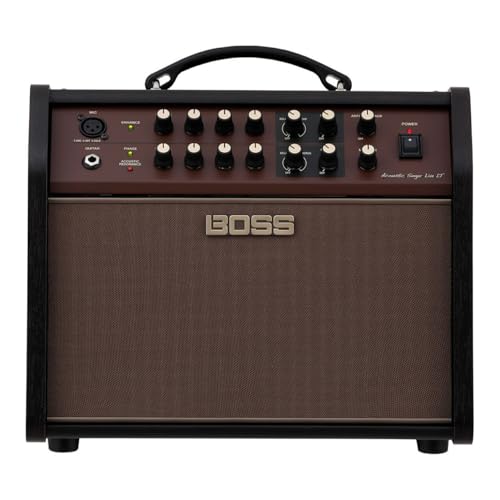
- 60-watt bi-amp design for guitar and vocals
- Separate channels with independent 3-band EQ
- XLR DI, aux, effects, and feedback controls
Best For: Acoustic singer-songwriters and small live performances
Compact Feature Pick

- 30 watts with a custom 10-inch speaker
- Four channels from clean to overdrive
- Built-in effects and headphone output
Best For: Players needing a compact amp for practice and intimate venues
Portable Warmth

- Rechargeable and easy to carry
- Warm VOX-style analog tone
- Built-in overdrive and headphone connection
Best For: Portable practice and intimate small-room performances
High-Gain Value

- Two channels with high-gain preamp
- Three-band EQ for tone shaping
- Aux input and headphone output
Best For: Rehearsals and small-room electric guitar performance
Acoustic Two-Channel Choice

- 60-watt two-channel design
- Mic, aux, Bluetooth, and D.I. connectivity
- Reverb and chorus onboard
Best For: Acoustic performers and singer-guitarists in small venues
Best Compact Fender

- 25 watts with an 8-inch speaker
- Built-in modulation, delay, and reverb effects
- USB, aux, and headphone connectivity
Best For: Rehearsals, home practice, and smaller amplified gigs
Best High-Power Feature Set

- 300 watts total rated stage power
- Four inputs for microphones and instruments
- Bluetooth, USB, effects, and recording features
Best For: Busking and compact multi-input live setups
Best Beginner Modeling Amp

- 25 watts with an 8-inch speaker
- 30 built-in presets for varied tones
- Color display, USB, and headphone output
Best For: Beginners, practice, and intimate rehearsal spaces
Versatile Stage Pick – BOSS Katana-50 Gen 3
The BOSS Katana-50 Gen 3 is a flexible choice among guitar amplifiers for small venues, combining 50 watts of output with a custom 12-inch speaker. Its range of amp characters, onboard effects, and updated Tube Logic response make it suitable for players who want one combo to cover practice and live performance.
Best For: Guitarists who need versatile tones and stage-ready volume in a single 50-watt combo.
Pros:
- 50-watt output and custom 12-inch speaker deliver powerful, clear sound.
- Twelve amp voicing options include the expressive Pushed character.
- Five independent effects sections provide broad tone-shaping control.
- USB connectivity and the BOSS Tone Studio app support remote editing.
Cons:
- It is a corded combo, so it is not designed for battery-powered setups.
- Its broad feature set may be more than players seeking a simple amp need.
For small venues, the Katana-50 Gen 3 offers a useful balance of power, speaker size, tonal variety, and connectivity. It is especially compelling when one amplifier needs to cover multiple sounds without relying entirely on external pedals.
High-Headroom Choice – Orange Super Crush Combo 100
The Orange Super Crush Combo is a powerful option among guitar amplifiers for small venues, with 100 watts of solid-state output and a Celestion G12H-150 12-inch speaker. Its two independent all-analogue channels provide distinct clean and dirty voices, while the XLR output adds practical utility for live setups.
Best For: Electric guitarists who prioritize high output, analogue-style tones, and separate clean and dirty channels.
Pros:
- 100-watt output provides substantial volume for live applications.
- Independent clean and dirty channels cover contrasting tonal styles.
- Dirty channel includes four cascading gain stages and a passive 3-band EQ.
- Balanced XLR output includes CabSim speaker emulation.
Cons:
- At 49 pounds, it is comparatively heavy to transport.
- It has fewer built-in effects than some more feature-focused combos.
The Super Crush Combo suits players who want straightforward channel-based control and plenty of output. Its larger cabinet and weight are tradeoffs, but the 12-inch Celestion speaker, analogue preamp design, and XLR output make it a serious small-venue option.
Acoustic Singer Solution – BOSS Acoustic Singer Live LT
The BOSS Acoustic Singer Live LT is designed for acoustic performers who need both instrument and vocal support. Its 60-watt bi-amp design, separate guitar and microphone channels, and feedback-control features make it a practical choice among guitar amplifiers for small venues where one compact system must handle a complete performance.
Best For: Singer-songwriters using an acoustic guitar and vocal microphone in intimate live settings.
Pros:
- Dedicated guitar and mic channels have independent 3-band EQ controls.
- Acoustic Resonance helps restore natural tone from piezo-equipped stage guitars.
- Separate guitar, microphone, and reverb effects support complete performance setups.
- XLR DI, aux input, and phones/recording output add connection flexibility.
Cons:
- The 6.5-inch woofer is smaller than the speakers in many electric-guitar combos.
- Its feature set is specialized for acoustic guitar and vocals rather than electric guitar tones.
For acoustic duos, solo performers, and singer-songwriters, the Acoustic Singer Live LT is more than a conventional guitar amp. The two-channel layout, tilt-back cabinet, notch filter, and phase switch address the practical needs of small live performances.
Compact Feature Pick – Marshall MG30GFX
The Marshall MG30GFX is a compact 30-watt combo suited to rehearsals, intimate settings, and players who value built-in sound-shaping tools. As one of the more compact guitar amplifiers for small venues, it combines four channels, a 10-inch custom speaker, digital effects, and headphone and line-input connections.
Best For: Guitarists who want familiar Marshall-style voicings, onboard effects, and practice-friendly connections.
Pros:
- Four channels range from clean and crunch to two overdrive settings.
- Built-in chorus, phaser, flanger, delay, and octave effects expand tonal options.
- 30 watts and a custom 10-inch speaker suit compact setups.
- Headphone output and MP3/line input support quiet practice and play-along sessions.
Cons:
- Its 30-watt output and 10-inch speaker provide less power and projection than larger options.
- It does not list an XLR output for direct connection to a venue system.
The MG30GFX is a practical choice when portability and built-in features matter more than maximum headroom. Its four-channel layout and headphone functionality make it useful for home practice and smaller performance spaces, while the effects provide plenty of flexibility without requiring a large pedalboard.
Portable Warmth – Vox MSB25 Mini Superbeetle
For guitar amplifiers for small venues, the Vox MSB25 Mini Superbeetle offers a compact setup with warm, classic VOX-inspired tones. Its volume, tone, gain, and built-in overdrive controls provide useful flexibility for practice and intimate performances.
Best For: Players who want portable, warm-sounding amplification for small rooms, rehearsals, and on-the-go use.
Pros:
- Compact, portable design with a rechargeable battery
- Analog circuit delivers a warm and rich VOX-style sound
- Built-in overdrive supports gritty rock and blues tones
- 3.5mm connectivity supports guitar and headphone sessions
Cons:
- Its compact format may not suit larger venues
- Listed specifications include differing wattage details, so buyers should verify the exact configuration
The MSB25 is a practical choice when portability matters as much as tone. It is especially appealing for musicians who need a flexible small-room amp that can also support private practice.
High-Gain Value – Orange Crush 20
The Orange Crush 20 is a straightforward option among guitar amplifiers for small venues, pairing a 20-watt solid-state design with an 8-inch speaker and two channels. Its high-gain preamp, three-band EQ, auxiliary input, and cab-sim-loaded headphone output cover practice and compact performance needs.
Best For: Electric guitarists seeking accessible high-gain tones and practical connections for rehearsals or small rooms.
Pros:
- Two-channel layout with a high-gain preamp
- Three-band EQ allows useful tone shaping
- Aux input and cab-sim-loaded headphone output support practice
- Compact 20-watt combo format
Cons:
- Its 8-inch speaker and 20-watt output may be limited for larger spaces
- Corded operation is less flexible than a battery-powered design
With its familiar Orange styling and focused feature set, the Crush 20 makes sense for players who prioritize channel flexibility and high-gain sounds over extensive onboard effects.
Acoustic Two-Channel Choice – Fishman Loudbox Mini BT
The Fishman Loudbox Mini BT is designed for players who need more than basic guitar amplification in a small venue. Its 60-watt, two-channel solid-state design includes reverb, chorus, Bluetooth connectivity, microphone and auxiliary inputs, plus a D.I. output.
Best For: Acoustic guitarists, singer-guitarists, and performers who need vocal, playback, and direct-output flexibility.
Pros:
- Two channels support guitar and microphone use
- Reverb and chorus provide onboard effects
- Bluetooth and auxiliary inputs support playback
- D.I. output is useful for connecting to a larger sound system
Cons:
- Heavier than the other listed options at about 21.2 to 24.3 pounds
- Its 6.5-inch speaker is less suited to large venues without external reinforcement
The Loudbox Mini BT is the most versatile choice here for acoustic-focused performances. Its two-channel layout and D.I. output make it particularly practical when a small-venue setup includes vocals or backing tracks.
Best Compact Fender – Champion II 25
The Fender Champion II 25 is a compact option for guitarists comparing guitar amplifiers for small venues, rehearsals, and home use. Its 25-watt solid-state design, 8-inch speaker, and built-in effects provide a practical mix of volume and tone-shaping flexibility.
Best For: Bedroom players, rehearsals, and smaller gigs where a lightweight combo with built-in effects is useful.
Pros:
- 25 watts with an 8-inch Fender Special Design speaker
- Built-in reverb, delay/echo, chorus, tremolo, and other effects
- Auxiliary input, headphone output, and rear-panel USB port
- Includes a two-year limited warranty
Cons:
- Single-channel design offers less channel flexibility
- Its 8-inch speaker may be limiting for larger venues
The Champion II 25 is a sensible pick when portability, straightforward controls, and built-in effects matter more than high-output stage projection. For larger spaces, you may need sound reinforcement.
Best High-Power Feature Set – Coolmusic BP60D Plus
The Coolmusic BP60D Plus stands out among guitar amplifiers for small venues when you need substantial rated power and multiple inputs. Its four channels, separate EQ controls, effects, and wedge-style cabinet make it suited to performers handling both instruments and microphones.
Best For: Busking, small live performances, acoustic acts, and setups requiring multiple microphones or instruments.
Pros:
- 300 watts total rated stage power across two independent channels
- Four independent inputs with microphone and instrument mode switches
- Three-band EQ and built-in chorus, delay, phaser, tremolo, reverb, and flanger
- Bluetooth, USB playback, line out, stereo link, and recording connections
Cons:
- Its extensive feature set may be more than a solo guitarist needs
- The 11.5 kg weight is less portable than a small practice combo
The BP60D Plus is a versatile all-in-one performance system rather than a minimal guitar combo. Its connectivity and output are particularly useful when one unit must support vocals, instruments, playback, and recording.
Best Beginner Modeling Amp – Fender Mustang LT25
The Fender Mustang LT25 is an approachable choice for guitarists seeking guitar amplifiers for small venues, practice, and rehearsals. It combines 25 watts with an 8-inch speaker, a simple color display, and 30 presets covering a broad range of sounds.
Best For: Beginners and players who want easy access to varied amp tones in a compact modeling combo.
Pros:
- 25 watts paired with an 8-inch Fender Special Design speaker
- 30 preloaded presets cover a wide range of music
- Simple interface with a 1.8-inch color display
- USB and headphone output support practice and connectivity
Cons:
- Its 8-inch speaker is better suited to smaller spaces than large venues
- Single-channel output provides less live-rig flexibility
The Mustang LT25 is a practical entry point for experimenting with different tones without assembling separate pedals and equipment. It works well in intimate settings, while larger performances may require additional amplification or reinforcement.
How We Picked These Guitar Amplifiers for Small Venues
We focused on amps that suit intimate live settings rather than simply choosing the highest wattage. The selection considers power, speaker size, portability, tone-shaping controls, onboard effects, connectivity, and the needs of different players. Electric guitarists will find modeling and traditional solid-state options, while acoustic performers and buskers get dedicated choices with vocal or instrument-friendly features.
Because venue size, instrument output, and drummer volume vary, wattage is treated as one factor—not a guarantee of loudness or headroom. We also considered whether each amp offers practical value for rehearsals, recording, practice, or occasional gigs.
Quick Comparison
| Best For | What to Look For |
|---|---|
| Versatile electric guitar setups | Modeling, presets, effects, and flexible outputs |
| Clean acoustic performances | Dedicated acoustic voicing, feedback control, and balanced inputs |
| Rock and louder small stages | Higher wattage, speaker efficiency, and clean headroom |
| Busking and mobile gigs | Battery operation, multiple channels, and easy transport |
| Practice-to-stage use | Aux input, USB, headphone output, and manageable size |
Key Buying Factors for Guitar Amplifiers for Small Venues
Power and Headroom
A 20- to 30-watt combo can work well for quiet rooms, rehearsals, and mic’d performances. More powerful amps provide extra clean headroom and are better suited to unmic’d gigs or loud bands. Acoustic amps may use different power designs, so compare real-world features and output rather than wattage alone.
Speaker Size and Projection
Larger speakers often produce fuller low end and stronger projection, while smaller speakers can keep the amp compact and focused. A 10- or 12-inch speaker is a common compromise for live electric guitar; smaller speakers may still work well when the venue provides PA support.
Tone and Effects
Modeling amps provide multiple amp voices and effects in one package, which is useful for players covering varied styles. Traditional combos may offer a simpler signal path and faster setup. For acoustic players, prioritize natural voicing, independent channels, reverb, and feedback-resistant design.
Connectivity and Portability
Check for line or balanced outputs if you expect to connect to a PA, plus headphone, USB, Bluetooth, or auxiliary inputs for practice and playback. Weight, handle design, and battery capability matter when carrying gear to small venues or outdoor performances.
Who Should Buy Which Guitar Amplifiers for Small Venues?
Choose a modeling-focused combo if you need several tones and effects without additional pedals. Pick a straightforward solid-state amp if reliability, simple controls, and quick setup matter most. Acoustic singer-guitarists should prioritize dedicated acoustic channels and vocal support, while buskers will benefit from battery power and multiple inputs. If you regularly play with a loud drummer or need unmic’d projection, favor higher power and additional headroom. For occasional gigs and home practice, a compact amp with recording and headphone features may offer the best overall value.