The right charger can reduce downtime, protect rechargeable cells, and make everyday devices easier to keep powered. This roundup compares 10 options spanning compact AA/AAA chargers, high-capacity multi-bay models, and versatile Li-ion chargers.
Use the comparison and buying advice below to match charging speed, battery compatibility, slot count, and safety features to the way you actually use rechargeable batteries.
Best 10 Rechargeable Battery Chargers for Fast Charging Picks for 2026
Best Multi-Chemistry Pick

- Charges compatible Li-ion and Ni-MH cells
- LCD monitoring with diagnostic modes
- Includes 18W QC 3.0 adapter
Best For: Mixed battery types and advanced battery monitoring
Best Complete AA/AAA Kit
Energizer Recharge Pro Charger

- Charges two or four AA/AAA cells
- Includes four rechargeable AA batteries
- Provides alerts and bad-battery detection
Best For: Everyday AA/AAA charging with batteries included
Best Simple Household Charger

- Charges four AA or four AAA cells
- Includes four pre-charged AA batteries
- Foldable plug aids storage
Best For: Simple household AA/AAA battery charging
Best High-Capacity AA/AAA Charger

- Charges up to eight AA/AAA cells
- Individual bay control and LED status
- Supports NiMH and NiCd batteries
Best For: Charging large batches of AA/AAA cells
Best Fast USB-C Pick

- Charges AA/AAA cells in about 1.5 hours
- Supports Ni-MH and 1.5V lithium batteries
- LCD monitoring and recovery mode
Best For: Fast USB-C charging with mixed battery compatibility
Best High-Capacity Option

- Charges up to 16 batteries independently
- Mixes AA and AAA NiMH cells
- LED status and multiple safety protections
Best For: High-volume NiMH battery charging
Best Smart 8-Bay Charger

- Charges up to eight Ni-MH/Ni-CD cells
- USB-C fast-charging input
- Repair mode for over-discharged batteries
Best For: Smart charging and recovery for Ni-MH/Ni-CD batteries
Best with Extra Features
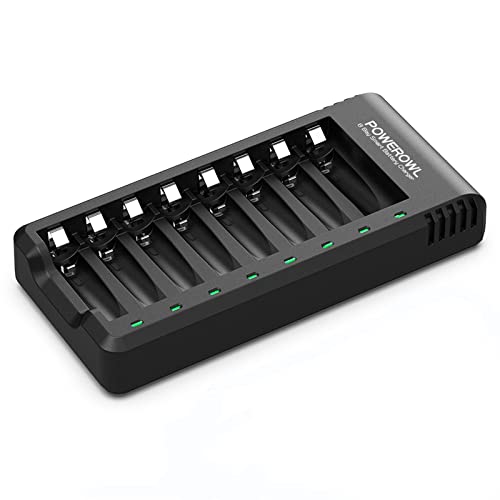
- Eight independent slots for flexible batch charging
- USB-powered design with automatic shutoff
- For NiMH/NiCD AA and AAA batteries only
Best For: Charging multiple AA or AAA batteries at once
Best Fast-Charging Travel Pick

- Charges two AA cells in about 3.5 hours
- Foldable plug and slim profile for travel
- Individual slots with LED and overcharge protection
Best For: Portable NiMH AA/AAA charging
Best Universal Battery Pick

- Supports many Li-ion and NiMH/NiCd battery sizes
- Up to 1000mA Li-ion charging current
- USB-C input with multiple safety protections
Best For: Mixed-format rechargeable battery users
Best Multi-Chemistry Pick – XTAR VC4SL 3A Fast Charger
For shoppers seeking rechargeable battery chargers for fast charging across multiple battery types, the XTAR VC4SL is a versatile four-bay option. It supports compatible Li-ion and Ni-MH cells, charges bays independently, and includes an 18W QC 3.0 adapter.
Best For: Users who need one charger for Li-ion cylindrical batteries and AA/AAA cells, along with battery testing and storage features.
Pros:
- Charges compatible Li-ion and Ni-MH batteries at the same time.
- LCD displays charging current, voltage, capacity, resistance, and battery type.
- Offers selectable currents up to 3A plus grade, storage, and resistance-measurement modes.
- Includes a USB-C cable, QC 3.0 wall adapter, and 24-month product assurance.
Cons:
- Batteries are not included.
- Its advanced controls may be more than casual AA/AAA users need.
The VC4SL stands out when charging flexibility and battery diagnostics matter as much as speed. Its broad compatibility and independent bays make it a strong choice for mixed-cell households.
Best Complete AA/AAA Kit – Energizer Recharge Pro Charger
The Energizer Recharge Pro is a practical choice among rechargeable battery chargers for fast charging if you primarily use AA or AAA NiMH batteries. It charges two or four cells in about four hours and includes four rechargeable AA batteries.
Best For: Households wanting a straightforward AA/AAA charger with included batteries and clear charging alerts.
Pros:
- Charges two or four AA or AAA batteries in approximately four hours.
- Includes four Energizer rechargeable AA batteries.
- LED indicators and audible alerts show charging progress and completion.
- Bad-battery detection, auto shutoff, and overcharge protection add convenience.
Cons:
- Limited to AA and AAA NiMH batteries.
- It does not offer the multi-cell compatibility or analysis features of more advanced chargers.
With batteries included and simple status feedback, the Recharge Pro is an easy starting point for everyday devices such as household electronics, cameras, and other AA/AAA-powered equipment.
Best Simple Household Charger – Duracell Ion Speed 1000
The Duracell Ion Speed 1000 keeps rechargeable battery charging simple. It handles four AA or four AAA NiMH batteries at a time, includes four pre-charged AA batteries, and uses a foldable wall plug for easier storage.
Best For: Users who want a compact, uncomplicated charger for standard household AA and AAA batteries.
Pros:
- Charges four AA or four AAA rechargeable batteries at once.
- Includes four pre-charged Duracell AA batteries.
- Foldable wall plug helps with storage and portability.
- Can recharge compatible rechargeable AA and AAA batteries from other brands.
Cons:
- Listed charge time is six hours, so it is slower than some fast-charging options.
- Designed for AA and AAA NiMH batteries rather than Li-ion cells.
This Duracell kit is best viewed as a basic, space-conscious solution rather than a feature-rich fast charger. It suits users who value simplicity and an included set of ready-to-use batteries.
Best High-Capacity AA/AAA Charger – EBL 8-Bay Individual Charger
The EBL 8-bay charger is useful when you need rechargeable battery chargers for fast charging several AA or AAA cells at once. Its independently controlled bays accept one to eight compatible NiMH or NiCd batteries and provide LED charging feedback.
Best For: Families, offices, and hobbyists charging larger batches of AA and AAA rechargeable batteries.
Pros:
- Charges one to eight NiMH or NiCd AA/AAA batteries independently.
- LEDs indicate charging, full charge, and possible bad or non-rechargeable batteries.
- MCU control can stop charging for improper input, defects, shorts, or non-rechargeable cells.
- Uses trickle charging and protection features intended to help limit over-voltage, over-current, and overheating.
Cons:
- Only for compatible NiMH and NiCd rechargeable batteries; other battery types should not be used.
- It has a basic LED interface rather than an LCD capacity or resistance display.
- The listed warranty is a 30-day money-back period.
The EBL’s main advantage is capacity: eight individually managed bays make it convenient for high-volume AA/AAA charging. It is a sensible batch charger when broad battery chemistry support is not required.
Best Fast USB-C Pick – XTAR L4 Pro
If you need rechargeable battery chargers for fast charging, the XTAR L4 Pro is a compact option for AA and AAA cells. Its four independent slots support both 1.2V Ni-MH and 1.5V lithium rechargeable batteries, with a stated full charge time of about 1.5 hours for compatible lithium cells.
Best For: Users who want fast USB-C charging, mixed AA/AAA support, and battery condition monitoring.
Pros:
- Charges 1 to 4 AA or AAA batteries independently, including mixed types and quantities.
- Supports compatible 1.5V lithium and 1.2V Ni-MH rechargeable batteries.
- LCD display shows charging information, while Refresh Recovery Mode can help recover over-discharged cells.
Cons:
- Designed for rechargeable AA and AAA batteries rather than alkaline cells.
- Requires a 5V USB-C power source; the included package lists a cable but not a wall adapter.
The L4 Pro stands out for shoppers prioritizing speed and flexibility in a four-slot charger. Its independent charging and recovery features add useful control for households using several rechargeable battery types.
Best High-Capacity Option – BONAI 16-Bay AA/AAA Charger
For households charging many cells at once, the BONAI 16-bay model offers generous capacity and independent slot control. It is a practical choice among rechargeable battery chargers for fast charging when convenience and batch charging matter more than the quickest single-cell charge time.
Best For: Families, offices, and other users who regularly charge large quantities of NiMH AA and AAA batteries.
Pros:
- Provides 16 independent bays, allowing any quantity of compatible batteries to charge in separate slots.
- Can mix AA and AAA NiMH batteries during charging.
- LED indicators show charging, completion, empty-port power, and possible defective batteries.
- Built-in protections include overcharging, overvoltage, overcurrent, overheating, short-circuit, and reverse polarity protection.
Cons:
- Only charges NiMH batteries; it cannot charge alkaline or lithium cells.
- Its listed 250–500mA output means charging can take longer as more batteries are added.
- Uses a standard AC power cord rather than USB-C.
The BONAI is best viewed as a high-capacity workhorse rather than a compact travel charger. Its independent bays and clear LEDs make it useful when you need to keep a large collection of NiMH batteries ready.
Best Smart 8-Bay Charger – NICEBATT Smart 8 Bay
The NICEBATT Smart 8 Bay combines USB-C input with intelligent charging for Ni-MH and Ni-CD batteries. It is a useful middle ground for shoppers seeking rechargeable battery chargers for fast charging while also wanting over-discharge repair and status monitoring.
Best For: Users with several Ni-MH or Ni-CD AA/AAA cells who want USB-C charging and battery recovery features.
Pros:
- Charges from one to eight compatible batteries while adjusting charging speed based on the load.
- USB-C 5V input offers modern connection convenience.
- Over-discharge repair can help give damaged Ni-MH and Ni-CD batteries a second life.
- Includes full-charge cutoff, LED status indicators, and defective-battery detection.
Cons:
- Supports Ni-MH and Ni-CD batteries, not lithium or alkaline cells.
- A USB power source is required, and the supplied notes do not specify a wall adapter.
- Its compact bay count is lower than the BONAI 16-bay model.
Choose the NICEBATT when recovery and smart charging are as important as speed. The eight independent bays suit regular household use, while the USB-C port makes it easy to power from compatible charging equipment.
Best with Extra Features – POWEROWL 8-Bay AA/AAA Charger
If you need rechargeable battery chargers for fast charging across a larger batch of cells, the POWEROWL 8-bay model is built for convenience. It accepts any number of compatible AA or AAA batteries, uses USB input, and includes independent-slot charging with automatic shutoff.
Best For: Households and users who regularly charge several NiMH or NiCD AA/AAA batteries at once.
Pros:
- Eight independent charging slots let you charge any number of AA or AAA batteries.
- USB input works with a laptop, car charger, or phone charger; a 5V/2A plug is recommended.
- Automatic shutoff, LED indicators, and chip control support safer charging.
- Includes an 18-month manufacturer warranty.
Cons:
- Charging time is listed at up to 10 hours.
- Only compatible with NiMH or NiCD AA and AAA rechargeable batteries.
- No power adapter is included.
This is a practical choice when capacity matters more than the shortest possible charge time. Its eight-slot layout and flexible USB power make it particularly useful for families, controllers, toys, and other devices that use many AA or AAA cells.
Best Fast-Charging Travel Pick – Amazon Basics 4-Bay Charger
The Amazon Basics 4-bay charger is a compact option for rechargeable battery chargers for fast charging, with specified charge times as short as two hours for two AAA batteries. Its foldable AC plug, individual charging, and LED indicators make it easy to use at home or while traveling.
Best For: Travelers and everyday users who want a slim charger for NiMH AA or AAA batteries.
Pros:
- Charges two AA batteries in about 3.5 hours or two AAA batteries in about 2 hours.
- Individual battery charging avoids requiring matched pairs.
- LED indicators, wrong-polarity detection, and overcharge protection add convenience and safety.
- Foldable plug and slim profile support travel use.
Cons:
- Only charges up to four batteries at a time.
- Compatible only with NiMH batteries.
- Includes a Type A American plug and no cable; international use requires a plug converter.
Choose this model if you prioritize a portable design and clearly specified charging times over high capacity. It is especially convenient for charging a few AA or AAA cells individually without carrying a separate cable.
Best Universal Battery Pick – UPUNAIS NL-U2 2-Bay Charger
For users who need rechargeable battery chargers for fast charging across multiple battery formats, the UPUNAIS NL-U2 offers broad compatibility. It charges supported 3.7V Li-ion cells at up to 1000mA and NiMH/NiCd batteries at up to 500mA, while automatically detecting battery type and adjusting current.
Best For: Users with mixed Li-ion and NiMH/NiCd batteries, including compatible 18650-style cells and AA/AAA batteries.
Pros:
- Supports many 3.7V Li-ion sizes plus 1.2V NiMH/NiCd AA, AAA, C, and SC batteries.
- Provides up to 1000mA for Li-ion batteries and up to 500mA for NiMH/NiCd cells.
- USB-C input and an intelligent LED indicator show charging status.
- Includes protection against overcharging, over-discharging, short circuits, and reverse polarity.
Cons:
- Only two charging bays are available.
- Requires a 5V USB power source; the package lists a USB-C cable rather than a wall adapter.
- Battery compatibility still depends on the listed voltage, chemistry, and size ranges.
This is the most versatile option of the group for users who rotate between cylindrical Li-ion cells and standard rechargeable household batteries. Its automatic detection and safety protections add reassurance, while the two-bay layout keeps it better suited to smaller charging batches.
How We Picked the Best Rechargeable Battery Chargers for Fast Charging
We focused on chargers that offer a useful balance of charging speed, battery compatibility, convenience, and safety. The selection includes dedicated NiMH AA/AAA models, chargers with independent slot control, USB-C and QC3.0 options, and universal chargers for compatible Li-ion cells. We also considered practical details such as included batteries or adapters, charge-status displays, independent monitoring, and portability.
Charging claims vary by battery type, cell capacity, input source, and the number of occupied bays. A charger marketed as fast may slow down when several cells are charging simultaneously, so the specifications and included power adapter matter.
Quick Comparison
- Best for Li-ion flexibility: Choose a model that explicitly supports the size and chemistry of your cells, such as 18650 or 21700 Li-ion batteries.
- Best for everyday AA/AAA use: A four-bay NiMH charger is usually compact, simple, and sufficient for household electronics.
- Best for many batteries: Eight- or 16-slot chargers suit families, photographers, gamers, and workplaces that recharge cells in batches.
- Best for travel: Look for USB-C input, a compact design, and a power source you already carry.
- Best for mixed charging: Independent-slot monitoring lets you charge partially depleted batteries without pairing cells.
Key Buying Factors for Rechargeable Battery Chargers for Fast Charging
Battery Chemistry and Size
Confirm that the charger supports your exact batteries. Standard AA and AAA NiMH cells are not interchangeable with 3.7V Li-ion cells, even when their physical dimensions appear similar. Some newer chargers support 1.5V rechargeable lithium AA/AAA batteries, but they may require a compatible charging method.
Input Power and Real-World Speed
Fast charging depends on both the charger and its adapter. USB-C or QC3.0 input can provide more power than a basic USB connection, but the output may be shared across slots. Check charging current, supported input standards, and whether an adapter is included.
Slot Control and Safety
Independent channels are valuable because they monitor each cell separately and reduce the need to charge batteries in matched pairs. Look for overcharge, short-circuit, reverse-polarity, and temperature protection. Automatic shutoff or charge termination is especially important for overnight use.
Display and Convenience
LED indicators are adequate for simple charging, while LCD displays can show current, voltage, capacity, resistance, or charging progress. Choose the level of information that helps you—not features that make the charger harder to use.
Who Should Buy Which Rechargeable Battery Chargers for Fast Charging?
Choose a basic four-bay AA/AAA charger if you mainly power remotes, toys, clocks, controllers, or household electronics. Choose an eight- or 16-bay model if you regularly recharge large batches and want fewer charging cycles. Choose a USB-C model for desks, travel, cars, or portable power setups. Choose an analyzer-style Li-ion charger if you use 18650, 21700, or other supported cells and want more detailed battery information. Before buying, verify voltage, chemistry, cell size, and the charger’s maximum output for your intended batteries.