The best rechargeable battery chargers for multiple devices make it easier to maintain everything from household AA and AAA cells to 9V, C, D, and compatible lithium-ion batteries. The right model can reduce charging clutter while adding useful features such as independent slot control, USB output, LCD monitoring, or solar backup power.
We selected 10 versatile options for different households and charging routines, including high-capacity multi-bay stations, compact USB-powered chargers, bundled battery kits, and portable power banks. Use the buying guide below to match charging compatibility, capacity, speed, and convenience to your devices.
Best 10 Rechargeable Battery Chargers for Multiple Devices Picks for 2026
Most Versatile
EBL 14-Bay Universal Battery Charger

- Charges AA, AAA, C, D, and 9V Ni-MH/Ni-CD batteries
- Provides up to 14 independent charging slots
- LCD status display with multiple safety protections
Best For: Households using multiple rechargeable battery sizes
Best for Outdoor Charging

- Built-in cables cover iOS, USB-C, Micro USB, and USB-A
- 49,800mAh capacity with up to 22.5W wired charging
- IP65-rated body with wireless charging and flashlight
Best For: Outdoor trips, travel, and emergency phone charging
Best High-Capacity Station

- Charges up to 20 AA or AAA NiMH batteries
- Independent slots allow any battery combination
- LCD shows voltage, current, time, and channel status
Best For: Frequent high-volume AA and AAA battery charging
Best Charger-and-Battery Bundle
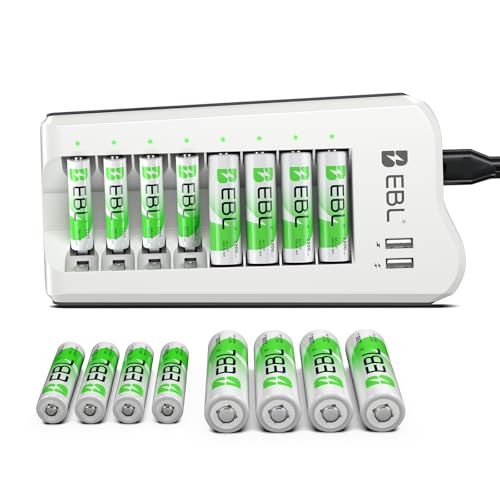
- Includes 8 AA and 8 AAA rechargeable batteries
- Eight-bay charger supports flexible AA/AAA charging
- Two USB ports charge devices alongside batteries
Best For: Everyday household AA/AAA charging with USB convenience
Best for Easy Setup

- Supports 18650, 21700, AA, and AAA cells
- Independent charging with LCD status display
- Compact design with built-in safety protections
Best For: Mixed-battery households and portable charging
Best High-Capacity Kit

- Includes 16 rechargeable AA and AAA batteries
- Charges up to 16 cells independently
- LED status indicators and safety protection
Best For: High-volume AA/AAA charging at home
Best USB Value
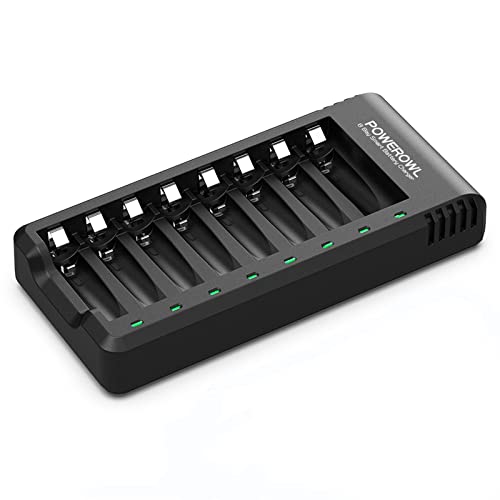
- Eight independent AA/AAA charging slots
- USB-powered for home, car, or laptop use
- Automatic shutoff and LED charging indicator
Best For: Flexible USB charging for Ni-MH or NiCD cells
Best All-in-One Kit
EBL 8-Bay AA/AAA Charger with Batteries

- Includes four AA and four AAA NiMH batteries
- Eight independent charging bays for AA or AAA cells
- Trickle charging and LED status indicators
Best For: Households needing batteries and a charger together
Best High-Capacity Charger

- Sixteen independent bays charge flexible quantities
- Mix AA and AAA NiMH batteries in one session
- LEDs show charging, completion, and fault status
Best For: High-volume AA and AAA NiMH charging
Best USB-C Option

- USB-C 5V input for modern charging setups
- Smartly adjusts speed across one to eight cells
- Adds defective-battery detection and repair mode
Best For: USB-C users charging NiMH or NiCD cells
Most Versatile – EBL 14-Bay Universal Battery Charger
For shoppers comparing rechargeable battery chargers for multiple devices, the EBL 12+2 Bay model stands out for its broad battery compatibility. It can charge AA, AAA, C, D, and 9V Ni-MH or Ni-CD batteries, with individual slots that let you charge different quantities without pairing batteries.
Best For: Households that use several battery sizes and need high-capacity, flexible charging.
Pros:
- Supports AA, AAA, C, D, and 9V rechargeable batteries.
- Offers up to 14 charging slots with independent charging.
- LCD and LED indicators show charging status and errors.
- Includes overheat, overcurrent, short-circuit, and defective-battery protection.
Cons:
- Designed for Ni-MH and Ni-CD batteries rather than lithium-ion cells.
- Uses an AC power supply, so it is less suited to charging away from an outlet.
This is a practical all-in-one option when your battery drawer includes several formats. Its large capacity and status monitoring are useful for busy households, though its AC-only design limits portability.
Best for Outdoor Charging – BLASOUL Solar Power Bank
The BLASOUL power bank is a useful alternative for people searching for rechargeable battery chargers for multiple devices while traveling or spending time outdoors. Rather than charging loose AA or AAA cells, it recharges phones and other compatible electronics through built-in cables, USB-C, wireless charging, and solar input.
Best For: Camping, hiking, travel, emergencies, and charging several types of mobile devices away from outlets.
Pros:
- Includes built-in iOS, Type-C, Micro USB, and USB-A cables.
- Offers 49,800mAh capacity and up to 22.5W wired charging.
- Supports up to 15W wireless charging for compatible devices.
- IP65-rated design includes a three-mode LED flashlight.
Cons:
- Solar charging is included, but the notes do not specify its charging speed.
- It is intended for phones and compatible electronics, not AA, AAA, C, or D batteries.
Choose this model when device charging portability matters more than charging traditional household batteries. Its cable selection, wireless pad, large capacity, and rugged outdoor features make it especially flexible for travel and emergencies.
Best High-Capacity Station – POWEROWL Pro 20-Bay Charger
For users who need rechargeable battery chargers for multiple devices in the form of many household cells, this POWEROWL Pro station provides 20 independent bays. It charges AA and AAA NiMH batteries in any combination, while the LCD reports voltage, current, charging time, and status for each channel.
Best For: Busy homes, offices, or hobby users charging large numbers of AA and AAA NiMH batteries at once.
Pros:
- Provides 20 independent charging slots.
- Allows any combination of AA and AAA NiMH batteries without pairing.
- LCD displays real-time information for each channel.
- Includes overcharge, overheat, short-circuit, and reverse-polarity protection.
Cons:
- Supports only AA and AAA NiMH batteries.
- Its larger 20-bay format may be more capacity than occasional users need.
This charger is a strong fit when throughput and visibility are priorities. The independent channels reduce pairing restrictions, and trickle charging helps keep batteries ready, but its compatibility is narrower than universal multi-size models.
Best Charger-and-Battery Bundle – EBL AA/AAA Charger Kit
The EBL AA/AAA kit combines an eight-bay charger with rechargeable batteries and two USB ports, making it a convenient choice among rechargeable battery chargers for multiple devices. It can charge AA and AAA Ni-MH or Ni-CD cells while also charging two USB devices, such as a phone or tablet.
Best For: Families that need replacement AA and AAA batteries plus convenient USB charging in one compact setup.
Pros:
- Includes eight 2300mAh AA and eight 1100mAh AAA rechargeable batteries.
- Charges one to eight AA or AAA batteries.
- Two USB ports can charge phones or other USB devices simultaneously.
- Batteries are designed to retain 80% power after three years, according to the supplied notes.
Cons:
- Supports AA and AAA batteries only.
- The charger has fewer battery bays than the 14- and 20-slot alternatives.
- USB output is listed at 1000mA, which may be slower for some newer devices.
This bundle offers good everyday value if you need both batteries and a charger rather than a charger alone. Its dual USB ports add useful flexibility, although users with C, D, or 9V batteries will need a different model.
Best for Easy Setup – Smart Multi-Battery Charger
If you need rechargeable battery chargers for multiple devices, this compact smart charger is designed to handle several battery formats, including 18650, 21700, AA, and AAA cells. Its LCD display and independent charging support make it a practical choice for mixed-battery households.
Best For: Users who need one portable charger for multiple rechargeable battery types.
Pros:
- Supports 18650, 21700, AA, and AAA batteries.
- Independent smart charging helps adjust charging based on battery status.
- Built-in protection against short circuits, reverse polarity, overheating, and overcharging.
- Compact 4.7-inch design with USB and AC plug connectivity.
Cons:
- Charging time is listed at approximately 8 hours.
- The supplied details list two ports, so it may be less suitable for large battery batches.
Choose this model when format flexibility matters more than maximum charging capacity. The LCD display, safety features, and portable size make it a well-rounded option for home, garage, or travel use.
Best High-Capacity Kit – Bonai 16-Bay AA/AAA Charger
For shoppers looking for rechargeable battery chargers for multiple devices, this Bonai kit combines 16 pre-charged Ni-MH batteries with a 16-bay charger. It can charge AA and AAA cells individually, in mixed combinations, or in batches for household electronics.
Best For: Families and high-use households that regularly need AA and AAA batteries for controllers, flashlights, and smart-home gadgets.
Pros:
- Includes eight 2800mAh AA and eight 1100mAh AAA rechargeable batteries.
- 16 independent bays allow charging one, several, or all batteries at once.
- LED indicators show charging, full, or battery-error status.
- Supports 110V–240V outlets and includes built-in safety protections.
Cons:
- Compatible with Ni-MH AA and AAA batteries rather than lithium-ion formats.
- The wide 9.8-inch design takes more space than a compact charger.
This is the strongest pick when you want both a large supply of batteries and high batch capacity. Its individual charging bays reduce the need to match batteries, while the included wall plug keeps setup simple.
Best USB Value – POWEROWL 8-Bay AA/AAA Charger
This POWEROWL model is a straightforward option among rechargeable battery chargers for multiple devices, with eight independent bays for Ni-MH or NiCD AA and AAA batteries. Its USB input lets you power it from a laptop, car charger, or phone charger.
Best For: Users who want flexible USB-powered charging for everyday AA and AAA batteries.
Pros:
- Charges any number of up to eight AA or AAA batteries.
- USB input works with laptops, car chargers, and phone chargers.
- Automatically stops charging when batteries are full.
- Independent slots and LED indicators simplify monitoring.
Cons:
- Only supports NiMH or NiCD AA and AAA batteries.
- An adapter is not included, so a compatible 5V/2A power source is needed.
- Listed charging time is approximately 10 hours.
This charger makes sense for desks, cars, and travel setups where USB power is convenient. It offers useful slot flexibility and automatic shutoff, but the slower listed charge time and need for a separate adapter should factor into your decision.
Best All-in-One Kit – EBL 8-Bay AA/AAA Charger with Batteries
If you want rechargeable battery chargers for multiple devices plus batteries to get started, this EBL kit combines four AA and four AAA NiMH cells with an eight-bay charger. Its independent slots accommodate different quantities of compatible AA or AAA batteries.
Best For: Households that need a starter set for everyday AA- and AAA-powered devices.
Pros:
- Includes 2800mAh AA and 1100mAh AAA rechargeable batteries.
- Eight-bay design supports charging any number of compatible AA or AAA cells.
- Automatic trickle charging, heat management, short-circuit protection, and voltage detection add safety features.
- LED indicators show charging progress and help identify non-recharging batteries.
Cons:
- Limited to NiMH and NiCD AA/AAA batteries.
- Uses a standard AC power plug rather than USB-C.
With batteries included, this is a practical choice for replacing disposable cells across common household devices. Choose it if convenience and mixed AA/AAA charging matter more than USB-powered operation.
Best High-Capacity Charger – BONAI 16-Bay AA/AAA Charger
For households managing many rechargeable cells, this BONAI model is one of the more spacious rechargeable battery chargers for multiple devices. Its 16 independently controlled bays can charge AA and AAA NiMH batteries in mixed quantities without requiring neighboring slots.
Best For: Families, hobbyists, or shared spaces that regularly rotate large numbers of AA and AAA NiMH batteries.
Pros:
- Sixteen bays let you charge single, double, or multiple batteries independently.
- Supports mixed AA and AAA NiMH charging without batteries needing to be adjacent.
- LEDs identify empty, charging, completed, and potentially defective batteries.
- Includes protection against overcharging, overvoltage, overcurrent, overheating, short circuits, and reverse polarity.
Cons:
- Batteries are not included.
- Cannot charge alkaline or lithium batteries.
- Charging can take longer when more batteries are installed.
The 16-bay layout is the main reason to choose this charger: it reduces the need for multiple charging cycles. Its attached AC cord is convenient, though shoppers seeking USB-C input will need another option.
Best USB-C Option – NICEBATT Smart 8-Bay Charger
This NICEBATT model stands out among rechargeable battery chargers for multiple devices with its USB-C input and smart charging control. It supports one to eight NiMH or NiCD batteries, adjusts charging speed, and includes an over-discharge repair function for eligible older cells.
Best For: Users who prefer USB-C power and want diagnostic or recovery features for NiMH and NiCD batteries.
Pros:
- USB-C input with 5V operation works with compatible USB-C power sources.
- Automatically adjusts charging speed for one to eight batteries.
- Detects defective batteries and provides LED charging status.
- Includes over-discharge repair and trickle charging designed to help maintain battery capacity.
Cons:
- Only compatible with NiMH and NiCD batteries.
- Requires a suitable 5V USB-C power source.
- The repair function cannot be assumed to restore every damaged battery.
Choose this charger when USB-C convenience and battery monitoring are priorities. Its eight bays suit regular household use, while the repair mode offers a useful extra for batteries affected by over-discharge.
How We Picked the Best Rechargeable Battery Chargers for Multiple Devices
We focused on chargers that support more than one battery format or combine rechargeable-cell charging with USB device charging. Selection criteria included battery compatibility, number of charging bays, independent slot control, charging-status indicators, power-input options, portability, and the usefulness of included batteries or cables. We also separated general-purpose Ni-MH chargers from models that support lithium-ion cells, since those chemistries require different charging systems.
Because specifications vary by configuration, confirm the charger’s supported battery types, input voltage, included adapter, and maximum charging current before ordering.
Quick Comparison
| Best For | Look For | Typical Advantage |
|---|---|---|
| Busy households | 12- or 16-bay charging | Charges many cells at once |
| Large battery collections | 20 independent bays | High capacity and flexible scheduling |
| Travel and USB setups | USB-C input or built-in cables | Works with common power banks and adapters |
| Mixed battery formats | AA, AAA, C, D, and 9V support | One charger covers more household devices |
| Rechargeable battery starters | Charger-and-battery bundle | Ready to use without buying cells separately |
Key Buying Factors for Rechargeable Battery Chargers for Multiple Devices
Battery Chemistry and Size Compatibility
Check whether you need Ni-MH and Ni-CD support, lithium-ion support, or both. AA and AAA are common, but C, D, 9V, 18650, and 21700 batteries are not universally supported. Never charge a cell in a bay that is not designed for its chemistry or size.
Bay Count and Independent Control
More bays help households with toys, controllers, cameras, flashlights, and other battery-powered products. Independent control is especially useful because it lets you charge cells individually rather than requiring matched pairs or a fully occupied row.
Power Source and Charging Speed
AC adapters are convenient for a fixed charging station, while USB-C models are easier to use at desks, in vehicles, or with portable power banks. Fast charging can save time, but higher speed is only beneficial when the charger manages heat and battery condition appropriately.
Monitoring and Protection
LCD screens and LED indicators make it easier to see charging progress. Look for automatic shutoff, overcharge protection, short-circuit protection, temperature control, and reverse-polarity protection. These features improve convenience and help protect both the charger and cells.
Who Should Buy Which Rechargeable Battery Chargers for Multiple Devices?
Choose a high-bay station if your household regularly cycles many AA or AAA batteries. Select a model with C, D, or 9V support if you maintain older radios, flashlights, alarms, or specialty equipment. A compact USB-powered charger suits travelers and anyone who charges near a laptop or power bank, while a solar power bank is better as an emergency phone-power option than as a replacement for a dedicated household battery charger.
Bundle kits are the simplest choice for new rechargeable-battery users because they include compatible cells and a charger. If you own both AA/AAA batteries and 18650 or 21700 cells, choose a clearly specified universal model and verify its supported lithium-ion formats before use. For any option, match the charger to your actual battery collection rather than choosing by bay count alone.