Choosing a smart smoke alarm should not require rewiring your home or deciphering complicated setup instructions. The best options combine dependable detection with an installation method that fits your existing wiring, preferred smart-home platform, and maintenance routine.
This roundup compares 10 models, from simple battery-powered alarms to hardwired and wirelessly interconnected systems, so you can find practical protection for apartments, single-family homes, and larger properties.
Best 10 Smart Smoke Alarms for Easy Installation Picks for 2026
Best Smart Pick
Kidde Smart Smoke & CO Detector
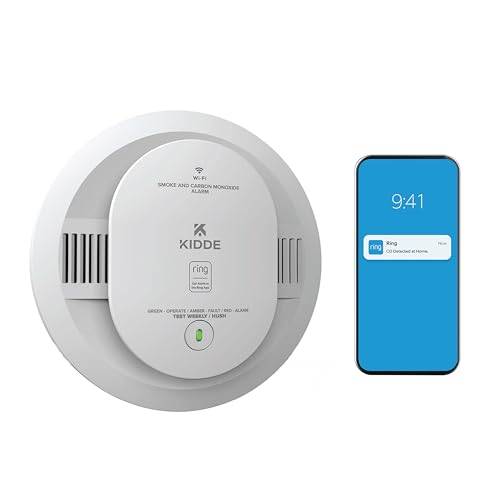
- Smoke and CO detection
- Ring app alerts without a required subscription
- Battery-powered, wire-free installation
Best For: Connected homes wanting smoke and CO alerts
Best Hardwired Upgrade
First Alert Smart Smoke & CO Alarm

- Smoke and CO app alerts
- Quick Connect Plug avoids rewiring
- Battery backup for outages
Best For: Replacing compatible hardwired alarms
Best No-Wire Value
X-Sense 10-Year Smoke Detector

- Sealed 10-year lithium battery
- Fast installation with included hardware
- Standalone photoelectric smoke detection
Best For: Low-maintenance bedrooms, hallways, and rentals
Best Whole-Home Kit
Heiman Wireless Interconnected Smoke Detector

- Six alarms plus smart gateway
- Wireless whole-home interconnection
- 10-year batteries and app notifications
Best For: Large homes and multi-room installations
Simple Battery Pick
First Alert Battery Smoke Alarm

- Battery-powered for easy installation
- Front-access battery compartment
- Precision Detection helps reduce cooking nuisance alarms
Best For: Straightforward smoke protection with simple maintenance
Best Connected Setup
Kidde Smart Smoke Detector with Ring

- Wire-free setup with two included AA batteries
- Ring app smoke and low-battery alerts
- Wireless whole-home interconnectivity
Best For: Connected homes wanting app alerts without required subscription fees
Smart Combo Coverage
First Alert SC5 Battery Smart Smoke & CO Alarm

- Battery-powered smoke and CO protection
- First Alert app notifications
- Voice alerts identify danger type and location
Best For: Homes wanting connected smoke and carbon monoxide coverage
Best Budget-Friendly Pick
Siterwell 9V Battery Smoke Alarm

- Easy wall or ceiling installation
- Adaptive sensing helps reduce dust-related nuisance alarms
- Loud alarm with test, mute, and low-battery warning
Best For: Simple smoke protection across multiple rooms
Best Smart Smoke-and-CO Pick
Kidde Smart Smoke & CO Detector
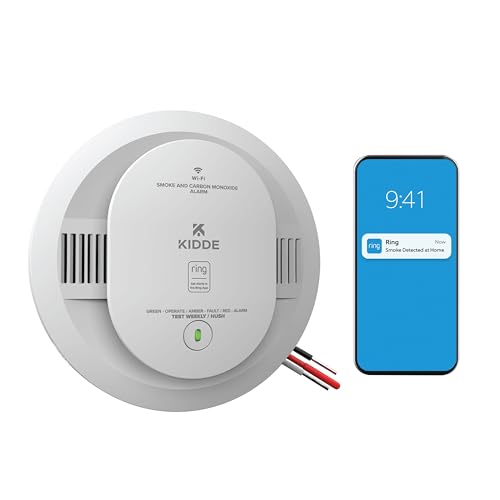
- Detects smoke and carbon monoxide
- Ring app alerts require no subscription
- Supports Alexa and whole-home smart connectivity
Best For: Connected hardwired home safety with remote alerts
Best Connected Smoke-Only Pick
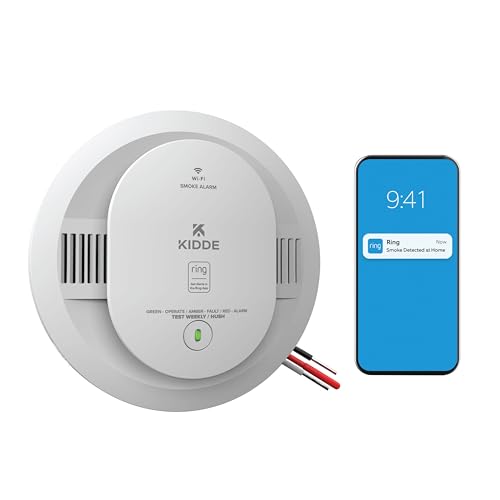
- Real-time Ring smoke and battery alerts
- Hardwired design with AA battery backup
- Alexa support and reduced nuisance alarms
Best For: Remote smoke alerts in homes with hardwired alarms
Best Smart Pick – Kidde Smart Smoke & CO Detector
For shoppers seeking smart smoke alarms for easy installation, this Kidde detector combines smoke and carbon monoxide protection with app alerts and battery-powered setup. It uses two included AA alkaline batteries, so no wiring is required.
Best For: Homes that want remote smoke, CO, and low-battery notifications without a subscription.
Pros:
- Detects both smoke and carbon monoxide.
- Sends real-time Ring app notifications, including low-battery warnings, without requiring a subscription.
- Wire-free interconnectivity can alert you through other compatible Kidde alarms.
- Works with Alexa-enabled devices and is certified to UL 217 and FCC standards.
Cons:
- Optional 24/7 Ring monitoring costs extra.
- App-based features require setup with the Ring ecosystem.
This is a strong choice when easy installation and connected alerts matter more than keeping the alarm completely offline. Its combination of smoke, CO, and whole-home connectivity gives it broader coverage than a standalone smoke detector.
Best Hardwired Upgrade – First Alert Smart Smoke & CO Alarm
This First Alert model suits buyers who want smart smoke alarms for easy installation while replacing an existing hardwired unit. Its Quick Connect Plug simplifies installation and replacement without rewiring, while battery backup helps maintain protection during outages.
Best For: Homes with compatible hardwired alarm wiring that want app alerts and voice warnings.
Pros:
- Sends smoke and CO alerts to your phone through the First Alert app.
- Quick Connect Plug supports easier replacement without rewiring.
- Battery backup provides protection during power outages.
- Voice alerts identify the danger type and location.
Cons:
- It is a hardwired alarm, so it is not the simplest choice for a new location without wiring.
- Smart alerts require use of the First Alert app.
Choose this alarm if you are updating an existing hardwired system rather than starting from scratch. Interconnectivity, Precision Detection Technology, and voice alerts add useful whole-home awareness, while the connector helps streamline replacement.
Best No-Wire Value – X-Sense 10-Year Smoke Detector
If your priority is smart smoke alarms for easy installation without wiring or app setup, this X-Sense detector keeps things straightforward. Its sealed 10-year lithium battery reduces maintenance, while photoelectric sensing is designed to limit nuisance alarms from cooking and steam.
Best For: Bedrooms, hallways, rentals, and homes needing a simple standalone smoke alarm.
Pros:
- Sealed battery lasts up to 10 years, reducing battery changes and chirps.
- Included hardware supports quick, no-wire installation.
- Photoelectric sensing helps reduce cooking-related nuisance alarms.
- ETL listed to meet the UL 217 standard and includes one-button testing and hush functions.
Cons:
- It has no Wi-Fi, app alerts, base station, or wireless interconnection.
- It provides smoke detection only, not carbon monoxide detection.
This is the practical pick for buyers who value low maintenance over connected features. Confirm that you want a standalone alarm before buying, since it will not make other alarms sound or send remote notifications.
Best Whole-Home Kit – Heiman Wireless Interconnected Smoke Detector
For larger properties, this Heiman kit offers smart smoke alarms for easy installation across multiple rooms. It includes six wireless interconnected detectors and a gateway, providing local whole-home alarms plus smartphone or email notifications when connected to a 2.4GHz Wi-Fi network.
Best For: Multi-story homes, apartments, offices, landlords, and contractors needing coordinated coverage.
Pros:
- Six detectors and one gateway provide a ready-made whole-home setup.
- Wireless interconnection makes all linked alarms sound when one detects smoke.
- Gateway enables smartphone and email notifications through the Heiman Home App.
- 10-year CR123A battery life and dual-beam photoelectric sensing reduce maintenance and nuisance alarms.
Cons:
- App connectivity requires a 2.4GHz Wi-Fi network; 5GHz is not supported.
- The six-pack may be more equipment than needed for a small home.
- Setup involves pairing the gateway and detectors with the Heiman app.
This kit makes the most sense when you need coordinated protection across several rooms rather than a single replacement alarm. It combines local wireless interconnection with remote notifications, while the long-life batteries reduce ongoing maintenance.
Simple Battery Pick – First Alert Battery Smoke Alarm
The First Alert SMI100 is a practical choice if you want smart smoke alarms for easy installation without wiring. Its battery-powered design, front-access battery compartment, and test/silence button make routine setup and maintenance straightforward.
Best For: Buyers seeking a simple, battery-operated smoke alarm with nuisance-alarm reduction features.
Pros:
- Battery operation supports easy installation.
- Front-access battery compartment simplifies replacements.
- Precision Detection technology is designed to reduce cooking nuisance alarms.
- End-of-life warning indicates when the alarm should be replaced.
Cons:
- It is a smoke alarm rather than a smoke-and-carbon-monoxide combination unit.
- The supplied notes describe a 9V alkaline battery but do not specify battery life.
The SMI100 keeps installation and upkeep uncomplicated while adding useful testing and replacement reminders. It is a sensible fit for straightforward smoke protection where app alerts and interconnected alarms are not required.
Best Connected Setup – Kidde Smart Smoke Detector with Ring
The Kidde Smart Smoke Detector with Ring is designed for smart smoke alarms for easy installation, using two included AA alkaline batteries instead of hardwiring. It adds Ring app alerts, whole-home wireless interconnectivity, and Alexa compatibility for connected protection.
Best For: Homes that want wire-free installation with phone notifications and connected alarm coverage.
Pros:
- Uses two included AA alkaline batteries, so no wiring is needed.
- Sends smoke and low-battery notifications through the Ring app without a subscription.
- Wire-free interconnectivity can make every Kidde alarm sound when one detects smoke.
- Alexa-enabled devices can provide additional notifications.
Cons:
- Optional 24/7 smoke monitoring requires a separately sold Ring subscription.
- Whole-home interconnectivity depends on compatible Kidde alarms and the user guide requirements.
For shoppers prioritizing easy, wire-free setup and remote awareness, this Kidde model offers a stronger smart-home feature set than a basic standalone alarm. The optional subscription is not necessary for app notifications, but it adds a separate ongoing-cost consideration.
Smart Combo Coverage – First Alert SC5 Battery Smart Smoke & CO Alarm
The First Alert SC5 is a strong option for smart smoke alarms for easy installation when you also want carbon monoxide detection. It runs on batteries, connects with the First Alert app for smoke and CO alerts, and can interconnect with compatible alarms.
Best For: Households wanting battery-powered smoke and carbon monoxide protection with app alerts and voice warnings.
Pros:
- Battery-powered design supports installation without wiring.
- First Alert app alerts you when smoke or CO are detected.
- Voice alerts identify the type and location of danger.
- Compatible alarms can interconnect so they sound together.
Cons:
- Interconnectivity is limited to compatible alarms.
- The supplied notes identify the product date as a manufacture date, not an expiration date.
The SC5 combines convenient battery installation with broader protection than a smoke-only model. Its app alerts, voice warnings, and interconnect capability make it especially useful for buyers building a more informed home alarm system.
Best Budget-Friendly Pick – Siterwell 9V Battery Smoke Alarm
For shoppers comparing smart smoke alarms for easy installation, the SITERWELL smoke detector offers a straightforward battery-powered setup with wall- or ceiling-mounting options. Its adaptive sensor is designed to reduce dust-related nuisance alarms while providing loud audible alerts when smoke is detected.
Best For: Homeowners, apartment residents, and property managers seeking an easy-to-install smoke alarm for multiple rooms.
Pros:
- Quick wall or ceiling installation with included hardware and magnetic fastening kit.
- Adaptive sensing and redesigned housing help minimize nuisance alarms caused by dust.
- Includes a test/mute button, low-battery warning, and loud alarm rated above 85 dB.
- Suitable for bedrooms, living rooms, hallways, basements, and kitchens.
Cons:
- Smoke-only protection; it does not detect carbon monoxide.
- Uses a replaceable 9V carbon-zinc battery rather than app-based notifications.
The SITERWELL is a practical choice when simple installation and broad room coverage matter more than connected features. Its included mounting components and replaceable battery make it convenient for basic whole-home smoke protection.
Best Smart Smoke-and-CO Pick – Kidde Smart Smoke & CO Detector
The Kidde Smart Smoke & CO Detector is a strong option for shoppers seeking smart smoke alarms for easy installation in a hardwired setup. It combines smoke and carbon monoxide detection with Ring app alerts, while an AA battery provides backup power.
Best For: Homes that need connected smoke and carbon monoxide alerts, including notifications when occupants are away.
Pros:
- Detects both smoke and carbon monoxide in one device.
- Ring app provides real-time smoke, CO, and low-battery notifications without a subscription.
- Can connect whole-home hardwired alarms to mobile alerts by adding one smart detector.
- Works with Alexa-enabled devices and is tested to UL 217 and FCC requirements.
Cons:
- Requires a hardwired installation, which may be less straightforward than a battery-only alarm.
- Optional 24/7 Ring monitoring requires a separate $5-per-month subscription.
Choose this Kidde model if remote notifications and dual smoke/CO coverage justify a more involved installation. Its connected features add useful awareness at home or away, while Alexa compatibility provides another notification channel.
Best Connected Smoke-Only Pick – Kidde Smart Smoke Detector
For homes focused on smoke protection, the Kidde Smart Smoke Detector brings Ring app notifications to a hardwired alarm with AA battery backup. It is a useful candidate among smart smoke alarms for easy installation when a compatible hardwired setup is already available.
Best For: Homeowners wanting remote smoke and low-battery alerts without adding carbon monoxide detection.
Pros:
- Provides real-time Ring notifications at home or away without a subscription.
- Enhanced sensing is designed to reduce nuisance alarms caused by cooking.
- Can send mobile alerts from other hardwired alarms when used as the smart detector in the system.
- Supports Alexa notifications and meets UL 217 and FCC requirements.
Cons:
- Detects smoke but not carbon monoxide.
- Hardwired installation may require more setup than a battery-only detector.
- Optional 24/7 Ring smoke monitoring costs $5 per month.
This model makes sense when smoke detection and connected alerts are the priority. It offers a practical balance of app access, Alexa integration, and nuisance-alarm reduction, provided your home supports hardwired installation.
How We Picked the Best Smart Smoke Alarms for Easy Installation
We focused on installation simplicity, sensing coverage, power options, connectivity, certifications, and long-term maintenance. The selection includes standalone battery alarms, hardwired models, smart alarms with Ring integration, and interconnected systems designed to alert multiple rooms at once.
We also considered whether each alarm uses replaceable batteries, a sealed long-life battery, or existing household wiring. Products with smoke-and-carbon-monoxide detection received extra consideration for buyers seeking broader protection from one device.
Quick Comparison
- Best for Ring users: Kidde Smart Smoke & CO and Smart Smoke Detector models with Ring integration.
- Best for hardwired replacements: First Alert SC5 Hardwire and Kidde hardwire-compatible models.
- Best for straightforward battery installation: First Alert Battery Smoke Alarm, X-Sense SD2J0AX, and SITERWELL alarms.
- Best for whole-home wireless coverage: Heiman’s six-pack with gateway.
- Best for combined protection: First Alert SC5 and Kidde smoke-and-CO detectors.
Key Buying Factors for Smart Smoke Alarms for Easy Installation
Choose the Right Power Method
Battery models are usually the quickest to install because they do not require electrical work. They are useful for rentals, older homes, and rooms without existing alarm wiring. Hardwired alarms can be a better replacement when your home already has compatible connections, but confirm the wiring and connector requirements before buying.
Check Connectivity and Compatibility
A smart alarm is only useful if it works with your ecosystem. Verify Ring, gateway, app, Wi-Fi, or other platform requirements, and check whether the alarm needs a separate hub. Wireless interconnection can help every alarm sound together without running new cable.
Consider Smoke-Only Versus Smoke-And-CO Detection
Smoke-only alarms may be sufficient for specific locations, while combination units can help monitor both fire and carbon monoxide risks. Follow local codes and place alarms according to the manufacturer’s instructions, especially near sleeping areas and fuel-burning appliances.
Plan for Maintenance
Look for clear low-battery alerts, accessible battery compartments, test and silence controls, and a replacement schedule. Sealed long-life batteries reduce routine changes but generally require replacing the entire alarm when the battery expires.
Who Should Buy Which Smart Smoke Alarms for Easy Installation?
Renters and DIY installers should prioritize compact battery-powered alarms with simple mounting and app setup. Homeowners replacing existing wired alarms should start with compatible hardwired options to preserve the current circuit and interconnection. Ring households will benefit from Kidde models designed to work with Ring, while larger homes may prefer a wireless interconnected kit such as Heiman’s multi-alarm package.
Before installation, check local regulations, test every alarm after setup, and avoid placing devices where cooking steam or bathroom humidity can cause nuisance alerts. The best Smart Smoke Alarms for Easy Installation are the ones that match your home’s wiring, coverage needs, and smart-home system without adding unnecessary complexity.