The best robot building kits turn screen time into practical problem-solving. Kids can assemble moving machines, experiment with sensors and hydraulics, and build confidence through trial and error.
These 10 picks cover beginner-friendly construction sets, programmable Arduino robots, app-controlled kits, solar projects, and ambitious engineering builds for different ages and interests.
Best 10 Robot Building Kits for Hands-On Learning Picks for 2026
Best All-in-One Build
Kyanio 3-in-1 App-Controlled Robot Kit

- 560-piece kit with three robot and vehicle builds
- Remote, app control, and programming activities
- Color-coded parts and guided instructions
Best For: Kids wanting construction, mechanics, and coding in one project
Best for Advanced Coding
ELEGOO UNO R3 Smart Robot Car V4

- Arduino-compatible programmable robot car
- Camera FPV, line tracking, and obstacle avoidance
- Guided wiring with sensors and rechargeable battery
Best For: Ages 12+ exploring electronics, sensors, and Arduino code
Best Beginner Coding Robot

- Quick, approximately 15-minute assembly
- Scratch, Arduino, and mBlock coding support
- Expandable with Makeblock modules and parts
Best For: Ages 8+ beginning robotics and programming
Best for Mechanical STEM Play
Thames & Kosmos Hydraulic Boxing Bots

- Build two water-powered boxing robots
- Explores gears, pistons, cylinders, and hydraulics
- Includes a scoreboard for robot battles
Best For: Hands-on mechanical science and two-player learning
Best Multi-Project Starter

- Five robot projects in one kit
- Includes screwdriver and illustrated instructions
- Supports engineering and fine-motor practice
Best For: Kids ages 6–13 who like building variety
Best Mechanical STEM Demo

- Wearable hand powered by air and water
- Adjustable joints and three configurations
- No batteries or motors required
Best For: Kids 7+ exploring hydraulics and mechanics
Best Coding-Ready Build
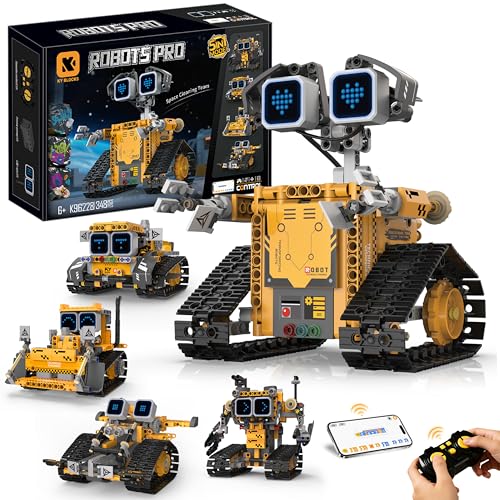
- Builds five models from 348 pieces
- Remote and smartphone-app control
- Includes programming and sensing modes
Best For: Kids 6–12 combining building with coding play
Hands-On Electronics Starter

- 100+ components for electronics projects
- 10 guided robotics builds
- Includes line-following and obstacle-avoidance functions
Best For: Beginners exploring electronics and robotics through guided projects
Solar-Powered Maker Challenge

- 190 parts for 12 build experiences
- Explores solar and renewable energy
- Builds robots, a car, or a boat
Best For: Children learning about solar power through creative rebuilding
Remote-Controlled Rebuild Set

- Builds a robot, ATV, or tank
- 388 pieces with remote control
- Includes rechargeable battery and motor
Best For: Kids who want construction projects followed by remote-controlled play
Best All-in-One Build – Kyanio 3-in-1 App-Controlled Robot Kit
For families seeking robot building kits for hands-on learning, the Kyanio set combines a 560-piece construction project with remote control and app-based programming. Its three build options give kids ages 8–14 a way to explore gears, mechanics, creative construction, and introductory coding in one kit.
Best For: Kids who want varied building projects with both physical construction and app-controlled play.
Pros:
- Builds three models: a machine gun robot, tracked vehicle, or mechanical cannon tank.
- Includes step-by-step instructions and color-coded blocks.
- Supports remote control, app programming, and mechanical-gear exploration.
- Uses 2.4GHz control and a rechargeable Type-C setup.
Cons:
- The military-themed models may not suit every child or classroom.
- Programming and construction may require adult guidance for younger builders.
This is a flexible choice when you want a substantial building experience that extends beyond assembling a single robot. The multiple models and control options add replay value, while the included battery and one-year manufacturer-defect warranty provide practical convenience.
Best for Advanced Coding – ELEGOO UNO R3 Smart Robot Car V4
The ELEGOO UNO R3 V4 is one of the more electronics-focused robot building kits for hands-on learning. Builders assemble a programmable car, then experiment with Arduino coding, camera-based FPV video, line tracking, obstacle avoidance, and app or IR remote control.
Best For: Older beginners, coding clubs, STEM classrooms, and families ready to explore sensors and Arduino programming.
Pros:
- Combines assembly, Arduino programming, electronics, and robotics.
- Includes camera-based FPV video, line tracking, and ultrasonic obstacle avoidance.
- Keyed XH2.54 connectors and an illustrated tutorial help reduce wiring errors.
- Includes a rechargeable 2000 mAh lithium-ion battery.
Cons:
- Recommended for ages 12 and up, with adult guidance for first-time builders.
- Its electronics and wiring make it a more involved project than a basic construction toy.
This kit offers strong room for experimentation after the initial build. The included example programs provide a starting point, while Arduino IDE access lets learners modify movement, sensor responses, and driving behaviors.
Best Beginner Coding Robot – Makeblock mBot STEM Robot
The Makeblock mBot is a straightforward entry point into robot building kits for hands-on learning. Designed for ages 8 and up, it can be assembled in about 15 minutes and then used to introduce Scratch and Arduino programming, electronics, line following, and obstacle avoidance.
Best For: Children and families seeking a quick-start coding robot with structured lessons and room to expand.
Pros:
- Designed as an entry-level introduction to electronics, robotics, and programming.
- Clear instructions support a build that can be completed in about 15 minutes.
- Works with Scratch, Arduino, mBlock software, coding cards, and three free Makeblock apps.
- Open-source platform connects with more than 100 electronic modules and 500 parts.
Cons:
- The robot requires four AA batteries, and the remote requires a CR2025 battery; batteries are not included.
- Additional expansion parts are separate from the core kit.
mBot is a practical pick when ease of entry matters. It offers enough guided content for beginners while retaining an expandable platform for children who want to move from block-based coding toward Arduino projects.
Best for Mechanical STEM Play – Thames & Kosmos Hydraulic Boxing Bots
The Thames & Kosmos Hydraulic Boxing Bots take a different approach to robot building kits for hands-on learning: instead of batteries or app coding, builders create two water-powered robots. The project demonstrates gears, cylinders, pistons, and hydraulic movement, followed by a head-to-head robot battle.
Best For: Kids ages 8 and up who learn best through mechanical construction, demonstrations, and interactive play with a friend.
Pros:
- Builds two working hydraulic boxing robots.
- Explores water-powered mechanisms, gears, cylinders, and pistons.
- Independent upper- and lower-body movement enables dodging, jabbing, and punching.
- Includes a scoreboard for friendly competitions.
Cons:
- It does not provide app control, electronic programming, or battery-powered operation.
- The hydraulic tubes and mechanisms may require careful assembly and setup.
This kit is especially appealing for learners interested in how forces and mechanical systems work. Its two-robot format turns the engineering lesson into a social activity, making it a strong alternative to screen-based coding kits.
Best Multi-Project Starter – 5-in-1 Robot Building Kit
For families seeking robot building kits for hands-on learning, this 5-in-1 set offers several approachable projects in one box. Kids can assemble a crawler, obstacle-avoiding car, delivery bot, doodle robot, or single-engine flyer while practicing basic engineering and problem-solving skills.
Best For: Kids ages 6–13 who enjoy repeatable building projects, independent tinkering, or parent-child STEM activities.
Pros:
- Includes five different robot projects for varied play.
- Comes with building parts, a motor, wheels, battery holder, screwdriver, and illustrated instructions.
- Supports creativity, fine motor skills, logical thinking, and engineering practice.
- Uses durable materials with rounded edges and requires no more than battery power for operation.
Cons:
- The kit is battery-powered, but batteries are not listed among the included components.
- The broad recommended age range may mean younger children need more adult assistance.
This is a versatile choice when you want one affordable-looking kit to support multiple builds rather than a single extended project. The five configurations also make it suitable for repeat play and weekend learning sessions.
Best Mechanical STEM Demo – Mega Cyborg Hydraulic Hand
This wearable hydraulic hand is a hands-on alternative to conventional robot building kits for hands-on learning. Instead of motors or batteries, children build and operate a mechanical hand using air pressure, water, adjustable joints, and their own fingers.
Best For: Kids ages 7 and up who are especially interested in hydraulics, pneumatics, mechanical movement, and tactile STEM experiments.
Pros:
- Demonstrates hydraulic and pneumatic principles through direct operation.
- Adjustable finger joints allow different movement angles and more precise gripping.
- Can be configured as a right hand, left hand, or claw-like design.
- Requires no batteries or motors and is adjustable to fit virtually any human hand.
Cons:
- It focuses on one mechanical-hand project rather than multiple robot builds.
- Assembly uses small hardware such as screws, springs, and flexible tubing, so younger builders may need supervision.
Choose this kit when the learning goal is understanding force, pressure, and mechanical systems rather than coding or electronic controls. Its wearable design makes the cause-and-effect lesson especially engaging.
Best Coding-Ready Build – 5-in-1 App-Controlled Robot
For children ready to combine construction with digital control, this robot building kit for hands-on learning includes 348 pieces and five smart robot models. After building, kids can drive and program their creations with a 2.4GHz remote or smartphone app.
Best For: Kids ages 6–12 who want a mix of building, app control, remote driving, path programming, and introductory coding play.
Pros:
- Offers five robot models from 348 interlocking building pieces.
- Supports remote control, smartphone-app control, path programming, driving, and gravity sensing.
- Encourages engineering thinking, logical reasoning, spatial awareness, and storytelling.
- Includes the required two lithium-ion batteries according to the product details.
Cons:
- App-based features may require access to a compatible smartphone.
- The larger piece count and multiple control modes could be more demanding for younger builders.
This is the strongest fit for families that want building to lead into interactive robotics and coding concepts. Its combination of five models, app control, and character customization gives children several ways to keep experimenting after assembly.
Hands-On Electronics Starter – 10-in-1 STEM Robotics Kit
For families comparing robot building kits for hands-on learning, this 10-in-1 set offers a compact introduction to electronics, mechanics, and robotics. It includes more than 100 components, step-by-step instructions, and projects designed for children ages 8–12.
Best For: Young beginners who want to explore electronics and build multiple robotics projects with guided instructions.
Pros:
- Includes more than 100 components, including wires, switches, connectors, and LED lights.
- Offers 10 STEM robotics projects with an illustrated, step-by-step manual.
- Supports hands-on exploration of electronics, engineering, mechanics, and robotics.
- Some builds can be completed in about 15 minutes and include line-following or obstacle-avoidance functions.
Cons:
- The manufacturer recommends adult supervision for the listed child age range.
- The compact wood-based kit may be better suited to guided projects than large-scale construction.
This is a practical entry-level choice for children who benefit from clearly structured builds and a variety of basic electronics activities. Its multiple project formats help maintain interest while introducing core STEM concepts.
Solar-Powered Maker Challenge – 12-in-1 Solar Robot Kit
This solar robot kit stands out among robot building kits for hands-on learning by connecting construction with renewable energy. Children ages 8–12 can assemble 12 models, including robots, a car, and a boat, using 190 parts and a larger solar panel.
Best For: Kids interested in building, rebuilding, and learning how sunlight can power simple moving models.
Pros:
- Provides 12 build experiences from 190 parts.
- Introduces solar power and renewable energy through hands-on construction.
- Can be used outdoors in sunlight or indoors with a flashlight.
- Step-by-step instructions support independent building or parent-child projects.
Cons:
- Solar operation depends on sufficient light, so indoor use may require a flashlight.
- The plastic parts and medium-size format may not suit children seeking larger construction sets.
Choose this set when renewable energy is part of the learning goal. The progression from simpler to more advanced models gives children opportunities to practice assembly while revisiting the kit in different ways.
Remote-Controlled Rebuild Set – 3-in-1 STEM Robot Kit
For shoppers seeking robot building kits for hands-on learning with active play afterward, this 388-piece set combines construction and remote control. Children can build a robot, all-terrain vehicle, or tank, then operate the battery-powered model after assembly.
Best For: Builders who want multiple vehicle-style models, remote-controlled play, and a larger parts count.
Pros:
- Transforms into three models: a robot, all-terrain vehicle, and tank.
- Includes 388 building blocks, a motor, rechargeable battery, remote control, stickers, and instructions.
- Encourages building, troubleshooting, reassembly, and problem-solving.
- Compatible with most standard bricks for additional expansion.
Cons:
- Assembly and troubleshooting may require more time than a simple beginner kit.
- Remote-control play requires charging the included rechargeable battery.
- The product listing contains broad age references, while the manufacturer recommendation is 8–12 years.
This option is a strong fit when the child enjoys both building and controlling finished models. Its three configurations and brick compatibility offer more opportunities for repeat play than a single-build robot kit.
How We Picked the Best Robot Building Kits for Hands-On Learning
We focused on kits that combine construction with meaningful learning rather than simple assembly. Our evaluation considered age guidance, build variety, programming or electronics access, control methods, educational value, expected adult supervision, and the quality of the hands-on challenge. The lineup includes options for beginners, coding-focused learners, and children who prefer mechanical or hydraulic projects.
Because capabilities vary widely, check the listed age range and required tools before buying. Some kits are best for independent play, while others are more rewarding when an adult helps with wiring, troubleshooting, or interpreting instructions.
Quick Comparison
- Best for introductory coding: Makeblock mBot and the app-enabled 5-in-1 robot kit.
- Best for Arduino experimentation: ELEGOO UNO R3 Smart Robot Car Kit V4.
- Best for mechanical engineering: Thames & Kosmos Hydraulic Boxing Bots.
- Best for advanced hands-on building: Thames & Kosmos Mega Cyborg Hand.
- Best for variety: the 10-in-1 electronics kit or a multi-model 12-in-1 solar kit.
- Best for remote-control play: the Kyanio, 5-in-1 remote-control, and erector-style robot sets.
Key Buying Factors for Robot Building Kits for Hands-On Learning
Age, Complexity, and Supervision
Choose a kit that is challenging without becoming discouraging. Younger beginners generally benefit from larger parts, visual instructions, and app or remote controls. Older children may be ready for breadboards, Arduino-compatible components, sensors, and code editing. Small parts and wiring often require adult oversight.
What Children Will Actually Learn
Look for a clear learning path. Mechanical kits teach gears, leverage, force, and motion; hydraulic sets demonstrate pressure and fluid systems; electronics kits introduce circuits and components; programmable robots build logic, sequencing, debugging, and sensor-based decision-making. A kit with several build modes can extend its useful life, but only if the instructions explain the underlying concepts.
Control and Programming Options
Remote control is approachable and immediately rewarding, while app control adds convenience and interactive challenges. Programmable platforms offer deeper learning and more room to modify behavior, but they usually involve a steeper setup process. Confirm device compatibility, software requirements, and whether batteries, cables, or a computer are included.
Build Quality and Replay Value
Check whether parts can be disassembled and reused, whether replacement components are available, and how many distinct projects the instructions support. A durable kit with expandable builds is typically a better long-term value than a single-use model.
Who Should Buy Which Robot Building Kits for Hands-On Learning?
For a first robotics experience, choose a straightforward remote- or app-controlled set with a guided build. For children interested in coding, an mBot-style platform or Arduino-compatible car provides a stronger progression from block coding to more advanced programming. Mechanical-minded builders may prefer the hydraulic boxing bots or cyborg hand, while children who enjoy experimenting across subjects can get more value from a multi-project electronics or solar kit.
Finally, match the kit to the child’s patience and preferred outcome. Choose an engaging build with manageable steps, then prioritize expandability if the child is likely to revisit the project and keep learning.