The best overhead camera rigs for documentaries make top-down interviews, archival work, demonstrations, and process footage easier to frame and repeat. The right setup can also reduce operator fatigue while keeping the camera stable during long takes.
This roundup covers compact clamp arms, desk stands, horizontal tripods, and modular production rigs. Compare load capacity, working height, portability, and mounting flexibility to find a setup that fits your documentary workflow.
Best 10 Overhead Camera Rigs for Documentaries Picks for 2026
Best Clamp-Mount Rig
NEEWER NK002 Overhead Camera Mount

- Clamp-mounted design saves desk space
- Adjustable height and width
- Dual ball heads support flexible angles
Best For: Compact tabletop documentary setups
Best Freestanding Option
SmallRig CT200 Horizontal Overhead Tripod

- Rotating and tilting horizontal column
- 33-pound maximum tripod load
- Converts to a monopod
Best For: Flexible documentary shooting in varied locations
Best Tabletop Platform
NEEWER ST100 Heavy-Duty Overhead Rig

- Steel tabletop construction
- 14-position height adjustment per column
- 12 crossbar mounting points
Best For: Stable flat-lay and demonstration scenes
Best for Moving Video
COMAN KX3939Mini-v1 Overhead Tripod

- Fluid head supports smooth panning
- 90-degree overhead center-column rotation
- Folds to 22.8 inches and converts to monopod
Best For: Portable documentary video production
Best Modular Studio Rig

- Configurable to 4, 8, or 12 feet
- Includes ball head and accessory spacers
- Supports ceiling or stand mounting
Best For: Studio documentary crews needing adjustable overhead coverage
Best Heavy-Duty Desk Mount
DNSbabi Articulating Camera Arm
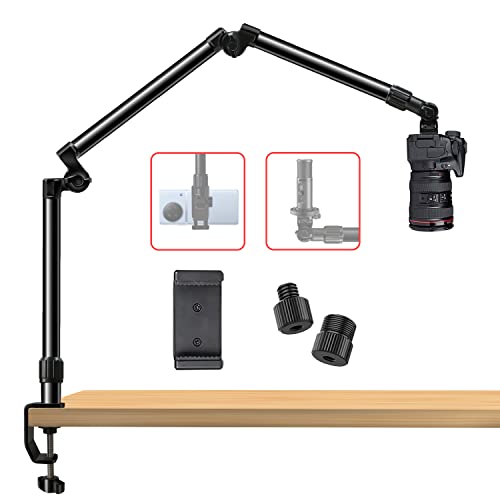
- Extends to 35.4 inches
- 360-degree top and bottom rotation
- Includes multiple mounting screws
Best For: Tabletop documentary shoots using cameras or compact accessories
Best Compact Clamp Kit
K&F CONCEPT 22in Magic Arm
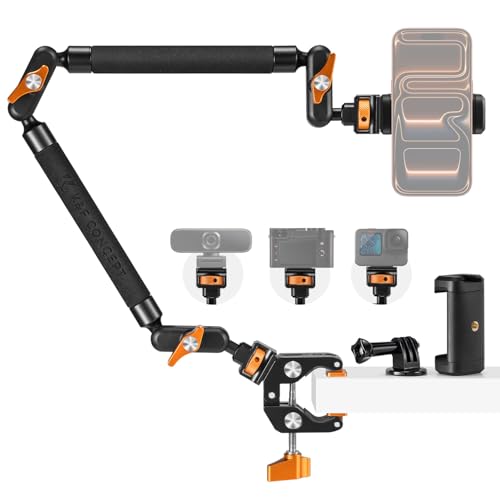
- Includes phone and action-camera adapters
- Three 360-degree ball heads
- Supports up to 1 kg
Best For: Lightweight static overhead shots with phones or action cameras
Best Adjustable Desk Rig

- Supports camera setups up to 2kg
- 30–73cm height adjustment
- Two-device mounting capability
Best For: Stable tabletop documentary shots and overhead B-roll
Best Long-Reach Desk Mount
ULANZI Aluminum Camera Desk Stand

- 29.53-inch extending arm
- Supports up to 2kg
- Clamp fits desks up to 5cm thick
Best For: Wide tabletop coverage and long-reach overhead filming
Best Compact Magic Arm

- 22-inch flexible double-ball arm
- Includes phone holder and adapters
- 600g recommended load capacity
Best For: Lightweight POV shots and compact documentary accessories
Best Clamp-Mount Rig – NEEWER NK002 Overhead Camera Mount
For overhead camera rigs for documentaries where desk space is limited, the NEEWER NK002 offers a flexible clamp-mounted setup. Its adjustable crossbar, dual ball head, and included phone holder support cameras, phones, action cameras, and other lightweight accessories.
Best For: Tabletop documentary scenes, interviews with overhead inserts, unboxing footage, and compact shooting spaces.
Pros:
- Heavy-duty aluminum construction supports up to 26.5 pounds overall.
- Adjustable height from 27.2 to 48 inches and width from 25.2 to 47.2 inches.
- Dual 360-degree ball heads provide flexible overhead viewing angles.
- Includes a phone holder and multiple 1/4-inch mounting options.
Cons:
- The crossarms and additional expansion accessories are sold separately.
- The dual ball head has a 3.3-pound maximum load.
The NK002 is a practical choice when portability and efficient use of a tabletop matter more than a freestanding tripod footprint. Check the individual head load limit before mounting a larger documentary camera or multiple accessories.
Best Freestanding Option – SmallRig CT200 Horizontal Overhead Tripod
The SmallRig CT200 is a versatile pick among overhead camera rigs for documentaries, especially when you need a freestanding support that can also handle standard tripod work. Its horizontal center column rotates for overhead or panoramic shooting, while the included counterweight bag helps improve stability.
Best For: Documentary crews needing overhead, low-angle, panoramic, and conventional tripod shots from one support system.
Pros:
- Horizontal column tilts 180 degrees and rotates 360 degrees.
- Supports up to 33 pounds, with a 22-pound head load rating.
- Converts into a monopod for additional shooting flexibility.
- Includes a counterweight bag, carrying bag, smartphone holder, and quick lever locks.
Cons:
- At 4.4 pounds, it is less compact than a tabletop clamp rig.
- Its larger freestanding footprint may be less convenient in crowded interiors.
Choose the CT200 when documentary work demands more than a single top-down angle. Its rotating center column and monopod conversion make it the most adaptable option here, while the counterweight bag is useful for overhead stability.
Best Tabletop Platform – NEEWER ST100 Heavy-Duty Overhead Rig
The NEEWER ST100 is designed as a stable tabletop platform for overhead camera rigs for documentaries. Its steel frame, spring-loaded height adjustment, and multiple crossbar mounting points make it suitable for repeatable top-down scenes involving documents, crafts, cooking, or demonstrations.
Best For: Flat-lay documentary sequences, cooking demonstrations, drawing sessions, tutorials, and other controlled tabletop scenes.
Pros:
- Steel construction supports up to 10 pounds.
- Height adjusts from 24 to 39 inches using positioning points and locking hardware.
- Crossbar includes 12 mounting points for accessories.
- T-base and nonslip rubberized feet improve stability and protect the desk.
Cons:
- It requires a flat desk at least 39.4 inches wide or a suitable floor area.
- Super clamps, phone clamp, backdrop, and other expansion accessories are not all included.
- Its 10-pound capacity is lower than the CT200’s stated load rating.
The ST100 is a good fit for a dedicated tabletop station rather than fast location changes. Its broad base and accessory-ready crossbar favor controlled documentary setups where repeatable framing and a stable platform are priorities.
Best for Moving Video – COMAN KX3939Mini-v1 Overhead Tripod
The COMAN KX3939Mini-v1 combines overhead capability with video-oriented control, making it a useful option among overhead camera rigs for documentaries. Its 90-degree rotating center column, fluid head, counterweight hook, and travel-friendly folded size support both top-down sequences and mobile production.
Best For: Portable documentary video work, food styling, product details, and shoots that alternate between overhead and conventional framing.
Pros:
- 90-degree rotating center column enables horizontal overhead shooting.
- Fluid head provides 360-degree panning and 147-degree tilt.
- Converts to a detachable monopod and includes a counterweight hook.
- Folds to 22.8 inches, weighs about 3.5 pounds, and includes a carrying bag.
Cons:
- Its 11-pound load limit is below the SmallRig CT200’s stated 33-pound capacity.
- Overhead stability depends on appropriate counterweighting and secure setup.
The COMAN stands out for documentary videographers who value smooth pans and transportability. It is less load-oriented than the heaviest rig here, but its fluid head and monopod conversion make it well suited to varied, location-based shooting.
Best Modular Studio Rig – PROAIM 12ft Overhead Rig
For filmmakers building overhead camera rigs for documentaries, the PROAIM Overhead 12ft Modular Rig offers adjustable coverage for studio-style top-down and bird’s-eye shots. Its rail system can be configured to 4, 8, or 12 feet, with payload capacity varying by length.
Best For: Documentary crews needing a configurable overhead setup for cameras, gimbals, lights, microphones, or fixed ceiling installation.
Pros:
- Configures to 4, 8, or 12 feet for different spaces and shot requirements.
- Includes accessory spacers, a 3-inch riser, ball head, and quick-release plate.
- Can work with C-stands and light stands or be mounted directly to a ceiling.
- Aluminum rail construction and included carrying bag support production use.
Cons:
- Payload drops to 5 kg/11 lb at the full 12-foot length.
- Stands are sold separately.
- The assembled system is substantially larger than a compact desk mount.
This is the most adaptable option here for controlled documentary production environments, especially when you need a longer overhead span. Confirm the required payload and support hardware before using the longest configuration.
Best Heavy-Duty Desk Mount – DNSbabi Articulating Camera Arm
For compact overhead camera rigs for documentaries, this DNSbabi desk stand provides a flexible arm for tabletop filming, interviews, demonstrations, or live production. The three-section arm extends to 35.4 inches and folds to 13.8 inches for storage or transport.
Best For: Documentary creators working from a desk or table with a DSLR, webcam, phone, projector, microphone, or video light.
Pros:
- Top and bottom sections rotate 360 degrees for flexible positioning.
- Supports up to 16 lb horizontally and up to 22 lb maximum, according to the supplied notes.
- Includes 1/4-inch, 3/8-inch, and 5/8-inch screws plus a spring-loaded phone holder.
- Padded clamp adjusts to surfaces up to 2.4 inches high.
Cons:
- Its 35.4-inch reach is better suited to tabletop work than large overhead scenes.
- Requires a suitable desk or table for clamping.
- It is not water resistant.
This arm is a practical choice when documentary shooting happens at a workstation and portability matters more than a wide studio span. Its articulated design makes angle changes straightforward without adding a separate rotating ball head.
Best Compact Clamp Kit – K&F CONCEPT 22in Magic Arm
The K&F CONCEPT Magic Arm Clamp Kit is a lightweight option for overhead camera rigs for documentaries when the setup uses a phone, action camera, LED light, or microphone. Its 22-inch arm and super clamp are designed for static scenes and support up to 1 kg.
Best For: Lightweight documentary setups, remote interviews, tabletop details, streaming, and compact action-camera or phone rigs.
Pros:
- Includes a phone holder and action-camera adapter.
- Three 360-degree ball heads allow overhead and multi-angle positioning.
- Clamp grips flat surfaces up to 50 mm and cylindrical objects from 20 to 60 mm.
- Anti-twist pins, silicone pads, and all-metal construction help maintain a secure static setup.
Cons:
- Maximum supported load is 1 kg/2.2 lb.
- Designed for static scenes rather than dynamic outdoor activities.
- The 22-inch arm provides less reach than the larger modular rig.
This is the easiest option to pack for lightweight overhead coverage, but its 1 kg limit makes it unsuitable for heavier documentary camera packages. Use it where a secure clamp point is available and the scene remains stationary.
Best Adjustable Desk Rig – SMALLRIG Camera Desk Mount
For documentary makers building overhead camera rigs for documentaries at a desk or tabletop, the SMALLRIG Camera Desk Mount offers a sturdy, highly adjustable setup. Its height-adjustable main pole, repositionable extension arm, and 360-degree ball head support cameras, phones, lights, and microphones.
Best For: Stable tabletop documentary shots, product demonstrations, interviews, and overhead B-roll in indoor spaces.
Pros:
- Supports up to 2kg with a widened base and reinforced structure.
- Adjustable height from 30 to 73cm and arm length from 30 to 50cm.
- Offers 1/4-inch and 3/8-inch mounting options plus a detachable 360-degree ball head.
- Can hold two devices simultaneously.
Cons:
- Designed for desk mounting on surfaces 1 to 6cm thick.
- Its tabletop format is less suitable for fieldwork or large studio setups.
This is a strong choice when stability and precise positioning matter more than portability. The detachable, retractable design also makes storage and setup relatively convenient for a permanent or semi-permanent documentary workstation.
Best Long-Reach Desk Mount – ULANZI Aluminum Camera Desk Stand
The ULANZI Aluminum Camera Desk Stand is a practical option for overhead camera rigs for documentaries when you need substantial reach from a tabletop clamp. Its 29.53-inch extending arm, adjustable center shaft, and 360-degree ball head provide broad positioning flexibility for cameras, lights, and webcams.
Best For: Long-reach overhead filming, document displays, crafting footage, lessons, and indoor documentary workstations.
Pros:
- Long 29.53-inch arm with three stages of adjustment.
- Center shaft reaches up to 27.56 inches.
- Supports up to 2kg and uses sturdy aviation aluminum alloy.
- Padded clamp expands to desks up to 5cm thick.
Cons:
- Phone clamp, camera, and lighting equipment are not included.
- Long arms can require careful positioning to maintain stability.
- Listed warranty is three months.
Choose this model if reach is the priority. It gives a documentary setup more room to frame large work areas from above, though its extended arm may be more than necessary for compact desks or close-up shots.
Best Compact Magic Arm – SMALLRIG 22-Inch Clamp Mount
For lightweight overhead camera rigs for documentaries, the SMALLRIG 22-inch Magic Arm Clamp provides a compact way to mount a phone, webcam, action camera, microphone, monitor, or light. Its double-ball joints allow independent angle adjustments, while the crab clamp attaches to desks and round tubes.
Best For: Lightweight POV shots, mobile documentary setups, desk-mounted phones, webcams, and compact accessories.
Pros:
- 22-inch arm offers flexible overhead positioning.
- Crab clamp opens up to 63.5mm and can attach to desks or round tubes.
- Includes a phone holder, two 1/4-inch screws, and a 1/4-to-3/8-inch adapter.
- Silicone pads and rubber rings help reduce slipping and scratches.
Cons:
- Recommended load capacity is limited to 600g.
- Heavy phones or extended arm positions may cause ball-head slippage.
- Less suitable for full-size cameras or heavier lights.
This kit is best viewed as a lightweight accessory mount rather than a full camera support. Its low 600g capacity limits equipment choices, but the included phone holder and flexible clamp make it useful for quick, portable documentary angles.
How We Picked the Best Overhead Camera Rigs for Documentaries
We focused on the factors that matter when a camera must remain directly above a subject: structural stability, usable reach, payload support, adjustment range, and compatibility with cameras, phones, lights, and accessories. The selection includes lightweight desk-mounted arms for small cameras as well as larger tripod and modular systems for cinema-style production.
We also considered setup practicality. A rig that supports a heavy camera but takes too long to balance may be less useful in the field than a simpler mount that can be repositioned quickly. Clamps, locking mechanisms, ball heads, fluid heads, and modular mounting points all affect how easily you can build and repeat a shot.
Quick Comparison
- Desk clamps and magic arms: Best for phones, compact cameras, tabletop demonstrations, and small documentary setups.
- Articulating desk stands: Useful when you need more positioning flexibility without attaching hardware to a table edge.
- Horizontal overhead tripods: Better for repeatable top-down framing, larger cameras, and greater working distance.
- Modular production rigs: Ideal for heavier camera, gimbal, and lighting combinations, provided you have room and time for setup.
Key Buying Factors for Overhead Camera Rigs for Documentaries
Payload and Safety Margin
Check the rig’s stated load rating against the complete setup, including the camera body, lens, cage, monitor, microphone, and any adapter. Leave a safety margin rather than operating at the maximum capacity, especially when the arm is fully extended.
Reach, Height, and Footprint
Measure the distance from the mounting point to the subject and confirm that the rig can clear your table, set, or interview area. Long arms provide reach but increase leverage and can make vibration more noticeable. Tripods need enough floor space and a wide, stable base.
Adjustment and Locking Hardware
Ball heads allow quick reframing, while fluid heads can provide smoother adjustments. Look for secure knobs, strong clamps, compatible screw sizes, and joints that do not drift after tightening. A built-in 1/4-inch or 3/8-inch mounting option can simplify accessory placement.
Portability and Workflow
For location documentaries, prioritize compact components, fast assembly, and a manageable total weight. Studio or tabletop production may benefit more from a heavier system that stays permanently configured and offers better vibration control.
Who Should Buy Which Overhead Camera Rigs for Documentaries?
Choose a compact clamp or magic-arm mount if you mainly shoot with a phone, action camera, mirrorless body, or small LED light. These are convenient for tabletop details and limited-space locations.
Choose an articulating desk stand if you need flexible positioning but cannot rely on a table-edge clamp. It is a practical middle ground for repeatable tabletop filming.
Choose a horizontal overhead tripod if stable, centered framing is more important than the smallest packed size. These systems suit interviews, demonstrations, documents, maps, and archival material.
Choose a modular overhead rig if your documentary setup includes a heavier camera, gimbal, multiple accessories, or lighting. Verify the load rating, counterbalance requirements, and available floor or ceiling clearance before buying.